
Trump says Iran was “begging to make a deal” at a White House cabinet meeting
Israel says it killed Commodore Alireza Tangsiri, the head of Iranian Revolutionary Guard’s navy
Oil prices rise back to over $100 a barrel
Starmer tells media of “war on two fronts”
Iran charges ships for safe passage through the Strait of Hormuz
Strikes reported in Iran and Gulf states, with two killed by missile shrapnel in the UAE
Over 1,937 people killed in Iran, 1100 in Lebanon, 20 in Israel and 13 US military personnel, according to officials. Millions have been displaced in Lebanon
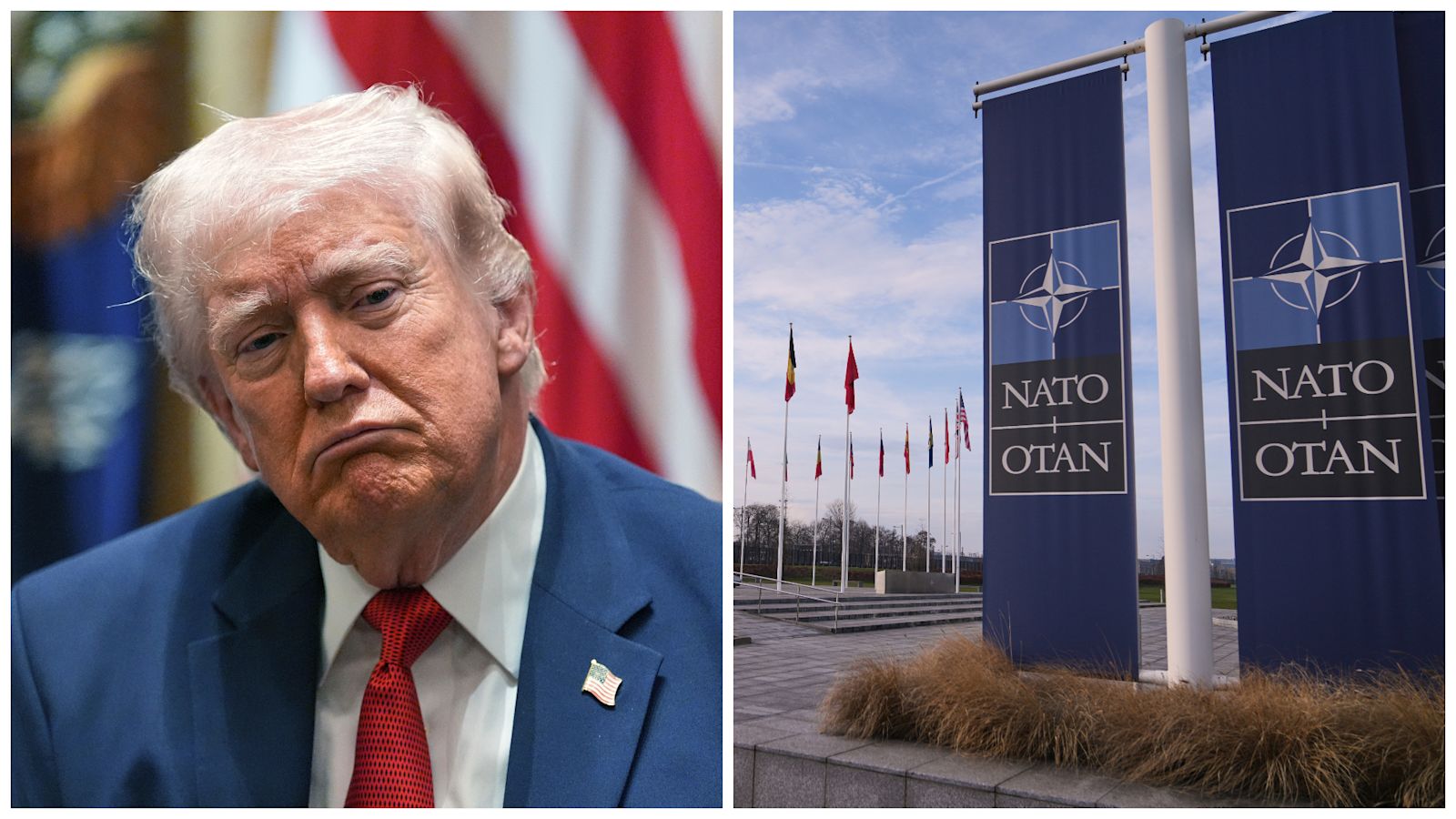
President Donald Trump has once again directed his anger at NATO for doing “absolutely nothing” to help the United States with Iran, which he claims is “begging” to make a deal.
In a cabinet meeting on Thursday, Trump repeated his claims that the US was winning the war in Iran, saying: “Over the past three weeks, we’ve been hitting Iran’s military capabilities at a level that few people have ever seen before.”
He also repeated his claim that Iran “are begging to make a deal”, adding that Iranians are “lousy fighters” but “great negotiators”.
Trump then went on to denigrate the UK’s aircraft carriers, HMS Queen Elizabeth and HMS Prince of Wales, as “toys” and lashed out at NATO allies.
Vice President JD Vance also reiterated Trump’s claims about winning the war, asserting that the”conventional military” in Iran has been “effectively destroyed” during the war.
Echoing Trump, Vance said Iran no longer has a navy and “they don’t have the ability to hit us like they could of even a few weeks ago.”
“And what that does is that gives us options,” Vance said. He did not go into detail about those options.
The Trump administration also confirmed, for the first time, the 15-point plan it presented to Iran.
Addressing the cabinet, envoy Steve Witkoff said the US has presented a 15-point “action list”, delivered through Pakistan as a framework for a possible peace deal.He added that Trump directed Witkoff to “maintain confidentiality” as the administration reached out, citing sensitive diplomatic discussions.”If a deal happens, it will be great for the country of Iran, the entire region and the world at large,” he said.
IRGC navy chief killed
Israel said on Thursday that it killed Commodore Alireza Tangsiri, the head of the Iranian Revolutionary Guard’s navy, who oversaw the blockade of the Strait of Hormuz.
Tangsiri was killed along with other senior naval commanders in a strike overnight, Israeli Defence Minister Israel Katz said.
Katz said Tangsiri was responsible for bombing operations that have blocked ships from crossing the Strait of Hormuz.
He said the strike should serve as a “clear message” to top Iranian military officials that the Israeli military would hunt them down.
Iran did not immediately comment on Tangsiri’s reported killing.
It comes after an official said Iran is charging fees for ships to safely transit through the vital shipping route.
The Secretary-General of the Gulf Cooperation Council Jasem Mohamed al-Budaiwi, who is from Kuwait, told reporters in Saudi Arabia on Thursday: “They closed the Strait of Hormuz and imposed fees for passing through it, which is an aggression and a violation of the United Nations agreement on the law of the sea”.
Al-Budaiwi oversees the GCC, a bloc of six Gulf Arab nations including Bahrain, Kuwait, Oman, Qatar, Saudi Arabia and the United Arab Emirates.
His comments come as the war in Iran approaches the one-month mark.
US officials continue to insist an end to hostilities is close and proposed a 15-point ceasefire deal, which Iran has rejected.
President Donald Trump speaks at the National Republican Congressional Committee’s annual fundraising dinner on Wednesday. Credit: AP
Iran rejects US ceasefire plan
Two officials from Pakistan described the 15-point US proposal broadly, saying it included sanctions relief, a rollback of Iran’s nuclear program, limits on missiles, and the reopening the Strait of Hormuz, through which a fifth of the world’s oil is normally shipped.Iran issued its own plan via state TV, which includes a halt to killings of its officials, means to make sure no other war is waged against it, reparations for the war, the end of hostilities, and Iran’s sovereignty over the Strait of Hormuz.”No negotiations have happened with the enemy until now, and we do not plan on any negotiations,” Iran’s foreign minister later told state TV.Without offering a specific threat, Trump said on Truth Social on Thursday that Iranian leaders should engage “before it is too late, because once that happens, there is NOT TURNING BACK”.
Starmer warns media there is a “war on two fronts”
Western nations are facing a “war on two fronts”, Sir Keir Starmer has said, as he meets allies at a major European defence summit.
The invasion of Ukraine and the US-Israel conflict with Iran are the two major arenas of war impacting European nations, the prime minister said at the Joint Expeditionary Force (JEF) leaders’ summit in Finland.
Oil prices climb
The rise in oil prices came as Tehran on Wednesday dismissed a ceasefire plan by the US.
After Trump’s apparent de-escalation in hostilities, oil prices had fallen to below $100 a barrel, but have since seen prices climb back above this mark.
“Weaponising the Strait of Hormuz is not an act of aggression against one nation,” Sultan al-Jaber, who leads the massive state-run Abu Dhabi National Oil Company, said in a speech for an event hosted by the Middle East Institute in Washington.
“It is economic terrorism against every consumer, every family that depends on affordable energy and food. When Iran holds Hormuz hostage, every nation pays the ransom, at the gas pump, at the grocery store and at the pharmacy. No country can be allowed to destabilise the global economy in this way. Not now. Not ever.”
The comment byal-Jaber signaled the hardening rhetoric of the United Arab Emirates as the war nears its one-month mark.
A cargo ship sails in the Arabian Gulf towards Strait of Hormuz in United Arab Emirates on Sunday. Credit: AP
Two killed by missile shrapnel in the UAE
In the United Arab Emirates, authorities in Abu Dhabi said two people had been killed and three others wounded by shrapnel from a ballistic missile interception.
In Israel, sirens sounded about an hour after sunrise across a large swath of central Israel, including areas around Tel Aviv and Jerusalem, and in the occupied West Bank.
Israel’s military said early Thursday morning that Iran had launched missiles toward the country. The first such alert of the day came after an unusually long lull of more than 14 hours.
People take cover in a bomb shelter as air raid sirens warn of incoming Iranian missile strikes in Bnei Brak, Israel, on Wednesday. Credit: AP
Hezbollah rocket fire, however, remained constant overnight in northern Israel, and once reached the Tel Aviv area overnight.
Missile alerts also sounded on mobile phones in Dubai, United Arab Emirates, on Thursday morning.
Saudi Arabia’s Defence Ministry said it intercepted multiple drones over its oil-rich Eastern Province on Thursday morning.
Kuwait reported it was working to intercept incoming Iranian fire early Thursday morning. Bahrain sounded its missile alert sirens early Thursday morning.
Subscribe for free to our weekly newsletter for exclusive and original coverage from ITV News. Direct to your inbox every Friday morning.
Heavy strikes reported around Isfahan
Activists in Iran reported heavy strikes early on Thursday morning around Isfahan, a city some 330 kilometres south of Iran’s capital, Tehran.
Ham Mihan, an Iranian newspaper critical of the regime, reported online about strikes in the area.
Isfahan is home to a major Iranian air base and other military sites, as well as one of the nuclear sites bombed by the United States during the 12-day war between Israel and Iran in June.
The semiofficial Fars news agency, close to the paramilitary Revolutionary Guard, described the attacks as targeting “two residential areas,” without elaborating.
Earlier, Israel’s military said it had completed “a wide-scale wave of strikes” across Iran, including in Isfahan.
Reporting History sees journalists join News At Ten anchor Tom Bradby to revisit their remarkable on-the-day reports of the defining events of the modern age. Listen to the episodes below…