
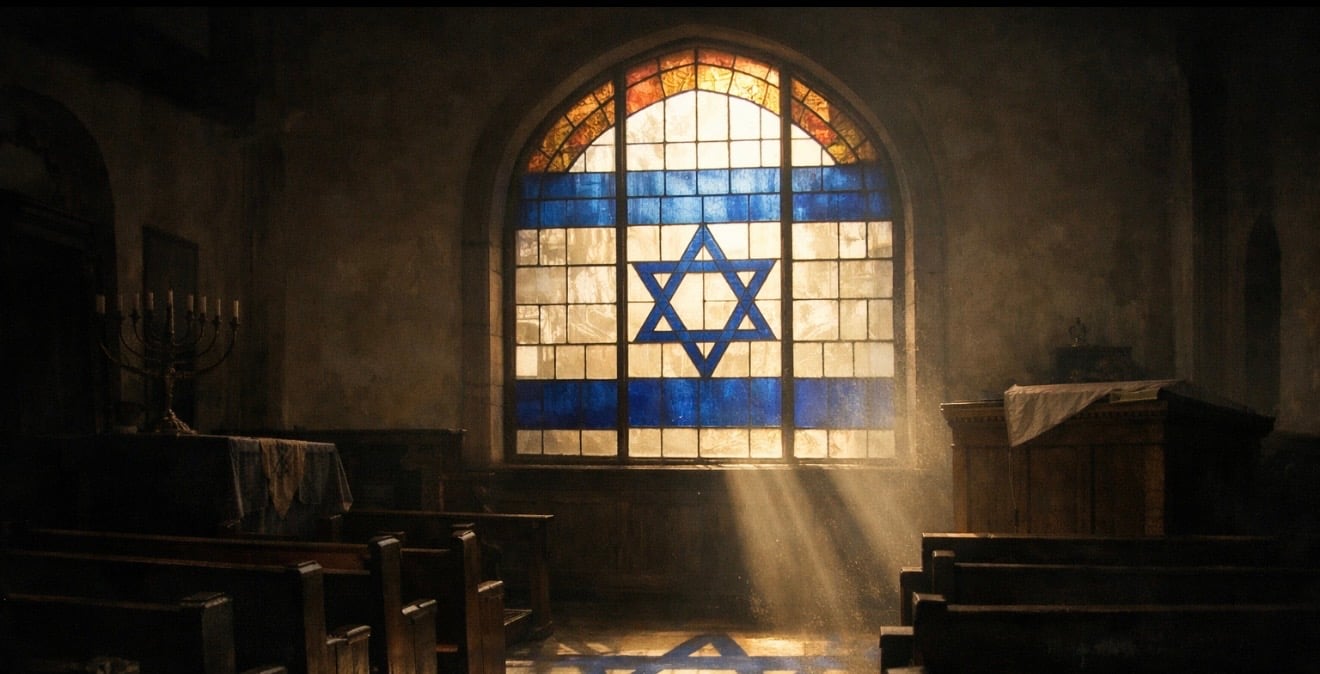
I had been sitting in a bomb shelter in Israel holding my toddler when the messages began arriving: there was an active shooter in a Detroit synagogue.
Photos started circulating almost immediately. Smoke was rising from the building after an attacker drove a truck into the preschool lobby. Temple Israel and its preschool had gone into lockdown. More than a hundred children had been inside that morning.
Temple Israel is not just any synagogue. It is the largest Reform congregation in the United States, home to more than 3,000 families and a central pillar of Jewish life in the Detroit area. For many of us who grew up there, it represents the stability and confidence of American Jewish life at its best.
My texts to friends back home were simple: Is everyone safe? Eventually we learned that they were, thank G-d.
“That really scared me,” I said to my husband.
He looked surprised, “More than what’s happening here?”
“In a sense,” I said, “I think so.”
Not because Israel is calm. It is not. Sirens have become part of the rhythm of daily life. But here we know exactly what we are dealing with.
In Israel, threats against Jews are not abstract. They are named plainly, confronted directly, and met with a society mobilized to defend itself. The army is ours. The responsibility is ours. Jewish security is not outsourced.
Diaspora Jewish life has always rested on something more fragile. It ultimately depends on the goodwill and stability of societies that Jews do not control.
For most of my life that arrangement worked extraordinarily well in America. I grew up believing, correctly, that the United States was the safest and most successful diaspora Jewish community in history.
That sense of security shaped my childhood. Jewish life in suburban Detroit felt open, confident, and unguarded. Synagogues, summer camps, youth groups, and community centers were simply part of the fabric of everyday life. I cannot remember a single armed guard outside a Jewish institution when I was growing up.
Those institutions nurtured a deep love for Jewish life and for Israel itself, a love that eventually led my husband and me to move to Israel, nearly seven years ago.
Of course Detroit was never entirely immune. Like many American cities, it has seen antisemitic incidents over the years. Synagogues have received threats. Jewish university regents have been targeted. Antisemitic flyers have appeared in suburban neighborhoods.
Jewish families living nearby cannot help but feel that atmosphere.
And yet for many who grew up in suburban Detroit, Jewish life still seemed stable. We’d thought, or hoped that perhaps the peaceful suburbs of Detroit would remain an oasis of simpler times amidst a greying wilderness of antisemitic turbulence.
That is why seeing the Detroit Jewish community suddenly go into lockdown felt so jarring.
It’s not because the possibility was unimaginable; Jewish communities across America have been preparing for precisely such scenarios. The heroic security team and staff at Temple Israel deserve enormous praise for their swift and disciplined response.
But something about this moment felt different, it felt like an inflection point – the moment when a threat that once seemed distant suddenly arrived inside the institutions that shaped my childhood.
Since October 7, Jewish communities around the world have felt the ground shifting beneath their feet. One campus after another. One incident after another. One community after another forced to confront realities that once felt remote.
We seem to have moved from an era of rising antisemitism to something closer to a global pandemic of antisemitism.
Moments like this force a question many Jews are quietly asking themselves: What does long-term Jewish safety actually look like?
The usual answers are familiar. Strengthen security. Install better cameras. Hire more guards.
But that is already happening. According to the Jewish Federations of North America, Jewish communities across the United States now collectively raise and spend more than $750 million each year on security alone. It is a quiet but constant tax that no other ethnic or religious community is required to pay. And it is impossible not to wonder what Jewish life might look like if that money were spent on building rather than defending it.
Yet even that extraordinary effort has not stopped the attacks.
The decision now is how we will respond.
Things aren’t as they were a few years ago, and old solutions aren’t solving the problem. As such, I think there is a compelling response, one that for completely valid reasons, many will not want to choose. But that option is Israel.
Jewish safety ultimately means Jewish security in Jewish hands. It means Jewish self-determination. And that occurs here.
Of course building a life here is not simple. For many people it is far from realistic. Family, careers, language, and culture make such decisions deeply complicated.
But moments like this can at least open the door to a conversation.
Perhaps it begins with two simple points.
First, if one can apply for Israeli citizenship, it might be worthwhile. In an uncertain world, it may be a valuable door to keep open, and getting a passport doesn’t happen overnight.
Second, when this war eventually ends, and it will, Israel will continue to grow stronger. It may not replace a life built elsewhere, but one can choose to make it more of a second home, in mind and in practice.
Israel can become a place you know, a place you return to, a place that is yours.
Growing up in Michigan, we often looked toward Israel in moments of turbulence.
Now, from Israel, I find myself looking back. And from here, I want to say something simple to Jewish communities overseas:
You are not alone. From here, we are watching closely, carrying the weight of this with you, and facing it too.
For generations Jews dreamed of a place where our safety would not depend on the goodwill of others but on our own ability to defend and shape our future.
And today that place exists. It is Israel.