
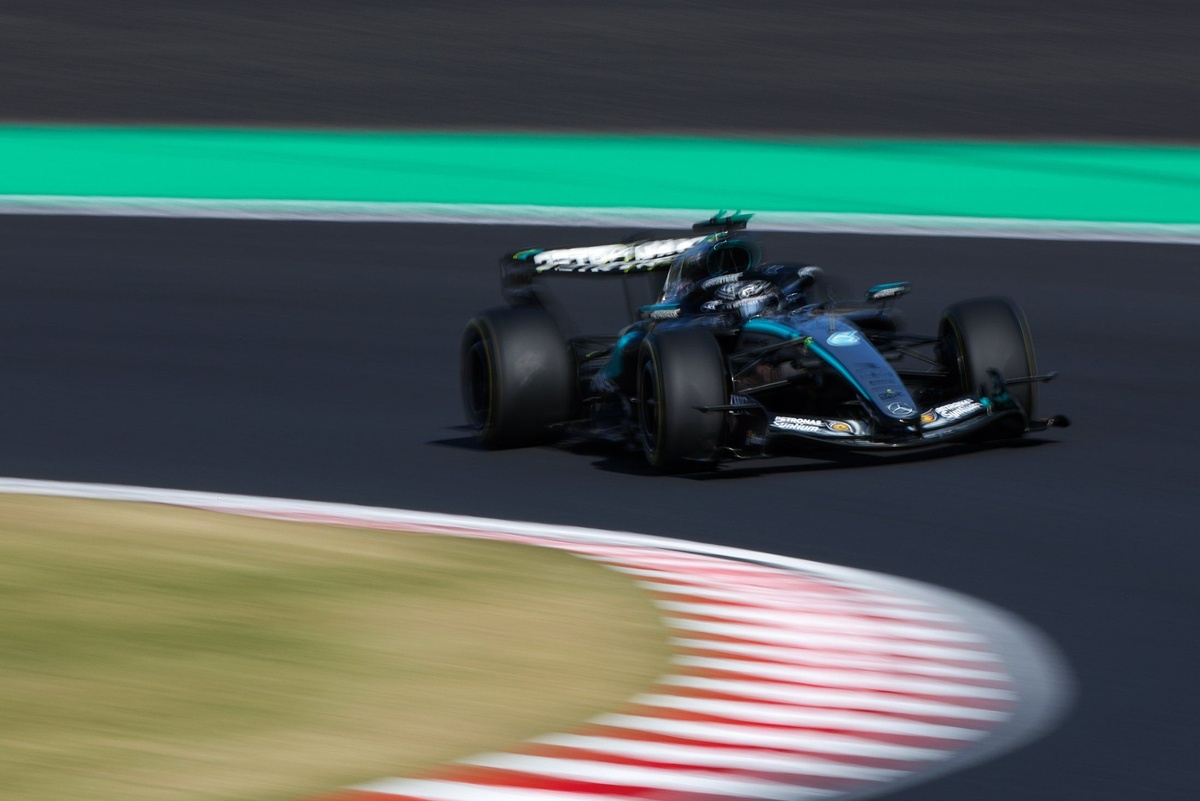
After what could charitably be described as a less-than-ideal start to the 2026 Formula 1 season, McLaren’s presence at the top of the second free practice timesheets at Suzuka might have been cause for optimism. Yet, the team has already been here before this year: Oscar Piastri also headlined FP2 in Australia, but his journey home was ultimately wasted as his MCL40 had been smeared into the wall before the car even made it to the grid.
It wasn’t entirely surprising that expectations at McLaren were kept muted, despite Piastri’s run to a chart-topping 1m30.133s. The slender advantage over China winner Kimi Antonelli, at just 0.092s, did suggest that Mercedes had taken it easy through FP2; indeed, Piastri mentioned after the session that the current championship-leading outfit was still “very strong”.
McLaren also chose not to be too boisterous about being ahead of Ferrari in the times, as the brace of SF-26s continued to find life difficult in terms of one-lap pace. Both Charles Leclerc and Lewis Hamilton found it difficult to press the Ferrari into complying with their demands over a hot lap, particularly at the rear axle. It took a couple of bites at the cherry for the two drivers to nail down a ‘clean’ qualifying simulation, both struggling to get the tyres in the right window at the first attempt.
While McLaren is still behind the Mercedes-Ferrari axis, it should be buoyed by how close it is in the performance stakes to the latter. Yes, the Woking team’s chances of defending the title look slim, but pace without any real updates applied to the car will be of some encouragement. It just needs its MCL40 to work properly on a Sunday.
The other differentiator between qualifying laps had lain in deployment plans, as the teams sought to maximise the MGU-K up-time on the run out of Spoon and through 130R. Although Suzuka isn’t a particularly speedy course overall, the lack of hard stops on the course (beyond the chicane and the hairpin) have tended to put a bit of a premium on recharging.
While clipping isn’t too common around the whole lap, the approach to the Esses presented one of the cases expected ahead of the season, where drivers try to sit at part-throttle to run with just the internal combustion engine. Superclipping out of 130R has been a less-than-ideal scenario, although the effect here has been mitigated by the reduction in maximum recharge capacity.
Average FP2 long run times
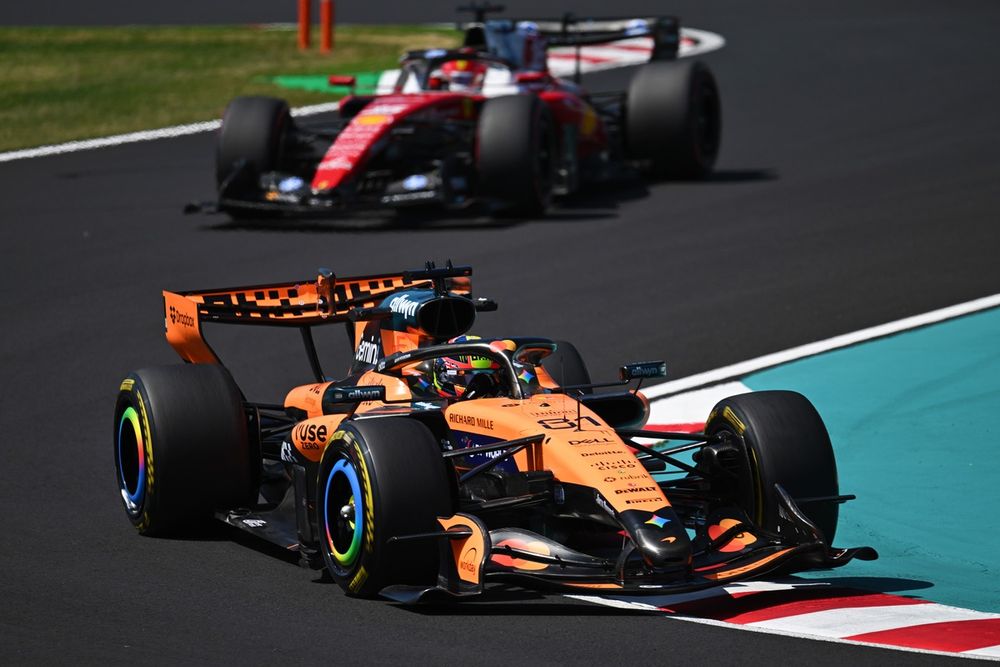
McLaren topped FP2 in Japan, but still expects to finish behind Mercedes and Ferrari
Photo by: Sam Bagnall / Sutton Images via Getty Images
#
Team (Driver)
Av. time
Laps
Tyre
1
Mercedes (ANT)
1m34.780s
9
M
2
Ferrari (LEC)
1m35.442s
9
M
3
McLaren (PIA)
1m35.744s
9
M
4
Haas (OCO)
1m36.190s
12
M
5
Alpine (GAS)
1m36.241s
10
H
6
Red Bull (VER)
1m36.456s
15
H
7
Audi (HUL)
1m36.485s
7
H
8
Racing Bulls (LAW)
1m36.842s
12
M
9
Williams (ALB)
1m37.248s
10
M
10
Cadillac (BOT)
1m37.985s
12
M
11
Aston Martin (ALO)
1m38.555s
5
S
It will be of little surprise that Mercedes leads the way in terms of race pace – and it does so with quite a margin. Antonelli’s average stint on the medium compound was a good deal faster than Leclerc’s comparable run on the same tyre, to the tune of about 0.6s per lap, with Russell about a quarter of a second down on his team-mate’s pace. On average, it tallies with the half-second-per-lap disadvantage that Ferrari has found against Mercedes so far this season, one that the team will have to work hard to address.
Piastri’s also-comparable stint was a further 0.3s back; this places McLaren neatly between the front two teams and the remainder of the field. His data will be of great help to the other side of the garage, although Lando Norris did not necessarily view it as a safety net; the Briton suffered with a hydraulic issue at the start of FP2, and felt that the most damaging consequence was simply the lack of track time he’d been able to gather at full pelt.
“The first [session] was just aero running, so even the few laps that I did get was not that representative for me,” Norris rued. “Of course I have data to look at, but around a track like this, you just want laps. I don’t care what data I can look at, you just want laps under your belt to give you some confidence and good knowledge. Which I got some of at the end, but I’m just two or three steps behind at the minute with set-up, with no long running.”
“We just struggled a lot more with the balance of the car grip – not similar to China, but we’re still off. We’re still not really understanding why we’re that far off in sector 1, and the medium to high speed” Max Verstappen
By comparison, Red Bull seemed very off-the-boil on Friday. There was the expectation that the team could shrug China off and enjoy a circuit that is by all accounts much more energy-critical; the deploy-and-charge characteristics of its own powertrain had been a helpful feature in Australia, but Suzuka has so far exposed a greater grip issue with the RB22 chassis.
Verstappen explained that the car was experiencing great swings in handling characteristics across a lap; understeer in some corners, and oversteer beyond his comfort level in others. Sector 1 was his biggest bugbear. “We just struggled a lot more with the balance of the car grip – not similar to China, but we’re still off,” said the world champion. “We’re still not really understanding why we’re that far off in sector 1, and the medium to high speed.
“I don’t think it’s an easy fix overnight. But, yeah, a few things that are not going right at the moment.”
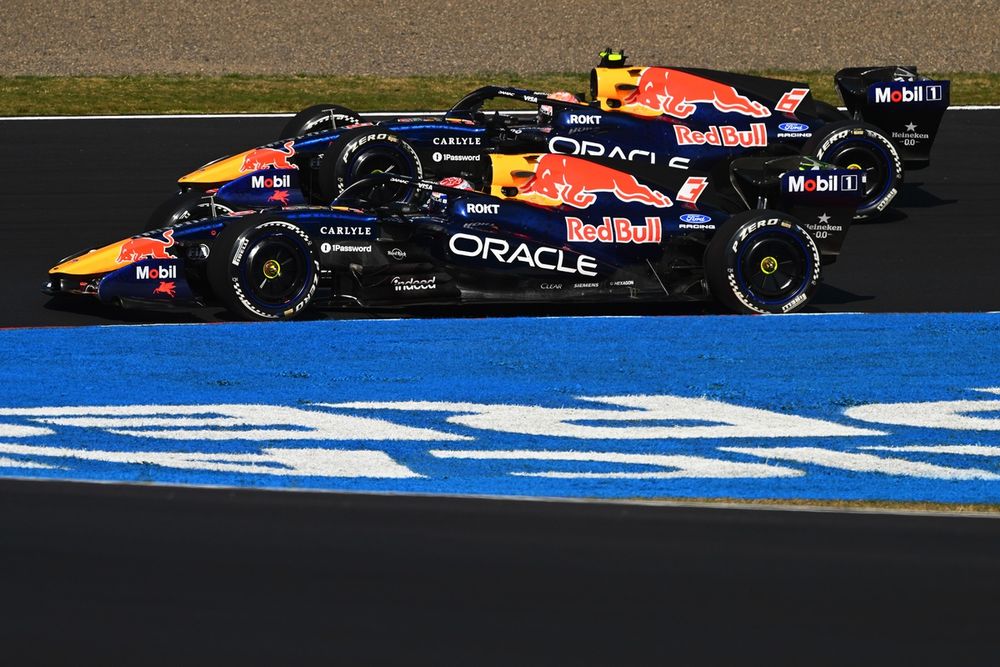
The Red Bull woes continue
Photo by: Rudy Carezzevoli / Getty Images
In comparison to the other teams, Verstappen’s long stint on the hard tyre arguably explains his position versus the shorter stints of the midfield teams, but the Dutchman’s laps were not particularly consistent in the opening half of his 15-lap stretch. Esteban Ocon and Pierre Gasly thus factored ahead, the first-named Frenchman on medium tyres and the latter conducting a 10-lap run on the hards.
The Haas this year has appeared to be quite a benign customer over a race distance, but one perhaps lacking that final couple of tenths during an all-out qualifying lap. Although the Alpine is capable of matching it across a stint, and the stack of times from FP2 continue to corroborate this, the A526 has an identifiable weakness with its front-end. Gasly found understeer a persistent problem through the afternoon in Suzuka, something that he hoped an overnight tweak would alleviate.
Red Bull’s pace was ensconced between the Haas-Alpine pair and the other midfield contenders in Audi and Racing Bulls. Neither team had easy days, as Audi had to change the rear end of Gabriel Bortoleto’s car as a precautionary measure, while Arvid Lindblad also spent FP2 stuck in the garage – eating into the time he needed to acquaint himself with the challenges of the Suzuka circuit. By comparison, Williams struggled; Carlos Sainz stated that on low fuel, the FW48 seems to be somewhat okay to work with. On high fuel, however, he noted that it was “bit of a shocker how much of a step backwards we took again”.
This accounts for its 0.4s per lap loss to the VCARB machines, although it is well clear of Cadillac. The American squad trialled a series of new updates on the diffuser of its MAC-26 chassis, and the current strategy to continue to add load should bring it closer into the mix.
Aston Martin, meanwhile, was the focus of attention as Honda’s Koji Watanabe spoke to the media between practice sessions – and at least tried to ensure that the British squad took some of the share for the blame in as respectful a manner as possible. Per Watanabe, the Honda powertrain ran fine on the dyno, but the vibrations come from when the PU is mounted to the chassis. This very much suggests a harmonics issue, one where the frequencies of the engine are incorrectly damped. And that’s very much a problem that both parties must solve…
Read Also:
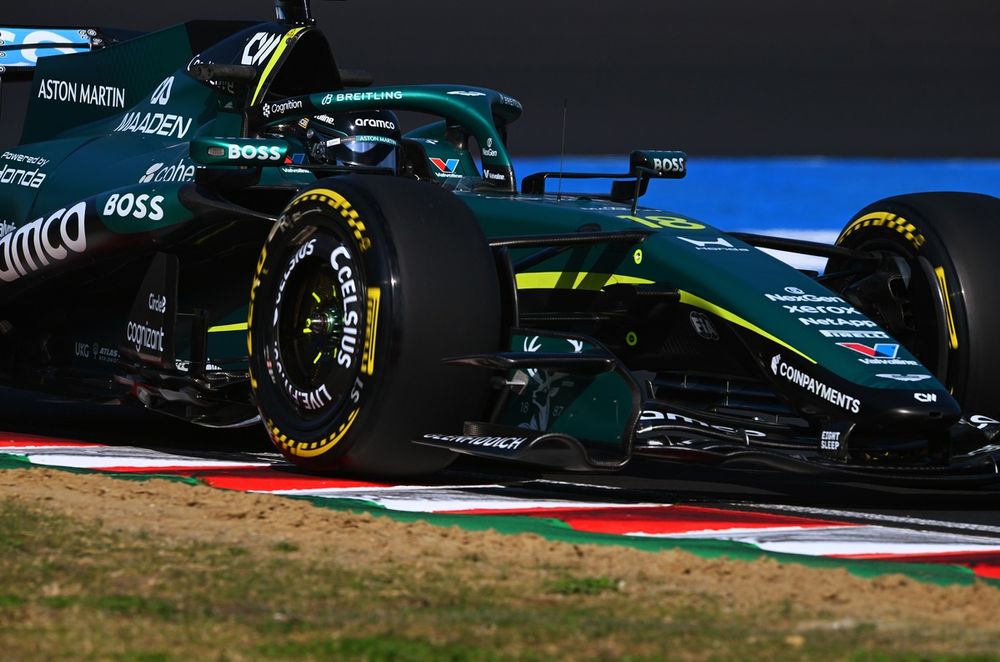
Aston Martin still trails the pack
Photo by: Rudy Carezzevoli / Getty Images
We want to hear from you!
Let us know what you would like to see from us in the future.
– The Autosport.com Team