
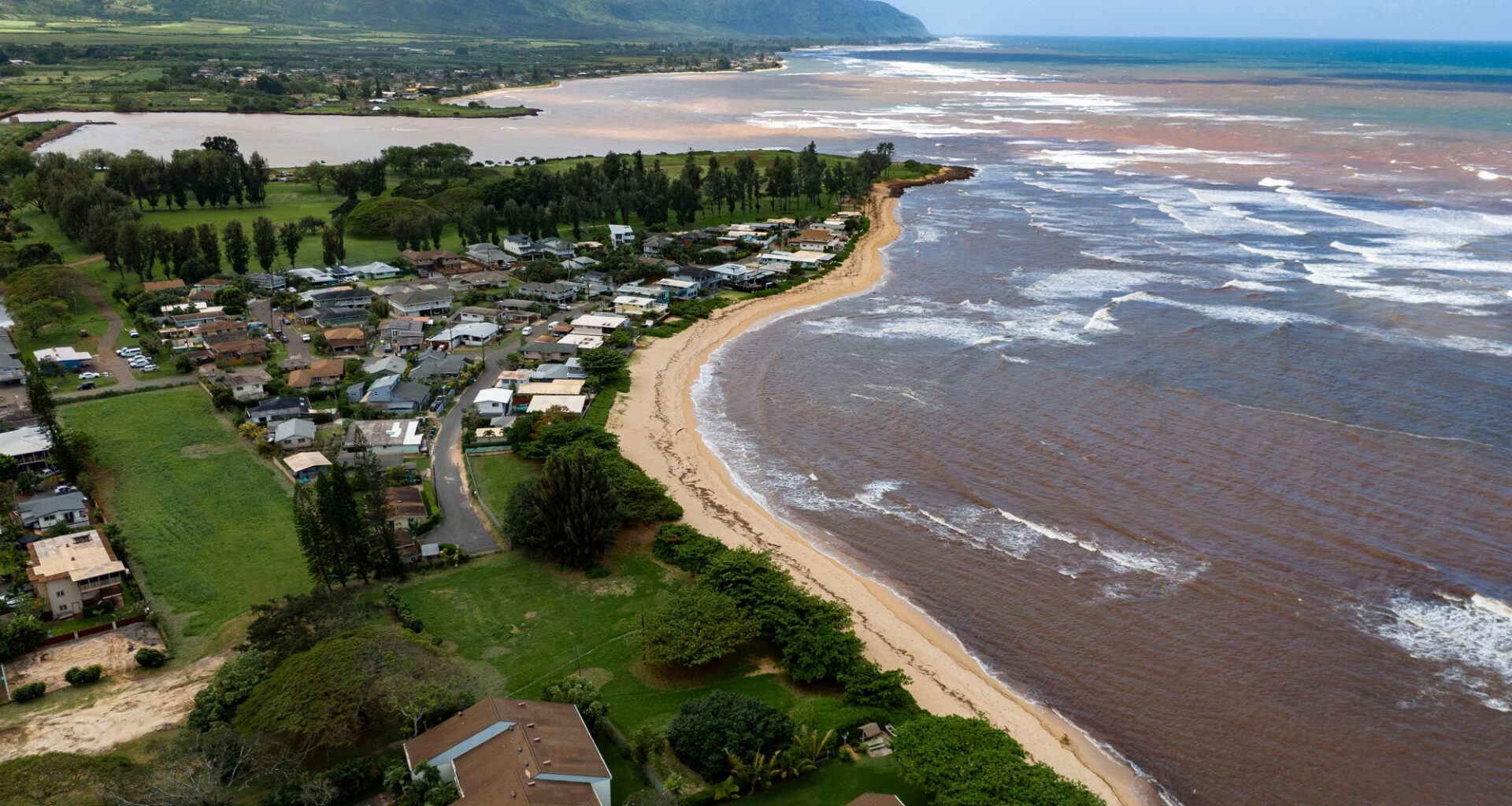
Last week’s powerful Kona low storms, which caused catastrophic flooding on land, might also have devastated much of Hawaiʻi’s nearshore corals and reef fish, smothering them in tons of mud laced with pesticides and other toxic runoff, marine experts and conservation groups say.
Divers have barely started to survey the damage below the surface, as the lingering murky, polluted waters have kept most areas unsafe to enter throughout the state. Still, a worrisome picture is emerging.
The coastal waters off Waialua, the area hardest hit on Oʻahu by the floods, boast beautiful, abundant coral that stretch to the island’s northwestern tip, at Kaʻena Point, said Alika Garcia, a diver, spear fisherman and executive director of the nonprofit Kuleana Coral Restoration.
Those waters remain chocolate brown, raising concerns coral bleaching or even die-offs could occur there.
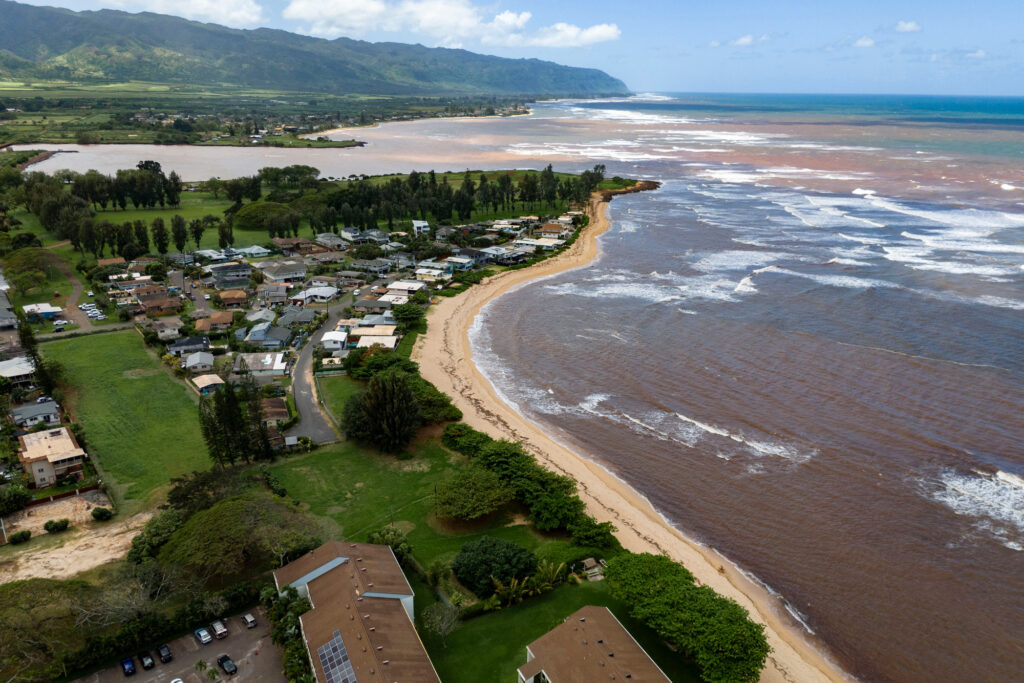 Muddy, murky water bleeds out into the ocean along Oʻahu’s North Shore coastline in Haleʻiwa. Divers have yet to survey the extent of the damage to coral and other marine life but researchers are already concerned there’s been widespread devastation. (AP Photo/Mengshin Lin)
Early reports indicate Maui coral reefs off Kīhei were hit hard by the record rainfall’s torrents of mud, said Joe Pollock, a senior reef strategy lead with The Nature Conservancy.
West Maui’s sprawling Olowalu reef, Pollock said, is also a major point of concern. It seeds other coral colonies across the Maui region and regularly endures storm runoff. Pollock and his colleagues further worry about damage to Hawaiʻi island reefs off Kealakekua Bay, Kahuwai Bay and South Kohala.
Hawaiʻi corals are already struggling to survive against warming seas from climate change, cesspools, overtourism and other human impacts. Goats, pigs, deer and other animals brought to the islands dig up soil loosely held in place by invasive plants and send it downstream, fueling the toll.
Last week’s unusually large dumps of soil, sediment and toxins could be too much for the weaker and more besieged corals to take, according to those who regularly monitor the reefs. They’re now watching to see if favorable surf might wash away enough mud in time to give those corals a chance to recover.
“These kinds of (Kona) lows aren’t something brand new,” Pollock said. “But one this dramatic and this prolonged on top of the other stress that these reefs are under is worrying.” A Nature Conservancy team aims to dive Friday off the Big Island, he added, to get a closer look at the reefs there.
The mud isn’t the only threat. On Oʻahu’s south shore, strong waves propelled by the Kona lows caused extensive coral damage, Ocean Alliance Project Executive Director Dylan Brown said.
That includes corals that broke apart at Kewalo Basin and Maunalua Bay’s Turtle Canyon, a nursery site where conservation groups grow coral that might better endure climate change.
3-D imagery produced with special software by Ocean Alliance Project shows a stretch of reef in Maunalua Bay’s Turtle Canyon East after the two Kona Low storms. A 3-foot-wide boulder with corals that took an estimated 50 years to grow can be seen overturned. (Courtesy: Dylan Brown/Ocean Alliance Project)
Another big concern, University of Hawaiʻi Kewalo Marine Laboratory Director Robert Richmond said, is whether local coral will be able to spawn offspring later this year with all the sludge, toxins and reduced salinity wrought by the Kona lows.
Those critical spawning events only happen once or twice a year, Richmond said, starting in June.
The deluge of mud and freshwater into the corals’ saltwater environment, he said, may have already affected their eggs’ viability. Even if the eggs do manage to get fertilized, it’s not clear the offspring will find habitat to latch onto amid all the muck, which Richmond said often lingers for years.
He and his team plan to assess the eggs’ health in April or May, prior to the full-moon spawning event that’s expected in June.
On Friday, Hawaiʻi Gov. Josh Green warned that the nation’s lone island state now faces at least $1 billion in damages to local schools, homes and roads.
Jacob Johansen, an associate researcher with the Hawaiʻi Institute for Marine Biology, said the state should go further and estimate how much damage its marine resources endured — not just the infrastructure on land.
“What about the fisheries? What about subsistence food security? What about all those aspects?” Johansen said Tuesday. “I don’t think that anyone has any numbers on that, and they could be very tall as well.”
To get that figure, he recommended that state officials monitor over the next year the reefs hit by the Kona lows. Representatives with the Division of Aquatic Resources said the agency will start assessing damage once the water quality improves and it’s safe to return.
Prior to the recent storms, Hawaiʻi’s reefs were found to protect some $836 million in assets on land as a natural barrier that protects the coast from storm surge.
A Rapid Response
There is at least some hope. Brown and Pollock, of The Nature Conservancy, pointed to an emerging coalition of local groups that aim to help state aquatic officials respond faster to destructive storms and assess coral damage.
Those faster responses could prove critical. Some coral that took decades to grow might be salvaged and reattached to the reef, they said, if the animals are rescued in time.
That coalition, dubbed the Hawaiʻi Emergency Reef Restoration network, formed several years ago when The Nature Conservancy bought a novel private insurance policy to cover up to $2 million a year in storm-related coral damage and use those dollars to get recovery efforts in the water faster than the state could.
The insurance policy wasn’t used after the recent Kona lows because the wind speeds must reach hurricane-force strength to trigger it. Many of the restoration groups linked to the policy are already assessing the damage, nonetheless.
Their repairs can only go so far — they can triage corals that were broken off the reefs, but not those covered in mud and sediment. Those coral could die within days, Pollock said, if they’re fully buried. Others might die later as the soil-clouded water dims the sunlight they depend on for energy.
The only way to address the mud and sediment problem, Pollock said, is to better manage runoff before it reaches the ocean.
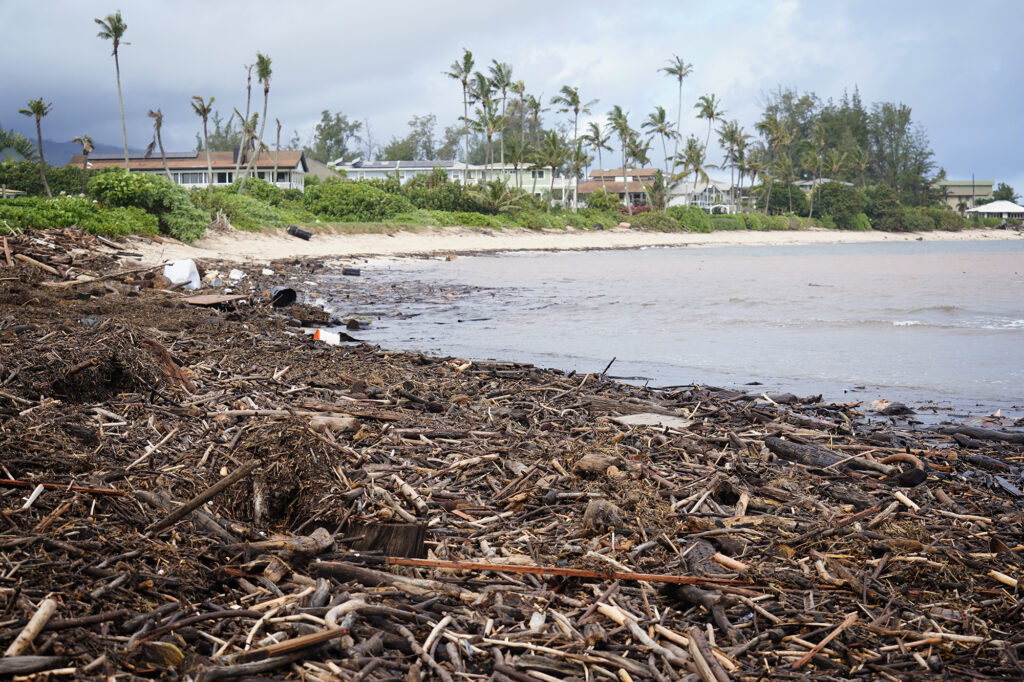 Debris lines Pu‘uiko Beach in Waialua. A second Kona low storm brought heavy rain after the previous week’s downpour and high winds, dumping torrents of mud into the ocean. (Kevin Fujii/Civil Beat/2026)
Richmond recommended using traditional Hawaiian practices such as growing more loʻi patches, where taro is harvested, in Hawaiʻi’s upland hills and creating fish ponds at the shore to better capture sediment. He also recommended building more culverts and pond basins near Kalanianaʻole Highway that could trap the water to be used for irrigation.
Such trapped stormwater could be valuable in the coming decades, he added, as rainfall levels steadily decline due to climate change.
Several miles east of Waialua, the shoreline of Pūpūkea Marine Life Conservation District, which includes Waimea Bay and Shark’s Cove, remains overrun with household trash and natural debris, said Jenny Yagodich, educational programs director with Mālama Pūpūkea-Waimea.
Group volunteers have worked in the past decade to restore native Hawaiian plants to the landscape above the watershed and reduce erosion, Yagodich said, and surveys of the coral taken downstream last summer showed the colonies were increasing.
The group will resurvey the coral this summer, she added, to see whether the Kona lows reversed that trend.
‘The Death That Keeps Killing’
Just how much coral dies from Hawaiʻi’s rare back-to-back Kona lows, the researchers said, ultimately depends on how quickly most or all of the sediment might be swept off the shallower reefs closer to shore and out to sea.
“The concern is that it doesn’t take much for it to become not-healthy coral,” Yagodich said. “It’s just going to be a matter of waiting and seeing.”
The National Weather Service forecasts small surf along Hawaiʻi’s north-facing shores through Saturday.
A key problem, Richmond said, is the sediment can often linger for years — often because invasive algae such as avrainvillea, or mud weed, helps keep it there. Waves often kick up the mud only to have it resettle, so he and his colleagues call it “the death that keeps killing.”
Much of the coral that isn’t fully covered in mud runoff, Pollock said, dies eventually because it spends too much energy trying to remove at least some of the sediment.
The damage isn’t limited to coral. The reef fish that the coral depend on, Johansen said, often flee a polluted area long before the coral there start to die. Johansen, who works in Kāneʻohe Bay on Oʻahu’s Windward side, said the Kona lows delivered “substantially more” mud in the shallows there than the bay typically sees.
“We’ll see how they cope,” he said.
The bay features a system of patch reefs, where sediment runoff and the toxins they carry have gradually filled the crevices over the years, Johansen said, with nowhere to go. “You dive down, you’re only going to get 15 feet down and then it’s pure mud down there,” Johansen said. “That’s not going anywhere. There’s not enough current to push it. There’s no waves. It’s just sitting there.”
On Wednesday, Honolulu Mayor Rick Blangiardi’s office advised the public to stay out of the waters surrounding Oʻahu for at least the next 72 hours.
Ekolu Lindsey, a Lahaina resident involved in various conservation groups, said the last time a storm comparable to the Kona lows hit Maui it took about a year for the mud to disappear from the shore by his home, in an area known as Polanui, or Shark Pit.
“And that’s a year of constant surf and turning it up and sucking it out to those currents,” Lindsey said Thursday. “It’s happened again, except the intensity is just so much stronger, and the velocity and the volume of water coming down.”
“And you know what? It’s going to get worse as people maximize their building envelopes,” Lindsey added. “There’s no place to slow that rain down and everything’s all hard now, so it’s just going to run off more.”
Civil Beat’s coverage of climate change and the environment is supported by The Healy Foundation, the Marisla Fund of the Hawai‘i Community Foundation and the Frost Family Foundation.

Sign up for our FREE morning newsletter and face each day more informed.
Sign Up
Sorry. That’s an invalid e-mail.
Thanks! We’ll send you a confirmation e-mail shortly.