
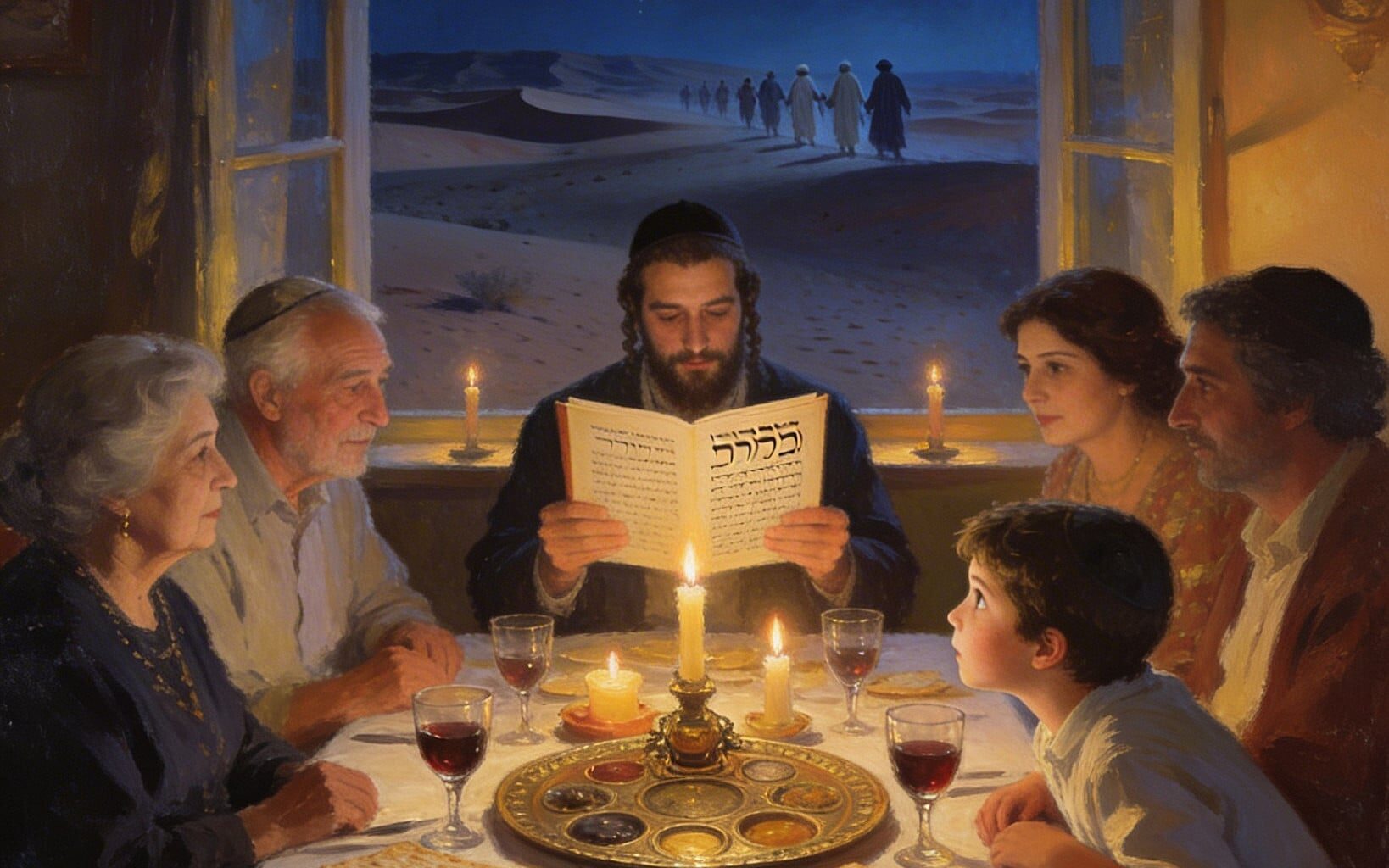
Every year, on one night in spring, the Jewish people sit down to tell a very old story. Not a swaggering epic of conquest, but a stubborn memory of servitude: of a small, stiff‑necked people enduring the whims of an empire that regarded them as a sort of ambulant brick‑laying apparatus. Pharaoh, in the book of Exodus, is less a villain than a system in human form – a man who looks at human beings and sees only quotas. Pesach, the festival of Passover, is the annual refusal to accept that arrangement as the default setting of the universe.
Once you see it that way, the parallels with our own age come alarmingly into focus. We flatter ourselves that slavery is over; we sign declarations, pass resolutions, and applaud one another in comfortable conference halls. Yet the spirit of Egypt – that cold conviction that some people are properly objects to be arranged rather than subjects to be heard – is not only alive, it is positively networking. It manifests in totalitarian ideologies of the left, the right, and the fanatically religious; in regimes that patrol thought as eagerly as they patrol borders; in movements which purr the word “liberation” while quietly tightening the manacles.
Radicalism, in its modern guises, is very fond of the language of emancipation. It is an acquisitive borrower of fine words. But beneath the rhetoric one finds the same old blueprint: declare that this group, this sect, this nation is the problem; declare that their presence is the obstacle to harmony; instruct the world that peace will bloom the moment these troublesome people efface themselves. The tools have changed – social media campaigns instead of stone tablets, drones rather than chariots – but the plot is drearily familiar. Decide that certain lives are negotiable and then persuade everyone else that morality demands their negotiation.
Pesach insists, quite impolitely, that this is intolerable. It drags us back to the memory of chains and forces us to admit that the first step out of bondage is the decision not to internalise the logic of the oppressor. You are not, in fact, born for the brick pit. You are not condemned to live out somebody else’s narrative about your proper place. The Israelites do something outrageous: they walk. They step out into the wilderness with no guarantee beyond a promise and a stubborn refusal to be accessories in their own diminishment.
Israel, the modern state, is that refusal written in contemporary ink and very solid concrete. It is many other things as well – chaotic, argumentative, inventive, infuriating, tender, noisy – but at its core it is a declaration that the Jewish people will not again be history’s permanent tenants, forever at the mercy of landlords who reserve the right to evict. In strict political terms, Israel is one state among many. In moral and historical terms, it is the answer to a question that haunted two millennia: where can the Jews stand that is truly their own, and not merely on loan until the next bout of pogroms or polite exclusion?
This is what makes the current rise of radicalisms so chilling. For they do not simply challenge this or that policy; they challenge the idea that a people so long hounded is entitled to stand at all. Whether in the theological ferocity of jihadists, the leaden certainties of neo‑imperial strongmen, or the manic absolutism of certain Western ideologues, one detects an oddly shared irritation at the spectacle of Jewish self‑determination. The Jews, you see, were supposed to play a particular part: victim, symbol, abstract lesson. They were not supposed to be a sovereign people with tanks, traffic jams, comedians, high‑tech start‑ups, and the tiresome habit of arguing about everything under the sun.
And so we arrive at the spectacle of movements that rail against oppression while calling, with a straight face, for the dismantling of the world’s only Jewish state. It is as if someone had looked at history’s bloodiest century, with its ghettos and death camps and meticulously documented attempt to erase the Jews from the ledger of the living, and concluded that the true obscenity was not the gas chambers but the airport in Tel Aviv. One can and should argue about settlements, governments, and peace processes; no state’s policies are above criticism, and Israel’s citizens, bless them, are often the fiercest critics of all. But the moment the conversation shifts from “this should be done differently” to “this should not exist”, we have left the territory of policy and wandered back into the desert of Pharaoh.
Because make no mistake: to declare that Jews may be safe only as a tolerated minority in other people’s countries, never as a majority in their own, is to propose a kind of elegant modernised bondage. It sounds, on the surface, terribly high‑minded – post‑national, anti‑colonial, pick your buzzword – but the effect is neatly medieval. The Jews are once more to be a people by permission, never by right. Pesach stands in front of this notion and raises one skeptical eyebrow. Really? Have we learnt nothing?
Israel is not a utopia. Freedom seldom is. The biblical Exodus does not deposit the Israelites into a land of eternal harmony with artisan bakeries on every corner. It ushers them into a long, quarrelsome grappling with law, responsibility, and the appalling discovery that liberty means you can no longer blame Pharaoh for everything. In similar fashion, Israel is a tremendously human place, full of arguments and mistakes and attempts to correct them. It is precisely this untidiness that makes it so profoundly the child of Pesach. Real emancipation is not porcelain; it is clay, smudged and re‑moulded by real hands.
One can spend an evening listing Israel’s faults; Israelis frequently do. Yet even in the most acerbic critique there is an underlying fact so luminous that one almost has to squint: Jewish life, for the first time in centuries, proceeds on its own terms in a place where it is not the oddity but the norm. Hebrew – once largely confined to prayer books – is used to order coffee, flirt, quarrel, and file lawsuits. Jewish children grow up expecting, as an entirely unremarkable thing, that the police, the hospitals, the army, and the government are there in part for them, not in spite of them. For a people with our history, that is not a detail. It is a revolution.
Radical ideologies of all stripes, those eager artisans of new chains, are instinctively affronted by this spectacle. They prefer their Jews tragic, abstract, and preferably silent – either as icons of universal victimhood or as convenient villains in some grand narrative about colonialism, capitalism, or whatever the slogan of the month may be. What they cannot comfortably digest is a living, squabbling, democratic, self‑defending Israel, neither saint nor demon but simply and unapologetically there. It is an affront to the tidy story that some peoples are destined always to be acted upon, never to act.
Pesach whispers – or rather, chants – that this story is false. The same text that commands Jews to remember their own slavery also commands them to resist the enslavement of others. The point of leaving Egypt was not to establish a new Egypt with Hebrew signage. It was to model a different way of being a people: aware of its own trauma yet not defined solely by it; anchored in a particular land yet conscious of a universal duty not to re‑enact the crimes once committed against it. Israel, at its best, is an attempt to live that paradox: fiercely protective of its right to exist, yet engaged in perpetual argument about how to wield that right justly.
And so, as new Pharaohs arise – some in robes, some in uniforms, some in impeccably cut suits with hashtags – the Pesach story and the Israeli reality form a single, rather beautiful rejoinder. No, we will not accept a world in which nations are told they are safer as clients than as citizens. No, we will not smile indulgently while people who brook no dissent in their own movements lecture a small democracy on the horrors of self‑determination. And no, we will not agree that the only people on earth who must relinquish the protections of statehood are the ones who were nearly annihilated for lacking them.
In that sense, Israel is not merely a country but a test. It asks the watching world a disarmingly simple question: do you truly believe in the right of peoples to be free, or only in the right of some peoples to be free while others play the eternally instructive victim? To answer in the affirmative, to affirm Israel’s right to exist in security and dignity, is not to sign up to an itemised endorsement of every future government. It is to acknowledge that a people which has walked through fire is entitled, finally, to live without waiting for the knock on the door.
Pesach ends each year with the words “Next year in Jerusalem” – not as a wistful travel aspiration, but as a pledge that the journey out of bondage is never entirely finished. In our age, with radicalisms clamouring to re‑enslave minds and nations, that pledge takes on a renewed urgency. Israel, beautiful, exasperating, splendid Israel, stands as proof that a people can cross deserts of history, crawl out from under the rubble of hatred, and still stand upright in its own land, arguing, singing, mourning, and rejoicing in its own language.
In a world so full of those who promise freedom and deliver chains, that uprightness is not only a Jewish achievement. It is a gift to the imagination of every nation that refuses to bow.