
I believe in democracy, and I believe in the right to free speech. Everyone has the right to express opinions—even strong criticism—about governments, policies, and conflicts, including Israel.
But free speech does not mean free from responsibility. And lately, I’ve been noticing something that doesn’t sit right with me—especially in the context of the war involving Israel and Iran.
Across social media, podcasts, and interviews—whether it’s Joe Rogan, Tucker Carlson, or countless clips and YouTube channels—you see the same pattern: people being given a microphone to speak with authority on topics that are incredibly complex, without necessarily having the knowledge or background to do so.
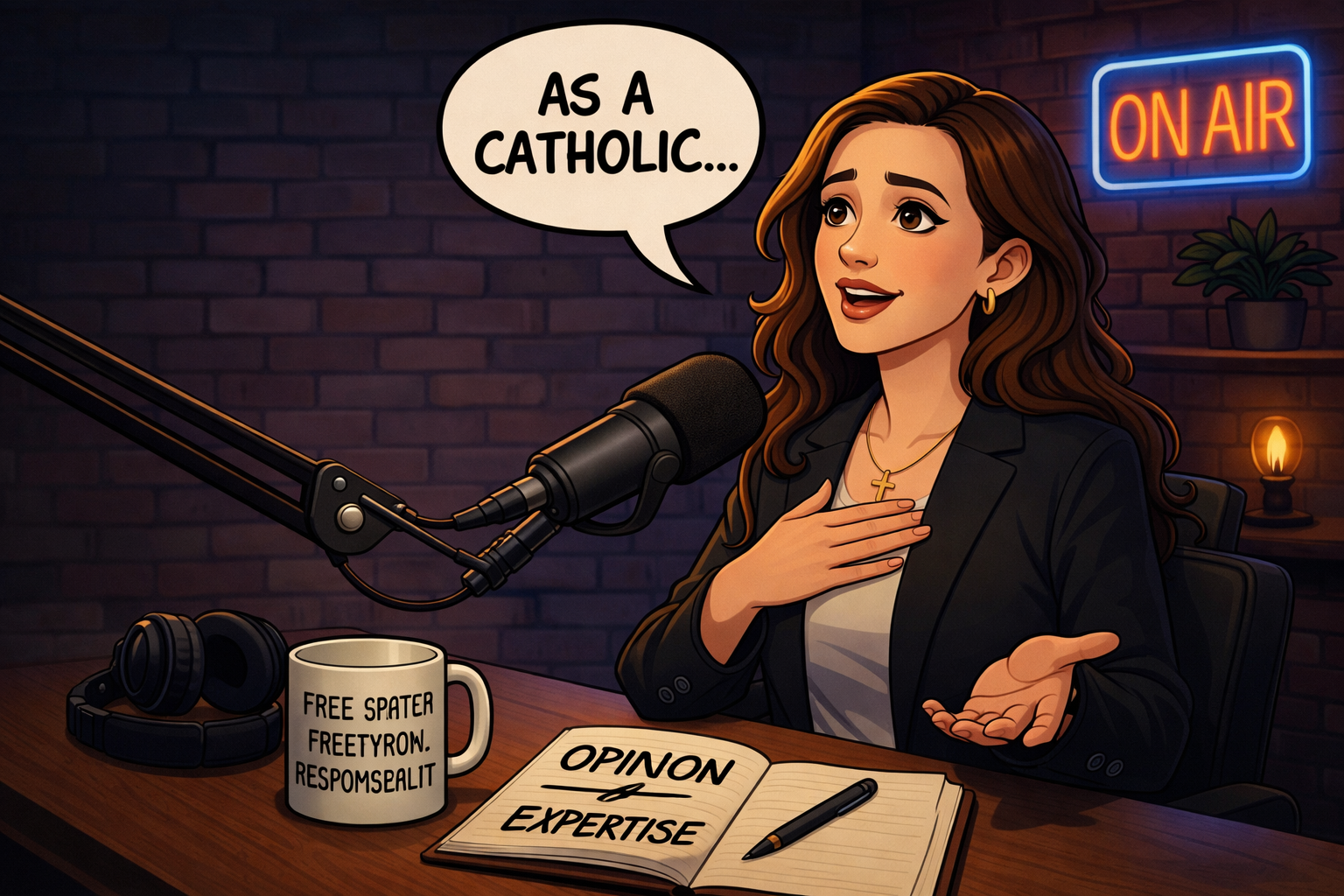
One example really stood out to me. I watched an interview with a woman who kept saying, “As a Catholic, I don’t support Israel,” and framing her position as a religious argument.
But I found myself asking—who is speaking here?
She’s not a priest. She’s not a nun. She’s not a theologian. She’s not an authority in the Catholic Church. She’s a private individual expressing her personal belief.
And that’s fine. She has every right to her opinion. But that’s exactly the point—it is her opinion. Nothing more.
When someone speaks “as a Catholic,” or “as a Jew,” it can sound like they’re representing something much bigger than themselves. But unless you’ve actually dedicated years to studying theology or hold a recognized role, you’re not speaking on behalf of a faith—you’re speaking for yourself.
And I think there needs to be more intellectual honesty around that. It should be normal to say, “This is my personal opinion.” That doesn’t weaken your voice—it strengthens your credibility.
And as a Jew, I have to say—it is particularly difficult to hear Jewish voices speaking this way. Sometimes they don’t even need to say “as a Jew”—their names already signal it. And to hear them openly criticizing and disparaging the State of Israel at a time when Jews are under attack, when people in Israel are literally dying, feels especially painful. It doesn’t move us closer to peace. It adds fuel to hatred. And there is something deeply troubling about seeing that hatred amplified by someone from within the Jewish people themselves.
The second thing that really troubles me is timing and consequence.
We are living in a moment where Jews are under real threat. People in Israel are literally under fire. And in a moment like that, I struggle to understand why individuals—especially those without real expertise—are using platforms to deliver harsh, one-sided criticism that ends up fueling more hostility.
This is not about silencing criticism. Not at all. Criticism is part of a healthy society. But there’s a difference between thoughtful, informed critique and careless amplification that adds fuel to an already dangerous fire.
Words have consequences. They travel far beyond the person speaking them. And when they become incendiary—when they contribute to hostility or give cover to hatred—they stop being part of a constructive conversation.
There’s also something else that needs to be said clearly: this is not just “Israel’s war.”
The United States has its own history in the Middle East. Americans have been attacked, targeted, and killed in the region—long before and independent of many of today’s events. Iran has posed threats not only to Israel, but to American interests as well.
So to say this is only Israel’s issue is simply not accurate. There are real strategic, security, and geopolitical interests at play. Whether people like it or not, that is the reality.
At the end of the day, this is about responsibility.
Speak—absolutely speak. But speak with awareness. Speak with humility about what you do and do not know. Speak with an understanding that your words matter, especially in times like this.
Because yes, free speech is a right.
But responsible speech—that is a duty.
Ariana Mizrahi is an author, educator, and doctoral candidate originally from Buenos Aires, Argentina. She serves as the Hebrew Language Coordinator at Yeshiva Har Torah in New York. Her writing — including The Blue Butterfly of Cochin and Super Cactus — explores language, coexistence, and diversity, reflecting her belief that storytelling and education can bridge cultures and illuminate the shared essence of humanity.