
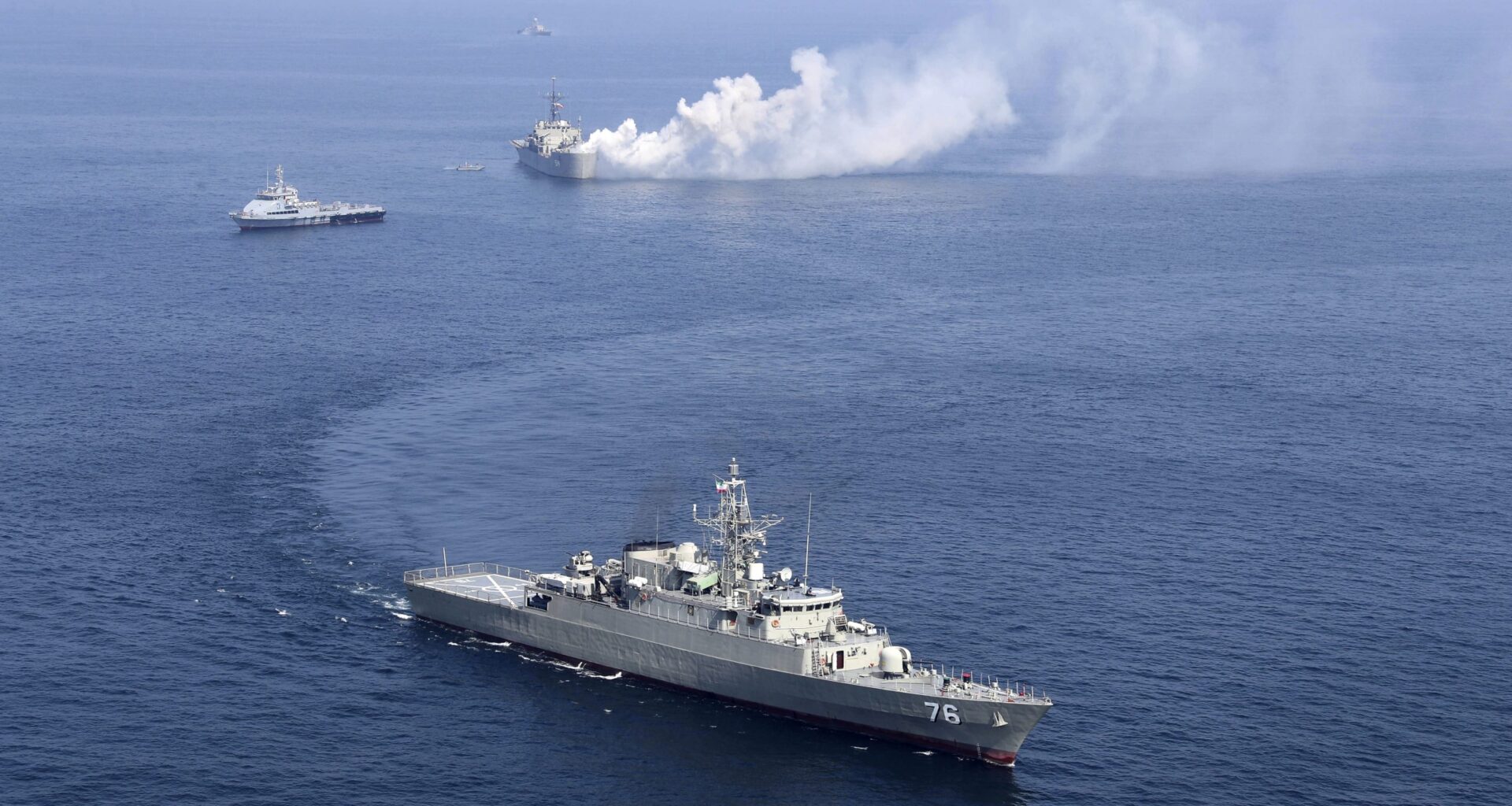
This is the second of a two-part series examining Iran’s naval power during Operation Epic Fury and what it reveals about Tehran’s layered defense architecture. Read the first article here.
In the opening phase of Operation Epic Fury, U.S. strikes inflicted significant damage on Iran’s naval forces, targeting key bases, surface combatants, and supporting infrastructure. Yet these losses have not eliminated Iran’s maritime threat, which continues to be sustained by the Revolutionary Guards’ asymmetric warfare doctrine.
Even with the bulk of Iran’s deep-water surface combatants disabled, Tehran retains significant capacity to project power in Gulf waters through the Islamic Revolutionary Guard Corps Navy (IRGCN). Unlike the conventional navy, the IRGCN does not rely primarily on large surface combatants. Instead, the IRGCN is structured around irregular warfare designed to counter larger, more powerful naval forces operating in the Gulf’s shallow and constrained environment.
Structure, Scale, and Survivability
The Revolutionary Guards’ naval branch fields roughly 20,000 personnel, including more than 5,000 specialized marine troops. By comparison, Iran’s conventional navy accounts for approximately 18,000 personnel, many of whom cannot easily be reassigned to other high-end operational roles given the loss of major surface combatants.
Unlike its conventional counterpart, the IRGCN operates relatively few crew-intensive platforms. Most of its vessels require only small crews, often fewer than a dozen personnel. These include larger assets, such as C-14-class missile boats, Tondar-class fast attack craft, and a range of lighter platforms. These smaller vessels are typically equipped with launchers for short-range anti-ship cruise missiles, and some are also fitted with torpedo tubes or adapted for naval mine-laying operations. While a comprehensive inventory of IRGCN losses from U.S. strikes is unavailable, it is likely that several larger vessels were destroyed or disabled, whereas many smaller craft survived. Their size and mobility allow them to be concealed or relocated to protected coastal locations.
Operationally, the IRGCN organizes its presence across five naval districts along Iran’s Gulf coastline, stretching from Mahshahr to Bandar Abbas. Within each district, the Revolutionary Guards typically maintain supporting drone or missile facilities. Iran is also believed to operate concealed shore-based missile batteries and dispersed weapons depots along the shore, using bays and coastal islands as potential launch points for swarm attacks. The IRGCN also maintains a network of forward outposts at sea, such as on Farsi Island in the northern Gulf and several strategically located islands along major shipping routes in the eastern Gulf. These outposts are used for monitoring maritime traffic, collecting intelligence, and conducting low-intensity disruption operations.
IRGCN naval facilities along the Iranian coastline have been heavily targeted by U.S. air strikes, causing substantial damage to infrastructure and equipment. However, Iran’s defense posture relies on a decentralized command-and-control structure rooted in its “mosaic defense” concept, which grants local commanders significant operational autonomy. As a result, even if key bases or command nodes are degraded, remaining units retain the tactical capacity to sustain operations.
A Looming Threat
Since the onset of the conflict, the confrontation has largely been fought above ground. Despite repeated announcements by the Revolutionary Guards about closing the Strait of Hormuz, the disruption to international shipping appears more symbolic than an actively enforced blockade. While Iranian actions, such as attacking vessels with drones, projectiles, and explosives or laying mines, have contributed to rising risks, the reduction in traffic is also driven by insurance companies suspending or sharply increasing war-risk coverage. This has left hundreds of vessels stranded in and around the Gulf.
At least twenty military incidents have been reported across the Gulf, including near the Shatt al-Arab estuary, Al Jubail, and Manama. Most attacks, however, have been concentrated in the southern Gulf, particularly in the Strait of Hormuz. While none of these incidents resulted in the sinking of commercial vessels, they did cause casualties, including four civilian seafarers. So far, Iran has not mobilized IRGC naval forces in a sustained or coordinated manner to halt navigation in Gulf waters, and the most feared escalation scenarios reminiscent of the 1980s “Tanker War” have yet to materialize.
Several factors may explain Tehran’s controlled approach to escalation at sea. First, Iran may calculate that greater strategic gains can be achieved by limiting its confrontation to missile and drone exchanges rather than escalating to a full-scale maritime blockade. This assessment appears consistent with ongoing shipping patterns. While some commercial vessels continue to transit the Strait of Hormuz, they are increasingly avoiding established shipping lanes and instead rerouting through Iran’s territorial waters. Such behavior suggests a selective, controlled approach to disruption. Rather than halting maritime traffic altogether, Tehran appears to be leveraging its position to negotiate transit arrangements on a case-by-case basis, exerting pressure while preserving a degree of navigational flow.
Second, U.S. naval forces remain largely positioned in the Arabian Sea, which Iran considers its outer defensive perimeter. While Washington is moving the Tripoli and Boxer amphibious assault ships, along with embarked marine expeditionary units, into the region, Tehran may not perceive these deployments as an imminent prelude to a large-scale land invasion. As long as these assets remain east of Hormuz, their posture is more consistent with rapid-response and contingency positioning rather than immediate offensive intent. Yet, these forces retain a central operational role if the Trump administration initiates a new phase of Operation Epic Fury. This could involve tightly scoped missions to seize control of strategic swaths of territory, such as Iran’s energy hub on Kharg Island, key coastal segments adjacent to the Strait, or heavily-fortified islands across the Gulf shipping routes.
Third, Iran’s conventional mine-laying platforms, chiefly midget submarines, have been significantly degraded, with U.S. strikes also eliminating multiple smaller mine-capable vessels. While naval mines could still be deployed by concealed craft and fishing dhows, such efforts would likely be limited in scale to narrower tactical minefields and difficult to conduct covertly given the dense presence of U.S. reconnaissance and surveillance assets in the region.
Yet even relatively contained minefields could generate disproportionate strategic effects. The mere perception of a mining threat could spread alarm among commercial shipping operators and significantly disrupt maritime traffic. In the absence of sustained escort and mine-countermeasure operations, such risks alone could be sufficient to temporarily halt transit through the Strait, amplifying the economic and psychological impact well beyond the limited scale of the mining effort itself.
The Next Phase at Sea
The future trajectory of the naval dimension of the war remains uncertain. It is unclear whether U.S. forces will move assets through the Strait of Hormuz to pursue their objectives or continue to operate primarily from the Arabian Sea. As the U.S. seeks to establish air superiority over mainland Iran, achieving a comparable level of control in the maritime domain will also be critical to protecting American surface combatants before entering the confined waters of the Gulf. In this environment, large blue-water vessels would face restricted maneuverability due to narrow navigation routes and the dense network of Iranian-controlled islands that further complicate evasive actions.
For now, Tehran appears to have opted to limit maritime escalation. That restraint, however, could shift if the pressure generated by Operation Epic Fury intensifies or if the regime’s threat perception grows. While the conflict has thus far centered on missiles and one-way attack drones, the maritime domain could quickly emerge as a key theater of military escalation.
The views and opinions expressed in this article are those of the authors and do not necessarily reflect the views of Gulf International Forum.
Issue: Defense & Security
Country: Iran