

The Knesset voted to pass the largest state budget in Israel’s history early Monday morning, growing the defense budget to unprecedented levels amid the war with Iran and sending billions of shekels to Haredi educational institutions and other priorities of the governing coalition.
The vote averted early elections, which would have been triggered had the budget failed to pass before its legally mandated deadline on Tuesday.
Lawmakers voted 62-55 in favor of the NIS 850.6 billion ($271 billion) spending bill, which Finance Minister Bezalel Smotrich called “a budget that takes care of everyone and fights the cost of living” and Yesh Atid chair Yair Lapid, the opposition leader, called “the greatest theft in the history of the state.”
“We are passing this budget under a right-wing government that will serve out its full term and complete its mission in security, the economy, and in reforming the judicial system,” said a jubilant Smotrich, speaking before the Knesset plenum ahead of the vote.
“Anyone who votes against the budget is voting against Israel’s security, against tax relief for working people in Israel, and against taxation of the banks,” he said.
Get The Times of Israel’s Daily Edition
by email and never miss our top stories
By signing up, you agree to the terms
The vote followed over thirteen hours of filibustering from the opposition, and multiple interruptions from sirens warning of ballistic missiles from Iran, causing proceedings to pause repeatedly. Because of the sirens, MKs cast their votes from an alternate, fortified room.
One of those votes, taking place shortly after midnight, approved amendments that allocated approximately NIS 800 million ($255 million) to programs and institutions favored by Haredi parties, including yeshivas.
The vote came after the ultra-Orthodox parties agreed to support the budget even though the coalition hasn’t passed a bill they demanded enshrining blanket exemptions from military conscription for yeshiva students.

Prime Minister Benjamin Netanyahu speaks with National Security Minister Itamar Ben-Gvir during a vote on the state budget, March 29, 2026. (Yonatan Sindel/Flash90)
The allocations to Haredi budget priorities appear to deliver funding that Attorney General Gali Baharav-Miara blocked due to the lack of ultra-Orthodox conscription, according to Hebrew media reports. Because budget amendments are usually proposed by the parliamentary opposition as a way to stymie the budget, opposition MKs mistakenly voted for the added Haredi funding before realizing their error.
Opponents of the coalition decried the last-minute amendments, which they described as unprcedented.
“There’s never been anything like this in the history of the Knesset,” Lapid posted on X early Monday morning. “This is a collection of lowly thieves who are disconnected from the people, who are looting the citizens of Israel while they’re in bomb shelters” due to the war with Iran.
In total, according to a tally by Channel 13, the budget increased allocations to Haredi educational institutions by more than NIS 1 billion, from NIS 4.1 billion ($1.3 billion) to NIS 5.17 billion ($1.65 billion).
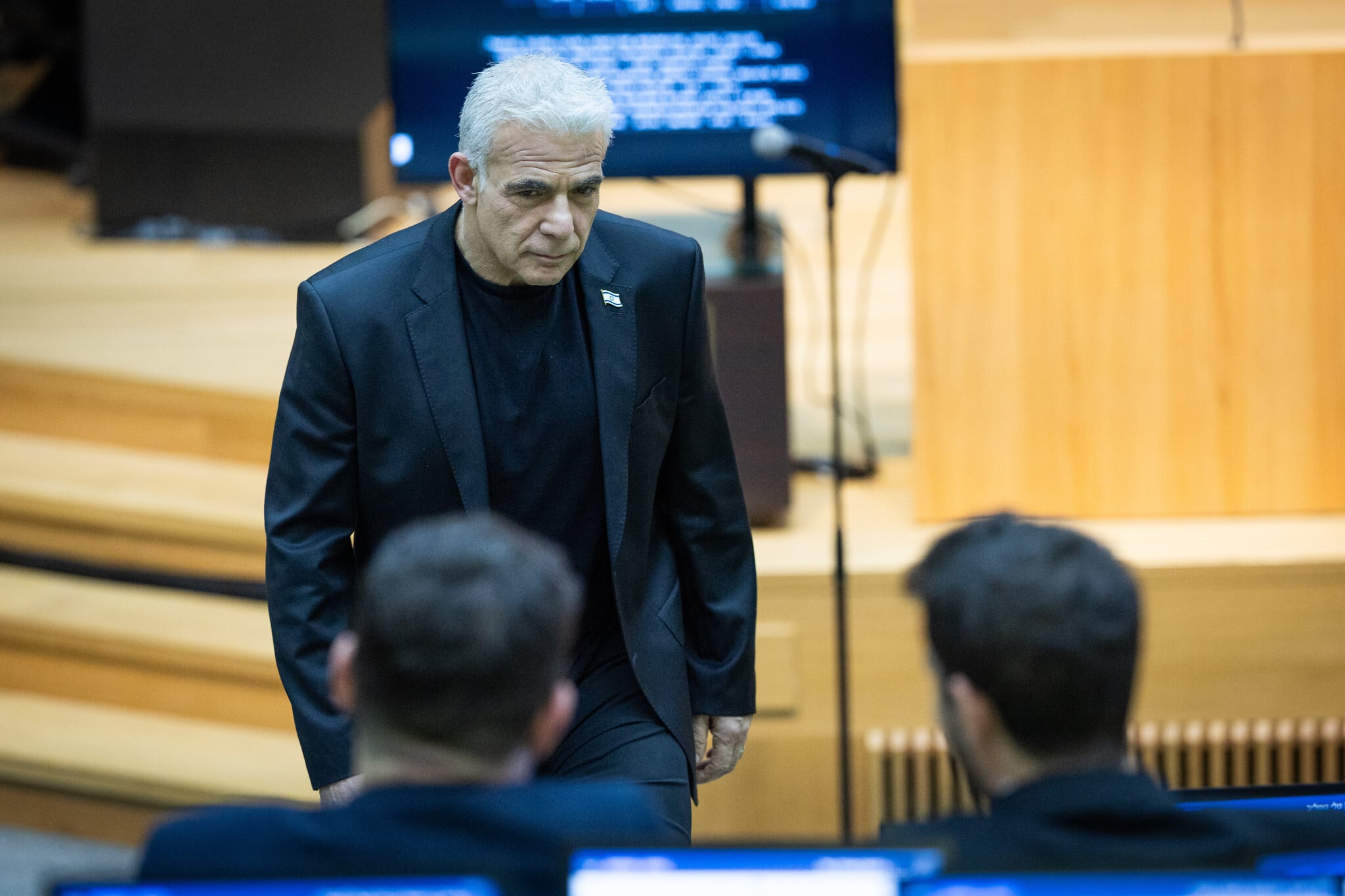
Opposition Leader Yair Lapid, seen during a vote on the state budget in the Knesset, on March 29, 2026. (Yonatan Sindel/Flash90)
A record defense budget
The budget totals NIS 850.6 billion ($271 billion) for the 2026 fiscal year, and the Defense Ministry’s budget alone will be a record NIS 143 billion ($45.8 billion), plus NIS 22 billion ($7 billion) in income-dependent expenditure and NIS 82.2 billion ($26.3 billion) allocated to long-term spending commitments.
Smotrich called the defense package the “core” of the wartime budget, adding that it would allow Israel to “dramatically improve our geopolitical and diplomatic standing” and “dismantle and rebuild the Middle East.”
“This budget enables the state to win,” said Smotrich.
Earlier this month, the government approved a 3% across-the-board cut to all ministries except the Defense Ministry to help fund an additional NIS 28 billion ($9 billion) in wartime spending.

IDF troops of the 226th Reserve Paratroopers Brigade operate in southern Lebanon, in a handout photo issued by the military on March 29, 2026. (Israel Defense Forces)The ministries that received the next-largest allocations are the Education Ministry, which is slated to receive just over NIS 97 billion ($30.9 billion) for the school system, plus about NIS 14.9 billion ($4.7 billion) for higher education; the National Insurance Institute, which will receive some NIS 64 billion ($20.3 billion); and the Health Ministry, which will receive roughly NIS 63 billion ($20 billion).
In addition to voting on the first reading of the 2026 budget, lawmakers also passed the 2026 Arrangements Law, a key part of the annual budgetary legislative package that determines how funds will be disbursed.
The Knesset also passed the Deficit Reduction and Budgetary Expenditure Limitation Bill, which sets the deficit ceiling for 2026 at 4.9% of GDP — up from the 3.9% in the first reading of the budget passed in January.
Opposition decries ‘looting’ the public purse
Opposition lawmakers harshly criticized the budget for the allocations to Haredi institutions, West Bank settlements, and other priorities of coalition parties.
“This isn’t a budget – it’s a robbery,” said Lapid, addressing the plenum before the vote.
“The Israeli public is not stupid. It understands that this budget is a bonanza for the corrupt and for draft evaders who are celebrating at our expense,” he continued, vowing that “the next budget” will be for “those who serve, work, and pay taxes – the Israeli middle class – all the people who are the primary victims of this flawed and distorted budget.”

The Democrats party leader Yair Golan leads a faction meeting at the Knesset in Jerusalem, March 29, 2026. (Yonatan Sindel/Flash90)
Former prime minister Naftali Bennett, widely seen as one of the leading challengers to Prime Minister Benjamin Netanyahu in this year’s elections, called the budget the “most reckless and anti-Zionist” in the state’s history.
“We are at war, and, when cuts are necessary, the people of Israel know how to bear them. But the government is doing something entirely different: looting the public purse,” he said in a video.
The left-wing Democrats party leader Yair Golan likewise said the “worst government in Israel’s history” is passing a budget that amounts to “a working plan for dismantling the State of Israel,” citing the funding for ultra-Orthodox schools that “refuse to teach core curriculum subjects,” amid cuts to higher education, and allocations to West Bank settlements “in amounts exceeding those given to communities inside the Green Line.”
The budget also allocates NIS 400 million ($129.5 million) to the Settlements and National Missions Ministry.
Avigdor Liberman, chair of the opposition Yisrael Beytenu party, said, “On a day when the State of Israel is at war, when our soldiers are on the front lines, and reservists are leaving behind families and livelihoods, the government chooses to pass a misleading, sectarian budget that encourages draft evasion.”
“This is a moment that shows who and what matters to this government, and who matters less,” he continued.
Under the wire
The passage of the budget was not assured, and it at one point appeared likely that the coalition would fail to approve it before the March 31 deadline – the day the Knesset’s spring recess begins.
Had that happened, it would have set the government’s collapse in motion, leading to early elections. The vote is now scheduled for October.

MK Yitzchak Goldknopf, who chairs the ultra-Orthodox United Torah Judaism party, attends a committee meeting at the Knesset, February 12, 2026. (Yonatan Sindel/Flash90)
But the coalition maneuvered to postpone and separate several controversial pieces of legislation from the budget in order to expedite its passage, most notably the legislation to exempt Haredi men from mandatory military enlistment.
Ultra-Orthodox parties have demanded a law to keep their constituencies out of the military after the High Court in June 2024 ruled that there was no legal basis for Haredi yeshiva students’ decades-long blanket exemption from the draft.
However, ahead of the vote, Hebrew media reported that the ultra-Orthodox United Torah Judaism and Shas parties were conditioning their support for the budget on the draft exemption bill being reintroduced following the budget’s approval.
The Knesset also voted to split the Arrangements bill in two, leaving some of the more controversial reforms out of the legislation that needs to be approved to pass the 2026 state budget. Those include Finance Minister Bezalel Smotrich’s dairy reform, which sparked significant opposition from farmers, and a proposed tax on tobacco products and 1.5% property tax on vacant land.
“This is a budget with good tidings for the State of Israel and its citizens — in defense, welfare, education, health, for reservists, for residents of border communities and more,” coalition whip Ofir Katz said in a statement. “We’re stable, we’re strong and we will continue to work for the citizens of Israel until the coalition completes its term.”