
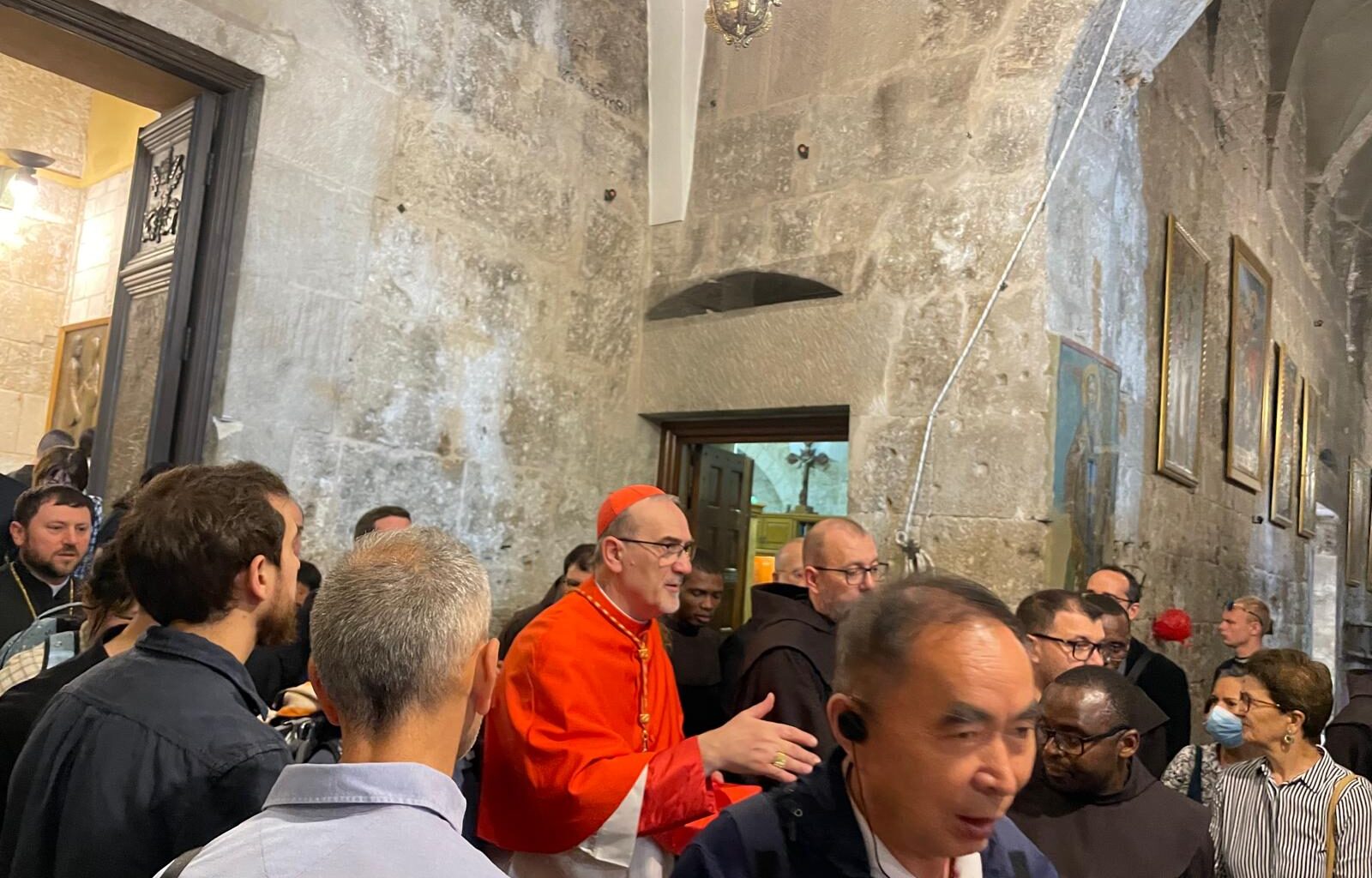
After widespread outrage over its refusal to let top Catholic figures pray at the Church of the Holy Sepulchre to celebrate Palm Sunday, the Israel Police announced that it had reached an agreement with the Latin Patriarchate to allow limited prayer at the Christian holy site.
Later, Prime Minister Benjamin Netanyahu said that he had ordered that Cardinal Pierbattista Pizzaballa, the most senior Catholic official in Israel, “be granted full and immediate access” to the church.
The statements came after police blocked Pizzaballa, Latin patriarch of Jerusalem, and Father Francesco Ielpo, custos of the Holy Land, from the church on Palm Sunday, which commemorates the day Jesus traditionally rode into Jerusalem, where he was greeted by cheering crowds bearing palm fronds, according to the New Testament. The day marks the start of Holy Week, which ends with Easter, this year on April 5.
The institutions led by Pizzaballa and Ielpo said after the incident that it set a “grave precedent,” and that it “disregards the sensibilities” of billions of Christians who celebrate Holy Week.
Initially, police as well as Netanyahu’s office defended the refusal as a security measure amid the war with Iran, which has seen missile fragments impact the Old City, including near the Church of the Holy Sepulchre.
Get The Times of Israel’s Daily Edition
by email and never miss our top stories
By signing up, you agree to the terms
But later in the day, two police officials — Jerusalem District Commander Deputy Commissioner Avshalom Peled and David Sub-District Commander Dvir Tamim — met with a representative of the Latin Patriarchate. They agreed on a framework that will allow all Christian denominations to worship in the church while the Iran war continues, said the police.
A police official told The Times of Israel that the details of the framework would be released tomorrow after a meeting with all Christian denominations.
Netanyahu’s statement affirmed that Pizzaballa would henceforth be let into the Christian holy site.
“I have instructed the relevant authorities that Cardinal Pierbattista Pizzaballa, the Latin Patriarch, be granted full and immediate access to the Church of the Holy Sepulchre in Jerusalem,” he said in a statement, adding, “as soon as I learned about the incident with Cardinal Pizzaballa, I instructed the authorities to enable the Patriarch to hold services as he wishes.”
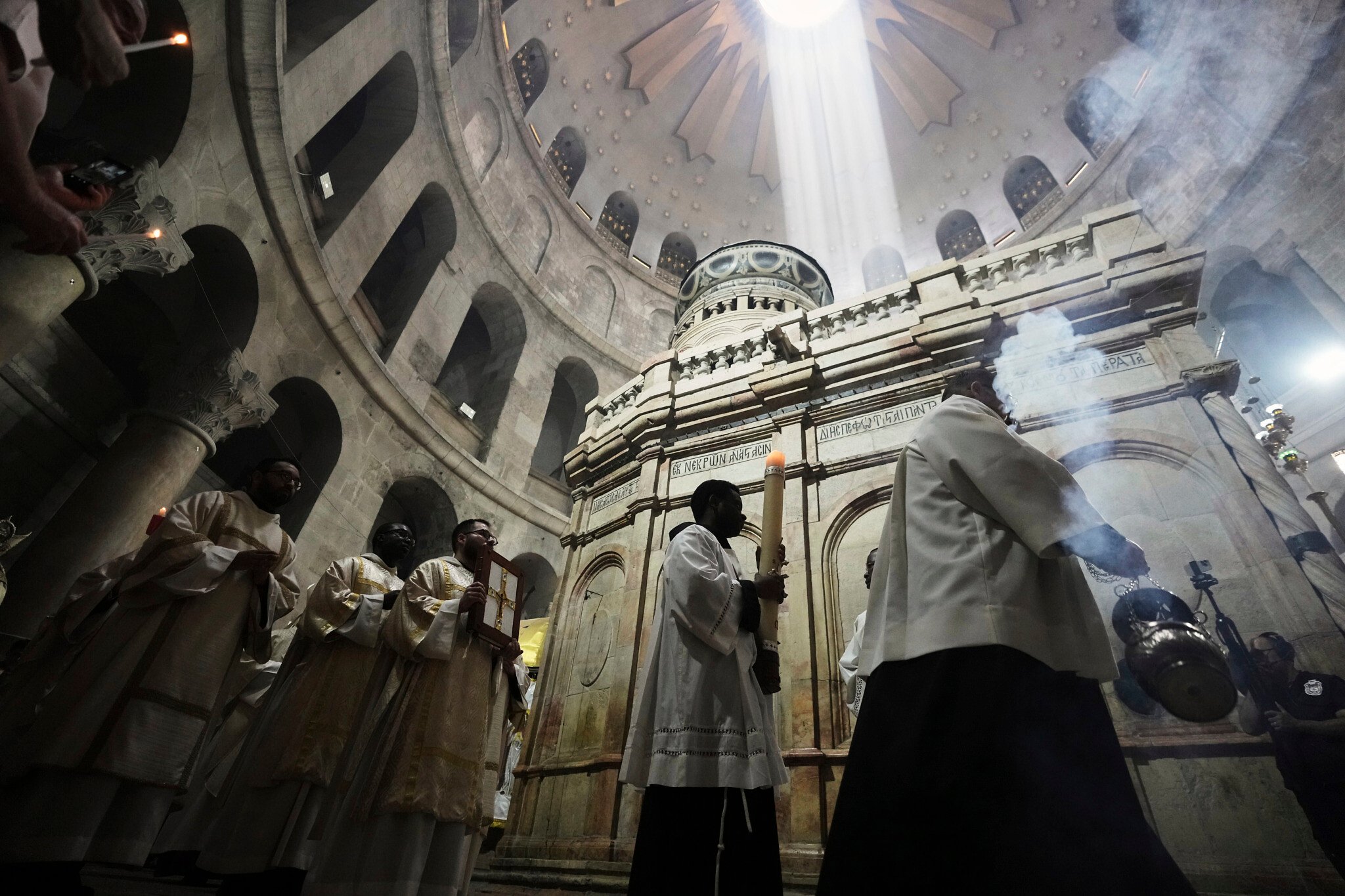
Catholic pilgrims and clergymen participate in the Easter Sunday Mass led by the Latin Patriarch of Jerusalem Pierbattista Pizzaballa, at the Church of the Holy Sepulcher in Jerusalem’s Old City, April 20, 2025. (AP/Mahmoud Illean)
Since the start of the US-Israel war against Iran on February 28, Israeli authorities have, for security reasons, barred access to the Old City for everyone other than residents or shop owners.
The restrictions extend to all holy sites, including the Western Wall, Al-Aqsa Mosque and Church of the Holy Sepulchre, which have been closed since March 6. Gatherings in Jerusalem and many other places nationwide remain limited to 50 people, provided a shelter can be reached in time.
Earlier this month, a fragment of an intercepted Iranian missile impacted in Jerusalem’s Old City, around 400 meters from the Western Wall and Al-Aqsa Mosque compound on the Temple Mount.
Days before that, missile fragments from intercepted Iranian missiles landed near the Church of the Holy Sepulchre.
In their previous statement on the incident, police pointed to those dangers to justify the decision to bar Pizzaballa and Ielpo, while emphasizing that “freedom of worship will continue to be upheld, subject to necessary restrictions.”
“Since the beginning of Operation Roaring Lion, and in accordance with directives issued by the Home Front Command, all holy sites in the Old City of Jerusalem have been closed to worshipers, particularly locations that do not have standard protected spaces, in order to safeguard public safety and security,” police said in the earlier statement.
“The Patriarch’s request was reviewed yesterday, and it was clarified that it could not be approved for the reasons outlined above.”
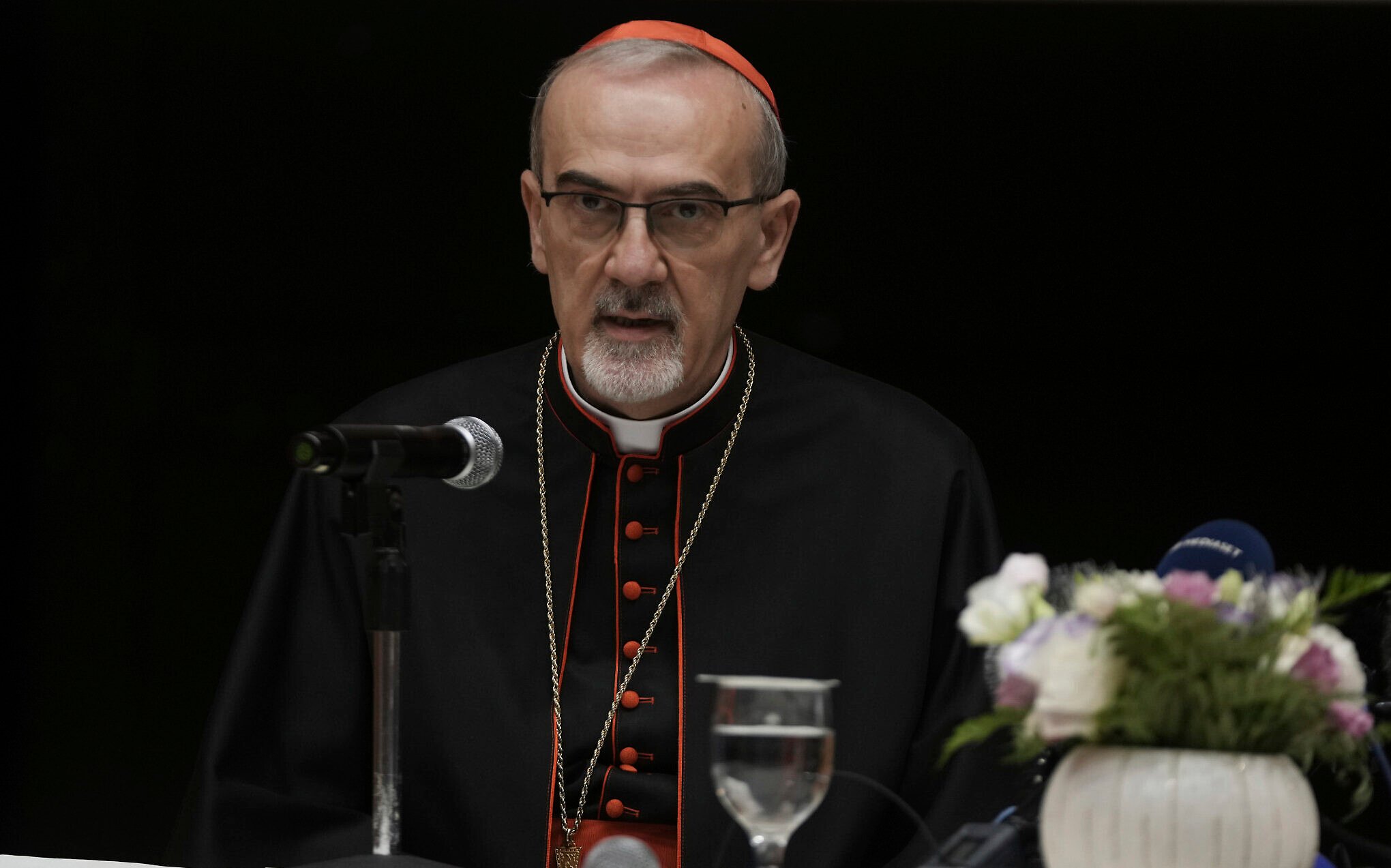
Latin Patriarch Cardinal Pierbattista Pizzaballa speaks during a joint press conference with the Greek Orthodox Patriarch Theophilos III, not pictured, following their visit to the Gaza Strip, in Jerusalem, July 22, 2025. (Mahmoud Illean/AP)
But the decision drew international condemnation from figures including US Ambassador to Israel Mike Huckabee, Italian Prime Minister Giorgia Meloni and French President Emmanuel Macron.
Huckabee said the decision was “difficult to understand or justify,” while Meloni called it “an offense not only to believers, but to every community that recognizes religious freedom.”
Macron said, “I condemn this decision by the Israeli police, which adds to the alarming proliferation of violations of the status quo of Jerusalem’s Holy Sites. The free exercise of worship in Jerusalem must be guaranteed for all religions.”
Netanyahu’s office had initially said the decision to block Pizzaballa was made “out of special concern for his safety.” But that statement added that Christian leaders would be able to access the church.
“However, given the holiness of the week leading up to Easter for the world’s Christians, Israel’s security arms are putting together a plan to enable church leaders to worship at the holy site in the coming days,” it said.
You appreciate our wartime journalism

You clearly find our careful reporting of the Iran war valuable, at a time when facts are often distorted and news coverage often lacks context.
Your support is essential to continue our work. We want to continue delivering the professional journalism you value, even as the demands on our newsroom have grown dramatically during this ongoing conflict.
So today, please consider joining our reader support group, The Times of Israel Community. For as little as $6 a month you’ll become our partners while enjoying The Times of Israel AD-FREE, as well as accessing exclusive content available only to Times of Israel Community members.
Thank you,
David Horovitz, Founding Editor of The Times of Israel