
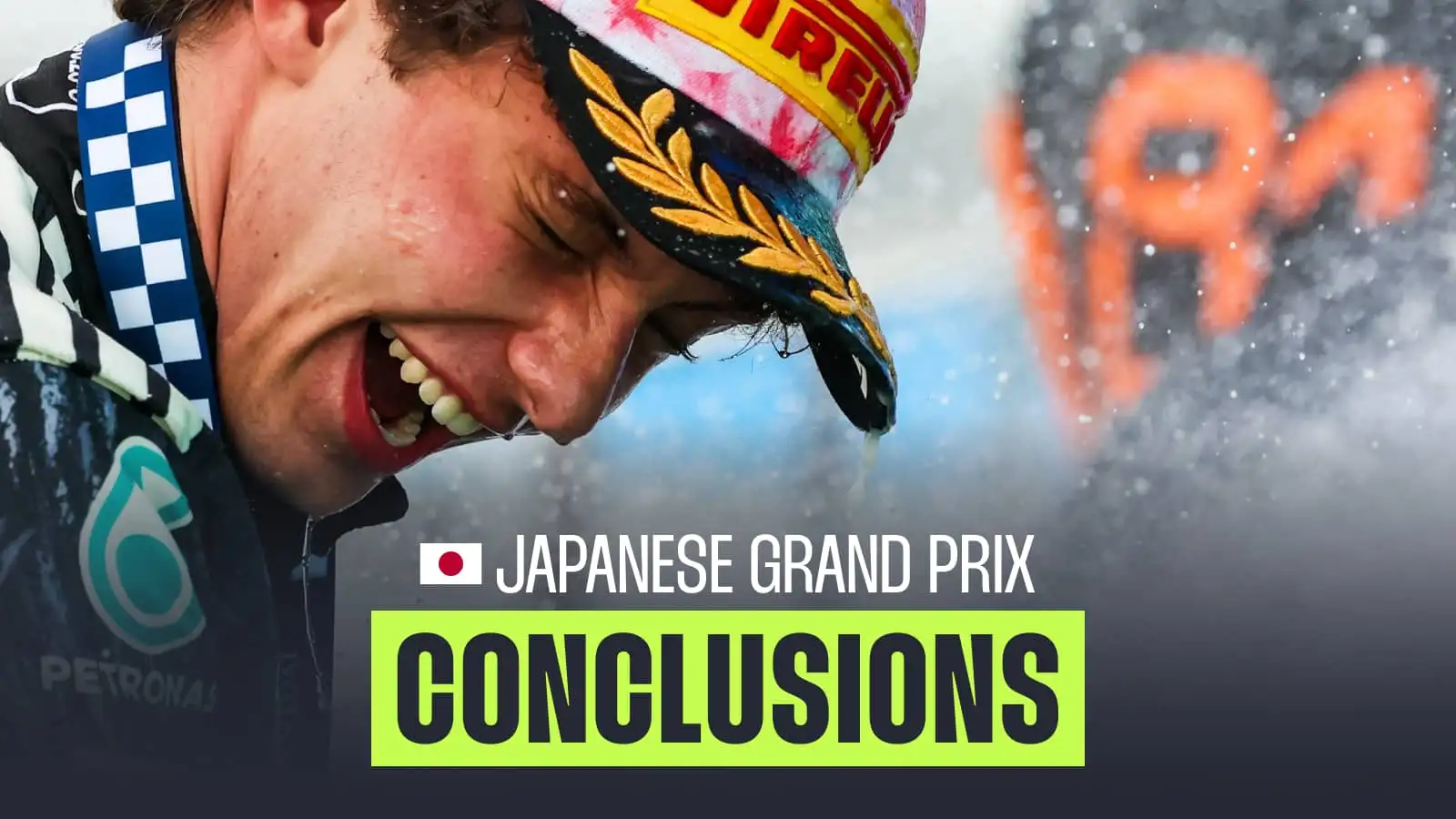
Mercedes driver Kimi Antonelli claimed his second victory of the F1 2026 season at the Japanese Grand Prix at Suzuka.
Antonelli recovered from a poor start to take the win and with it the lead of the F1 2026 world championship, with McLaren’s Oscar Piastri second and Ferrari driver Charles Leclerc in third. Here are our conclusions from Japan…
Oliver Bearman’s crash needed to happen to force action over the F1 2026 rules
Want more PlanetF1.com coverage? Add us as a preferred source on Google to your favourites list for news you can trust
There was a widespread sense of acceptance in the aftermath of the Chinese Grand Prix two weeks ago.
Nobody, it was said, was ever going to love the new rules for 2026.
But it is what it is, as Formula 1 people like to say, so what can we do about it now? Isn’t it time everyone stopped complaining and just got on with it?
And yes, yes, yes: qualifying isn’t great and it’s a shame about that… but the racing? The overtaking? It’s nobody’s idea of pure, granted, but it’s undeniable that it’s more exciting than ever.
It took just one more race weekend for Suzuka – dear old Suzuka – to blow that forced positivity pushed mainly by the broadcasters, as fake as the spectacle itself, to pieces.
It was one thing for Formula Net Zero to ruin the best corners in Melbourne and Shanghai; quite another for the 2026 cars to strip Suzuka, comfortably the greatest circuit on today’s calendar, of its challenge.
If you did not know any better, you would have thought an engine failure had occurred every time the revs dropped dramatically and suddenly on the approach to 130R as not-so-super clipping kicked in.
Listen closely to the onboard footage and you could even hear Max Verstappen dying inside a little bit more every time his Red Bull ran out of puff just before the turn-in point.
The issue with pretending that everything is fine when evidently it is not came to a head shortly after qualifying in Japan when as usual Formula 1 posted to its social media channels the onboard footage of the lap for pole position.
With one difference: a technical issue (resolved by F1 physically retrieving the vision from the offending camera on Sunday morning) meant it suddenly cut to an external shot for the remainder of the lap after Kimi Antonelli’s Mercedes exited Spoon and began to coast towards 130R.
So it had hardly been a flattering weekend for the 2026 rules even before the accident involving Oliver Bearman on race day increased the urgency for a change to the regulations.
Turns out that the 2026 cars do not just make a mockery of the pinnacle of motorsport and neuter the world’s great circuits – they’re actively dangerous too.
Conclusions recap: How the F1 2026 season has unfolded so far
Chinese GP conclusions: Verstappen sabbatical fear, mixed Hamilton feelings, McLaren Powertrains
Australian GP conclusions: Formula Net Zero, Russell’s main threat, Aston Martin-Honda mistake
It has been plain since Romain Grosjean’s accident in Bahrain six years ago that accidents on the straights remain the final frontier of F1 safety.
F1 has seen various near misses with lethal speed differentials – of the type that claimed the life of Gilles Villeneuve at Zolder in 1982 – on the straights in qualifying over recent years without doing very much about it.
What happens when you have a set of rules that result in one car deploying energy at the same time another is harvesting it?
No prizes for guessing that they end up meeting in the middle.
At that point, F1 stops being motor racing and becomes dodgeball on wheels: missile guidance versus missile avoidance.
That’s Mario Kart racing for you in a nut – sorry, blue – shell.
With Carlos Sainz revealing after the race that drivers had previously aired concerns about accidents of this nature in 2026, perhaps Bearman’s crash needed to happen in order to open some eyes to the true madness of the 2026 rules.
The shocking footage of an F1 driver limping away from an accident before dropping to the floor will inevitably travel far and wide, providing all the ammunition the likes of Sainz need to strengthen their calls for change.
The FIA, to its credit, has shown a willingness to act on matters this weekend, making a tweak to help minimise energy management requirements in qualifying and confirming after Bearman’s accident plans for “a number of meetings” during the April break with a view to refining the regulations.
If the powers that ought not to be were not listening before, they sure as hell are getting the message loud and clear now.
Max Verstappen can no longer hide his contempt for current F1
There was a time, and not too long ago, when Fernando Alonso felt that his talents were best served away from Formula 1. Kimi Raikkonen too.
And what happened? Both came running back in the end. They always do.
It might seem enticing in your dreams at night, zapping down the Mulsanne Straight as the sun sets at Le Mans, tipping the car into Turn 1 at the Brickyard or Daytona, or barreling down an ice-cold Col de Turini in a rally car.
And no doubt it does get the heart pumping when you first get there.
But then the novelty wears off and soon you realise that actually, no, nothing compares to F1 after all.
The hard truth? This is the only form of motorsport that matters.
Sometimes it requires a driver to step away from Formula 1 for a while – even this version of Formula 1, unlovable as it is – for it to hit home just how much he needs it and to appreciate the way this sport is central to his very existence.
Even now, as he is rattled numb by the vibrations of his Aston Martin-Honda, there is likely nowhere else Fernando would rather be.
This is in his bones. It is part of him.
Max Verstappen hasn’t got to that point yet, realising that the essence of F1 itself is alive and flowing inside his being.
But, made of exactly the same stuff as Alonso, soon enough he will. He just might need to step out of it first.
As noted in PlanetF1.com’s conclusions from the Chinese Grand Prix, the prospect of Max taking a sabbatical from F1 has never felt more real than over the last few weeks.
It’s not just his disillusionment with the direction in which F1 is heading with the 2026 rules, but the hopelessness of his competitive situation – and the sudden shortage of serious options away from Red Bull – too.
This perfect storm means Formula 1 is in the process of losing Max Verstappen.
Or perhaps it already has lost him.
Compare and contrast the Max who turned up in his happy place at the Nurburgring last weekend, all smiles and charm personified, to the altogether darker character we witnessed at Suzuka.
The reporter ejected from his media briefing on Thursday was effectively collateral damage in Verstappen’s rampage against 2026-spec F1 and all that comes with it.
It is far easier for a driver to carry out an act of that nature – and later defend it – when he no longer cares about the consequences of his actions, far less how those actions are perceived.
Or, put another way, has Max finally reached the stage of contempt for Formula 1 where he has no more effs left to give? It’s beginning to look that way.
See also the footage of him waving – waving! – at Pierre Gasly as the Alpine flew past him on the main straight during the race.
He might as well have turned his hand and directed the gesture towards the onboard camera on his Red Bull.
Verstappen himself has hinted that his light is starting to dim, admitting after qualifying at Suzuka that he has moved “beyond” frustration with what “life here” has become.
When even Max no longer has the energy to get worked up about things, having raged heroically against the 2026 rules from the start, the writing is on the wall.
If F1 is already a poorer place this year without Verstappen at the front, imagine how mundane it will be when he is no longer on the grid, potentially as soon as 2027.
But Max Verstappen was not made to finish eighth.
For the first time in years you would not have known that Max, this hurricane of a racing driver, was even in the Japanese Grand Prix.
And when a driver of such talent and gravitas is reduced to making up the numbers, like Alonso in 2018, maybe the time really has come to step away if only for a little while.
To repeat the point from Shanghai: enjoy watching him while he’s still here.
At this rate, it won’t be for much longer.
Kimi Antonelli is growing with each passing race
Regular readers of this column will be familiar with a concept called the complete elimination of doubt.
It is the point at which a driver begins to have the look and feel of a world champion, best captured in those moments when he sets pole position or takes the lead of a race and never looks back.
It is a step change not just in performance but psychology; the moment at which confidence morphs into certainty.
At this stage of a driver’s development, victory starts to feel not only inevitable, but a matter of routine.
Kimi Antonelli is not there yet. Not even close.
If he had been, he would have taken pole at Suzuka and promptly disappeared into the distance, not allowing his over-enthusiastic (nervy?) right foot to lose him a bunch of places at the start.
But in a season like this, and with a Mercedes this dominant, you can see how he could get there – and in a quicker manner than pretty much every driver to have come before.
Still in the afterglow of his maiden victory in China, it made more sense than ever this weekend why Mercedes was prepared to take a chance on a teenager two years ago.
The boy wonder has had no option but to grow up quickly, the signs of promise and moments of exasperation rolling into one over the last 12 months.
And what does Mercedes have now as a result of that occasionally painful process?
Probably the most advanced driver for his age (19) and experience (27 races) there has ever been in Formula 1.
Overlook the lacklustre start and it was as though Antonelli’s first win bled naturally into another at Suzuka.
This victory – the effortless way he glided to pole on Saturday, the style with which he coolly converted the lucky break handed to him by a well-timed safety car – was marked by a self-assurance and confidence that comes only with the feel of a winner’s trophy in your hands for the first time.
He is growing rapidly in stature and getting better with each passing race.
And which race just happens to be next?
Ah, yes: Miami, where he offered the first real glimpse of his potential by setting pole for the sprint race last year.
If he was not already aware, George Russell has a battle on his hands…
George Russell is facing the same early test as Lando Norris in 2025
And how might George Russell cope with this battle on his hands?
Better, you suspect, than Lando Norris did last year.
The doubts that hung over Norris for so much of 2025 – that he was psychologically suspect and lacked the toughness to win the title – simply do not apply to Russell, who has never needed reminding how good he is.
That self-confidence and assertiveness, the sort retired athletes like to refer to as ‘good arrogance’, will serve him well as 2026 unfolds.
Yet it is noteworthy the way Russell’s start to the season seems to have mirrored that of Norris a year ago.
Like Lando, George lived up to his status as the pre-season favourite by winning the opening race in Australia.
And like Lando, nothing has gone right for him since.
For Norris, victory in Melbourne was followed by a subdued weekend in China, a penalty in Bahrain and a qualifying accident in Saudi Arabia.
For Russell, it is as though his season has not recovered from the moment his front wing broke during qualifying in Shanghai.
Then came the power loss moments later at the start of Q3. Then came the Ferraris to swarm him at the start of the race.
Then came the lack of rear grip in qualifying at Suzuka. And then came the safety car right after he had pitted.
As Russell himself put it over team radio behind the safety car on Sunday: “Wow, our luck these last two races…”
If there is a lesson to be learned from 2025, it is that setbacks of this sort need not be season-defining.
Yet it is amazing what can happen when an athlete’s little bubble of peace is punctured and they take a punch to the face from an opponent they did not expect.
Just as few saw Oscar Piastri, in just his third season, as a serious threat to Norris at the start of last year, so nobody expected Antonelli to give Russell too much trouble in 2026.
And yet here George is trailing Kimi by nine points with three races completed.
Nothing in the grand scheme of things, of course. Nothing that can’t be overcome with a good weekend in Miami.
But annoying nonetheless. And a large enough gap to make a driver fret about whether the points lost over the last two weekends will matter when it’s all said and done in December.
Norris’s reaction to the rise of Piastri was to stew in his own self-pity for a while, making mistakes he shouldn’t have made under pressure, only adding a second win of 2025 months after his first and not peaking until much later in the season.
Russell?
Everything we know about him to this point strongly suggests he will meet the challenge posed by Antonelli head on, but…
That’s the beauty of a title race, you see.
It is the greatest examination of a driver’s character and never fails to reveal what really lies beneath even the stoniest surface.
Whatcha got, George?
McLaren should still emerge as Mercedes’ most consistent threat in F1 2026
Around a year ago, when talk of a significant Mercedes advantage for 2026 stopped being mere rumour and started being treated as fact, a worst-case scenario did the rounds.
The worry was that F1 in 2026 would effectively become a two-tier category, split down the middle between the haves and the have-nots.
The Mercedes-powered teams, the theory went, would lock out the top-eight slots on the grid two-by-two on most weekends like some Merc-sponsored Noah’s Ark, leaving the remaining seven to fight over the scraps on the fringes of the points.
Mercifully, and largely thanks to the competence of Ferrari and Red Bull Powertrains, it has not turned out that way.
Yet among the bigger surprises of 2026 so far is that Mercedes’ three customer teams – McLaren, Alpine and Williams – have not made more of the inherent advantage the best engine has given them.
A repeat of 2014, when Williams and Force India were catapulted overnight into podium contention by a Mercedes power unit, this is not.
McLaren has been particularly vocal on the reasons why those Merc-a-thon fears have not translated into reality, pointing frequently over recent weeks to its basic lack of knowledge, integration and optimisation compared to the Mercedes factory team.
Constructors’ champions for the last two seasons, McLaren is back to feeling like a second-class citizen in 2026 now the natural balance between works team and customer has been restored.
Yet McLaren has come too far and grown too strong over the last few years for it to meekly fade away now.
After a muted start to the season, Oscar Piastri’s podium at Suzuka was a timely reminder of the team’s enduring quality.
Just three races in, McLaren already appears to be rapidly filling the knowledge gaps with which it started 2026, sufficiently enough to see off Ferrari here after two weeks of absorbing the data from the Australia-China double header.
What should prove to be the weakest portion of the team’s season has been negotiated.
And now?
Now comes the development race and the area in which McLaren has particularly excelled over recent years.
No team on the grid will put the five-week break between now and Miami to better use.
Want to be the first to know exclusive information from the F1 paddock? Join our broadcast channel on WhatsApp to get the scoop on the latest developments from our team of accredited journalists.
You can also subscribe to the PlanetF1 YouTube channel for exclusive features, hear from our paddock journalists with stories from the heart of Formula 1 and much more!
Read next: Japanese GP 2026 driver ratings: Piastri surge, Bearman crash, and Alonso’s quiet performance