
Click here to download the JINSA Insight.
Executive Summary
While global attention is focused squarely on Iran, that is a luxury Israel cannot afford. Even while it is prosecuting an intensive, round-the-clock aerial campaign against Iran, Israel has been forced to shift resources towards the Lebanon front. Following Hezbollah joining the conflict nearly a month ago, and launching over 1,000 projectiles towards Israel since then, Israeli forces have conducted air and ground operations on nearly a daily basis to remove Hezbollah’s presence in southern Lebanon and weaken the terror group across the country.
Hezbollah remains a regional threat due to the failure of the Lebanese Armed Forces (LAF) and the United Nations Interim Forces in Lebanon (UNIFIL) to disarm the group as required by the November 2024 ceasefire agreement. Without Israeli troops on the ground to help enforce disarmament, Hezbollah continued to operate, as evident through newly built tunnels and the buildup of Hezbollah’s elite Radwan Forces near the Israeli border.
Within this renewed operation, Israel’s military is prioritizing the most glaring threats to Israeli security first: pushing Hezbollah operatives north of the Litani River, putting Israel’s northern communities beyond the reach of Hezbollah’s anti-tank guided missiles (ATGMs) and ground incursions, and disrupting its ability to launch projectiles. Israel’s operations also more generally aim to weaken Hezbollah’s overall ability to function, conducting airstrikes across Lebanon, targeting its leadership and financial assets.
Israeli Prime Minister Benjamin Netanyahu announced on March 29 that he has “now instructed [the military] to further expand the existing security zone in order to finally thwart the threat of invasion and to push the anti-tank missile fire away from our border.” While Israel can still ratchet up the pressure further, and will do so if necessary, it continues to encourage the LAF to act against Hezbollah and assist in the group’s disarmament.
I. The Northern Threat: How We Got Here
Since its inception over 40 years ago, Hezbollah has posed an unending threat to Israel, and the present is no exception. The threat became intolerable for Israel when, in October 2023, Hezbollah joined the Iranian proxy network’s war on Israel. As northern Israeli villages came under constant fire, Israel conducted months of airstrikes to degrade and decapitate Hezbollah. In September 2024, the Israel Defense Forces (IDF) launched Operation Northern Arrows, destroying around 85 to 90 percent of Hezbollah’s pre-war weaponry and removing much of its infrastructure and command-and-control networks.
What was achieved in the war began to erode in peacetime. In November 2024, the United States and France brokered a ceasefire between Israel and Lebanon, drawing on United Nations Security Council Resolution 1701 (2006) after Israel’s 2006 war with Hezbollah. The ceasefire gave the LAF and UNIFIL responsibility for disarming Hezbollah south of the Litani River. While retaining the right, under its agreement with the United States, to counter imminent threats to its security, Israeli forces remained at five outposts in southern Lebanon to preserve freedom of action.
Lebanese President Joseph Aoun and Lebanese Prime Minister Nawaf Salam, shortly after each took office in early 2025, publicly promised to disarm Hezbollah. Lebanon’s leaders made a commitment to the United States in September 2025 that the Lebanese military would disarm Hezbollah by year’s end, starting south of the Litani River. After months of stalling action, the LAF claimed in January 2026 to have dismantled the group’s military capacity in southern Lebanon, aside from clearing out tunnels and defusing unexploded ordnance.
However, the LAF’s actions clearly did not eradicate Hezbollah’s pre-war weaponry, nor did they prevent the group from rebuilding. Despite sustaining enormous losses in its 2024 war with Israel, Hezbollah gradually began throughout 2025 to again threaten northern Israel, helped by over $1 billion in Iranian funding that year. This included Radwan forces moving back to southern Lebanon in the months leading up to the war, sources tell JINSA.
In the ceasefire’s aftermath, as former U.S. Central Command (CENTCOM) Deputy Commander Vice Admiral (ret.) Mark Fox and JINSA’s Ari Cicurel noted at the time, U.S. leaders “pushed the LAF to respond to many of the hundreds of [Hezbollah’s ceasefire] violations” – yet Lebanon did not adequately do so, and the results speak for themselves. According to exclusive JINSA data on Lebanese ceasefire enforcement, Lebanon’s central government arrested just one percent of Hezbollah’s fighting force in the year—conducting just 132 counter-Hezbollah operations, of which only 35 percent resulted in arms being seized. Lebanese officials even belatedly acknowledged that Lebanon could, at best, achieve “containment” rather than “disarmament” of Hezbollah.
II. The Simmering Lebanon Front
With its capabilities degraded, but not eliminated, Hezbollah joined the war on behalf of Iran on March 1. The group has fired an average of around 100 projectiles daily, far short of the multiple hundreds, if not a thousand, rockets it was believed to be capable of firing prior to 2024, but still enough to strain Israel’s air defenses. This has amounted to over 1,000 drones, missiles, and rockets total. In one instance, it even tried to launch over 600 projectiles in a single day. These attacks have resulted in the deaths of several Israelis, including six soldiers, while injuring several others and causing extensive damage throughout northern Israel. Although Hezbollah attacks have yet to impose property destruction or casualties at the same rate as they did during the first weeks of the October 2023 war, Israel is not waiting for things to get worse to act.
With Hezbollah probing both Israel’s will to fight and the extent of its resources, Israel has vowed a decisive response and is making good on its word. Since March 2, the IDF has struck hundreds of Hezbollah targets throughout Lebanon in over 300 waves of airstrikes and eliminated over 700 Hezbollah fighters, including hundreds of operatives within the organization’s Radwan Force.
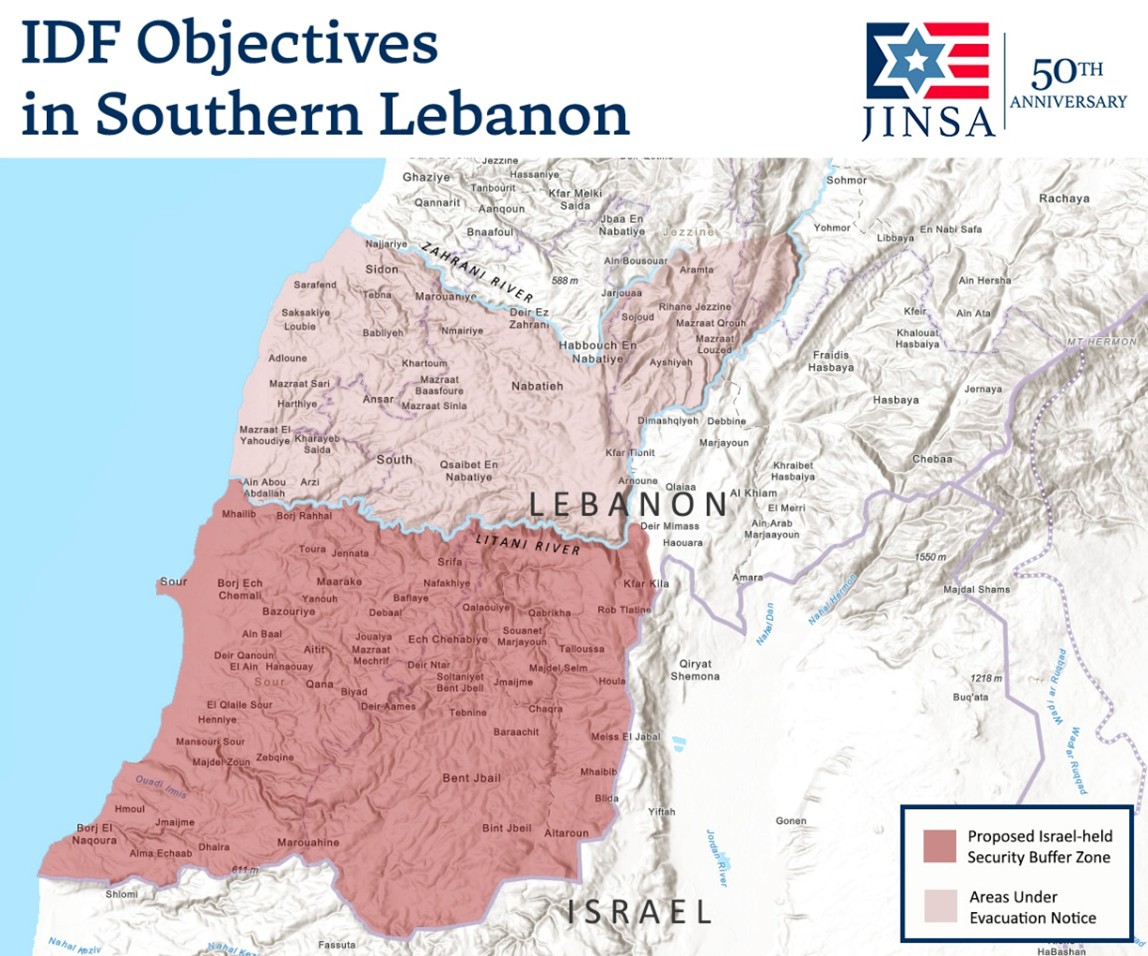
Israeli strikes are systematically removing Hezbollah’s ability to reach, let alone operate, in southern Lebanon. IAF operations have already targeted six key bridges used to move fighters and arms to and from territory south of the Litani River. The river, located roughly 30 kilometers north of the Israeli border, further distances Hezbollah and limits its ability to fire Kornet ATGMs, which have an uppermost range of around 10 kilometers, at northern Israel. In addition, Israel seeks to clear the area south of the Litani to neutralize three other persistent threats: Radwan Forces aiming to stage an October 7-style attack on Israel; Hezbollah explosive drones; and Hezbollah short-range rockets. To this end, Israel is working to form a broad security zone.
No longer is the IDF only clearing territory—it is increasingly holding it, too. Expanding out from the five outposts it held since 2024, according to sources who spoke with JINSA, Israeli forces are establishing over 20 forward operating posts, primarily to stage raids on Hezbollah strongholds and remove ATGMs positioned within striking range of Israel. Notably, five IDF divisions are operating on the ground in Lebanon, including in the north Litani Valley, and villages throughout the south.
Additionally, Israeli combat engineering forces began to dismantle Hezbollah infrastructure wholesale, rather than Israel relying on airstrikes to do so, with an Israeli military official noting that Israel is fully implementing the “Gaza Model” in southern Lebanon to evacuate, demilitarize, partially demolish, and take control of Hezbollah strongholds. Notably, in recent days, Israeli combat engineering forces have assumed indefinite control of the village of Al Khayyam, near the Israeli border—a location Israel’s Walla News outlet describes as a “strategic point” for Hezbollah operatives to store military equipment and stage attacks. Israel reportedly wants to adopt this model across southern Lebanon and is already taking control and clearing several areas in the region.
Yet Israel has made clear by the scope of its operations that it is not limiting its targeting packages geographically to southern Lebanon, nor exclusively to conventional military targets. Israeli airstrikes have targeted Hezbollah’s financial, logistical, and military sites throughout Lebanon, including targets in Baalbek, the Beqaa Valley, and Beirut’s Dahiyeh area. Israeli forces have struck over 30 facilities belonging to Hezbollah’s al-Qard al-Hasan financial network since the war began, and a number of Hezbollah-owned Al-Amana gas stations across the country.
III. What is Israel Trying to Accomplish?
Showing that there is likely more in store, Israel has shifted large numbers of troops to the theater—at least five divisions—to undertake limited ground operations. Israel seeks to clear the area of Hezbollah fighters and infrastructure, while also evacuating Lebanese residents north of the Zahrani River, over 10 miles north of the previous evacuation perimeter of the Litani River. Though it has not conducted major ground operations yet near the Zahrani River, it is clearly setting the stage to do so.
Israel may be holding off on such an offensive, for now, for two reasons. One, Israel may be expanding its force posture in gradual stages to allow for the LAF and other international forces to assist in the disarmament process, should they choose to. Second, it may be waiting until it can shift its primary attention from the Iran theater to Lebanon. In a recent JINSA webinar, former Israeli National Security Advisor and JINSA Distinguished Fellow Maj. Gen. (ret.) Yaakov Amidror remarked, “from time to time, [Israel is staging] raids into areas in which we have intelligence about [Hezbollah activity]. But this is not the offensive maneuver of the IDF, yet.” Maj. Gen. Amidror (ret.) added, “The decision to move from defensive to offensive positions and to begin the big ground maneuver in Lebanon is very much connected to the question of Iran—we don’t want to allocate resources we need for Iran, to Lebanon, mainly Air Force [bandwidth].” Essentially, as Israeli troops hold limited territory and maintain forward operating posts, they will need more assistance from the air force before launching a major offensive operation.
IV. Real Action, or No Point: Déjà Vu in Lebanon?
Facing the prospect of an Israeli ground incursion, the Lebanese government is yet again saying the right things publicly and taking some measured steps against Hezbollah. Following Hezbollah’s initial strikes, Lebanon banned Hezbollah military activity on March 2, calling on the organization to “hand over its weapons to the Lebanese state”— the exact demand the LAF has made repeatedly before. Furthermore, Lebanon expelled Iran’s ambassador on March 24, blaming Iran for dragging Lebanon into the current war.
Yet, after failing to implement the 2024 ceasefire agreement, which would have precluded the current Hezbollah attacks, there are few signs that Lebanon and its armed forces are preparing to take any serious action to strip the terror group of its weapons. Instead, Lebanon is urging the United States to help broker yet another ceasefire. For Israel, waging its most high-risk, high-reward campaign in modern history to transform its security situation, deals that kick the can down the road may no longer be in play. That is why U.S. and Israeli officials have questioned the endgame of Lebanon’s diplomacy, with an official telling Axios, “if it’s not real action about Hezbollah’s weapons, there’s no point.”
V. What’s Next?
As long as Israel remains the only force willing and able to address the Hezbollah threat, Israel’s military will continue to act in its own interest to secure the region. With Israel preparing to establish a buffer zone in southern Lebanon but refraining from launching a wide-scale offensive operation, Lebanon and the international community now have another chance to help step up and weaken Hezbollah’s regional threat.
Simultaneously, however, Israel must also learn from Lebanon’s previous ceasefire commitments that it failed to fulfill. Though it is certainly preferable for Lebanon and the international community to help neutralize the Hezbollah threat, as UNSCR 1701 requires, Israel is not holding its breath. And neither should the United States, though Washington should do everything in its power to push the Lebanese government to end Hezbollah as a military entity. Completely relying on the LAF and other forces, such as UNIFIL, to disarm Hezbollah could lead to Hezbollah’s re-emergence—again.