
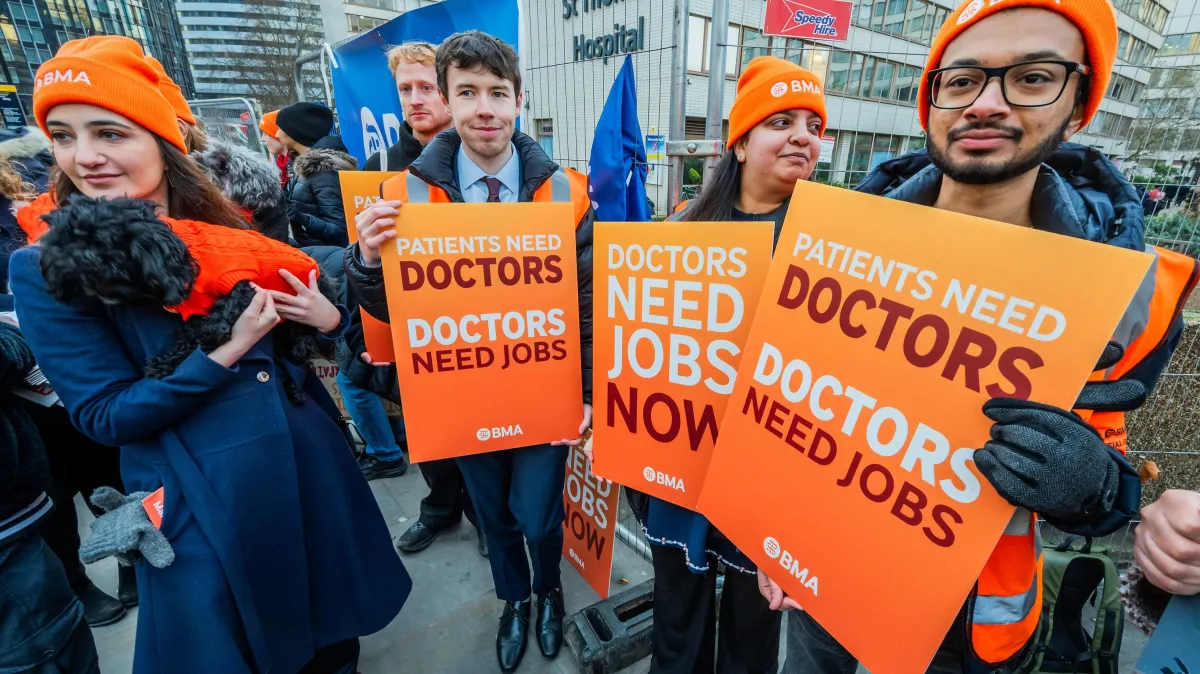
Last week, the BMA resident doctors’ committee rejected a historic deal. They now have 48 hours to reconsider. For patients, for the NHS, and for the doctors they represent — they should.
A thriving NHS. Decent working conditions. Fair pay. These are objectives that the BMA committee and I share.
For me, they are also deeply personal. My family’s life has been shaped by the NHS: my mum served as a nurse, my sister works in care and my wife continues to work in the service today. I know first-hand the dedication it demands and the pressures staff have been under.
The deal that the committee have now walked away from would have delivered another above-inflation pay rise this year, bringing the total pay rise over three years to 35 per cent, alongside reforms to pay progression to make sure doctors are rewarded more fairly as they gain experience and responsibility.
It would have reimbursed the cost of Royal College exams, putting thousands of pounds back into doctors’ pockets. And it would have unlocked up to 4,500 additional speciality training places over the next three years, a thousand of which would have opened for applications this month and which will be gone if this deal isn’t put to a vote on Thursday.
This was all on top of the extraordinary step we took at the start of 2026 to pass a law to prioritise UK medical graduates for speciality training places, so this year’s applicants don’t face bottlenecks that delay their career progression and makes the UK a less attractive place to be a doctor.
Politics newsletter
Get our daily insider’s guide to Westminster, plus a rundown of PMQs every Wednesday.
Sign up with one click
Those measures were not chosen randomly, nor were they imposed from above. They are the result of months of collaboration with the BMA, who engaged constructively throughout. At every stage, we listened to one another, recognising that above all else, we shared those same foundational goals.
That is why walking away from this deal is the wrong decision. It is a reckless decision. And doing so without even giving resident doctors themselves the chance to vote on it makes it even worse.
Because the truth is this: no one benefits from rejecting this deal.
Resident doctors will be worse off. Instead of the improved pay, progression and support on offer, they will receive the standard pay award this year, with none of the additional reforms that would have strengthened their working lives.
The NHS will be worse off. Each strike costs the NHS £250 million in paying for cover.
And patients will be worse off. Of course, we will do everything we can to protect care. We have already shown that even during industrial action, the NHS can continue to deliver the vast majority of planned treatment. But it would be wrong to pretend there is no impact. Progress slows. Waiting times fall more slowly. Pressure on staff increases.
That is what makes this so frustrating — and so completely avoidable.
Because the momentum is with us. Thanks to the efforts of NHS staff, waiting lists are falling. A&E performance is improving. Ambulances are arriving faster. Patient satisfaction is rising again. After years of strain, the NHS is beginning to move in the right direction.
This deal is not about whether the NHS will recover. It is recovering, and it will continue to do so. It is about how quickly we turn that recovery into a truly thriving NHS.
So, I say this directly to the BMA’s resident doctors’ committee: reconsider.
It is not too late to change course, to return to a constructive approach, and to do the most reasonable thing of all: give members a say and put this deal to a vote. Failing to do so will mean resident doctors are left with less, the NHS is weakened, and patients pay the price.
And to resident doctors themselves, I say this: make your voice heard. This deal improves your pay, your progression and your future. Do not let others decide that for you.
Our door remains open. Our shared objectives are unchanged. And our commitment to improving the NHS and the lives of working people continues to guide us.
There are still 48 hours left to choose a better path. For patients, the NHS, and our doctors — I urge you to take it.