
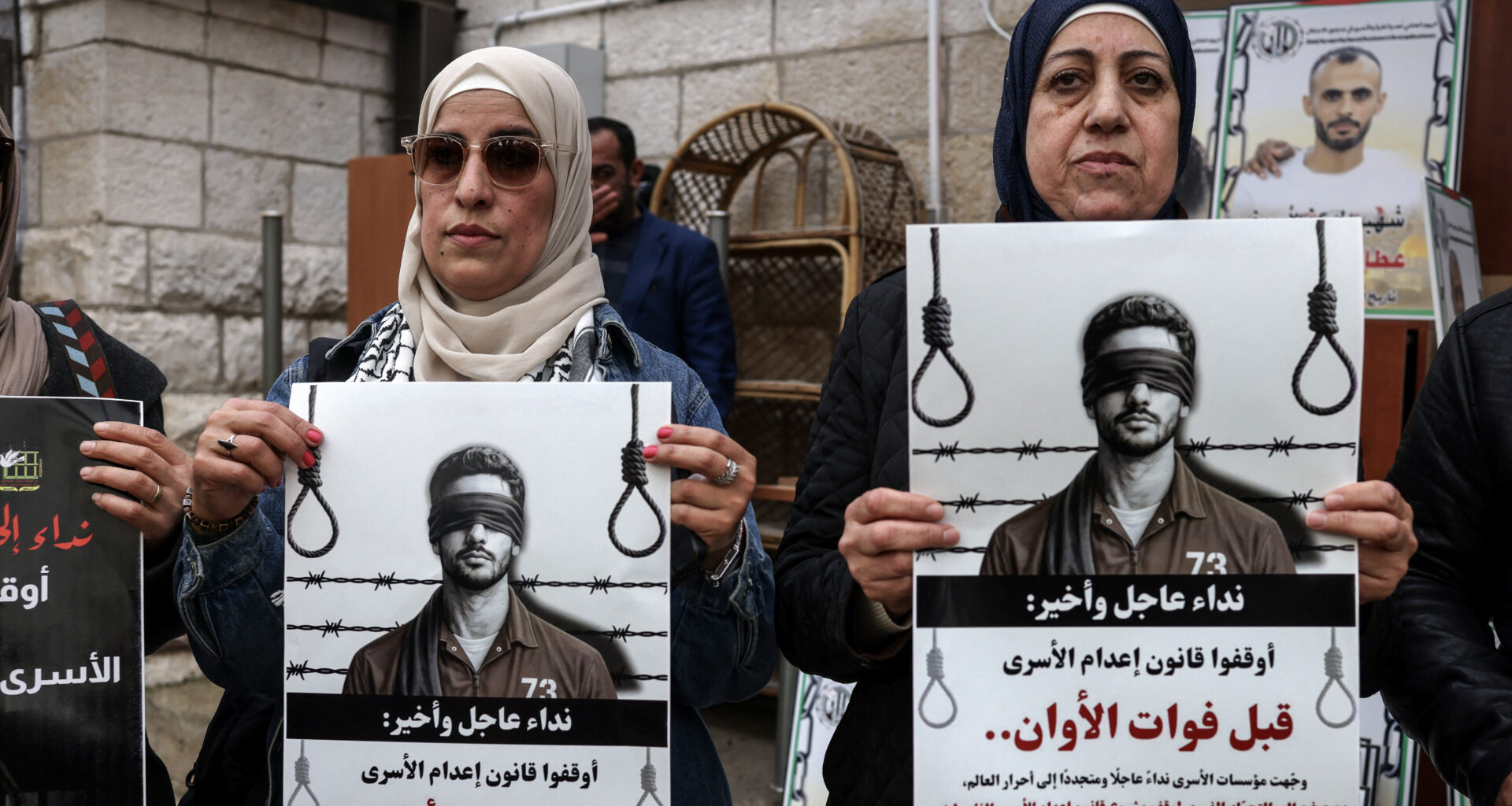
Along with a group of other Israeli international law scholars, we have written this statement concerning Israel’s new “Death Penalty for Terrorists Law.” The law, as described by The New York Times, “would allow the hanging of Palestinians convicted of deadly militant attacks, but… almost certainly cannot be applied to Jewish extremists convicted of similar crimes.…” What’s more, it “makes death by hanging the default sentence in Israeli military courts for Palestinians convicted of deadly attacks.” As of now, several petitions have been submitted to the Supreme Court of Israel challenging the law on both constitutional and international legal grounds. In the brief statement, we highlight the key ways in which the law violates basic rules of international law. The law can be found here (in Hebrew).
Statement by Israeli International Law Scholars Concerning Israel’s New “Death Penalty for Terrorists” Law
The undersigned, scholars of international law in Israeli academic institutions, wish to express our outrage and clear condemnation of Israel’s new death penalty law. It is not only immoral and in violation of the most basic dictates of public conscience, but is also unlawful both in terms of domestic constitutional law and Israel’s obligations under international law.
Israel is a party to the International Covenant on Civil and Political Rights from 1966. Under the Covenant it is prohibited to reintroduce the death penalty once abolished – a prohibition which includes, according to the Human Rights Committee’s General Comment 36 (2018), a ban on extending the list of crimes to which the death penalty applies or relaxing associated procedural safeguards, even for states that have not formally abolished the death penalty. As long as the death penalty is applicable, legal proceedings relating to its imposition must meet all due process safeguards, including the right to seek commutation of the death sentence. The right to commutation is also guaranteed in the Fourth Geneva Convention from 1949. Furthermore, under the Covenant, States must act towards abolition of the death penalty, and in no case may the death penalty be imposed in a discriminatory manner.
The new law violates all of these standards: It creates a new capital crime (intentional killing with an intent to deny the existence of the State of Israel), and transforms the existing capital punishment under law applicable in the West Bank for the crime of terror killing from an optional sentence to a default sentence which can be deviated from only in special cases. It further relaxes the procedural guarantees associated with the imposition of the death penalty under the law, by authorizing the bench to impose the penalty even by a non-unanimous decision based on a majority of two low-ranking officers, and without the prosecution even asking to impose the death penalty. The law also removes the military commander’s power to commute the sentence. It only allows the Prime Minister to request the court to suspend execution for no more than 180 days. In addition, the law requires the carrying out of execution through hanging – a form of punishment regarded in General Comment 36 as cruel, inhuman and degrading.
Crucially, the new death penalty law expands the legal circumstances in which the penalty would apply, in a manner that effectively applies to Palestinian convicts only. This is facilitated by the fact that, in civilian courts in Israel, the penalty would apply only to crimes undertaken with an intent to deny the existence of the State of Israel (a motivation unlikely to be attributed to Jewish terrorists), and by the fact that the relaxed procedures for the application of the death penalty in military courts in the West Bank would explicitly apply only to West Bank residents who are not Israeli citizens or residents. The law thus violates explicitly and implicitly both the right to life and the prohibition on discrimination.
In our view, imposing the death penalty in such circumstances amounts to racial discrimination and, in certain circumstances, even to the crime of apartheid, which may give rise to international criminal liability to anyone involved.
By having the Knesset legislating directly for the occupied territories, the law also exceeds Israel’s authority as the occupying power, and violates the international prohibition on annexation of territory. The Israeli parliament has no general legal power to pass legislation that governs the conduct of Palestinian residents inside the occupied territories, whether directly or indirectly by requiring the military commander to legislate in a certain manner. Therefore the law, insofar as concerns the occupied territories, is null and void from an international law standpoint.
We call on the Supreme Court to issue a preliminary injunction against the implementation of the law, and thereafter to declare the law unconstitutional in its entirety, and to strike it down. We also call upon the Attorney General to refuse to defend this law in any proceeding against its constitutionality, as defending the law will associate its office with this reprehensible law. We also forewarn the military commander in the occupied territories that the new law is in clear violation of international law and that any step towards its implementation might expose him, and others under his command, to international criminal liability. We also call on civil society to unite in a struggle against this law and its racist underpinnings, and to all members of the political opposition to commit, in their political platforms, to annul this law after the next elections.
Dr. Shelly Aviv-Yeini
Prof. Orna Ben-Naftali
Prof. Eyal Benvenisti
Dr. Ziv Bohrer
Prof. Tomer Broude
Prof. Iris Canor
Prof. Amichai Cohen
Dr. Natalie Davidson
Prof. Aeyal Gross
Prof. Guy Harpaz
Prof. Moshe Hirsch
Prof. Tamar Hostovsky Brandes
Prof. David Kretzmer
Prof. Eliav Lieblich
Dr. Doreen Lustig
Dr. Tamar Megiddo
Prof. Yael Ronen
Prof. Robbie Sabel
Dr. Michal Saliternik
Prof. Yuval Shany
Dr. Yahli Shereshevsky
Dr. Sivan Shlomo-Agon
Dr. Limor Yehuda
Dr. Dana Wolf
Dr. Ariel Zemach
FEATURED IMAGE: Protesters hold placards outside the Red Cross offices in Ramallah, in the Israeli-occupied West Bank, on March 31, 2026, during a rally against a bill approved by Israel’s parliament that would allow the execution of Palestinians convicted on terror charges for deadly attacks. Israel’s parliament approved a bill on March 30, that would allow the execution of Palestinians convicted on terror charges for deadly attacks. (Photo by Zain JAAFAR / AFP via Getty Images)