
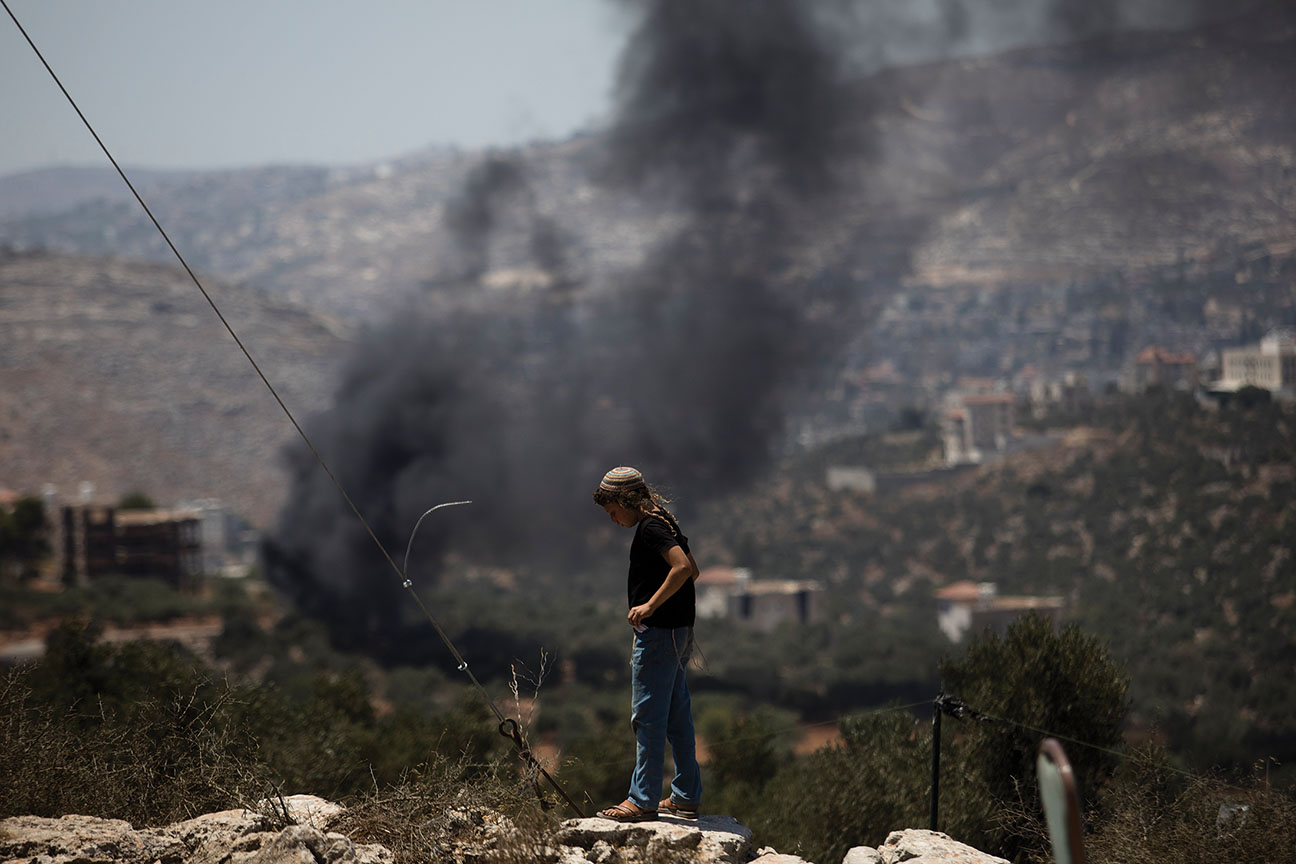
In recent days, prominent supporters of Israel have spoken out against acts of violence committed by far-right Israeli settlers toward Palestinian civilians in the West Bank. U.S. Secretary of State Marco Rubio, one of Israel’s strongest backers in Washington, said that the Trump administration is concerned and expects the Israeli government to solve this problem. U.S. Congressman Ritchie Torres (D-N.Y.), one of the most pro-Israeli lawmakers in his party, stated that “the crisis of extremist settler violence in the West Bank must be confronted, and the perpetrators must be prosecuted to the fullest extent of the law.”
These words — and the demand for action they imply — aren’t coming from the Jewish state’s critics and detractors, but from people who have consistently been on Israel’s side since Oct. 7, 2023. Israelis and pro-Israel Americans should listen to friendly warnings on this issue, and take them seriously. Israel’s best and most loyal friends are urging us to pay attention, and signaling that even they are tired of the harrowing and embarrassing images coming almost daily now from the West Bank.
It’s important to note that the majority of Israelis living in West Bank settlements don’t support these acts of violence and certainly aren’t involved in them. Nevertheless, the group that is responsible for these attacks is at least several hundred-strong, and according to some estimates now contains an active membership in the low thousands. It is wrong to affiliate this violence with the entire population of West Bank settlements, but that doesn’t make the problem any less urgent.
Some people choose to deny the phenomenon of extremist settler violence, or to minimize its scope. Often, these denialists will point out to a specific incident where the violence “went both ways,” or where Jewish extremists “simply responded” to earlier attacks by Palestinians, as if such excuses are viable in a country of laws as Israel aspires to be.
Such cases, while they do exist, don’t change the big picture: Israel has failed in curbing far-right attacks against Palestinian civilians, and is paying a price for that failure. If you don’t trust my word — a liberal-Zionist Israeli journalist — then take the word of U.S. Ambassador to Israel, Mike Huckabee, who already last year described some of the attacks carried out by Jewish fanatics against Palestinians as acts of terrorism. Huckabee isn’t just a supporter of Israel; he is a decades-long ally of the right-wing settler movement. But even he couldn’t stomach some of what he saw in visits to Palestinian villages that were attacked by “thugs,” as he put it. Unfortunately, his warning last year wasn’t enough to push the Israeli government to take decisive action on the matter; as a result, we are now facing even harsher criticism from more senior officials in the U.S. government.
Israel has failed in curbing far-right attacks against Palestinian civilians, and is paying a price for that failure.
This problem isn’t going to simply go away, or solve itself, without a determined and forceful intervention by the Israeli government, the IDF and our law enforcement. Such violence has been a cause for concern for years, but both the military and the police agree that it has gotten worse over the past two years, in the aftermath of Oct. 7 and under the shadow of the war in Gaza. A senior police officer who is responsible for tackling this problem told me recently: “There are more attacks, they are more violent and the young people behind them are out of control.” He warned that “we aren’t far from the ultimate nightmare scenario.”
What does that scenario look like? The officer who spoke with me fears that in the near future, a group of violent “hilltop youth,” as the extremists behind these attacks are often called in the Israeli media, will go down from an illegal outpost in the West Bank to a nearby Palestinian village in order to burn homes or destroy agricultural equipment; but this time, instead of being met by terrified civilians armed with cellphone cameras, they will enter an ambush and find themselves under fire. There would likely be many casualties, perhaps a hostage situation, and potentially an all-out war in the West Bank as a result of it.
Israel should put an end to the phenomenon of extremist settler violence first and foremost because it is a moral stain on our country. This fact was stated with impressive clarity last week by Haggay Loeber, himself a resident of a settlement north of Jerusalem, and a bereaved father whose son had died in combat in Gaza. In a social media post that attracted hundreds of thousands of views and reactions in Israel, he wrote that violence should be rejected and denounced, simply because “we cannot hurt an Arab just for being an Arab. Violence against innocent Arabs is a moral disgrace. It’s that simple.” He added that “this is what our enemies did to us, and we will never do it to others.”
Israel should put an end to the phenomenon of extremist settler violence first and foremost because it is a moral stain on our country.
But the terrifying scenario drawn by the senior police officer who spoke with me recently, is a reminder that alongside the moral imperative, there are practical reasons for Israel to take much stronger action against this phenomenon, and for supporters of Israel abroad to demand it from our government. Our moral standing as a country and a society is enough of a reason, but our security and international standing should serve as equally important justifications.
Israel has been at war for more than 900 days now. Our ground troops have fought in Gaza, Lebanon and Syria, while our air force has struck targets in Iran, Iraq, Qatar and Yemen. The burden placed on our soldiers is unprecedented, and the IDF Chief of Staff, Lt. General Eyal Zamir, has been warning for months that the army is overstretched. Last week he offered a sharper and more blunt warning, saying in a security cabinet briefing that he is “raising 10 red flags” and that the IDF was on the verge of “collapse” because of the breadths of its missions and the shortage of manpower.
His quotes made national and international headlines, and were mostly understood in the context of the fierce debate inside Israel about the exemption from military service given to the country’s ultra-Orthodox population. But Zamir actually said that the establishment of new, illegal settler outposts in the West Bank, and the violence often emanating from some of those outposts toward nearby Palestinian villages, have become major obstacles for the military. The outposts, he explained, require a growing presence of troops and a constant diversion of resources that the military needs in other places, as it continues the battle against Iran and Hezbollah while trying to protect our borders with Gaza, Syria, Egypt and Jordan.
When Hamas leader Yahya Sinwar gave the final order for the Oct. 7 massacre, his biggest hope was that Palestinians in the West Bank would join the battle, inspired by his success. But this never happened. Hamas’ failure to drag the Palestinians in Ramallah, Bethlehem and Nablus into the war it declared against Israel was a key moment in the conflict, one that helped Israel gain back control and focus more efficiently on Gaza.
It would be a strategic error straight out of Barbara Tuchman’s “March of Folly” if now, two and a half years later and in the midst of a fierce battle against Iran and Hezbollah, Israeli far-right violence and the failure of the government, military and police to address it, will finally bring Sinwar’s plan to fruition. For that reason alone, anyone who cares for Israel and its security should not only support, but insist on firm steps against far-right violence in the West Bank.
On top of that, there is the damage to our international image and reputation, which is undeniable. Israel’s ambassador to Washington, Yechiel Leiter — himself a settler and an outspoken supporter of the settlement movement — warned the government last week that violent attacks in the West Bank are harming Israel’s political and public standing in the U.S., at a time when Israel has no room for mistakes.
Support for Israel is currently at a historical low point in the U.S., as evident by recent polls showing greater support among American for the Palestinians than for the Jewish state. These numbers will only get worse in the coming years, because younger American are the most critical and sometimes downright hostile demographic group toward Israel. Videos and images of masked Israeli extremists burning Palestinian homes or vandalizing mosques and churches cause immense damage to Israel at a time when we are already fighting an upstream battle against antisemitism, antizionism and anti-Israeli sentiment. Settler violence, and more so, the government’s failure to tackle it, has become a useful tool in the hands of Israel’s haters, while further eroding confidence in pro-Israeli talking points among our supporters.
All this leads to the most important question: What should Israel do differently? One policy change that must be considered is bringing back the use of administrative detentions. It is a controversial and problematic tool that Israel routinely uses against Palestinians in the West Bank, putting behind bars people suspected of plotting terror attacks before taking them to trial. In the past, it was also used, in rare cases, against Jewish extremists suspected of violence against Palestinians. This was based on the view that such attacks are by themselves acts of terrorism, and also that violence against Palestinians could lead to revenge attacks that would ignite the West Bank and turn local clashes into a broader national security crisis.
Last year, the current Defense Minister, Yisrael Katz, ruled out the use of administrative detention orders against Jewish extremists in the West Bank. Palestinians suspected of terror ties are still being arrested under this process, but Jewish extremists are shielded from it, and those who had already been in detention prior to Katz’s new policy were all released.
Katz chose this course of action not out of profound concern for civil rights or an ideological opposition to detentions without trial; those are still being used widely against Palestinians. He did it because the leaders of the regional councils that represent Israel’s West Bank settlements are powerful figures within today’s Likud party, and their support could help him in the upcoming primary that will determine the party’s list for the next election.
The impact this decision has had on the level of violence on the ground seems clear, and the damages that have come along with it are causing some buyer’s remorse even within the Israeli right wing. Several influential commentators and journalists who are considered supporters of Netanyahu and his government said or wrote over the weekend that it was time to consider reversing Katz’s decision.
Another important change needs to take place within the military. Zamir, the IDF’s top general, should make it clear to mid-level commanders in the West Bank that stopping these attacks is a top priority. Sadly, there have been too many cases recently in which soldiers and officers were documented standing aside, or worse, cheering on, as violent extremists set cars ablaze. Zamir doesn’t need the government’s approval to send a message that this is unacceptable; he can simply state that officers who fail to stop such attacks on their watch are risking their next promotion.
Israel’s police, state prosecution and courts must realize that these acts of violence are also an attack on the country’s institutions. When a country fails over time to uphold its laws, and allows violence to spread out of control, it risks the very concept of state sovereignty. This is true regarding the crisis of violent crime among Israel’s Arab population; it is true regarding the troubling phenomenon of weapons and drugs being smuggled by Bedouin tribes along Israel’s border with Egypt; and it is equally true in the West Bank. Turning a blind eye or settling on absurdly light court verdicts is a dereliction of the legal system’s duty.
When a country fails over time to uphold its laws, and allows violence to spread out of control, it risks the very concept of state sovereignty.
The bottom line is clear: Israel’s friends are urging the country to do more, and for good reason. The reality of violent attacks by extremists against civilians is a moral stain on our country, it creates unnecessary security risks at the worst possible time, it is highly damaging to our international image, and it challenges the very foundations of our state sovereignty. The time for decisive action is now — before something breaks in the most terrible way possible.
Amir Tibon is an Israeli journalist and the author of “The Gates of Gaza,” an award-winning book on the Oct. 7 attack in Kibbutz Nahal Oz.