
Table of Contents
Table of Contents
Ask Anything
Top Questions
What is Operation Epic Fury?
Operation Epic Fury, which began on February 28, 2026, is the U.S. code name for its joint military operations with Israel against Iran. The opening salvo took out the heart of the Iranian regime, Supreme Leader Ali Khamenei, and triggered a torrent of hundreds of retaliatory missiles and thousands of drones from Iran across the Middle East. The attacks have left enormous damage, thousands of people dead in Iran, Lebanon, Israel, and the Gulf Arab states, and millions of people displaced in the region.
What were the main reasons for tensions between the United States and Iran before the 2026 conflict?
How did the United States and Israel begin their military operation against Iran?
On February 28, 2026, U.S. and Israeli forces launched nearly 900 strikes in 12 hours targeting Iranian missiles, air defenses, military infrastructure, and leadership. The initial wave of strikes killed Supreme Leader Ali Khamenei and dozens of other officials, but it also killed about 170 people when a missile struck a girls’ school adjacent to a naval base in Minab, near Bandar Abbas.
What was Iran’s response to the strikes by the United States and Israel in February 2026?
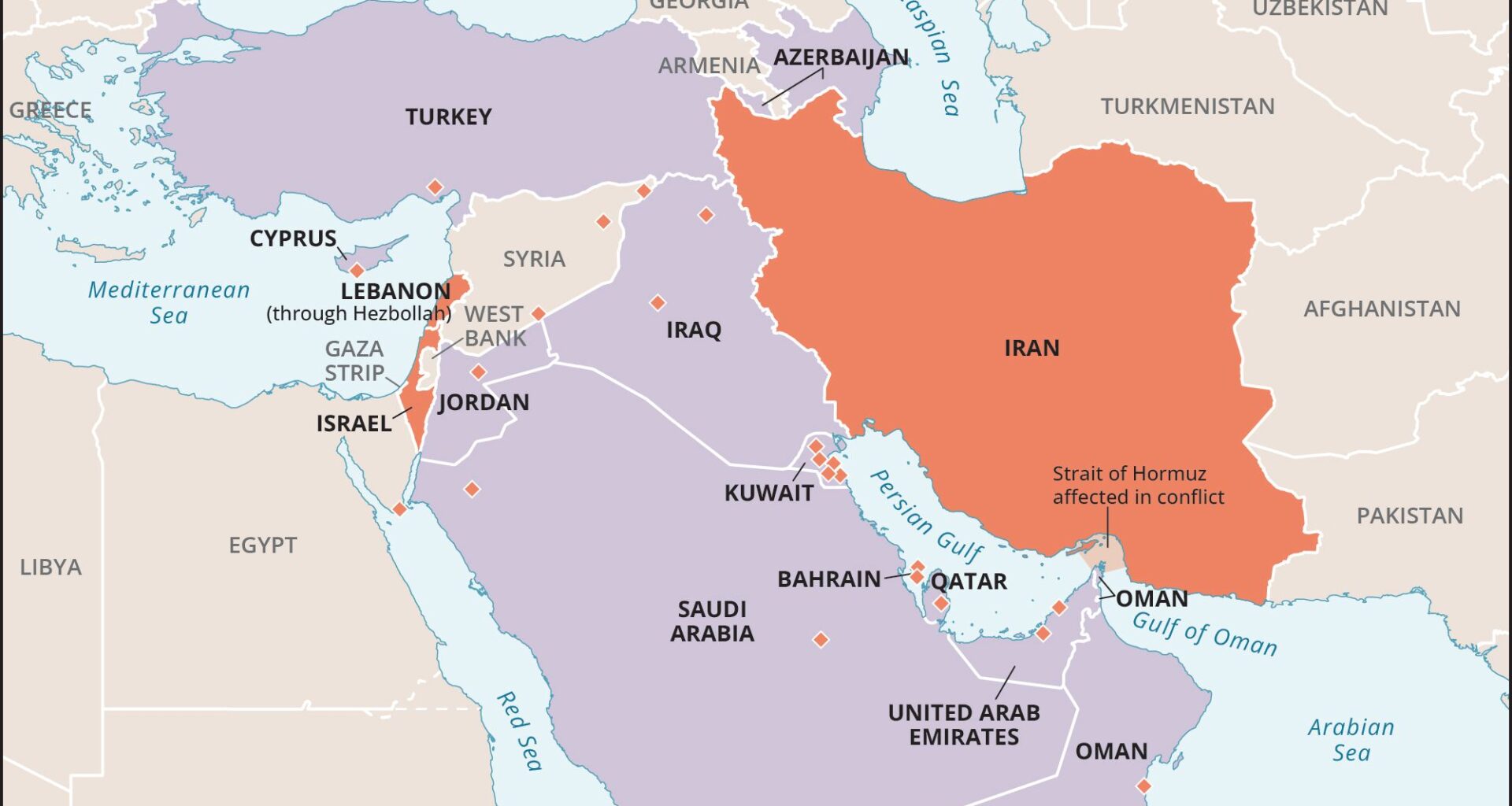
In response to the attacks by the United States and Israel on Iran on February 28, 2026, Iran launched retaliatory missile and drone strikes targeting U.S. embassies, military installations, and oil infrastructure (including vessels in the Strait of Hormuz) throughout the Middle East. Iran hoped its broad retaliation would exact costs and pressure its adversaries into mediation.
What was the global impact of the 2026 Iran war?
The 2026 Iran war disrupted global travel and trade, halted flights in and out of the Middle East, and led to shipping reroutes to avoid the Strait of Hormuz and the Red Sea.
2026 Iran war, conflict centered on Iran that was initiated by the United States and Israel on February 28, 2026, and has upended the dynamics of the Middle East. The opening salvo took out the heart of the Iranian regime, Supreme Leader Ali Khamenei, and triggered a torrent of hundreds of retaliatory missiles and thousands of drones from Iran across the region. The attacks have left enormous damage, thousands of people dead in Iran and Lebanon, dozens dead in Israel and the Gulf Arab states, and millions of people displaced in the region, including more than one-sixth of the population in Lebanon.
The confrontation took place after years of rising tension over Iran’s nuclear program, its ballistic missiles, and its military reach across the Middle East. Attempts to renegotiate a nuclear deal (after the collapse of the Joint Comprehensive Plan of Action [JCPOA]) in 2025 and 2026 were unsuccessful. Meanwhile, Iran’s posture was in a weakened state after years of sanctions, recent destabilizing protests, damage inflicted during the 12-day war with Israel in June 2025, and the diminished position of Iran’s allies during the Israel-Hamas War. Given Iran’s weakened position, the United States and Israel calculated that they had greater opportunity to advance their objectives through military means than by diplomatic means.
Conflict
Midmorning on February 28, U.S. and Israeli forces began conducting joint strikes on Iran, numbering nearly 900 in just the first 12 hours of what the United States dubbed Operation Epic Fury. The attacks targeted Iranian missiles and air defenses, other military infrastructure, and Iranian leadership. According to U.S. and Israeli officials, the timing of the initial attack was tied in part to the ability to target Ali Khamenei, Iran’s supreme leader, before he would go into hiding. Khamenei was killed in the first wave of strikes on February 28, as were dozens of other top Iranian officials. U.S. forces are also believed to have struck a girls’ school in a town east of Bandar Abbas, according to a preliminary investigation by the U.S. military, killing about 170 people while targeting adjacent buildings that belonged to an Islamic Revolutionary Guard Corps (IRGC) naval base.
Disrupting the regimeIsraeli strikes destroyed the building where Iran’s Assembly of Experts was expected on March 3, 2026, delaying Iran’s ability to select a new supreme leader after Ali Khamenei was killed.(more)
The United States gave contradictory signals as to whether it ultimately sought regime change. In the hours after the initial strikes, U.S. Pres. Donald Trump urged Iranians to “take over your government.” But a day later he indicated to The New York Times that he was open to an outcome similar to what took place after the U.S. capture of Nicolás Maduro in Venezuela, where the regime in Venezuela remained in place but began cooperating with U.S. demands.
On March 5, two days after an Israeli air strike designed to prevent Iran’s Assembly of Experts from meeting to choose a new leader, Trump told Axios that he wanted to be involved in choosing Khamenei’s successor and that he considered Khamenei’s son Mojtaba Khamenei “unacceptable” as Iran’s leader. Several days later, Iran’s cleric-led Assembly of Experts announced they had appointed Mojtaba Khamenei as supreme leader. Ali Larijani, a pragmatic senior official believed to have been the de facto leader of Iran after Ali Khamenei’s death—and a figure instrumental in advancing the JCPOA deal with the United States back in 2015—was killed on March 17. Larijani was replaced by Mohammad Bagher Zolghadr, an appointment that reflected the paramountcy of the IRGC over the political or clerical establishments in Iran’s wartime decision-making. The selection of both Mojtaba Khamenei and Zolghadr also indicated that the regime’s hard-liners were doubling down and further entrenching themselves in response to the hostilities.
The trusted destination for professionals, college students, and lifelong learners.



Meanwhile, retaliatory missile and drone strikes by Iran embroiled the region. They followed a familiar pattern of horizontal escalation, according to the international security scholar Robert A. Pape writing in Foreign Affairs. Iran’s strategy widened the arena of conflict, thereby extending the conflict beyond mere military might and into the political and economic realms, with the aim of withstanding bombardment until the conflict becomes too costly for the belligerents to maintain. Iranian strikes targeted U.S. embassies and military installations in the United Arab Emirates, Saudi Arabia, Qatar, Kuwait, Bahrain, Iraq, Oman, and Jordan. NATO forces struck down Iranian drones and missiles near the Incirlik Air Base in Turkey (Türkiye). Iranian attacks also targeted oil infrastructure in the region—including vessels in the Strait of Hormuz, through which 20 percent of the world’s oil passes—as well as commercial hubs in neighboring countries that aid the U.S. military. The disruption of oil flows out of the Persian Gulf quickly led to fuel shortages and rationing in parts of Asia east of the gulf, which rely heavily on oil supplied through the Strait of Hormuz, as well as a sharp increase in price in the global oil market. By late March officials in the IRGC suggested Iran may push its Houthi allies in Yemen to block Bab el-Mandeb Strait to disrupt shipping in the Red Sea and further strain global markets. It remained unclear whether the Houthi movement, which in 2025 had reached a ceasefire with the United States in relation to its attacks on Red Sea shipping, was willing to confront U.S. pressure directly, but on March 28 it launched missiles and drones toward Israel and opened a new front in the expanding regional conflict.
Conflict in Lebanon
The conflict also saw the resumption of hostilities between Israel and Iran’s close ally Hezbollah in Lebanon, which had been observing a fragile ceasefire since 2024. Despite the ceasefire, which required the disarmament of Hezbollah and the withdrawal of the Israel Defense Forces (IDF) from southern Lebanon, Hezbollah had been seeking to restore its military capabilities and the IDF had continued to strike targets in southern Lebanon almost daily. After the opening wave of attacks on Iran on February 28, the IDF conducted air strikes on Hezbollah’s infrastructure and warned the militant group against getting involved in the conflict with Iran. On March 2, Hezbollah launched missiles and drones into Israel, prompting an escalation in Israeli air strikes that reached north to southern Beirut. A drone believed to have been launched by Hezbollah also struck a base in Cyprus used by the British Royal Air Force. In the following days Israel issued sweeping evacuation orders across southern Lebanon, displacing more than 1,000,000 people by late March, as Israel prepared for a ground invasion.
A limited invasion began on March 17 amid reports that a broader ground offensive was likely. On March 24 Israeli minister of defense Israel Katz announced plans for the IDF to occupy southern Lebanon up to the Litani River, a swath of territory that the IDF had previously occupied in 1982 during the Lebanese Civil War (1975–90) until Israeli forces withdrew 2000.
Reactions and impact
The outbreak of conflict between three widely impactful countries led to a burst of reactions, ranging from anticipation to condemnation to confrontation. Many observers, including Iranians in the diaspora, hoped for the collapse of the oppressive Islamic Republic of Iran and a decisive end to its nuclear program and military reach. Within Iran, some Iranians celebrated Khamenei’s death while proponents of the regime mourned; security forces stepped up their presence in Tehran to crack down on celebrations and public dissent. Oman, which attempted to mediate negotiations between the United States and Iran, expressed disappointment that the “active and serious negotiations” were abandoned. Russia, Iran’s ally, condemned the U.S. and Israeli strikes as destabilizing but showed little interest in intervening on Iran’s behalf. Some countries questioned the legal basis of the initial U.S. and Israeli attack, while others urged Iran to show restraint in its response and condemned its attacks on its neighbors. Spain, a NATO member that had already squabbled with U.S. demands during the second Trump administration, refused to allow the United States to use its air bases, leading Trump to threaten to cut trade with the country.
The war had immediate impacts on global travel and trade. Flights in and out of the Middle East came to a near-complete stop, stranding residents, expatriates, and tourists alike, even as Iran struck the region’s most crowded cities and luxury hotels. When Dubai International Airport, one of the world’s busiest, was damaged by drone strikes during the second day of the conflict, it temporarily halted all flights and reopened in only a limited capacity a few days later. Shipping lines rerouted to avoid the Strait of Hormuz—even before Iran threatened to fire on ships passing through the strait—as well as the Red Sea, where the Iran-allied Houthi movement had previously attacked ships in response to the Israel-Hamas War.
Background 1953 coup in Iran: Protests in TehranIranian rioters armed with staves protesting against the coup, backed by the CIA and British intelligence, that overthrew the democratically elected Prime Minister Mohammad Mosaddegh, August 1953, Tehran.(more)
Relations between Iran and the United States have long been tense. The United States and Israel were both close allies with Iran’s government until the 1979 Islamic Revolution. But U.S. intervention in Iranian affairs became a sore spot for Iranians, particularly after U.S. involvement in the 1953 coup d’état propped up the unpopular Pahlavi monarchy. When the revolution took place, the revolutionaries blamed the United States and Israel for the region’s greatest grievances. The Iran hostage crisis only served to heighten tensions.
Matters escalated significantly in the early 2000s when Iran was revealed to have a suspiciously secret nuclear program and, as U.S.-led forces toppled the regime of Saddam Hussein in Iraq that fiercely opposed Iranian expansion, Iran expanded its reach across the region (see Axis of Resistance). Efforts to contain Iran diplomatically proved fragile, especially after 2018, when the United States withdrew from the 2015 JCPOA.
In 2024, during the Israel-Hamas War, Israel significantly diminished Iran’s reach in the Middle East, tipping the regional balance of power in Israel’s favor. Most notably, Israel decapitated Iran’s close ally Hezbollah in Lebanon in September–November, which in turn facilitated Ahmed al-Sharaa’s toppling of pro-Iran Syrian Pres. Bashar al-Assad in December. Meanwhile, direct exchange of fire between Israel and Iran in April and in October exposed vulnerabilities in Iran’s air defenses and damaged some of Iran’s key military assets.
The 12-Day War in June 2025 was the first test of open conflict between the two Middle East powers. Israel quickly debilitated Iran’s air defenses and caused significant damage to Iran’s military and nuclear infrastructure. The conflict ended after the United States struck underground nuclear facilities in Fordow, Natanz, and Isfahan using U.S. GBU-57 A/B “bunker buster” bombs, an operation that Trump said was intended to be a limited, one-off mission. A preliminary, low-confidence report from the U.S. Defense Intelligence Agency—in what the Trump administration characterized as a “political” leak to the press—assessed that Iran had moved much of its stockpile of enriched uranium before the U.S. strikes took place and that the strikes, which did not collapse the underground facilities according to the report, set back Iran’s ability to produce nuclear weapons by only a matter of months. The following day John Ratcliffe, the director of the CIA, said new information indicated severe damage to the nuclear facilities that would take years for Iran to rebuild.
Quick Facts
Date:
February 28, 2026 – present
(Show more)
In the aftermath of the 12-Day War, Iran’s currency entered a free fall, exacerbated by the imposition in September of new international sanctions. The economic spiral led to the outbreak of protests on December 28, 2025, which, at the encouragement of the United States, spread in January 2026 across Iran (see 2026 Iranian protests). Trump threatened U.S. intervention if Iranian security forces killed protesters. Nevertheless, on January 8 security forces unleashed a brutal crackdown, killing at least 30,000 people, according to officials in Iran’s Ministry of Health. In the weeks that followed, the United States undertook its largest military buildup in the Middle East since its 2003 invasion of Iraq.