
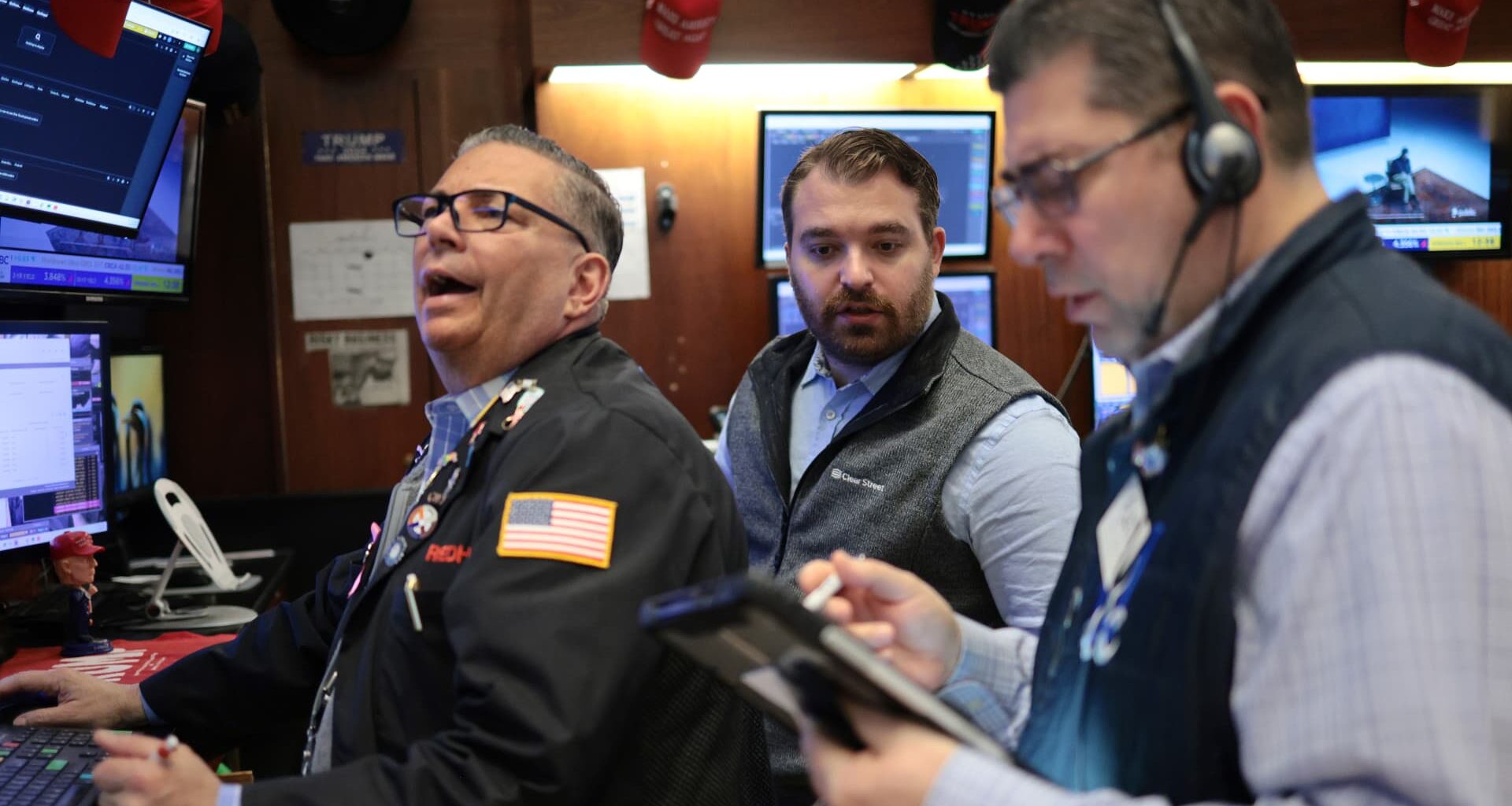
Traders work on the floor of the New York Stock Exchange during morning trading on March 30, 2026 in New York City.
Michael M. Santiago | Getty Images
U.S. stock futures fell on Wednesday night after President Donald Trump indicated that the Iran war would continue.
S&P 500 futures declined 0.8%, and Nasdaq 100 futures lost 1%. Futures tied to the Dow Jones Industrial Average slid 352 points, or about 0.8%.
Trump delivered an address Wednesday night, providing updates on the Middle East conflict. Though he said that the U.S. is “getting very close” to ending the Iran war, Trump added that the nation would “hit” Tehran “extremely hard.”
“Over the next two to three weeks, we’re going to bring them back to the stone ages where they belong,” the president said.
Stock futures slid during the speech, and oil prices surged. West Texas Intermediate crude futures were last up 3.5% at more than $103 a barrel, while Brent crude futures advanced more than 4% to top $105. At one point in the evening, Brent briefly hit $106 a barrel.
All three major indexes advanced in regular trading Wednesday, as investors became more optimistic that the end of the U.S.-Iran war was in sight. The S&P 500 and Nasdaq Composite respectively gained 0.72% and 1.16%. The Dow rose 224.23 points, or 0.48%.
In a Truth Social post on Wednesday morning, Trump said that Iran’s president had asked the U.S. for a ceasefire. However, Trump said that the U.S. would only “consider” the offer once the Straight of Hormuz was “open, free, and clear.”
The announcement came after the president told reporters at the White House on Tuesday afternoon that he expects U.S. military forces will leave Iran in “two or three weeks.”
“We don’t know how long this is going to last, but as market participants we need to understand the damage that has already been done,” Sebastien Page, head of global multi-asset and CIO at T. Rowe Price, said on CNBC’s “Closing Bell: Overtime” on Wednesday afternoon. “I don’t think we stabilize quickly back to normal levels of inflation. It’s a slow-moving macroeconomic chain.”
“You have this background of still a robust economy, but you have to worry you’re on the knife’s edge for a growth shock,” Page added.
Thursday marks the last trading day of the shortened week, as markets are closed for Good Friday. On Thursday morning traders will watch out for initial jobless claims for the week ending March 28, while March’s jobs report is set for release on Friday morning.
—CNBC’s Spencer Kimball contributed reporting.