
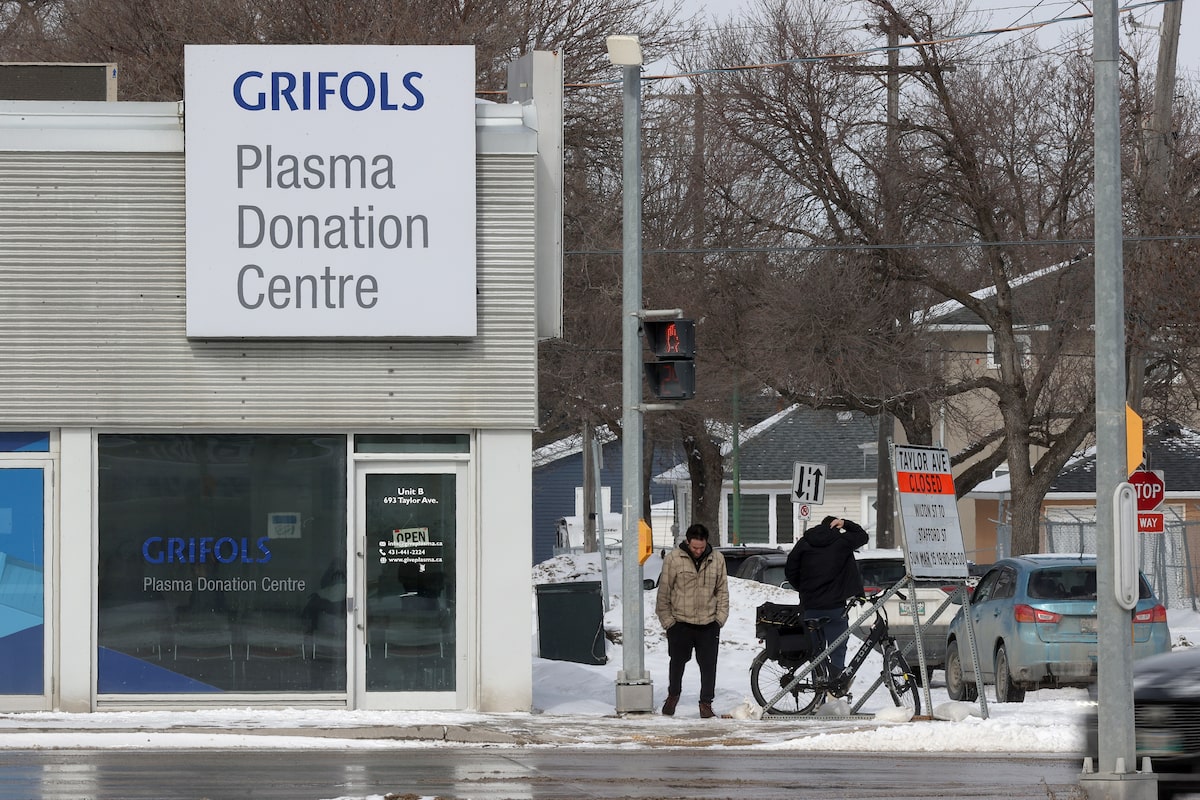
A Grifols Plasma Donation Centre in Winnipeg on March 13. Grifols’ two sites in Winnipeg, where two recent deaths occurred, have been found non-compliant after Health Canada inspections.Shannon VanRaes/The Globe and Mail
Health Canada is imposing new terms and conditions on the licences of Grifols, Canada’s only major commercial collector of blood plasma, after two people died following donations in recent months.
The regulator said inspectors had observed “recurring, systemic deficiencies across several sites” and that 16 Grifols centres must immediately reduce the number of appointments per hour, better supervise new staff and improve donor records.
The head office of those 16 centres is in Oakville, Ont. Health Canada said Wednesday it conducted an inspection at the head office because it oversees the national system, although Grifols does not collect any plasma at that location.
Grifols has a 17th location that is registered under a separate licence. Although that location is in Winnipeg and was the site of a donation in January that preceded a death, it was not clear Wednesday night if that location was also subject to the new terms and conditions.
Grifols donors not informed their plasma is used for drugs sold overseas, MPs hear
Grifols, which is headquartered in Barcelona and also manufactures pharmaceutical products, operates in Canada as part of a partnership with Canadian Blood Services, a government-funded charity that does not pay donors and operates the nation’s blood system everywhere but Quebec.
CBS has designated Grifols its “agent” for the purposes of circumventing a ban on paying plasma donors in Ontario, where Grifols has opened five collection centres since 2022 that pay donors. Paying for blood donations is also banned in B.C. and Quebec.
Plasma is a straw-coloured fluid found in blood that can be donated separately and is used most often for manufacturing medicines, such as for patients with immune deficiencies.
CBS advises plasma donors to leave at least six days between donations, whereas Grifols encourages donors to visit twice a week if they pass health screenings.
At Grifols centres, donors are paid between $30 and $100 a donation, depending on the volume and frequency of donation. They are also paid $50 bonuses for donating 10 times within six weeks and $100 bonuses for donating 100 times within a calendar year.
Health Canada said the recent inspections were prompted by the deaths following donations in Winnipeg. However, it has not released any specific details about what happened on the days the donors died.
Mary Hughes, Grifols’ vice-president of commercial operations and sales in Canada, testified at the House of Commons health committee that there was “no correlation between death and plasma collection.” She did not provide specific details about the Winnipeg deaths.
Neither Grifols nor CBS responded to a request for comment Wednesday night.
Grifols locations will continue to operate, though the federal department said it will take further action if necessary.
“Health Canada has required corrective actions from Grifols, and will continue to closely monitor progress of the implementation of corrective actions,” spokesperson Mark Johnson said in an e-mail.
“Establishments that fail to comply may be subject to further enforcement.”
The Canadian Health Coalition, a public health advocacy group, said Health Canada’s concerns support the group’s calls for Grifols to end operations in Canada.
“The secret 15-year contract that the Canadian Blood Services signed with this giant for-profit multinational should be cancelled and plasma collection should revert to the regulated, public, not-for-profit Canadian Blood Services,” spokesperson Anne Lagacé Dowson said.
The House of Commons health committee has ordered Grifols and CBS to turn over a copy of their agreement, which has not previously been made public, by April 10.
Grifols is also facing a lawsuit from another donor in Winnipeg who alleges they got an acute kidney injury after a donation machine malfunctioned. Grifols has said in court documents that the donor had been made aware of the risks of the procedure.