
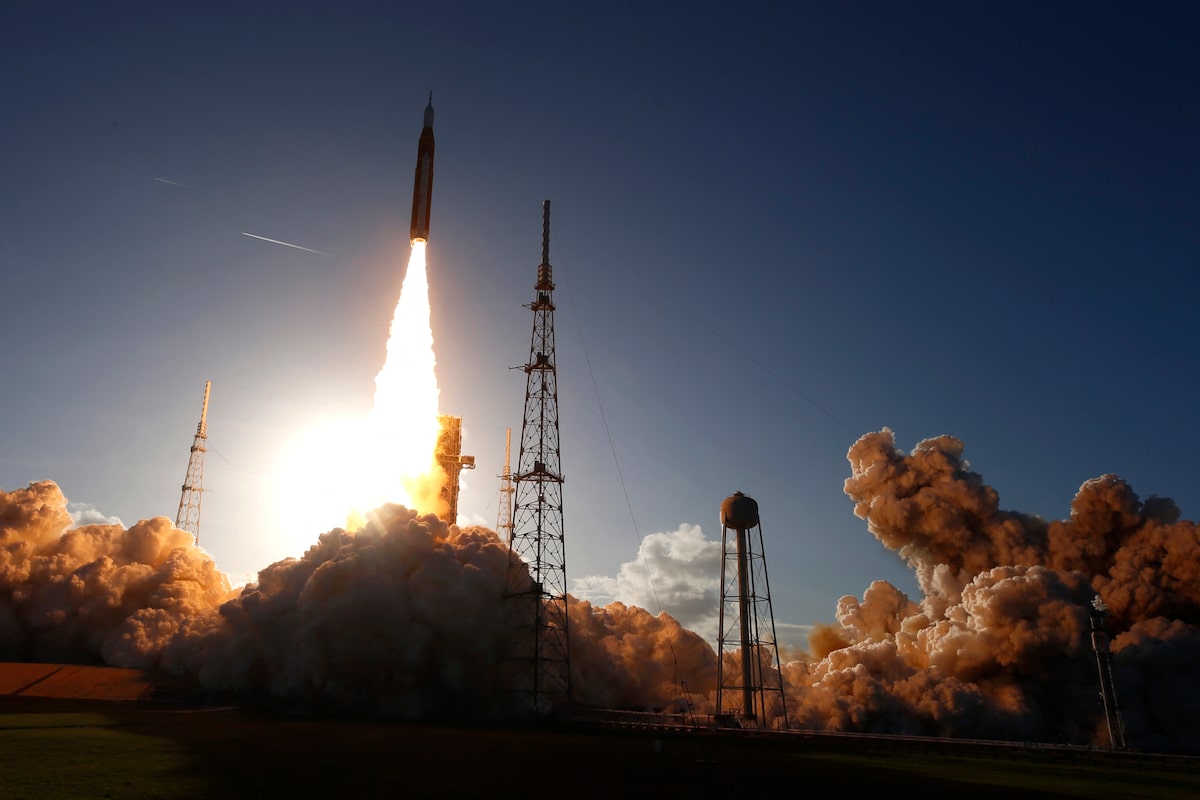
NASA’s Artemis II mission, comprising of the Space Launch System (SLS) rocket with the Orion crew capsule, lifts off from the Kennedy Space Center in Cape Canaveral, Fla.Joe Skipper/Reuters
Jeremy Hansen’s journey to the moon has begun.
Seventeen years after he was named an astronaut with the Canadian Space Agency, Colonel Hansen is in space for the first time and swiftly heading towards the journey of a lifetime.
And while the itinerary does not include a moon landing, it is the opening act that sets the stage for precisely that.
The Artemis II test flight, marking the first time that humans have travelled beyond low Earth orbit in more than 50 years – and the first time ever for any non-American – lifted off from NASA’s Kennedy Space Center in Florida at 6:35 p.m. ET on Wednesday.
The intense glare of the rocket’s powerful exhaust made for a striking sight as it roared upward into a clear blue sky brightly illuminated by the setting sun. The rocket then arced eastward, pushing its crew toward outer space with increasing speed and remained visible as a glowing spark that persisted for more than three minutes before receding from view.
Main engine cutoff came about eight minutes later, by which time the four astronauts on board – Reid Wiseman, Victor Glover, Christina Koch and Col. Hansen – had travelled halfway around the world.
“This is Jeremy, we are go for all humanity,” Col. Hansen declared a short time earlier when the crew made their final comments to launch director Charlie Blackwell-Thompson before taking flight.
Soon after liftoff, control for the mission was handed off to the Johnson Space Center in Houston.
With the launch behind them, the crew began a busy first day in space, shedding the space suits and working their way through a long to-do list of systems checks that includes a manoeuvring test of their Orion crew capsule under human control.
The mission is the first to fly humans on Orion, a NASA spacecraft intended for deep-space operations. An earlier mission, Artemis I, was launched with an empty crew capsule in 2022.
NASA’s Artemis II mission soars into the sky from the Kennedy Space Center.Joe Skipper/Reuters
A key objective for the mission is testing Orion’s life-support systems and environmental controls. This is expected to continue while the crew makes a long second orbit that will take them about 70,000 kilometres from Earth over a 24-hour period.
They will then come plunging back for a close pass of the planet. At that point an engine burn is scheduled to send them on a long looping trajectory around the moon over the next several days.
During a post-launch press briefing, mission managers noted a few anomalies that had arisen in the first hours of flight that were still being investigated and worked on by engineering teams. One was a temporary communications failure during which the crew could hear ground controllers but their responses were not being heard on the ground.
The day leading up to the launch proceeded with very few hitches, particularly when the 98-metre-tall SLS rocket was being loaded with liquid hydrogen and oxygen fuel. The fuelling, which began about 7:45 a.m., was accomplished in good time with no indication of the hydrogen leaks that had plagued a dress rehearsal earlier this year and delayed the launch to April.
“Today it’s gone smoothly well – strangely, smoothly well,” said Canadian astronaut John Kutryk, who spent much of the day at the Space Center explaining to media what was taking place as preparations for launch got under way.
How Canada came to be part of Artemis II’s historic mission to the moon
Earlier in the day, Col. Hansen and the rest of the crew donned their space suits and were driven out to the rocket on a road lined with well-wishers. They were sealed into their capsule by late afternoon. At that point, some of the cloud cover that had built up over the day was being driven away by shoreward winds.
By the time of launch, the weather outlook had improved to 90-per-cent favourable for a launch during the two-hour window that opened at 6:24 p.m. As it turned out, launch controllers did not need nearly that long and the final sprint to launch unfolded quickly.
NASA officials regard Artemis II as crucial for the success of the broader Artemis program, which includes an ambitious schedule of follow-up missions, including a moon landing by 2028.
Canadian Space Agency astronaut Jeremy Hansen will be the first Canadian to fly beyond low Earth orbit. Hansen explains the stages of the Artemis II, a mission that will fly astronauts around the Moon’s far side.
“When some of those pictures start coming back from the moon that’s going to further bring people into this story,” NASA’s administrator Jared Isaacman said during the briefing.
Lisa Campbell, president of the Canadian Space Agency, said: “Humanity is returning to the moon to stay. This opens up huge opportunities for Canada and the world.”
The public attention that has been paid to the mission underscores how challenging it has been for the U.S. space agency and its partners to mount a long-term lunar program in the 21st century, more than 50 years after Apollo astronauts planted the first steps on the moon’s surface.
While thousands of rockets have taken off from the Florida coast, only nine of them – Apollo 8 and then Apollo 10 through 17 – have sent people out to the moon. Artemis II now aims to make it 10.
The flight carries historic significance for Canada’s space program, which has never before sent an astronaut into deep space.
Artemis II is also the first flight by any Canadian Space Agency astronaut in nearly seven years – an unusually long gap in the program’s history. Only the interval between Marc Garneau’s first shuttle flight in 1984 and Roberta Bondar’s in 1992 compares.
In addition to Col. Kutryk, many former members of Canada’s astronaut corps journeyed to Florida in support of Col. Hansen’s launch, including Steve MacLean, Julie Payette, Robert Thirsk and Dafydd Williams.
All were present at a Canadian Space Agency reception on Tuesday evening.
Also among the attendees were Col. Hansen’s parents, who had earlier met with their son behind a quarantine glass to wish him well before his flight.
“We are so proud,” Nancy Hansen told The Globe and Mail. She said she had used the occasion to remind him what a tremendous achievement it was to have been selected for the mission.
In response, Col. Hansen told his mother that he was proud of Canada and its achievements, a sentiment he repeated in a social-media post a few hours ahead of launch.
Ms. Hansen said she then told her son, “Yes it’s about Canada, but it’s also about you Jeremy.”
To which Col. Hansen responded, “Okay, mom.”