
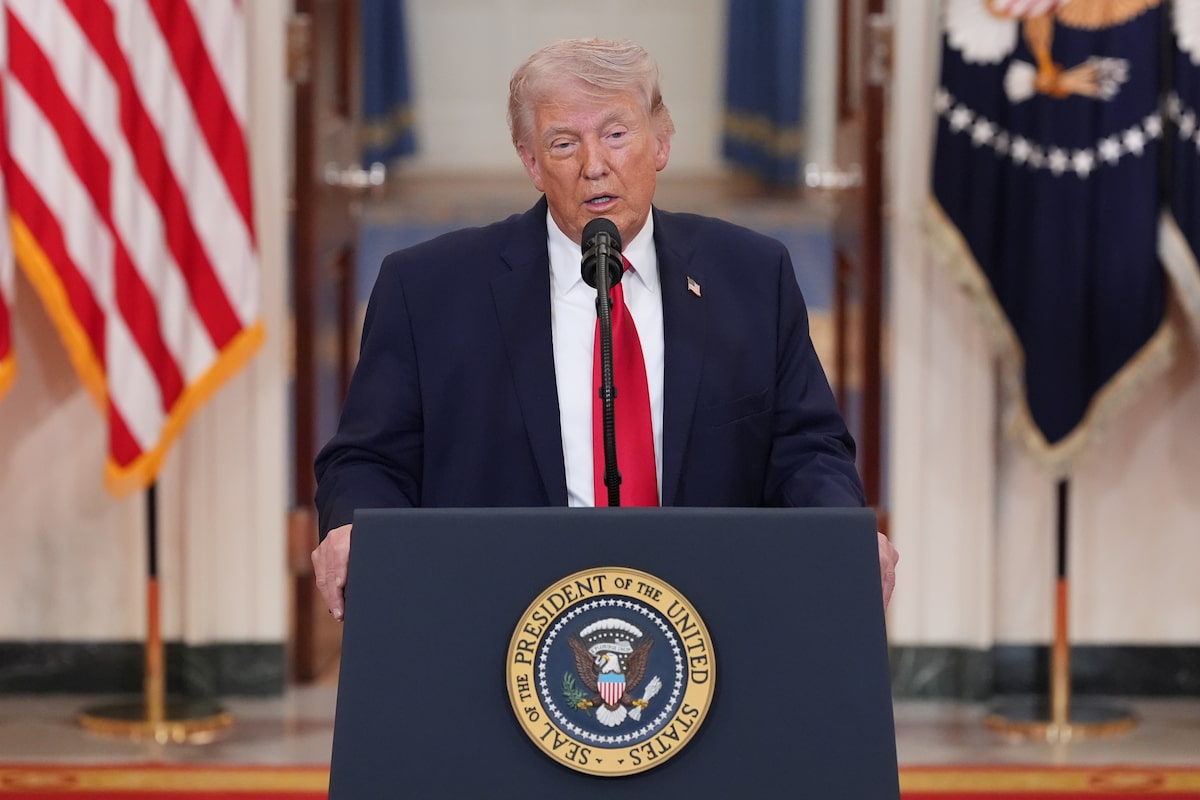
President Donald Trump speaks about the Iran war from the Cross Hall of the White House on Wednesday.Alex Brandon/The Associated Press
U.S. President Donald Trump said Wednesday night that the war on Iran will continue for another two or three weeks and threatened to destroy the country’s electrical power plants if its leaders do not make a deal with him – but also suggested that he might simply walk away from the conflict and leave other countries to find a way to end Tehran’s blockade of oil shipments through the Strait of Hormuz.
Mr. Trump used a White House address to deliver these seemingly contradictory messages in the face of a mounting global economic crisis that has already seen petroleum shortages drive up gasoline prices, with the cost of food expected to spike in the coming months.
While the President had been expected to announce either an end to the unpopular war or a ground invasion to reopen the strait, he did neither, opting instead to continue the uncertainty over the conflict’s purpose and the lack of any discernible plan to finish it, which have so far marked his initiation and handling of the month-long fight.
“We are on track to complete all of America’s military objectives shortly, very shortly. We are going to hit them extremely hard over the next two to three weeks. We are going to bring them back to the Stone Ages where they belong,” Mr. Trump said as he stood behind a podium.
Gulf allies privately urge Trump to continue war until Iran is decisively defeated
The President insisted that his country was “winning bigger than ever before” on the battlefield and that “never in the history of warfare” had anyone suffered as many losses as quickly as Iran has.
He also threatened to blow up all of Iran’s electrical plants “simultaneously” if the Islamic theocracy doesn’t reach an agreement with the U.S., an act that could be considered deliberate collective punishment of the civilian population and against the rules of war.
Mr. Trump attempted to deflect blame for the conflict’s driving up of gas prices by insisting that other countries should take responsibility for reopening the Strait of Hormuz. He has repeatedly threatened U.S. allies economically and militarily since returning to office last year and did not seek to build support among them – aside from Israel, which attacked Iran simultaneously with the U.S. – before starting the war.
Cargo ships in the Gulf, near the Strait of Hormuz, are seen from northern Ras al-Khaimah, near the border with Oman.Stringer/Reuters
“The countries of the world that do receive oil through the Hormuz Strait must take care of that passage, they must cherish it, they must grab it and cherish it,” he said Wednesday. “Just take it.”
A moment later, however, he insisted that “the Strait will open up naturally, it will just open up naturally” and the oil “will resume the flowing” as soon as the war ends.
The President also said that he had achieved “regime change” in Iran by killing the country’s long-time supreme leader, Ayatollah Ali Khamenei, and many of his top subordinates. He said those who had replaced them were a “new group” that is “less radical and much more reasonable.” The country’s new supreme leader is Mojtaba Khamenei, the son of the previous leader, and its president, Masoud Pezeshkian, has been in office since well before the war.
The President has repeatedly shifted his publicly stated goals and reason for going to war.
Initially, he said his aim was to overthrow the regime in Tehran before dropping that idea. He has also said the purpose was to destroy the country’s nuclear program despite previously insisting it had been “obliterated” in U.S. and Israeli air strikes last year. More broadly, he said Wednesday, the goal was to degrade Iran’s military capabilities to stop it threatening Israel.
Early in the war, Secretary of State Marco Rubio suggested that the U.S. had been forced into the conflict by Israel − before retracting the claim in the face of public backlash.
One month in, most Israelis still support the war on Iran, new poll shows
The Iranian regime has so far remained in place and retained military capabilities. It has retaliated with missile and drone attacks against a dozen countries, hitting U.S. military bases in the region, on top of shutting down the strait.
The war has killed thousands of people in Iran, plus 15 U.S. and 11 Israeli soldiers, and wounded hundreds more. One missile strike left 175 people dead at a girl’s elementary school in Iran. U.S. media, citing unnamed government sources, said preliminary investigation by the American military suggests that U.S. forces were responsible for destroying the school.
A woman sits on rubble across from a residential building damaged during the U.S.-Israeli air campaign in Tehran.Vahid Salemi/The Associated Press
In recent days, Mr. Trump has vacillated between escalating the war and seeking a negotiated way out. The U.S. has sent additional troops to the region in preparation for a prospective ground invasion, potentially to seize Iran’s main petroleum export facility on Kharg Island.
He has also, however, said that his administration is in talks with the Iranian regime to end the war, which Iran has repeatedly denied.
In a lengthy open letter Wednesday, Mr. Pezeshkian pointed out that Iran had a negotiated agreement limiting its nuclear program, which Mr. Trump cancelled in his previous presidential term. Both last year and this year, he said, Iran was in negotiations with the U.S. when Mr. Trump decided to launch surprise attacks, making Tehran hesitant to negotiate again.
Mr. Trump has become increasingly frustrated that none of the U.S.’s allies other than Israel has joined in the war. This week, he threatened to pull the U.S. out of the NATO defence alliance.
He returned to power last year on promises to end foreign wars and lower consumer prices and is now under intensifying domestic pressure over his decision to do the opposite. In a Reuters/Ipsos poll last week, just 35 per cent of respondents agreed with Mr. Trump’s decision to launch the conflict.
Gasoline prices in the U.S. have risen some 30 per cent since the start of the war, further driving consumer worries over affordability that have been the country’s dominant political issue.