
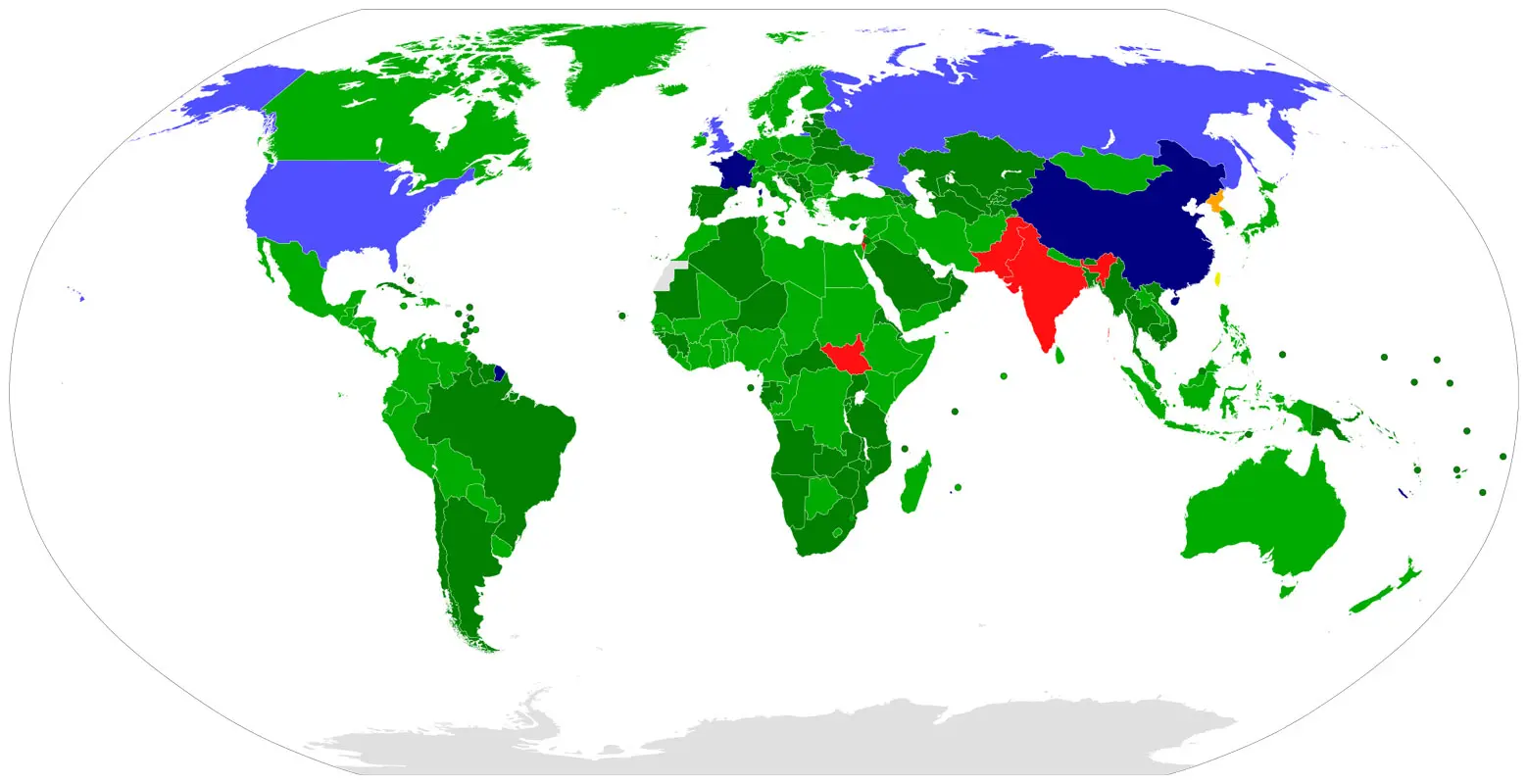
 Participation in the Nuclear Non-Proliferation Treaty. Countries in red or orange are non-members.
When President Trump withdrew the United States from the Joint Comprehensive Plan of Action in 2018, he cracked the brittle foundation of the global nonproliferation regime based on the 1970 Non-Proliferation Treaty (NPT). This was not seen clearly at the time, so its implications could not be fully addressed. Now the ramifications are becoming clearer: The war on Iran raises doubt that the NPT can be a central pillar of international security. If not, will more countries seek nuclear weapons, including US allies or friends? And will China and Russia be emboldened to follow the US-Israeli example to forcibly try to stop them?
The US and Israeli leaders who pushed withdrawal from the JCPOA, including President Trump, did not know or care much about the NPT. Israel saw the Iranian nuclear program as an ipso facto direct threat, not as something that could be managed through the treaty’s core bargains. Those bargains posited that states that already had nuclear weapons as of 1967—the United States and Russia, most importantly—would reward states that forego such weapons. The non-nuclear-weapon states would gain security, cooperation in civil nuclear energy development, and progress toward the equity of global nuclear disarmament.
Iran’s relationship with the NPT has always been somewhat tortured. After the CIA helped overthrow the Mossadegh government in 1953, the Shah’s regime became the United States’ leading ally in the Persian Gulf. Iran duly signed the NPT, but the Shah also had ambitions for a big nuclear energy program that made little economic sense at the time. Then came the revolution in 1978 and the hostage crisis in 1979, followed by Saddam Hussein’s invasion of Iran in 1980. That war lasted until 1988 and killed at least 500,000 total, with many more wounded.[1] The United States, the Soviet Union, France, and the United Kingdom helped Saddam. America assisted in targeting chemical weapons on Iranian cities.[2] It was then, according to later IAEA investigations, that Iranian leaders secretly initiated work on uranium enrichment to produce an option to make nuclear weapons if Iran ever again faced a threat of massive aggression. The US, Soviet, British, and French collusion with Iraq in the war violated the spirt of the NPT security bargain, as did Iran’s hedging pursuit of weapon capability. The covert nature of Iran’s subsequent work violated the country’s safeguards agreement with the IAEA. There are no saints in this history.
In the early 1990s, Iran resumed work on nuclear energy production that had been interrupted by the war. The United States and Israel sought to block the program. Russia stepped in to help Iran, despite periodic revelations about covert or illicit Iranian nuclear activity. Years of negotiation followed between Iran and the United States, Russia, the United Kingdom, France, Germany and the European Union over the permissible scope of Iran’s nuclear program. These talks were periodically interrupted by Iranian provocations or Israeli and US efforts to disrupt the program. The parties searched for a way to balance and reconcile all sides’ interests in security, nuclear energy, and nonproliferation (as well as disarmament, at least in the early years of the Obama administration). This ultimately led to the JCPOA in 2015.
Today it is clear that when the United States broke the JCPOA, Iran was condemned to a fate like Iraq’s in 2003. Objectives beyond nuclear proliferation became decisive for powerful actors in Washington, Israel, and the Gulf. Regime change. Reducing threats to the United States’ oil-exporting Arab friends and Israel. Countering terrorism. The JCPOA had “solved” the nuclear issue within the framework of the NPT bargains, but it did not address these other issues.
The massively horrific Hamas terror attack on Israel in October 2023 pushed the NPT framework further aside. Israel launched its inhumane war on Palestinians in Gaza, then attacked factions in Lebanon and other countries that supported Hamas. Israel also conducted multiple attacks on Iranian military figures and others involved in working with anti-Israel militants. The Iran “problem” – for all sides – clearly was not soluble within the NPT framework.
Now that Prime Minister Netanyahu and President Trump have attacked Iran without regard for international law or Iran’s rights under the NPT (and the UN-supported JCPOA), many commentators say nuclear weapon proliferation will be more likely. They say, the “lesson” of Iran today, like that of Iraq, Libya, and Ukraine—contrasted with North Korea—is that a country should acquire nuclear weapons if it doesn’t want to be attacked by a big nuclear power.
On the surface, this lesson makes sense. But dig a bit and each case becomes more complicated. Libya had no ability to make nuclear weapons. North Korea acquired weapon-usable plutonium before it could be detected, so it would have been much harder to stop. More important, Seoul is close enough that if the United States or anyone else had tried to attack North Korea, most of South Korea’s population could have been devastated with conventional or with nuclear weapons. Ukraine in the early 1990s had no choice but to transfer the weapons on its territory back to Russia, and if it had tried to keep them, Russia plausibly would have attacked and taken them away.
A clearer and more accurate lesson from Iran is that if you are an adversary of the United States or Israel, and you seek nuclear weapons, you will be sanctioned, sabotaged, and ultimately bombed or otherwise killed. You will be prevented from acquiring a survivable, useful nuclear deterrent, at great cost to your people. For the United States, Israel and their close Western partners, more immediate security and political interests trump the NPT bargain.
But what about friends or semi-friends of the United States such as South Korea, Japan, Poland, Germany, and Turkey that may seek nuclear weapons to deter Russia, China, or North Korea? Does the Iran lesson about force-versus-bargaining apply to them and their big-power foes?
More than worrying that the United States will attack, these states worry America won’t fight on their behalf if someone else attacks them. More immediately, they must wonder whether the United States will lead efforts to sanction them if they hedge on or seek to withdraw from the NPT. If China sought to coerce South Korea or Japan by denying access to rare earths or the Chinese market, would the United States rally to their side or shrug? If Russia sabotaged German or Polish infrastructure or murdered their scientists and engineers, what would Washington do? Do NPT-based rules and bargains frame and guide policy anymore, or is it all ad hoc and dependent on whom you know and pay off?
All of this highlights the shakiness of the NPT as an organizing construct for managing security, nuclear energy, and nonproliferation going forward. If nuclear-weapon states have clearly abandoned their commitments under Article VI of the NPT to cease arms racing and pursue nuclear disarmament, and nuclear-armed states have attacked other non-nuclear countries in violation of international law, why wouldn’t more countries feel justified to seek their own nuclear deterrents? If powerful countries have made trade and security accommodations for nuclear-armed India, how should others seek to apply limits on nuclear fuel-cycle activities?
The long negotiations that led to the JCPOA were premised on the idea that by foregoing nuclear weapons Iran would reap benefits from the few states that have them. This included hard-won toleration of a heavily regulated and monitored enrichment program that was Iran’s leverage against anyone who would break the deal.
More than threatening the NPT, the US-Israel war on Iran has removed bargaining from adversarial international relations more broadly. Washington and Tel Aviv demand that Iran stop all fuel-cycle activity, surrender all enriched uranium and ballistic missiles, end clerical rule, disarm the Revolutionary Guard, and cease supporting other regional actors that threaten Israel. The American and Israeli governments offer Iran no immediate or near-term benefits in response, except the possible end of military attacks and vague promises of Western corporate investment to help revive the Iranian economy. Essentially, the demand is for unconditional surrender. This is a different model of international affairs than the NPT was predicated on.
It is impossible to predict how all this will turn out, what the future of Iran and of the Middle East will be. As leading states move away from genuine give-and-take bargaining, will people around the world feel increasingly less secure or more? Will the lack of negotiated adjustment and reconciliation of competing interests lead more states to seek nuclear weapons? Will the most capable war-fighting countries be more inclined to tolerate such proliferation or to fight it? Will they fight each other over these matters? These questions were supposed to be settled under the NPT and then its offshoot – the JCPOA. The Iran war paired with the Ukraine war arguably leaves them less settled than ever.
Notes
[1] https://www.britannica.com/event/Iran-Iraq-War
[2] https://www.latimes.com/archives/la-xpm-1998-feb-16-mn-19796-story.html; https://www.npr.org/sections/thetwo-way/2013/08/26/215733981/new-details-on-how-u-s-helped-saddam-as-he-gassed-iran#:~:text=U.S.%20intelligence%20officials%20conveyed%20the,%2C%20or%20to%20protect%20them.%22