
Josef Olmert”
post_date=”April 02, 2026 06:55″
pUrl=”https://www.fairobserver.com/world-news/middle-east-news/fo-talks-will-trump-and-netanyahu-accept-irans-demands-as-peace-talks-begin/” pid=”161612″
post-content=”
Editor-in-Chief Atul Singh and Josef Olmert, a former Israeli government official and Middle East scholar, discuss the evolving war involving Iran, Israel and the United States. Nearly a month into the conflict at this point, they assess battlefield realities, the politics of perception and the fragile prospects for negotiation. They raise a core question: Even if Iran’s military capabilities are degraded, does that translate into strategic victory? And if so, for whom?
Military dominance and the limits of victory
Olmert begins with a stark assessment of the battlefield balance. Iran’s conventional military capacity has suffered severe damage, particularly in the air and at sea. “It’s a major, major defeat to the Iranians,” he says, pointing to the destruction of naval assets and the absence of effective air cover. Without those capabilities, he contends, Iranian ground forces cannot alter the strategic equation.
Singh presses him on whether military degradation alone determines the outcome. After all, Iran continues to launch missiles and project resilience. Olmert makes a crucial distinction between material losses and political meaning. Olmert emphasizes that victory is interpreted differently across cultures. From a Western strategic perspective, he suggests, the loss of command structures and military infrastructure signals defeat. Yet the Iranian capital of Tehran can claim success simply by surviving and continuing limited strikes.
This difference means the two sides are judging the war by different standards. As long as Iran continues to resist and avoids collapse, it can tell audiences at home and across the region that it is still standing firm. That makes it more difficult for the US or Israel to claim a clear-cut victory, even if they have done more damage militarily.
The Strait of Hormuz and global leverage
The conversation then shifts to the economic and geopolitical stakes surrounding the Strait of Hormuz. Singh underscores the chokepoint’s significance: A substantial share of global energy, fertilizers and critical materials moves through the Gulf. Any disruption reverberates across Asia, Africa and Europe, raising inflation and questioning American credibility as a security guarantor.
Iran’s strategy of threatening shipping is predictable but risky. Olmert argues that Tehran is attempting to extract geopolitical leverage by challenging freedom of navigation, though superior military power will eventually counter this strategy. Regardless, the very existence of the disruption strengthens Iran’s narrative that the war is not settled.
The Strait thus becomes both a military and symbolic battleground. If shipping remains threatened, Iran can claim leverage despite battlefield setbacks. Conversely, reopening the corridor becomes a political necessity for Washington. The economic stakes, therefore, underline the same point: How the war is interpreted does not necessarily match what is happening on the ground.
Political pressures in Washington and Jerusalem
Singh and Olmert also examine domestic constraints on leadership. Olmert says that time may favor Iran politically, even if it does not militarily. “[US President] Trump doesn’t have a limitless amount of time,” he notes, pointing to electoral pressures and public opinion. A prolonged conflict risks eroding American support, especially if the people do not see any concrete results from it.
Israeli Prime Minister Benjamin Netanyahu faces his own difficulties. Singh highlights Israeli public fatigue from continued missile threats and political controversies at home. Olmert agrees that Netanyahu is under pressure, though he believes Israel’s military achievements give him room to maneuver.
As a result, the political window is narrowing. Both leaders must demonstrate success without allowing the conflict to escalate out of control. This dynamic reinforces incentives for negotiation — but also for continued pressure to improve bargaining positions.
Negotiations and uncertainty about authority
Reports of potential talks, including mediation efforts by Pakistan, complicate the situation. Olmert questions whether negotiators on either side possess real authority. Iranian representatives may not fully control decision-making, especially amid leadership uncertainty. On the American side, internal divisions within the administration complicate strategy.
Israel, meanwhile, is not formally at the negotiating table but influences outcomes through continued military operations. Singh characterizes this as a “veto on the ground,” shaping conditions for diplomacy. Olmert agrees that Israeli actions will help determine whether any agreement emerges.
Despite discussion of a potential multi-point framework restricting nuclear activity and missile capabilities, Olmert remains cautious. He estimates the chances of success at less than even odds: “I would give it only 49%.”
Survival, escalation and possible outcomes
Singh and Olmert conclude with competing scenarios. Iran could capitulate, negotiations could succeed or escalation could continue. All parties have incentives to push further: Israel to degrade Iranian capabilities, the US to secure the Strait of Hormuz and Iran to maintain leverage through resilience.
Olmert ultimately argues that the Iranian regime’s primary objective is survival. Even limited concessions might be framed domestically as victory if the system endures. Historical precedent, such as Iran’s decision to end the Iran–Iraq War in 1988, suggests that ideological regimes may compromise when survival is at stake.
Whether that moment arrives depends on time, pressure and political calculations in Washington and Tehran. The coming weeks will be decisive. The battlefield may favor Israel and the US, but the strategic outcome will hinge on perception, leadership constraints and the fragile balance between escalation and negotiation.
[Lee Thompson-Kolar edited this piece.]
The views expressed in this article/video are the author’s own and do not necessarily reflect Fair Observer’s editorial policy.
”
post-content-short=”
Editor-in-Chief Atul Singh and Josef Olmert, a former Israeli government official and Middle East scholar, discuss the evolving war involving Iran, Israel and the United States. Nearly a month into the conflict at this point, they assess battlefield realities, the politics of perception and the…”
post_summery=”In this episode of FO Talks, Atul Singh and Josef Olmert assess whether heavy damage to Iran’s military translates into strategic victory for Israel and the United States. They examine the Strait of Hormuz, domestic political pressures and uncertain negotiations shaping the conflict’s trajectory. Iran’s survival strategy, combined with political constraints on leaders, keeps escalation and compromise equally possible.”
post-date=”Apr 02, 2026″
post-title=”FO Talks: Will Trump and Netanyahu Accept Iran’s Demands as Peace Talks Begin?” slug-data=”fo-talks-will-trump-and-netanyahu-accept-irans-demands-as-peace-talks-begin”>
FO Talks: Will Trump and Netanyahu Accept Iran’s Demands as Peace Talks Begin?

Mehdi Alavi”
post_date=”April 02, 2026 06:47″
pUrl=”https://www.fairobserver.com/world-news/middle-east-news/fo-talks-the-iran-war-may-push-tehran-toward-nuclear-weapons-and-a-new-middle-east/” pid=”161609″
post-content=”
Fair Observer’s Video Producer Rohan Khattar Singh speaks with Mehdi Alavi, the founder of the Peace Worldwide Organization, about the escalating US–Israel war with Iran following Operation Epic Fury. The conversation centers on a pivotal moment: the killing of Iranian Supreme Leader Ayatollah Ali Khamenei, and the unexpected political and military consequences that followed. Rather than weakening Tehran, the strike appears to have hardened domestic unity and intensified regional tensions.
As Khattar Singh presses Alavi on military capabilities, regional reactions and global alignments, the discussion probes whether Washington and Tel Aviv have triggered a wider strategic shift they cannot easily control.
A miscalculation with unintended consequences
Alavi argues that the killing of Khamenei reflects a fundamental misreading of Iranian society and the broader Muslim world. Instead of triggering unrest, the attack appears to have consolidated support for the Iranian state. “The United States and Israel miscalculated and did not realize the popularity of Ali,” he says, pointing to emotional reactions across Shia communities and beyond.
Khattar Singh tests this claim against the expectation in Washington and Tel Aviv that regime change pressures would follow. In Alavi’s account, the opposite has occurred. The removal of a central figure has not fractured the system but instead strengthened it, reducing the likelihood of internal dissent in the short term. This inversion of expectations raises a larger question about whether external military pressure can still produce predictable political outcomes in the region.
The nuclear threshold
What lies in the future for Iran’s nuclear policy? Alavi suggests that Khamenei had acted as a restraining force against weaponization and that his absence may remove a key barrier. “With him gone, chances are Iran probably will go [for a] nuclear weapon,” he warns, framing the shift as both a response to public sentiment and a strategic necessity.
Khattar Singh connects this argument to the logic of deterrence. If Iranian leaders conclude that nuclear capability could have prevented such a strike, the incentive structure changes dramatically. The war risks accelerating precisely the outcome it may have sought to prevent. It is unclear whether this shift would be immediate or gradual, but strategic calculations can quickly evolve under pressure.
Missiles, drones and the balance of force
Turning to the battlefield, Alavi emphasizes Iran’s use of ballistic missiles and drones to target US and allied assets across the region. He claims that Tehran has already degraded American infrastructure in the Persian Gulf and retains significant reserves of more advanced weaponry. According to his assessment, the current phase of attacks may represent only a partial deployment of Iran’s capabilities.
Khattar Singh raises a critical point about sustainability. While the tempo of launches has fluctuated, the key question is how long Iran can maintain pressure. Alavi says that Iran has planned for a prolonged conflict and may be conserving its most destructive systems. US defensive capacity could erode over time. “The sky is very much open for Iran,” he warns.
Regional reactions and shifting alignments
The conversation widens to examine how regional actors are responding. Alavi portrays Gulf states as constrained, reliant on US systems they do not fully control, and increasingly uneasy about Washington’s priorities. At the same time, he suggests that public sentiment in parts of the Arab world is diverging from official policy, reflecting deeper frustrations with existing political arrangements.
Khattar Singh introduces the roles of India and Pakistan, highlighting how the war is reshaping relationships beyond the immediate theater. Alavi predicts strain in Iran’s ties with India while describing Pakistan as more cautious, at least for now. These shifts point to a broader reordering in which countries are recalibrating their positions amid uncertainty about US strategy and regional stability.
Toward a multipolar order
The discussion concludes by examining global implications. Alavi situates the conflict within a larger contest involving Russia and China, both of which he believes have incentives to support Iran through intelligence, coordination or economic alignment. The war, in this view, is not an isolated crisis but part of a wider transition in the international system.
Khattar Singh presses on whether this moment marks a turning point. Alavi argues that sustained conflict could weaken US influence and accelerate the emergence of a more multipolar order. While his conclusions are sharply framed, the underlying point is clear: the consequences of this war extend far beyond the battlefield. What began as a targeted strike may instead be catalyzing a broader transformation in regional and global power dynamics.
[Lee Thompson-Kolar edited this piece.]
The views expressed in this article/video are the author’s own and do not necessarily reflect Fair Observer’s editorial policy.
”
post-content-short=”
Fair Observer’s Video Producer Rohan Khattar Singh speaks with Mehdi Alavi, the founder of the Peace Worldwide Organization, about the escalating US–Israel war with Iran following Operation Epic Fury. The conversation centers on a pivotal moment: the killing of Iranian Supreme Leader Ayatollah…”
post_summery=”In this episode of FO Talks, Rohan Khattar Singh and Mehdi Alavi discuss the escalating US–Israel war with Iran following the killing of Iranian Supreme Leader Ayatollah Ali Khamenei. Alavi argues the strike strengthened domestic unity and may push Iran toward nuclear weapons. The conflict could reshape regional alignments and accelerate a shift toward multipolarity.”
post-date=”Apr 02, 2026″
post-title=”FO Talks: The Iran War May Push Tehran Toward Nuclear Weapons and a New Middle East” slug-data=”fo-talks-the-iran-war-may-push-tehran-toward-nuclear-weapons-and-a-new-middle-east”>
FO Talks: The Iran War May Push Tehran Toward Nuclear Weapons and a New Middle East

Glenn Carle”
post_date=”March 31, 2026 08:09″
pUrl=”https://www.fairobserver.com/world-news/middle-east-news/fo-exclusive-the-dangerous-implications-of-the-new-us-israel-iran-war/” pid=”161515″
post-content=”
Editor-in-Chief Atul Singh and FOI Senior Partner Glenn Carle, a retired CIA officer who now advises companies, governments and organizations on geopolitical risk, continue the March 2026 edition of FO Exclusive by discussing the most consequential development of the month: the widening US–Israel war with Iran. They frame the conflict not simply as a regional confrontation but as a structural shock with military, economic and geopolitical implications. By examining battlefield dynamics, strategic scenarios and cascading economic effects, Atul and Glenn argue that the war is already reshaping assumptions about power, markets and the global order.
Tactical success, strategic uncertainty
Atul starts with the scale of the military campaign. By March 21, 21 days into the war, US and Israeli forces had struck more than 7,800 targets, destroyed over 120 vessels and flown more than 8,000 combat missions. The opening phase appeared to demonstrate overwhelming operational dominance. Yet the expected political result — rapid Iranian capitulation — has not materialized.
Instead, Iran has absorbed the strikes and continued to resist. Glenn emphasizes that tactical superiority does not automatically translate into strategic victory. The early assumption that Iran would collapse under pressure now appears misplaced. The discussion, therefore, pivots from battlefield metrics to the structural factors underpinning Iranian resilience.
The IRGC and the “mosaic” model
Atul and Glenn argue that Iran’s endurance stems largely from the Islamic Revolutionary Guard Corps (IRGC) and its decentralized “mosaic strategy.” Over decades, the IRGC has built a dispersed command structure with redundant leadership layers, independent provincial decision-making and distributed infrastructure. This design reduces the effectiveness of decapitation strikes and allows continued operations even after heavy losses.
Glenn explains the logic by comparing centralized vulnerability to distributed resilience: “If you have a single point of failure, you cut a telephone wire and… the communication stops, but if you have 50 different telephone wires going 50 different routes, then you have a much harder problem.” The analogy underscores how Iran’s structure mirrors modern networked systems. Deep underground facilities, dispersed drone production and succession planning up to four levels reinforce this resilience. As a result, the conflict has shifted from expectations of quick collapse to the prospect of prolonged attrition.
Four scenarios, one dominant trajectory
Atul and Glenn outline four potential outcomes. The first, Iran folding, now appears unlikely. The second, an early negotiated settlement, is rational but improbable given mutual distrust and divergent objectives. The third scenario, unilateral cessation by Washington and Jerusalem, also seems doubtful because Israel perceives the conflict as existential and seeks continued pressure.
The fourth scenario, escalation, appears the most likely. Iran’s leverage lies in constraining traffic through the Strait of Hormuz, while the United States faces pressure to reopen the chokepoint. Glenn questions Washington’s strategic clarity, invoking a proverb to highlight the problem: “Whatever wind is blowing… serves no purpose if you have no destination.” Without a clear objective, escalation risks becoming self-perpetuating.
Scenario
Key Factors
Likelihood
Scenario 1
Iran folds
Iran’s military resilience, deep underground missile infrastructure,
decentralised command structure, and resurgent nationalism make a rapid
capitulation highly unlikely. The conventional assumptions underpinning
this scenario are significantly weaker than markets currently recognize.
LOW
Scenario 2
Early negotiated peace
Tehran’s distrust of American and Israeli negotiating intentions, combined
with the physical danger posed to any Iranian negotiators, makes an early
peace deal improbable. Powerful factions within Israel’s ruling coalition
and in the security establishment also oppose a negotiated settlement.
LOW
Scenario 3
Unilateral US/Israeli cessation
American and Israeli strategic imperatives make a unilateral cessation
unlikely. Israel perceives an existential Iranian nuclear threat and views
this as its last window to act. The US must reopen the Strait of Hormuz to
preserve dollar hegemony and cannot afford the perception of defeat by a
middle power.
LOW
Scenario 4
Conflict escalates
With no party willing or able to stop fighting, escalation is the most
probable trajectory. Iran has curtailed traffic through the Strait of
Hormuz and is settling in for a war of attrition. The US and Israel,
unable to achieve their objectives at the current intensity of operations
and unwilling to accept the strategic cost of withdrawal, face mounting
pressure to escalate — but all conventional options, from forcing the
strait open to deploying ground troops, carry substantial risk. FOI
assesses with high likelihood that the conflict will intensify and
continue for months, not weeks.
HIGH
Atul adds that Israeli strategy resembles “mowing the lawn,” repeatedly degrading Iranian capabilities in hopes of weakening the regime. Yet this approach, combined with Iranian resilience, increases the likelihood of sustained conflict rather than decisive resolution.
Short- and medium-term economic shock
Beyond military scenarios, Atul and Glenn stress immediate economic consequences. Disruption in the Strait of Hormuz constricts energy supply, raising prices for crude oil, LNG and refined products such as jet fuel and diesel. Prices of fertilizers and industrial inputs will shoot up as well, causing high inflation globally. All “danger signs are flashing red.”
Within a year, the effects compound. Higher fuel and fertilizer costs threaten agricultural output, raising the risk of food shortages, particularly in import-dependent countries. Gulf monarchies, facing reduced energy revenue, may draw down investments, sell assets and pause purchases of US debt. These shifts could push interest rates higher and depress global asset prices.
The ripple effects extend across Europe, Asia and emerging markets worldwide. Energy-dependent economies face slower growth, while manufacturing centers confront rising input costs. Financial markets may be underestimating the persistence of these pressures.
Long-term consequences for global order
Looking further ahead, Atul and Glenn warn of a profound structural transformation. Sustained high energy prices could produce stagflation reminiscent of the 1970s, or even more severe inflation given today’s monetary conditions. Monetary policy has been far too loose for far too long. Furthermore, the petrodollar system may weaken if Gulf states lose confidence in US security guarantees. Reduced demand for dollars could gradually erode America’s financial dominance.
Glenn concludes with a broader geopolitical warning. He suggests what intelligence planners like him once envisaged as the worst-case scenario: Pax Americana is giving way to a fractured international system. The restraints of international law and the UN-Bretton Woods system on inter-state behavior are declining. Instead, the world is experiencing an increase in Hobbesian conflict, and increasing striation of states into “haves” and “have-nots,” in which the strong become stronger and the weak become de facto satellites. A system with several poles with several great powers is emerging. Weaker states increasingly orbit around these poles. A Hobbesian world where the powerful dominate and the weak suffer is increasingly coming into place.
Atul concludes by saying that this could be America’s Suez and 2026 is the new 1956. If Iran prevails then it will extract geopolitical rent from the Strait of Hormuz. The Persian Gulf will not be an American lake again. Donald Trump would end up as the American Anthony Eden who presided over the British disaster to retake Suez, another key chokepoint, in 1956. There is a further question about American global hegemony: If America cannot open the Strait of Hormuz, can the US Navy enter the Taiwan Strait?
[Lee Thompson-Kolar edited this piece.]
The views expressed in this article/video are the author’s own and do not necessarily reflect Fair Observer’s editorial policy.
”
post-content-short=”
Editor-in-Chief Atul Singh and FOI Senior Partner Glenn Carle, a retired CIA officer who now advises companies, governments and organizations on geopolitical risk, continue the March 2026 edition of FO Exclusive by discussing the most consequential development of the month: the widening…”
post_summery=”In this section of the March 2026 episode of FO Exclusive, Atul Singh and Glenn Carle highlight how Iran’s decentralized “mosaic” strategy and asymmetric tactics increase the chances of prolonged escalation of the Iran war. Continued conflict with Iran, choking off the Strait of Hormuz, seems most probable. The economic fallout would be global and dire, triggering energy shortages, fuel, fertilizer and food inflation, potential 1970s-style stagflation and long-term challenges to both American global leadership and the US dollar.”
post-date=”Mar 31, 2026″
post-title=”FO Exclusive: The Dangerous Implications of the New US/Israel–Iran War” slug-data=”fo-exclusive-the-dangerous-implications-of-the-new-us-israel-iran-war”>
FO Exclusive: The Dangerous Implications of the New US/Israel–Iran War

Glenn Carle”
post_date=”March 30, 2026 06:07″
pUrl=”https://www.fairobserver.com/world-news/fo-exclusive-global-lightning-roundup-of-march-2026/” pid=”161491″
post-content=”
Editor-in-Chief Atul Singh and FOI Senior Partner Glenn Carle, a retired CIA officer who now advises companies, governments and organizations on geopolitical risk, open the March 2026 edition of FO Exclusive with a rapid survey of a world under strain. They move from Washington’s fiscal position to Latin American diplomacy, Silicon Valley’s AI shakeup, European rearmament, South Asian conflict and the diverging fortunes of China and Germany. Taken together, the stories point to a broader pattern: a global system becoming more brittle, more militarized and less economically secure.
America’s fiscal warning lights
The US debt has crossed $39 trillion, less than five months after it first hit $38 trillion in late October 2025. When US President Donald Trump first took office in January 2017, this debt was $19.9 trillion. Not only has US debt nearly doubled since 2017, but interest costs have also risen to over $1 trillion per year. This has provoked alarm even in usually complacent Congressional circles. The most recent $69 billion auction of two-year Treasuries “drew tepid investor demand,” and the ten-year yield jumped from 3.94% to 4.38%.
Glenn and Atul believe the symbolism matters as much as the raw numbers. Trump had promised to eliminate or sharply reduce the debt, but clearly, the opposite has happened. They call this increase in US debt and the rate of increase of this debt “really dangerous territory” and argue that Americans are overlooking warning signs amid the louder drama elsewhere in the world.
Rapprochement between the US and Venezuela
The US closed its embassy in Caracas, the capital of Venezuela, in 2019. This month, the US re-established diplomatic and consular relations with Venezuela, two months after removing Nicolás Maduro as president and taking him as a prisoner to New York. While Maduro awaits trial on drug-trafficking charges, his spy chief, who oversaw torture dungeons, has become the new defense minister. The US-backed interim president, Delcy Rodríguez, has promoted the baby-faced 65-year-old to secure her grip on the throne.
Rodriguez’s leftist regime remains in power but has been working closely with Washington, DC to open up investment in its oil industry. Venezuela’s parliament has also approved a law that allows foreign and private companies to invest in mining.
Atul notes that many in Washington conservative circles believe that greater US influence over Venezuelan oil could eventually lower global energy costs and strengthen American industry. Glenn is skeptical, saying he is “left speechless.” He goes on to point out that, even under the best conditions, rebuilding Venezuela’s oil sector would require years of effort and cost billions of dollars.
The twists and turns of the fate of AI companies
Trump ordered American government agencies to stop using Anthropic’s AI technology within six months amid a row over its use in defence. The Pentagon wanted to use Anthropic’s AI for all legal purposes, but the company wanted safeguards in place when it came to its use for mass surveillance as well as for autonomous weapons. Trump accused Anthropic of being an “out-of-control radical left AI company.” His administration declared it to be a supply-chain risk to national security. This is an unprecedented designation for an American firm, although Anthropic’s tech is still reportedly being used in the Iran attacks. All is good, though. OpenAI stepped into the breach to help the Pentagon where Anthropic failed.
Block, which owns Cash App, the Square payments app and bitcoin assets, announced that it would cut 4,000 jobs, more than 40% of its workforce. Block CEO Jack Dorsey, who was once the boss of Twitter, said AI tools have “changed what it means to build and run a company,” and that most firms would soon make “similar structural changes,” i.e., fire lots of employees.
Atul and Glenn treat Block’s layoffs not as an isolated story but as evidence of a deeper transformation in relations between tech labor and capital. Not too long ago, Silicon Valley campuses had free food, lots of perks and great comforts. Now, their employees are no longer immune to job losses. Automation is destroying millions of jobs and displacing all sorts of labor. Today, driverless cars are more visible in San Francisco than driver-driven cars of Uber or Lyft, a sign of how quickly technological change is moving from theory to everyday reality.
Disruption is creating winners as well as losers, though. Swarmer, a Texas-based company that develops AI software for coordinating military drones, did spectacularly well. Its shares rose by more than 1,000% following its initial public offering on the Nasdaq on March 17. Ukraine’s armed forces have used the company’s technology since 2024. The Trump administration has recently sped up the rush to develop American drone technology. Last year, the US banned almost all imports of Chinese-made drones for national-security reasons. As civilian tech workers face layoffs, defense technology is attracting money, momentum and political backing.
Europe rearms, South Asia burns
French President Emmanuel Macron announced that his country would increase its nuclear-weapons capability and launch a new nuclear-armed submarine in 2036. He said, “The next 50 years will be an era of nuclear weapons.” Apparently, France will work with Britain, Belgium, Denmark, Germany, Greece, the Netherlands, Poland and Sweden on a new “forward deterrence” strategy that will involve joint exercises. As a modern-day emperor, the French president will have the ultimate say over firing the missiles.
Iran’s two Sunni neighbors to its east are having a go at each other. Fighting between Afghanistan and Pakistan has broken out in full earnest. Pakistan has been striking both what it calls terrorist sites and the Taliban’s military facilities, including the Bagram airbase. Pakistani jets destroyed a 2,000-bed drug rehabilitation hospital in Kabul, resulting in a reported death toll exceeding 400 people. They took a small break for Eid but intended to pick up where they left. At the heart of the matter is the Durand Line, which no government in Afghanistan has ever accepted: monarchical or democratic, communist or theocratic.
Glenn and Atul point out that Pashtuns have never accepted the Durand Line and want a Pashtunistan. Pakistan backed the Pashtun-led Taliban, which now backs its fellow Pashtun Islamist radicals across the border. The chickens have now come home to roost and Pakistan now has a bloody conflict with the very regime it once backed on its hands.
Chinese resilience, German pain
The Chinese government set this year’s GDP growth target at between 4.5% and 5%. This is the lowest range in decades. Atul and Glenn predicted the bursting of a real estate bubble for years and this lower growth target is because of China’s property slump. Last year, the Chinese economy expanded by 5%, miraculously meeting the official target. Apart from setting a growth range this year, China also laid out a strategic plan to boost AI and its “core digital economy industries”, and pledged to keep its competitive advantage in rare earths.
Defying American tariffs, China’s exports rose by 21.8% in January and February, year on year, blowing past market expectations. Imports were up by 19.8%. Chinese manufacturers have turned to other markets to offset a decline in trade with the US. Exports to Europe, South Korea and Southeast Asia increased by 27.8%, 27% and 29.4% respectively.
Even as Chinese exporters did well, their German counterparts suffered. Battling American tariffs and falling sales in China, Volkswagen’s operating profit fell by 50% in 2025. The carmaker is now cutting 50,000 jobs in Germany by 2030, up from the 35,000 it had agreed to with unions in December 2024.
For Atul and Glenn, the contrast is revealing. The Chinese economy may be slowing down, but Beijing is still repositioning with strategic intent. Germany, and by extension much of Europe, appears to be absorbing pressure rather than shaping events.
[Lee Thompson-Kolar edited this piece.]
The views expressed in this article/video are the author’s own and do not necessarily reflect Fair Observer’s editorial policy.
”
post-content-short=”
Editor-in-Chief Atul Singh and FOI Senior Partner Glenn Carle, a retired CIA officer who now advises companies, governments and organizations on geopolitical risk, open the March 2026 edition of FO Exclusive with a rapid survey of a world under strain. They move from Washington’s fiscal position…”
post_summery=”In this section of the March 2026 episode of FO Exclusive, Atul Singh and Glenn Carle survey a turbulent month marked by fiscal stress, technological disruption and geopolitical instability. They highlight the US debt crossing $39 trillion, renewed US ties with Venezuela and the Pentagon’s AI drama. They then discuss France’s nuclear ambitions, renewed Afghanistan–Pakistan conflict, China’s economic resilience and Germany’s industrial decline.”
post-date=”Mar 30, 2026″
post-title=”FO Exclusive: Global Lightning Roundup of March 2026″ slug-data=”fo-exclusive-global-lightning-roundup-of-march-2026″>
FO Exclusive: Global Lightning Roundup of March 2026
Maurizio Geri”
post_date=”March 29, 2026 05:34″
pUrl=”https://www.fairobserver.com/world-news/us-news/fo-talks-trumps-greenland-strategy-exposes-the-next-phase-of-great-power-competition/” pid=”161476″
post-content=”
Fair Observer’s Video Producer Rohan Khattar Singh speaks with Maurizio Geri, an EU Marie Curie Global Fellow and Italian Navy Reservist POLAD (Political Advisor), about why the Arctic is moving from peripheral geography to strategic center stage. As the Earth warms, sea routes, resources and military operating space expand in the far north. Geri believes that physical and systemic shifts help explain US President Donald Trump’s repeated fixation on Greenland, and why the Arctic is becoming a new arena of “great power competition.”
Climate change turns the map into strategy
Geri frames climate change not as a distant environmental story but as a near-term driver of geopolitics. As ice coverage recedes, the Arctic becomes more navigable and contestable. That, he argues, changes how the United States thinks about defense. Washington’s traditional Grand Strategy focused on preventing any rival from dominating Eurasia either in the East or West. Now the Northern approach matters in ways it once did not, because threats can arrive by sea routes also from the North, and by missile trajectories that run across the polar region.
Khattar Singh presses him to translate this into policy, and Geri points to Trump’s interest in large-scale missile defense. He portrays the “Golden Dome” idea as an attempt to harden the Western Hemisphere against new vectors of attack, with spillover benefits for NATO allies. If the Arctic becomes a corridor rather than a barrier, Greenland’s location starts to look like infrastructure, not just territory.
Why Trump makes it louder than past presidents
Khattar Singh asks why Trump is uniquely public and seemingly insistent about Greenland compared with previous US presidents. Geri answers that the underlying strategic logic has been building for years, but Trump amplifies it through a negotiating style that is explicitly “transactional” and deliberately unpredictable. In Geri’s telling, Trump escalates rhetorically to shift the bargaining range, then seeks concessions that look disproportionate to the initial ask.
Game theory helps explain the pattern, especially the Prisoner’s Dilemma. Geri highlights that Trump behaves like a player who prefers defection over cooperation to secure the best individual outcome, even if the posture looks abrasive. Still, there is a distinction between democracies and dictatorships. Democratic leaders face electoral accountability. Dictators answer primarily to a narrower elite. If voters come to believe their interests are being ignored, they can remove leaders, and democratic constraint ultimately shapes how far escalation can go.
Russia, China and the rules of the Arctic
The conversation then widens from Trump’s tactics to the structure of Arctic competition. Khattar Singh and Geri emphasize that the legal framework matters. Under the UN Convention on the Law of the Sea, the Arctic’s coastal states have special rights in their exclusive economic zones, and the Arctic Council (comprising Canada, Denmark, Finland, Iceland, Norway, Russia, Sweden and the US) has operated since the 1990s as a forum to manage disputes. China is not an Arctic littoral power, but it holds observer status and has pursued a long-term presence, including a “Polar Silk Road” announced in 2016. It also describes itself as a “near-Arctic state.”
Khattar Singh adds that after Russia’s 2022 invasion of Ukraine, Moscow expanded its northern military footprint, creating roughly 19 to 21 new stations near the Arctic. Geri treats that buildup, plus China’s economic entry strategy, as the practical challenge for Western planners. Europe’s problem is not a lack of rhetoric about law and norms, but the speed of decision-making. He argues that the European Union’s bureaucratic constraints slow strategic adaptation, and that in a world where rivals violate rules, strict rule-following can become a disadvantage.
Greenland’s future and Europe’s defense test
The most contentious question is why Greenland cannot simply remain Danish territory inside NATO, with the US increasing basing and coordination. The issue is burden-sharing and credibility. Geri argues that the US has protected Europe for decades, and that Washington now wants Europeans to assume real leadership for the continent’s defense, not only through higher spending but through faster political coordination and stronger capabilities.
From there, Greenland becomes both a symbol and instrument. Denmark’s capacity cannot match the US in a high-stakes contest over resources, surveillance and military access. He also emphasizes Greenland’s scale, roughly two million square kilometers, and its small population of around 50,000 indigenous residents, easy to be controlled by a rival if not protected with the right means. In Geri’s view, Greenland “makes sense geographically” as part of the North American strategic space, and its people might weigh protection and investment differently as competition intensifies.
What might an actual deal look like? Geri suggests a spectrum, from a lease arrangement to a broader economic and military exchange, but he stresses that any sustainable outcome must involve Greenlanders themselves, not only Copenhagen and Washington. He then looks beyond the Arctic, predicting that similar rivalries will extend into the Antarctic and even into space as states compete for new resource frontiers. He closes on a European challenge: whether the EU can develop the long-term strategic vision and defense integration needed to compete with authoritarian powers, while still working with the US.
On the preceding question, Khattar Singh asks if other NATO members might someday trade territory for protection. Geri acknowledges that “everything is possible” in an interconnected era, but argues Greenland is a different beast because of its autonomy, location and resource potential. His bottom line is that the Arctic is no longer a frozen buffer. It is becoming a frontline, and Greenland sits where geography, law, security and bargaining power collide.
[Lee Thompson-Kolar edited this piece.]
The views expressed in this article/video are the author’s own and do not necessarily reflect Fair Observer’s editorial policy.
”
post-content-short=”
Fair Observer’s Video Producer Rohan Khattar Singh speaks with Maurizio Geri, an EU Marie Curie Global Fellow and Italian Navy Reservist POLAD (Political Advisor), about why the Arctic is moving from peripheral geography to strategic center stage. As the Earth warms, sea routes, resources and…”
post_summery=”In this episode of FO Talks, Rohan Khattar Singh and Maurizio Geri discuss how climate change is opening the Arctic to military access, resource competition and new missile routes. US President Donald Trump’s Greenland focus may reflect both geography and a transactional negotiating style. Can Europe build real defense capacity as Russia and China expand in the north?”
post-date=”Mar 29, 2026″
post-title=”FO Talks: Trump’s Greenland Strategy Exposes the Next Phase of Great Power Competition” slug-data=”fo-talks-trumps-greenland-strategy-exposes-the-next-phase-of-great-power-competition”>
FO Talks: Trump’s Greenland Strategy Exposes the Next Phase of Great Power Competition

Erik Geurts”
post_date=”March 24, 2026 06:57″
pUrl=”https://www.fairobserver.com/video/fo-talks-eight-presidents-in-ten-years-perus-political-chaos-explained/” pid=”161399″
post-content=”
Fair Observer’s Video Producer Rohan Khattar Singh speaks with consultant Erik Geurts about Peru’s deepening political instability, a crisis that has seen eight presidents come and go in just a decade. What appears at first glance to be a series of individual scandals reveals something more structural: a political system in which Congress has learned to dominate the executive, while parties remain fragmented and weak. As Peru approaches its general elections on April 12, 2026, the question is whether institutional reforms can restore stability or whether the cycle of turmoil will continue.
When impeachment becomes routine
Geurts begins by explaining that presidential turnover in Peru has become normalized. “It has become a kind of a folkloric event to change presidents,” he observes, capturing how this otherwise extraordinary situation has become routine. The immediate triggers may vary, from corruption allegations to political maneuvering, but the underlying mechanism is clear.
Congress holds the decisive lever. With 87 out of 130 votes, lawmakers can remove a president, and since 2016, they have repeatedly exercised that power. Geurts traces this shift to a narrow election that year, when a razor-thin presidential victory collided with a hostile congressional majority aligned with former autocratic President Alberto Fujimori’s political legacy. That confrontation set a precedent. Once Congress realized it could unseat presidents, it began using impeachment as a tool of political strategy rather than a last resort.
From 2000 to 2016, presidents often governed with minority support but survived by negotiating with Congress. That political culture has now eroded, replaced by constant brinkmanship between the two branches.
Presidency weakened, Congress empowered
The result is a system in which the president formally controls the executive but operates under persistent threat. Geurts argues that, in practice, Congress has emerged as the dominant force. Political parties within it act less as coherent ideological blocs and more as shifting alliances, often driven by short-term interests.
This fluidity produces what he describes as a “cat and mouse game” between Congress and the executive. While the president retains the theoretical power to dissolve Congress after repeated votes of no confidence, lawmakers have strong incentives to avoid such outcomes. Many benefit materially from their positions, while others maintain ties to powerful local or even illicit economic networks.
The removal of interim President José Jerí in February illustrates this dynamic. Although the allegations against him — contacts with lobbyists and questionable appointments — were relatively minor by local standards, Congress found a procedural workaround to remove him without the required supermajority. The episode illustrates how politicians often bend legal mechanisms to serve political ends.
Fragmented politics and the 2026 test
Looking ahead, the electoral landscape offers little immediate reassurance. With dozens of parties and candidates, Peru’s political system is highly fragmented. Many parties function less as enduring institutions and more as vehicles built around individual candidates or narrow interests.
Geurts bluntly notes that some of them are backed up by lobbies of informal, sometimes even criminal, sectors. Such fragmentation makes it easier for outsider or disruptive candidates to reach the decisive second round of presidential elections, often without broad-based support.
Still, reforms tied to the 2026 elections may begin to reshape the system. A new electoral threshold will require parties to secure at least 5% of the vote and representation across multiple districts to enter Congress. This could reduce the number of parties and encourage more stable coalitions.
Simultaneously, Peru will return to a bicameral legislature, reintroducing a Senate abolished in the 1990s under Fujimori. In theory, a second chamber could improve the quality of legislation by adding scrutiny. In practice, public skepticism runs deep, with many Peruvians viewing the Senate as little more than an expansion of political patronage.
Peru’s economy defies the chaos
One of the most striking aspects of Peru’s situation is the disconnect between political instability and economic performance. Despite constant leadership changes, the economy has remained relatively stable. Strong institutions, particularly an independent central bank, have insulated monetary policy from political turbulence, while high commodity prices have supported growth.
Geurts recounts a telling remark circulating in the region: “The real president of this country is the president of the central bank.” This reflects both the strength of economic governance and the weakness of political leadership.
Yet this stability has limits. Without a functioning government capable of investing in infrastructure and addressing rising crime, economic growth remains constrained. Analysts suggest that Peru could grow significantly faster under more stable political conditions.
Public frustration without revolt
For ordinary Peruvians, the constant churn in leadership has produced a mix of frustration and resignation. Citizens express dissatisfaction not only with politicians but also with public services, from healthcare and education to infrastructure. Rising crime, particularly extortion in poorer urban areas, has deepened the sense of insecurity.
And yet, widespread unrest has not materialized. Geurts attributes this to a combination of economic resilience and daily necessity. Much of the population works in the informal sector, relying on daily income to survive. As he explains, “They have no time to go to the streets because every day they go to the street, there is no income.”
This tension between dissatisfaction and survival helps sustain the status quo. Peru’s political system may be unstable, but it persists because the conditions for large-scale upheaval have not fully coalesced.
Incremental reforms and institutional adjustments offer some hope for the upcoming elections. But as Geurts cautions, these remain aspirations rather than guarantees. For now, Peru continues to navigate a fragile equilibrium, where political disorder coexists with economic continuity, and where stability remains an open question.
[Lee Thompson-Kolar edited this piece.]
The views expressed in this article/video are the author’s own and do not necessarily reflect Fair Observer’s editorial policy.
”
post-content-short=”
Fair Observer’s Video Producer Rohan Khattar Singh speaks with consultant Erik Geurts about Peru’s deepening political instability, a crisis that has seen eight presidents come and go in just a decade. What appears at first glance to be a series of individual scandals reveals something more…”
post_summery=”In this episode of FO Talks, Rohan Khattar Singh and Erik Geurts examine Peru’s political crisis, where Congress has repeatedly removed presidents and weakened the executive since 2016. Fragmented parties and opportunistic alliances have turned impeachment into a routine tool for power consolidation. Despite this turmoil, economic stability persists, even as crime and public dissatisfaction grow.”
post-date=”Mar 24, 2026″
post-title=”FO Talks: Eight Presidents in Ten Years — Peru’s Political Chaos Explained” slug-data=”fo-talks-eight-presidents-in-ten-years-perus-political-chaos-explained”>
FO Talks: Eight Presidents in Ten Years — Peru’s Political Chaos Explained

Lauren Dagan Amoss”
post_date=”March 19, 2026 06:16″
pUrl=”https://www.fairobserver.com/world-news/middle-east-news/fo-talks-why-israel-sees-india-as-a-game-changer-in-the-middle-east-power-balance/” pid=”161317″
post-content=”
Fair Observer’s Video Producer Rohan Khattar Singh speaks with Lauren Dagan Amoss, a senior researcher at the Begin-Sadat Center for Strategic Studies, about the geopolitical significance of Indian Prime Minister Narendra Modi’s February 25 visit to Israel. Taking place amid heightened tensions in West Asia and after the Iran–Israel confrontation, Modi’s trip signals an important moment in the evolution of India–Israel relations. The conversation explores how symbolism, strategy and shifting regional alignments are reshaping the partnership between the world’s largest democracy and the Jewish state.
The symbolism of recognition
For Israel, Modi’s return visit carries both symbolic and strategic weight. In 2017, Modi became the first sitting Indian prime minister to visit Israel. His decision to return now — and to address the Knesset, Israel’s house of representatives — reinforces the sense that the relationship has entered a new phase.
Amoss argues that the meaning of these visits lies in the way India publicly frames the relationship. As she explains, “the meaning of that is that India sees Israel as a strategic partnership.” For Israeli observers, the optics matter. Modi’s speech, delivered partly in Hebrew and referencing historical connections between the two countries, resonated widely in Israel.
The timing also heightened this visit’s significance. The international community has criticized Israel since 2023, when Israel went to war in the Gaza strip following the infamous October 7 attacks. In that environment, India’s continued engagement and Modi’s willingness to appear publicly in Israel carries diplomatic importance beyond the bilateral relationship.
From quiet cooperation to a broad partnership
India and Israel formally normalized relations in 1992, but cooperation between the two countries had already begun decades earlier. Agriculture, water management and defense formed the foundation of early ties. Over time, defense cooperation became the most visible pillar of the relationship.
Amoss notes that much of this collaboration remained discreet for years. Until the mid-2010s, the relationship was often conducted quietly, even when defense cooperation was substantial.
That dynamic has changed significantly. Since 2014, the partnership has expanded into new areas such as the digital economy, finance, education, innovation and labor mobility. Government-to-government engagement now complements longstanding business and research ties.
For Israeli policymakers, this diversification reflects a growing recognition that India represents far more than a defense partner. With its vast market, technological ambitions and expanding global influence, India increasingly appears as a long-term strategic actor.
India’s “multi-alignment” approach
Amoss continues on to discuss India’s distinctive foreign policy strategy. Unlike many Western countries, India maintains relationships with a wide range of competing powers, including the United States, Russia, Iran and China.
Amoss describes this approach as “multi-alignment.” Rather than choosing sides in geopolitical rivalries, India seeks to pursue overlapping partnerships based on national interests.
This logic contrasts sharply with the Western diplomatic mindset, which she characterizes as more binary. As she puts it, “the West way is a zero-game play.” Amoss believes Israel could benefit from understanding this difference rather than interpreting India’s relationships as contradictions.
India’s ties with Iran, for example, include economic projects such as the development of the Chabahar port. Yet Amoss argues that such cooperation does not necessarily conflict with India’s relationship with Israel. Instead, it reflects India’s need to navigate a complex regional environment that includes difficult neighbors such as Pakistan and China.
IMEC, regional integration and stalled normalization
The discussion also turns to the India–Middle East–Europe Economic Corridor (IMEC), an ambitious project intended to connect India to Europe through Gulf states and Israel. Announced at the 2023 G20 summit, the corridor was widely interpreted as a potential driver of regional economic integration.
The October 7 attacks disrupted that momentum. One motive behind the violence, Amoss suggests, may have been to derail emerging normalization between Israel and Saudi Arabia — a development that would have strengthened the corridor’s viability.
For now, the project remains uncertain. Israel is largely sidelined while other participants, including India, the United Arab Emirates and several European countries, continue exploring cooperation.
Amoss nevertheless believes India’s engagement remains important for Israel’s regional standing. India’s partnerships across the Middle East could help maintain diplomatic openings that might eventually revive broader economic integration.
Strategic gaps and the future of the partnership
Khattar Singh and Amoss conclude with a broader reflection on Israel’s strategic outlook. Amoss argues that Israel often focuses on immediate security threats at the expense of long-term planning. As she states, “In Israel, we don’t have a national strategy.”
India provides a useful contrast. Its ability to maintain diverse partnerships while pursuing long-term economic growth illustrates a different model of international engagement.
Despite the challenges, Amoss remains optimistic about the trajectory of India–Israel relations. Expanding business ties, growing technological cooperation and stronger political recognition are gradually deepening the relationship. As both countries navigate a rapidly changing geopolitical landscape, their partnership may increasingly extend beyond defense into a broader strategic alignment.
[Lee Thompson-Kolar edited this piece.]
The views expressed in this article/video are the author’s own and do not necessarily reflect Fair Observer’s editorial policy.
”
post-content-short=”
Fair Observer’s Video Producer Rohan Khattar Singh speaks with Lauren Dagan Amoss, a senior researcher at the Begin-Sadat Center for Strategic Studies, about the geopolitical significance of Indian Prime Minister Narendra Modi’s February 25 visit to Israel. Taking place amid heightened…”
post_summery=”In this episode of FO Talks, Rohan Khattar Singh and Lauren Dagan Amoss explore the geopolitical meaning of Indian Prime Minister Narendra Modi’s latest visit to Israel. They discuss Modi’s symbolic Knesset speech, the expansion of India–Israel ties beyond defense and India’s “multi-alignment” foreign policy. They also examine IMEC’s uncertain future and Israel’s search for greater regional legitimacy.”
post-date=”Mar 19, 2026″
post-title=”FO Talks: Why Israel Sees India as a Game Changer in the Middle East Power Balance” slug-data=”fo-talks-why-israel-sees-india-as-a-game-changer-in-the-middle-east-power-balance”>
FO Talks: Why Israel Sees India as a Game Changer in the Middle East Power Balance

Gary Grappo”
post_date=”March 18, 2026 06:23″
pUrl=”https://www.fairobserver.com/world-news/middle-east-news/fo-live-iran-war-analysis-will-the-trump-administration-put-boots-on-the-ground/” pid=”161298″
post-content=”
Editor-in-Chief Atul Singh speaks with former US Ambassador Gary Grappo, who served as Envoy and Head of Mission of the Office of the Quartet Representative Tony Blair in Jerusalem; and FOI Senior Partner Glenn Carle, a retired CIA officer who now advises companies, governments and organizations on geopolitical risk. They discuss the expanding war between the United States, Israel and Iran. They analyze a simple but urgent question: Can Washington or Jerusalem shape the conflict on their own terms, or has the region already entered a more dangerous and open-ended phase? As the three discuss military limits, Iranian regime dynamics and global economic exposure, they suggest that the war is unlikely to end neatly and may instead deepen many of the structural problems it is supposed to solve.
War without a clear end
Atul begins by pressing Gary and Glenn on the most immediate issue: how long the conflict might last. Gary rejects the idea that US President Donald Trump can simply decide when the war ends. Iran retains agency and can continue the confrontation even after Washington declares success. Tehran has multiple ways to keep pressure on the US, Israel and the Gulf states, so the conflict could stretch on for weeks or even months.
Glenn agrees and places the problem in a broader American mindset. He argues that US leaders too often imagine war as if it were governed by the logic of sports, with fixed rules, a final whistle and an obvious winner. That illusion is especially dangerous in this case. “There is always a tomorrow and today is never decisive,” he says, warning that military campaigns rarely produce clean political endings.
Even so, Glenn notes that the war does have material limits. However powerful the US may be, it cannot sustain high-intensity operations indefinitely because munitions are being consumed faster than they can be replaced. That creates a likely window of several weeks, after which political patience in Washington may begin to erode.
Iran’s regime is wounded, not transformed
The discussion then turns to Iran’s internal structure after the death of Iranian Supreme Leader Ayatollah Ali Khamenei and the rise of his son, Mojtaba. Atul describes the succession as a hardening rather than a break, arguing that the new order combines personal vengeance with institutional continuity. Gary agrees that the regime sees the war as existential, but he stresses that the decisive force is not the supreme leader alone. In his account, the Islamic Revolutionary Guard Corps remains the true center of power, shaping strategy, controlling major parts of the economy and exercising influence across intelligence, security and the judiciary.
Although many Iranians may despise the system they live under, both Gary and Glenn are skeptical that popular anger can easily become organized political transformation. Glenn argues that autocratic systems are highly effective at eliminating credible challengers before they can emerge. Gary adds that in wartime, ordinary people worry first about survival: food, water, work and family security, not abstract democratic transition.
Military pressure may weaken Iran, destroy infrastructure and deepen public misery without producing a viable alternative political order. It seems hopes for a sudden uprising or a unifying opposition figure remain improbable.
Global economic shock
Atul next broadens the frame from strategy to economics. He points to soaring insurance costs, stalled shipping and the vulnerability of the Strait of Hormuz, through which roughly a fifth of global gas and oil passes, along with a significant share (a third) of the global fertilizer trade. Even before any total closure, fear alone is enough to disrupt commerce. Shipowners hesitate, insurers raise premiums and energy markets become unstable.
Glenn argues that these effects will not collapse the world economy outright, but instead generate inflationary and recessionary pressures that reach nearly every country. Gary further emphasizes how deeply interdependent the global economy remains. Gulf monarchies rely on hydrocarbon revenues, imported food and fragile social bargains. South Asia and Africa are particularly exposed to spikes in oil, gas and fertilizer prices. Iran, already under strain, is even more vulnerable.
Atul also raises a larger possibility: that prolonged disruption could force states to accelerate their transition away from Middle Eastern hydrocarbons. Gary agrees, suggesting that the war may strengthen long-term investment in electric vehicles, solar energy and other alternatives. In that sense, a conflict centered on oil could also hasten the search for a post-oil future.
Grand strategy or chaos
Atul asks whether the Trump administration is pursuing a wider geopolitical strategy aimed at controlling oil chokepoints, weakening Iran and squeezing China. Glenn dismisses this idea outright. “That is crazy talk,” he says. He argues that foreign policy is usually far less coherent than outside observers imagine. Statesmen are rarely master strategists calmly moving pieces across a global chessboard. They are more often overwhelmed officials responding to crises as they arise.
Gary broadly agrees. Long-range planning exists in theory, he says, but war reduces governments to reacting under pressure. He doubts that any such strategy would work anyway, especially because Russia would almost certainly continue supplying China if Beijing faced an energy shock. Both Gary and Glenn therefore see less evidence of a grand design than of improvisation, contradiction and strategic drift.
That diagnosis leads to a deeper criticism of US power. Glenn argues that American conservatives have repeatedly assumed military force can reshape political and cultural realities abroad, despite decades of evidence to the contrary. Iraq remains the obvious warning. In Iran, as in earlier wars, destruction may be achievable, but durable political transformation will not be.
A long conflict with no satisfying outcome
Atul, Gary and Glenn converge on the view that Iran may emerge weaker and less able to project power beyond its borders, but the underlying political structure may survive. Israel and the US may win battles in the air while failing to produce a stable regional order. The global economy may absorb the shock, but only by spreading pain far beyond the battlefield.
Gary and Glenn also dismiss fears of an imminent Israeli nuclear strike on Iran, arguing that such an action serves no meaningful military purpose under present conditions. That restraint matters, but it does not change the larger picture. This war is less a controlled campaign than a dangerous process whose consequences will be felt in the capitals of Tehran, Tel Aviv, Washington and far beyond.
[Lee Thompson-Kolar edited this piece.]
The views expressed in this article/video are the author’s own and do not necessarily reflect Fair Observer’s editorial policy.
”
post-content-short=”
Editor-in-Chief Atul Singh speaks with former US Ambassador Gary Grappo, who served as Envoy and Head of Mission of the Office of the Quartet Representative Tony Blair in Jerusalem; and FOI Senior Partner Glenn Carle, a retired CIA officer who now advises companies, governments and organizations…”
post_summery=”In this episode of FO Live, Atul Singh, Gary Grappo and Glenn Carle examine the escalating US–Israel–Iran war and argue it’s unlikely to end quickly. They highlight the limits of military power, the resilience of Iran’s regime and the low probability of meaningful change. They also underscore major economic risks, from disruptions in the Strait of Hormuz to global inflation.”
post-date=”Mar 18, 2026″
post-title=”FO Live: Iran War Analysis — Will the Trump Administration Put Boots on the Ground?” slug-data=”fo-live-iran-war-analysis-will-the-trump-administration-put-boots-on-the-ground”>
FO Live: Iran War Analysis — Will the Trump Administration Put Boots on the Ground?

John Friedman”
post_date=”March 17, 2026 07:27″
pUrl=”https://www.fairobserver.com/more/global_change/education/fo-talks-public-anthropology-in-the-age-of-startup-universities-and-profit-driven-education/” pid=”161281″
post-content=”
Fair Observer’s Communications and Outreach officer, Roberta Campani, speaks with Professor John Friedman, a public anthropologist who spent over two decades teaching at University College Roosevelt, part of Utrecht University in the Netherlands. They diagnose the neoliberal transformation of higher education, the erosion of academic freedom and the uncertain future of the humanities.
Shock therapy: the “startup university”
Friedman begins by recounting the moment his university abruptly dismissed roughly 30% of its staff. Administrators locked the campus, summoned faculty into brief meetings and informed them of their termination. He watched colleagues emerge from five-minute sessions in tears, before going in himself and returning to finish his lecture.
The episode reflects what Friedman calls a “startup type of management mentality.” Universities, he argues, are increasingly run by professional managers rather than educators — leaders trained to optimize processes, pivot quickly and prioritize efficiency. In this model, institutions once conceived as public goods begin to resemble corporations, guided by short-term metrics and quarterly logic rather than long-term intellectual commitments.
Campani presses him on whether management theory has colonized academia. Friedman agrees. A broader neoliberal framework, he explains, has seeped into universities, nonprofits and public administration. Executive boards operate with the mindset of CEOs, treating education as a system to be streamlined. The result is speed over deliberation, flexibility over stability and performance indicators over intellectual mission.
From classroom to TikTok
After Friedman’s dismissal, a student proposed making a TikTok video. Within days, one clip reached 40 million views. What began as a protest became a new pedagogical experiment.
Anthropology, he notes, is traditionally slow. Classroom learning unfolds over semesters; intellectual transformation takes years. Social media operates in flashes. Yet Friedman sees value in these brief interventions. He does not aim to replicate the seminar room, but to create moments of recognition.
If a 30-second clip helps viewers grasp two ideas — that others experience the world differently, and that we share common ground despite those differences — then it succeeds. “If I can provide more questions than answers,” he says, “I always feel I’m being an effective educator.”
Contrary to his expectations, he finds online exchanges often earnest and constructive. He has not had to block anyone. Social media becomes for him a form of participant observation — anthropology conducted in a digital field site.
The humanities under pressure
Campani raises a familiar critique: Disciplines like anthropology are impractical and ill-suited to the job market. Friedman defends liberal arts education as preparation for a lifetime of adaptability. Its strength lies in breadth — the ability to connect politics and economics, history and culture, rather than remaining confined within hyper-specialized silos.
He traces the rise of academic specialization from the late 19th century onward. Over time, disciplines fractured into increasingly narrow domains. Scholars often write for a few hundred peers worldwide. Promotion systems reward peer-reviewed output over teaching or public engagement. This emphasis, he says, “detracts from anthropology itself,” narrowing its impact.
Department closures across the United Kingdom and the Netherlands illustrate the consequences. Programs are gutted; students find their degrees destabilized midstream. Even tenure, once designed to protect intellectual independence, no longer guarantees security. Friedman himself was tenured when dismissed. Becoming a public intellectual now carries risk, particularly in political climates where universities fear losing funding.
The fight for relevance
Friedman distinguishes between academic anthropology, applied anthropology and what he calls public anthropology. The first seeks to understand what it means to be human. The second applies anthropological tools to specific problems, sometimes in corporate or governmental contexts. Public anthropology, by contrast, aims to insert anthropological perspectives into public debate.
Why, he asks, are anthropologists absent from conversations on immigration, climate crisis or geopolitics? Why are these debates ceded to politicians and economists alone? A discipline that examines culture, power and meaning should have a visible voice in news media, schools and even popular platforms.
The stakes are existential. If anthropology fails to demonstrate relevance beyond conferences and journals, its future dims. Friedman acknowledges cyclical crises in the field’s history but believes this moment demands greater outward engagement.
A slower future?
Campani and Friedman end the conversation on a note of cautious optimism. Friedman senses that many young people are questioning perpetual growth and transactional logic. They seek meaning, reflection and a slower pace of life.
Universities, he argues, should embody that slowness, and be places where long-term thinking survives in a culture obsessed with immediacy. The destruction of knowledge infrastructures, from department closures to shrinking archives, threatens not only academic careers but society’s capacity to remember and reflect.
The task ahead is modest but vital: generate recognition, spark curiosity and cultivate better questions. In a profit-driven global system that rewards speed and efficiency, the humanities may endure precisely by insisting on depth, context and the complexity of being human.
[Lee Thompson-Kolar edited this piece.]
The views expressed in this article/video are the author’s own and do not necessarily reflect Fair Observer’s editorial policy.
”
post-content-short=”
Fair Observer’s Communications and Outreach officer, Roberta Campani, speaks with Professor John Friedman, a public anthropologist who spent over two decades teaching at University College Roosevelt, part of Utrecht University in the Netherlands. They diagnose the neoliberal transformation of…”
post_summery=”In this episode of FO Talks, Roberta Campani and John Friedman examine how European universities are being reshaped by “startup” governance, short-term metrics and managerial capitalism. Friedman links layoffs, department closures and weakened tenure to a neoliberal shift that treats higher education like a profit-driven system. He believes “public anthropology” should defend academic freedom and keep the humanities relevant.”
post-date=”Mar 17, 2026″
post-title=”FO Talks: Public Anthropology in the Age of Startup Universities and Profit-Driven Education” slug-data=”fo-talks-public-anthropology-in-the-age-of-startup-universities-and-profit-driven-education”>
FO Talks: Public Anthropology in the Age of Startup Universities and Profit-Driven Education

Esther Wojcicki”
post_date=”March 14, 2026 05:47″
pUrl=”https://www.fairobserver.com/business/technology/fo-talks-why-social-media-and-clickbait-are-undermining-journalism/” pid=”161237″
post-content=”
Fair Observer’s Communications and Outreach officer, Roberta Campani, speaks with renowned educator Esther Wojcicki about the crisis of modern media and the weakening of the public’s ability to tell fact from falsehood. Their conversation begins with journalism’s changing role but quickly expands into a broader diagnosis of social media, literacy, education and parenting. Wojcicki believes the collapse of trust in news cannot be separated from how people now read less, watch more and grow up without the habits needed to judge information for themselves.
Journalism under pressure
Campani opens with the central democratic question: Can journalists still hold the powerful accountable? Wojcicki says the profession’s mission has not changed — journalists are still supposed to inform the public, serve their communities and provide accurate information about issues that affect ordinary life. But this work has become harder because reporters now operate under political pressure while competing with a digital environment in which anyone can imitate the form of news.
Looking back over more than 50 years in journalism, Wojcicki says the work once felt more stable and direct. Reporters gathered information, wrote their stories and published them without constantly facing harassment or attacks on their legitimacy. Local reporting on school boards or government meetings was more straightforward because the surrounding information ecosystem was less chaotic. Now, journalists must work in an environment where fabricated stories circulate alongside real ones and where many readers no longer know how to distinguish between them.
For that reason, Wojcicki argues that journalism should not be treated as a profession understood only by reporters. Students, she says, should learn how journalism works, including the basic structure of reporting through the five Ws (who, what, where, when, why) and one H (how). If young people understand how a proper story is built, they are better equipped to see when information has been distorted.
Clickbait, monetization and the collapse of trust
Wojcicki identifies monetization as one of the central forces corrupting the information system. Social media platforms did not simply broaden access to information; they also created strong incentives to produce sensational, manipulative or false content that attracts attention and advertising revenue. As she puts it, “There’s a monetary incentive for people to corrupt the news.”
She explains that fake or exaggerated stories are often designed not to inform but to generate clicks. The more traffic a story receives, the easier it becomes to sell advertising against it. Political agendas intensify the problem, but the profit motive is just as corrosive. The result is a media environment filled with emotionally charged claims, viral distortions and growing public confusion.
Campani notes that independent platforms such as Fair Observer can sometimes step back from the frantic news cycle and focus on deeper analysis. Wojcicki agrees that this is valuable, but she also insists that large news organizations still matter. In her view, major outlets and local newspapers remain more reliable than random sources on social media. Even so, she recognizes the limits of that answer. Paywalls, shrinking newsrooms and changing ownership structures make access and trust more difficult than they once were.
Why misinformation spreads so easily
The conversation then shifts from media institutions to the audience itself. Wojcicki points to a deeper literacy crisis in the United States — many adults lack the reading ability needed to process complex information. She says the average reading level is now around the fifth grade and suggests that this decline worsened during and after the pandemic, when more people turned to video and stopped reading regularly.
This is not just a technological problem, but an educational one also. Wojcicki argues that reading instruction over the past two decades has often failed students, especially boys, who may need more time and support in learning to read well. She strongly favors phonics: It is “the only system that has been proven to actually teach reading,” she says. Other methods leave too many children guessing rather than actually decoding words.
Campani links this to a wider cultural shift toward short-form content, fragmented attention and constant digital stimulation. Wojcicki agrees. People are bombarded by snippets of information, dramatic images and video clips, but they often do not stop to ask basic questions about the source, the motive or the evidence. That makes them vulnerable to written misinformation as well as manipulated audio and video.
Teaching media literacy early
Wojcicki’s solution is to begin media literacy education in elementary school. She says she would start in third grade by teaching children the difference between fact and opinion. Her method is practical rather than abstract. She uses product reviews, beginning with cookies, to show students that ingredients and place of manufacture are facts, while judgments about taste are opinions.
Wojcicki believes this simple exercise builds the foundation for critical thinking. Once students grasp that not every claim has the same status, they begin to question the authority of what they see online. From there, they can learn concrete habits such as checking sources, comparing coverage across multiple outlets, looking for sponsorship or financial motives and being wary of sensational language.
Democracy depends on ethical journalists and capable readers. If students never learn how to evaluate information, they will grow up easily manipulated.
From media literacy to self-reliance
To conclude, Wojcicki connects media literacy to parenting and emotional development. Children need to feel capable in the world, she says, and parents often undermine this by doing too much for them. A child who never learns to manage basic tasks may struggle to believe in their own competence later in life.
This leads to a wider reflection on mental health, therapy and dependence. Wojcicki worries that too many young people are treated as fragile and too quickly pushed toward pharmaceutical or therapeutic solutions. Campani suggests that some distress may simply be part of growing up. Even so, the two agree that independence, critical judgment and confidence are essential qualities that should be cultivated early.
For Wojcicki, the crisis of journalism is inseparable from the crisis of education. A healthier media culture will require better reporters, but it will also require readers and viewers who know how to think for themselves.
[Lee Thompson-Kolar edited this piece.]
The views expressed in this article/video are the author’s own and do not necessarily reflect Fair Observer’s editorial policy.
”
post-content-short=”
Fair Observer’s Communications and Outreach officer, Roberta Campani, speaks with renowned educator Esther Wojcicki about the crisis of modern media and the weakening of the public’s ability to tell fact from falsehood. Their conversation begins with journalism’s changing role but quickly…”
post_summery=”In this episode of FO Talks, Roberta Campani and Esther Wojcicki discuss how social media economics, declining literacy and shrinking newsrooms are reshaping journalism. Misinformation spreads easily because many citizens lack the reading skills and critical habits needed to evaluate news. She proposes early media literacy education and child independence as essential foundations for a healthier democratic information culture.”
post-date=”Mar 14, 2026″
post-title=”FO Talks: Why Social Media and Clickbait Are Undermining Journalism” slug-data=”fo-talks-why-social-media-and-clickbait-are-undermining-journalism”>
FO Talks: Why Social Media and Clickbait Are Undermining Journalism

Stephen Zunes”
post_date=”March 13, 2026 06:30″
pUrl=”https://www.fairobserver.com/geopolitical-philosophy/fo-talks-why-killing-irans-supreme-leader-khamenei-did-not-collapse-the-regime/” pid=”161229″
post-content=”
Fair Observer’s Video Producer Rohan Khattar Singh speaks with Stephen Zunes, professor of politics and director of Middle Eastern Studies at the University of San Francisco, as the United States and Iran enter a direct military conflict. Washington expected Operation Epic Fury, its February 28 joint attack with Israel, to destabilize the Islamic Republic and possibly trigger regime collapse. Instead, following the death of Iranian Supreme Leader Ayatollah Ali Khamenei, Iran has responded with missile and drone strikes against US bases and allied targets across the Gulf.
Khattar Singh and Zunes examine why the Trump administration may have misjudged Iran’s internal structure and resilience. Their discussion explores Iran’s military capabilities, the regional consequences of the war and the possibility that the conflict could settle into a prolonged war of attrition with global economic repercussions.
The limits of decapitation strategy
The conflict began with what the US described as precision strikes targeting Iranian leadership and military infrastructure. Some in Washington expected Khamenei’s death to create a power vacuum that might weaken or even collapse the regime.
Zunes argues that this expectation misunderstood how the Iranian political system actually works. Iran is not governed by a single leader whose removal would dismantle the state. Instead, the system functions through overlapping institutions that collectively sustain the regime.
“It’s not a matter of one-man rule where you could get rid of the bad guy and then things can open up,” Zunes says. He describes Iran as an oligarchic structure in which clerical authorities, state institutions and military organizations share power.
Perhaps the most important pillar of that system is the Islamic Revolutionary Guard Corps (IRGC). Over decades, the IRGC has expanded its authority far beyond military functions, controlling major sectors of the economy and embedding itself throughout Iranian political life. Even after the loss of senior commanders in US strikes, Zunes notes that the organization’s leadership network “runs pretty deep,” making regime collapse unlikely.
Geography and the limits of war
A large-scale ground invasion of Iran remains improbable. Unlike Iraq, where US forces advanced rapidly across open terrain in 2003, Iran presents formidable geographic obstacles.
Iran is roughly three times larger than Iraq in both area and population and is dominated by mountainous terrain. This geography alone makes conventional invasion extremely difficult.
“Iran is a very mountainous country,” Zunes explains. It is not a place where mechanized forces could simply “roll your tanks through.”
As a result, the conflict is likely to remain an air and missile war rather than a conventional invasion. Both sides are increasingly striking infrastructure and urban areas as the initial strategy of targeted attacks fails to achieve decisive results.
Retaliation and regional risk
Iran’s response has expanded the battlefield across the wider Middle East. Missile and drone attacks have struck US bases as well as facilities in allied states including Israel and the United Arab Emirates (UAE).
Zunes finds Iran’s targeting choices noteworthy. Although the UAE hosts relatively limited US military infrastructure compared with countries like Qatar or Bahrain, Iranian forces have launched multiple strikes against it.
He suggests that the UAE may represent something symbolic in Iranian calculations. “The UAE symbolizes some of the worst excesses of an Arab Islamic state, and its ties to global capitalism and the United States,” he says.
At the same time, many Arab governments have avoided joining the US-Israeli strike campaign. Despite possessing advanced Western weapons systems and large military budgets, states such as Saudi Arabia and the UAE have kept their distance from direct participation outside of their own defense.
According to Zunes, regional leaders recognize that their populations are deeply uncomfortable with the sight of thousands of Muslims being killed by a US-led coalition. Public opinion and fears of domestic unrest are therefore constraining their involvement.
A war of attrition
As the fighting continues, both sides appear increasingly locked in a struggle of endurance rather than quick victory. Iran has sustained significant losses, including the destruction of naval assets and repeated attacks on missile infrastructure. Yet the country continues to launch retaliatory strikes.
Zunes believes Washington underestimated Iran’s ability to sustain this type of conflict. “The United States grossly underestimated Iran’s military capabilities and its ability to continue firing missiles even after significant losses,” he argues.
Simultaneously, American forces face their own constraints. Missile defense systems are under pressure, particularly in protecting regional allies from Iranian ballistic missiles and drones. Both sides may therefore be hoping the other will exhaust key resources first.
In such situations, conflicts often end in what analysts call a “hurting stalemate” — when neither side achieves its objectives and the costs become unsustainable.
Economic shock and political fallout
Beyond the battlefield, the war is already affecting the global economy. Roughly 20% of the world’s oil supply ships through the Strait of Hormuz, which has become a central pressure point in the conflict. Iranian strikes on regional energy infrastructure and the threat to maritime traffic have already pushed energy prices higher.
Zunes warns that prolonged disruption could ripple across the global economy. Oil is not only essential for transportation but also for fertilizer, plastics and countless industrial processes. Rising energy costs could therefore contribute to inflation and economic slowdown worldwide.
Domestically, the war also carries political consequences for the US. Polling cited during the conversation suggests unusually strong public opposition to the conflict. Zunes notes how even controversial wars, like the 2003 invasion of Iraq, had majority support once they got underway. US citizens tended to rally around the flag and “support our troops,” only to decline as more American casualties mounted, the goals remained elusive and it became clear there was no end in sight. This is the first time there has been such strong opposition at the outset.
For Zunes, the larger problem is strategic rather than political. He argues that neither side can realistically achieve a decisive victory and that the war risks producing massive human and economic costs without a clear outcome.
In his view, this conflict resembles a natural disaster more than a traditional military campaign. Once unleashed, it may simply continue until both sides are exhausted.
[Lee Thompson-Kolar edited this piece.]
The views expressed in this article/video are the author’s own and do not necessarily reflect Fair Observer’s editorial policy.
”
post-content-short=”
Fair Observer’s Video Producer Rohan Khattar Singh speaks with Stephen Zunes, professor of politics and director of Middle Eastern Studies at the University of San Francisco, as the United States and Iran enter a direct military conflict. Washington expected Operation Epic Fury, its February 28…”
post_summery=”In this episode of Talks, Rohan Khattar Singh and Stephen Zunes discuss the escalating US–Iran war following the death of Iranian Supreme Leader Ayatollah Ali Khamenei. Washington may have misjudged Iran’s political structure and military resilience, making regime collapse unlikely. As missile exchanges widen across the Gulf, the conflict risks becoming a prolonged war of attrition with global consequences.”
post-date=”Mar 13, 2026″
post-title=”FO Talks: Why Killing Iran’s Supreme Leader Khamenei Did Not Collapse the Regime” slug-data=”fo-talks-why-killing-irans-supreme-leader-khamenei-did-not-collapse-the-regime”>
FO Talks: Why Killing Iran’s Supreme Leader Khamenei Did Not Collapse the Regime

Stephen Zunes”
post_date=”March 12, 2026 06:30″
pUrl=”https://www.fairobserver.com/geopolitical-philosophy/fo-talks-could-a-us-strike-unite-iran-instead-of-breaking-it/” pid=”161211″
post-content=”
[Editor’s note: This video was recorded on Monday, February 23, 5 days before the February 28 US–Israeli attack on Iran.]
Fair Observer’s Video Producer Rohan Khattar Singh speaks with Stephen Zunes, professor of politics and director of Middle Eastern Studies at the University of San Francisco. As the United States positions nearly 600 fighter jets, two carrier strike groups and dozens of warships around Iran, the conversation explores whether Washington is preparing for war.
Khattar Singh asks the central question: Can the US carry out a limited strike on Iran, or would escalation be inevitable? Zunes analyzes the legality of military action, the internal dynamics of Iranian politics and the wider geopolitical risks if conflict spreads across the Middle East.
The limits of “limited strikes”
US President Donald Trump suggested that Washington could launch “limited strikes” against Iran. Zunes argues that such action would violate international law and potentially the US Constitution if undertaken without congressional authorization.
More importantly, he doubts the premise that any conflict could remain contained. Iran possesses multiple ways to retaliate, including attacks on US bases across the region or disruptions to maritime traffic. The Strait of Hormuz, through which roughly a fifth of global oil flows, is particularly vulnerable.
Zunes warns that history rarely supports the idea of neatly bounded conflicts. As he puts it, even if Washington intends a small operation, there is a very high chance of it “getting totally out of hand.” Regional militias aligned with Iran could also target American forces, expanding the battlefield beyond the initial strike.
The massive US military buildup itself signals to Zunes that Washington may be preparing for more than coercive diplomacy.
Maximum pressure without diplomacy
Khattar Singh highlights the contradiction in US policy: Trump withdrew from the 2015 nuclear agreement in 2018 but now demands new concessions from Iran’s capital of Tehran. Zunes argues that the “maximum pressure” campaign leaves Iran with little incentive to negotiate.
Effective diplomacy, he says, requires a credible exchange. Sanctions relief was central to the earlier agreement, but Washington has indicated that sanctions might remain even if Iran complied with new demands.
Zunes also challenges the idea that nuclear proliferation or democracy promotion is the primary US concern. He believes the deeper issue is geopolitical alignment. Iran remains one of the few regional powers that refuses to accept US strategic dominance in the Middle East.
This broader contest for influence, he argues, shapes Washington’s confrontational approach.
Nationalism and the rally effect
Could military pressure weaken the Iranian regime? Zunes believes the opposite is more likely.
Iran’s political leadership is unpopular among many citizens, and the country has experienced waves of protest in recent years. Yet Iranian society also possesses a strong sense of national identity rooted in thousands of years of history.
Many Iranians who oppose the regime still reject foreign military intervention. In such circumstances, external attacks often strengthen rather than weaken governments. “People tend to rally around the flag if they’re being attacked,” Zunes explains.
He compares the situation to NATO’s bombing of Serbia in the 1990s, which was opposed by the student leaders in the anti-Milosevic struggle because it strengthened Serbian nationalism. Though the pro-democracy movement eventually won, they recognized that it set back their efforts. For Zunes, this dynamic undermines the idea that bombing Iran could trigger regime change.
Internal weakness, structural resilience
Khattar Singh asks whether Iran’s government is now at its weakest point after years of economic pressure and protest. Zunes acknowledges that the regime faces declining legitimacy and widespread dissatisfaction.
Recent demonstrations have drawn support from social groups traditionally aligned with the state, including merchants in Iran’s historic bazaars. This broader coalition reflects deep frustration with corruption, economic mismanagement and authoritarian rule.
Yet Zunes cautions that regime change is far from imminent. Iran’s political system is complex and oligarchical, not centered on a single ruler. Power is distributed among clerical authorities, the Islamic Revolutionary Guard Corps, elected institutions and competing factions.
That structure, he argues, makes the system harder to topple than more centralized dictatorships.
Nuclear logic and global consequences
Khattar Singh and Zunes conclude by examining Iran’s nuclear program and the reactions of other global powers.
Zunes suggests that military pressure could actually accelerate Tehran’s pursuit of nuclear weapons. Observing the contrasting fates of Iraq and North Korea, Iranian leaders may conclude that nuclear deterrence offers the only reliable protection against invasion.
At the regional level, Gulf Arab states and Turkey appear wary of war. Although they rival Iran strategically, they fear the economic and security consequences of a wider conflict.
China and Russia, meanwhile, are unlikely to intervene militarily. However, Zunes argues that a unilateral US attack would reinforce their belief that Washington disregards international law. “It will just underscore their concern that the United States is a rogue superpower,” he says.
For Zunes, the ultimate danger is precedent. If major powers openly violate international norms, others may follow. In that scenario, a conflict with Iran would not remain a regional crisis but could reshape global geopolitics.
Ultimately, the US and Israel would launch a missile strike on Iran on February 28, triggering the 2026 Iran war.
[Lee Thompson-Kolar edited this piece.]
The views expressed in this article/video are the author’s own and do not necessarily reflect Fair Observer’s editorial policy.
”
post-content-short=”Fair Observer’s Video Producer Rohan Khattar Singh speaks with Stephen Zunes, professor of politics and director of Middle Eastern Studies at the University of San…”
post_summery=”In this episode of FO Talks, Rohan Khattar Singh and Stephen Zunes discuss the rising US–Iran tensions as Washington deploys massive military forces around Iran. A “limited strike” would likely escalate, strengthen Iranian nationalism and potentially accelerate Tehran’s pursuit of nuclear deterrence. They also examine regional reactions, oil disruption risks and the broader implications for global power politics.”
post-date=”Mar 12, 2026″
post-title=”FO Talks: Could a US Strike Unite Iran Instead of Breaking It?” slug-data=”fo-talks-could-a-us-strike-unite-iran-instead-of-breaking-it”>
FO Talks: Could a US Strike Unite Iran Instead of Breaking It?
Josef Olmert”
post_date=”March 11, 2026 06:49″
pUrl=”https://www.fairobserver.com/world-news/middle-east-news/fo-talks-iran-war-former-israeli-negotiator-josef-olmert-explains-what-comes-next/” pid=”161189″
post-content=”
Editor-in-Chief Atul Singh and Josef Olmert, a former Israeli government official and Middle East scholar, speak as Israel and the United States intensify strikes on Iranian military targets. Singh presses Olmert on the central question behind the war: Even if Iran’s military infrastructure is being battered, can that pressure actually bring down the Islamic Republic? Their discussion moves from battlefield assessments to regime durability, regional fragmentation, US domestic politics and the wider contest for power in the Middle East.
The conversation, though clear on the military aspects, remains cautious not to predict the campaign’s overall outcome.
Military dominance, political uncertainty
Olmert argues that Israel has established overwhelming superiority in the opening phase of the Iran war. He says Israeli intelligence penetration is deep, aerial control is firm and Iran’s armed forces have taken severe damage across multiple fronts. In his view, the immediate military picture is not ambiguous. As he puts it, Israel’s battlefield performance is “an amazing but really unbelievable success.”
Singh pushes back, citing skeptical reporting in Israeli media, including Haaretz, and noting that air superiority does not automatically break an adversary’s will. He points out that Iran has continued to fight and that Israeli officials themselves acknowledge that the war is not yet over. Olmert does not deny that Iran remains dangerous, but he insists that the military balance is already clear and that the real issue is no longer whether Iran is losing on the battlefield. The real issue is whether the regime can survive sustained military and psychological pressure.
That distinction runs through the entire conversation. For Olmert, war is judged not only by what happens on the ground, but also by its political outcome. The battlefield may already favor Israel and the US, but the decisive question is whether that military success can trigger internal collapse inside Iran.
Regime change without a clear day-after plan
Singh repeatedly asks what comes next if the strikes continue to weaken Tehran. Olmert says a collapse of the regime is possible and more plausible now than before the war began. He points to reports of weak coordination inside the Iranian leadership and signs of unrest among Kurds, Baluchis and Arabs. He als notes that many Iranians abroad appear openly jubilant, which he interprets as evidence of broader anger inside the country.
Yet he also admits that neither Israel nor the US appears to have a fully determined plan for postwar Iran. That is one of Singh’s sharpest concerns. If the regime falls, what replaces it? A stable transition, a patchwork of autonomous regions or a prolonged civil conflict?
Olmert outlines three elements he sees as necessary for regime change: weakening the regime militarily, encouraging internal opposition and connecting those pressures into a coherent political transition. He says the first has largely happened and the second may be emerging, but the third remains uncertain. He hopes discussions are taking place behind the scenes between Israel, the administration of US President Donald Trump and Iranian opposition figures, but he cannot say that a genuine blueprint exists.
Assassination, succession and the risk of fragmentation
The conversation turns to the killing of Supreme Leader Ayatollah Ali Khamenei. Singh raises a criticism from an unnamed Israeli intellectual who believes the killing may have turned an old and unpopular ruler into a martyr across parts of the Shia world. Olmert rejects that argument completely. He describes Khamenei as “the modern-day Hitler” and says Israel had no reason to spare a man who openly threatened its destruction.
Even so, Singh raises a deeper strategic issue. Removing senior leaders does not necessarily end a regime. It can produce harder, younger and more fanatical successors. Olmert says the regime still has committed supporters, but many more Iranians oppose it. Prolonged military destruction could make the system unsustainable.
From there, the discussion widens into the possibility of fragmentation. Singh asks whether Iran could face a Syria-like future, with weakened central authority and stronger peripheral actors. Olmert says he supports some form of Kurdish self-rule and suggests that different regions may demand greater autonomy in any postwar settlement. He points in particular to the Kurds, Baluchis and Azeris, noting that Azerbaijan is an important Israeli partner and that Turkey and Pakistan would also have major stakes in any new regional order.
Still, he stresses that Israel cannot manage such an outcome on its own. Any serious transition, he says, would require US leadership and coordination with neighboring states.
Trump, China and the wider geopolitical game
Singh then shifts to the US angle. The war is unpopular with much of the American public, including many in Trump’s Make America Great Again base, and rising oil and gas prices could intensify that discontent. Olmert acknowledges the risk, especially for Israel’s long-term standing in the US, but he believes the Trump administration sees the war in broader strategic terms.
For him, the conflict is not only about Iran. It is also about China. He argues that disrupting energy routes weakens Beijing at a time when the Chinese economy is already under strain. In that framework, support for Israel’s campaign also serves a larger American objective. He even suggests that Trump’s earlier posture toward Russia may reflect a “reverse Kissinger” logic aimed at loosening Moscow’s ties to Beijing.
Even so, Olmert remains cautious about Washington’s planning. He believes Trump is willing to take risks and may hope for a dramatic political payoff before the November elections.
A short war or a longer reckoning
Singh concludes by asking the question that hovers over the whole conversation: How long can this last? Olmert says Israeli sources believe Iran’s remaining missile-launch capacity is limited and that the war should end sooner rather than later. He dismisses talk of nuclear escalation as political theater designed to frighten audiences. Israel still has other ways to intensify pressure.
If the current rate of military destruction continues, Olmert does not believe the regime can endure for long. But even he stops short of certainty. The war may be moving quickly on the battlefield, yet the politics of collapse, succession and reconstruction remain unsettled.
However, military victory is one thing, political resolution another. Olmert believes Iran’s rulers may be nearing the end. But it remains to be seen whether this war marks the beginning of regime change or simply the opening of a longer and bloodier phase.
[Lee Thompson-Kolar edited this piece.]
The views expressed in this article/video are the author’s own and do not necessarily reflect Fair Observer’s editorial policy.
”
post-content-short=”
Editor-in-Chief Atul Singh and Josef Olmert, a former Israeli government official and Middle East scholar, speak as Israel and the United States intensify strikes on Iranian military targets. Singh presses Olmert on the central question behind the war: Even if Iran’s military infrastructure is…”
post_summery=”In this episode of FO Talks, Atul Singh and Josef Olmert examine the escalating Iran war and the strategy behind US and Israeli strikes. They discuss whether sustained pressure can trigger the collapse of the Islamic Republic. Even if Iran’s military power degrades, the greater uncertainty lies in what follows: regime change, internal fragmentation or a prolonged regional struggle.”
post-date=”Mar 11, 2026″
post-title=”FO Talks: Iran War — Former Israeli Negotiator Josef Olmert Explains What Comes Next” slug-data=”fo-talks-iran-war-former-israeli-negotiator-josef-olmert-explains-what-comes-next”>
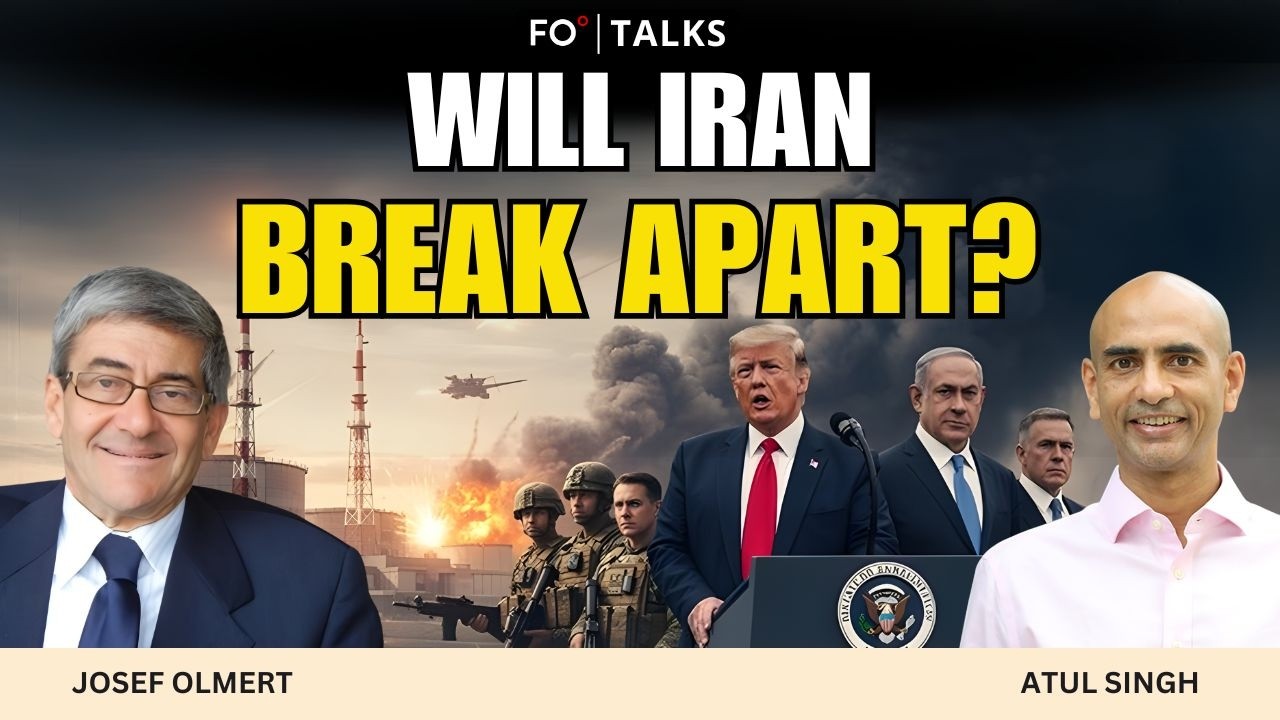
FO Talks: Iran War — Former Israeli Negotiator Josef Olmert Explains What Comes Next
Russell Stamets”
post_date=”March 10, 2026 06:05″
pUrl=”https://www.fairobserver.com/world-news/fo-talks-india-us-trade-deal-agreement-and-the-real-beginning-of-liberalization-2-0/” pid=”161170″
post-content=”
Fair Observer’s Video Producer Rohan Khattar Singh speaks with FOI Partner Russell Stamets, a lawyer who has spent more than two decades advising American and multinational firms on doing business in India. They discuss the significance of the India–US trade deal at a time when global commerce is shifting away from multilateral frameworks toward bilateral agreements. They examine tariffs, foreign direct investment, IT services, agriculture and the broader geopolitical logic of decoupling from China. The agreement may mark the beginning of what Stamets calls Liberalization 2.0 for the Indian economy.
Stamets frames the deal as part of a structural transition in global trade. As the World Trade Organization loses centrality, countries are increasingly pursuing direct, negotiated arrangements. For India and the United States, the absence of such a deal had become a major issue and even an embarrassment after earlier efforts collapsed. Given the political investment on both sides, the failure to secure an agreement had taken on disproportionate symbolic weight.
Divergent languages, necessary convergence
Khattar Singh presses Stamets on why negotiations have previously stalled and whether one side wanted the deal more than the other. Stamets says the breakdown was more about mindset than desire. The Trump administration approached trade from an intensely transactional, mercantile perspective, while India treated negotiations as matters closely tied to sovereignty and pride.
The two sides, he says, were speaking “the most divergent language.” When trade becomes entangled with emotion and national honor, rational bargaining becomes harder. In that environment, asking who “won” obscures the larger shift that was needed.
Still, Stamets credits New Delhi’s performance. In his estimation, India has done a “terrific job” navigating a difficult political and economic landscape. He suggests that Indian Prime Minister Narendra Modi has used the deal as leverage to restart a reform agenda that had stalled. For Stamets, this moment may later be remembered as Liberalization 2.0, echoing the watershed reforms of 1991 that opened India’s economy to global competition.
Decoupling from China and FDI revival
A central question is whether the agreement meaningfully advances US efforts to reduce reliance on China. Khattar Singh connects the deal to earlier discussions about American firms shifting manufacturing footprints. Apple’s expanded production in India is one visible sign, but Stamets emphasizes that the broader objective is not deglobalization. Rather, it is diversification.
Washington, he argues, desperately seeks a confident and economically vibrant India as a partner in global supply chains. The reaction to early tariff announcements underscores that appetite. When the 18% tariff figure emerged, Stamets recounts that his phones were abuzz with US businesses eager to explore sourcing and manufacturing opportunities in India.
This renewed interest, he believes, could help reverse a worrying decline in foreign direct investment. By lowering tariffs from 25% to 18% in key areas and signaling policy stability, the agreement restores market confidence and invites longer-term commitments.
Tariffs, consumers and agricultural red lines
Agriculture, dairy and poultry have long been politically sensitive sectors in India. Publicly, these areas were described as red lines. Stamets notes that public and private negotiating positions often differ, but he acknowledges the government’s need to protect farmers while managing transition.
Khattar Singh highlights concrete examples, including walnuts and almonds. India produces only a fraction of its domestic demand, yet it previously imposed tariffs as high as 120% on certain imports. Such measures, Stamets argues, were “anti-consumer” and “mostly punished the Indian consumer,” even if they were justified as protective tools for the domestic industry.
The deal’s tariff reductions, including cuts from 25% to 18% in several categories, may appear technical. But for consumers, lower import costs translate into tangible price changes. Apples, dairy and other everyday goods illustrate how trade policy filters into household budgets. While the details are still emerging, both Khattar Singh and Stamets expect benefits to broaden over time.
Media noise and strategic reality
Khattar Singh observes that the Indian media has fixated on the agreement, while American outlets have given it limited attention. Stamets bluntly explains that economically, India “doesn’t really matter that much to the United States” relative to its largest trading partners. That asymmetry shapes coverage.
However, the strategic value exceeds immediate trade volumes. For India, securing stability for IT services and the outsourcing sectors is crucial. Stamets describes the avoidance of potential US protectionist action against these industries as “an ICBM dodge,” safeguarding one of India’s most important exports.
Ultimately, the deal’s deeper significance may be psychological. Stamets hopes it signals a more self-confident India, willing to defend its interests and say yes when integration advances them. For Washington, a stable and self-assured India strengthens efforts to reshape supply chains and counterbalance China.
Whether this marks the beginning of a new trade architecture remains uncertain. But as bilateralism replaces multilateralism, the India–US agreement stands as an early test case for how two large democracies reconcile protectionist impulses with global ambition — and whether Liberalization 2.0 can deliver on its promise.
[Lee Thompson-Kolar edited this piece.]
The views expressed in this article/video are the author’s own and do not necessarily reflect Fair Observer’s editorial policy.
”
post-content-short=”
Fair Observer’s Video Producer Rohan Khattar Singh speaks with FOI Partner Russell Stamets, a lawyer who has spent more than two decades advising American and multinational firms on doing business in India. They discuss the significance of the India–US trade deal at a time when global commerce…”
post_summery=”In this episode of FO Talks, Rohan Khattar Singh and Russell Stamets examine the India–US trade deal and its broader geopolitical and economic implications. It may signal a shift toward bilateralism, support US supply chain diversification away from China and revive foreign direct investment in India. A potential “Liberalization 2.0,” this moment reflects renewed economic confidence and integration.”
post-date=”Mar 10, 2026″
post-title=”FO Talks: India–US Trade Deal Agreement and the Real Beginning of Liberalization 2.0″ slug-data=”fo-talks-india-us-trade-deal-agreement-and-the-real-beginning-of-liberalization-2-0″>
FO Talks: India–US Trade Deal Agreement and the Real Beginning of Liberalization 2.0

Glenn Carle”
post_date=”March 09, 2026 04:46″
pUrl=”https://www.fairobserver.com/world-news/middle-east-news/fo-exclusive-a-new-iran-us-conflict-looms-large/” pid=”161153″
post-content=”
[Editor’s note: This video was recorded on Wednesday, February 25, three days before the US–Israeli attack on Iran.]
Editor-in-Chief Atul Singh and FOI Senior Partner Glenn Carle, a retired CIA officer who now advises companies, governments and organizations on geopolitical risk, discuss a mounting crisis in the Middle East. A new US–Iran conflict, they warn, now “looms large.” With American military deployments at their highest level since the 2003 Iraq War and faltering diplomacy in Geneva, Switzerland, the risk of a large-scale strike appears high and rising. What began as maximum pressure may be drifting toward shock and awe.
Maximum pressure and military momentum
Atul opens with the scale of the buildup. The US armada now in and around the Persian Gulf follows intensified sanctions and Operation Midnight Hammer, the joint US–Israel action targeting Iranian nuclear facilities. Security, political and diplomatic sources tell Fair Observer that US military action is increasingly probable.
Washington’s approach combines coercive diplomacy with visible force. Negotiators in Geneva, led on the American side by US Special Envoy to the Middle East Steve Witkoff and former Senior Advisor to the President Jared Kushner, have struggled to find common ground with Iranian counterparts whose patient, formal style contrasts sharply with the blunt, fast-moving dealmaking culture of New York real estate. Talks have failed thus far to produce a breakthrough.
Meanwhile, Iran has conducted maritime drills in the Strait of Hormuz, through which roughly 20% of global oil and gas transit. Failed diplomacy and expanding deployments now reinforce each other. With so many assets in the theater, backing down carries political costs. Advancing carries strategic risks.
Three weak governments, one dangerous dynamic
Atul recounts a British security source’s observation that the three pertinent governments — Iran, Israel and the United States — are all domestically weak and cannot afford to appear so. Massive anti-government demonstrations in Iran have narrowed the regime’s social base. Israeli Prime Minister Benjamin Netanyahu leads a fractious coalition and faces corruption allegations. In Washington, the US Supreme Court has just struck down most of US President Donald Trump’s sweeping tariffs, undercutting executive authority at home even as he projects power abroad.
This convergence of weakness raises the risk of miscalculation. As Atul notes, none of the actors may want a full-scale war, yet all may drift toward one. Some US military sources worry that the “Venezuela high” — referring to Operation Absolute Resolve, the January military operation to seize Venezuelan President Nicolás Maduro — could breed overconfidence in Washington. After US Secretary of State Marco Rubio’s Munich speech called for a renewal of the West under American leadership, Iran appears next in line for pressure.
Israeli sources suggest Trump may pursue a shock-and-awe operation, which would use incredible displays of force to make Iran lose its nerve. But Glenn cautions against strategic optimism built on thin assumptions. He argues that the belief that “kinetic power” can remake a society rests on “the thinnest of all imaginable grounds.” History offers sobering parallels.
Regime change or regime hardening?
Atul detects a generational divide within Washington. Some younger Republicans believe Iran’s economic woes, youth unemployment and protests by students, women and minorities create a window for a “smart intervention” that weakens or even topples the regime of 89-year-old Ayatollah Ali Khamenei. American firepower could degrade military capacity, intensify domestic unrest and open space for intelligence operations by the CIA and Mossad, Israel’s foreign intelligence agency.
Older intelligence and military hands are more skeptical. Glenn warns that removing leaders does not dissolve entrenched power structures. The Islamic Revolutionary Guard Corps (IRGC), founded after the 1979 Iranian Revolution as a parallel military reporting directly to the clerical leadership, functions as a praetorian guard. Khamenei has reportedly implemented succession planning up to four levels deep across key posts.
Even if the top leadership was eliminated, Atul predicts that “black beards” would replace “white beards.” The likely successors would not be liberal reformers but hardened elements of the IRGC. To highlight the stakes, Iran’s capital of Tehran has acknowledged 3,117 deaths during recent unrest, while independent authorities have confirmed over 6,800 killings. Higher estimates reach 30,000. The regime is ruthless, but it is organized.
Asymmetry, oil and global shock
Glenn frames the conflict in existential terms. For the Iranian leadership, survival is nonnegotiable. For the US, war remains a policy choice. States do not act on altruism when vital interests face grave danger.
The military balance is asymmetric. The US could reportedly conduct up to 800 sorties a day. Yet Iran possesses large numbers of relatively cheap missiles and drones capable of targeting high-value assets, including $5 billion aircraft carriers. The “cost per kill” calculus favors Tehran: low-cost weapons against high-cost platforms. Iranian tolerance for casualties, in a system that valorizes martyrdom, may far exceed that of the US.
The economic stakes are global. Closure or disruption of the Strait of Hormuz could trigger oil price spikes reminiscent of those seen in the 1973 and 1979 oil crises, raising input costs, transport expenses and worldwide inflation. Missile strikes on refineries, maritime insecurity and surging insurance premiums would disrupt shipping and logistics. Equity selloffs, widening credit spreads, emerging-market currency instability and risk-off capital flows could follow. A prolonged conflict could push the world toward recession.
The nuclear deal revisited
Against this backdrop, Glenn points to a pragmatic alternative: revive the 2015 Joint Comprehensive Plan of Action. The original agreement constrained Iran’s nuclear program under international monitoring. Tehran expanded its activities only after Washington withdrew.
A restored deal, perhaps rebranded to allow Trump to claim political victory, would not satisfy Iranian protesters seeking systemic change. Yet Glenn argues it could avert catastrophe. Even if imperfect, diplomacy is preferable to a regional war that might draw in Israel and Gulf states and potentially escalate to tactical nuclear threats. This rhetoric is already circulating on the far right in Israel and within segments of the IRGC.
Ultimately, on Saturday, February 28, the US and Israel coordinated a bombing attack on Iran as part of Operation Epic Fury, killing Khamenei and initiating a greater offensive.
[Lee Thompson-Kolar edited this piece.]
The views expressed in this article/video are the author’s own and do not necessarily reflect Fair Observer’s editorial policy.
”
post-content-short=”Editor-in-Chief Atul Singh and FOI Senior Partner Glenn Carle, a retired CIA officer who now advises companies, governments and organizations on geopolitical risk, discuss a…”
post_summery=”In this section of the February 2026 episode of FO Exclusive, Atul Singh and Glenn Carle examine the rising risk of a US–Iran military conflict as diplomacy in Geneva falters. Domestic political weakness in Washington, Tehran and Jerusalem increases the danger of miscalculation, while Hormuz disruption could trigger global economic shock. Reviving the nuclear deal remains the least catastrophic option.”
post-date=”Mar 09, 2026″
post-title=”FO Exclusive: A New Iran–US Conflict Looms Large” slug-data=”fo-exclusive-a-new-iran-us-conflict-looms-large”>
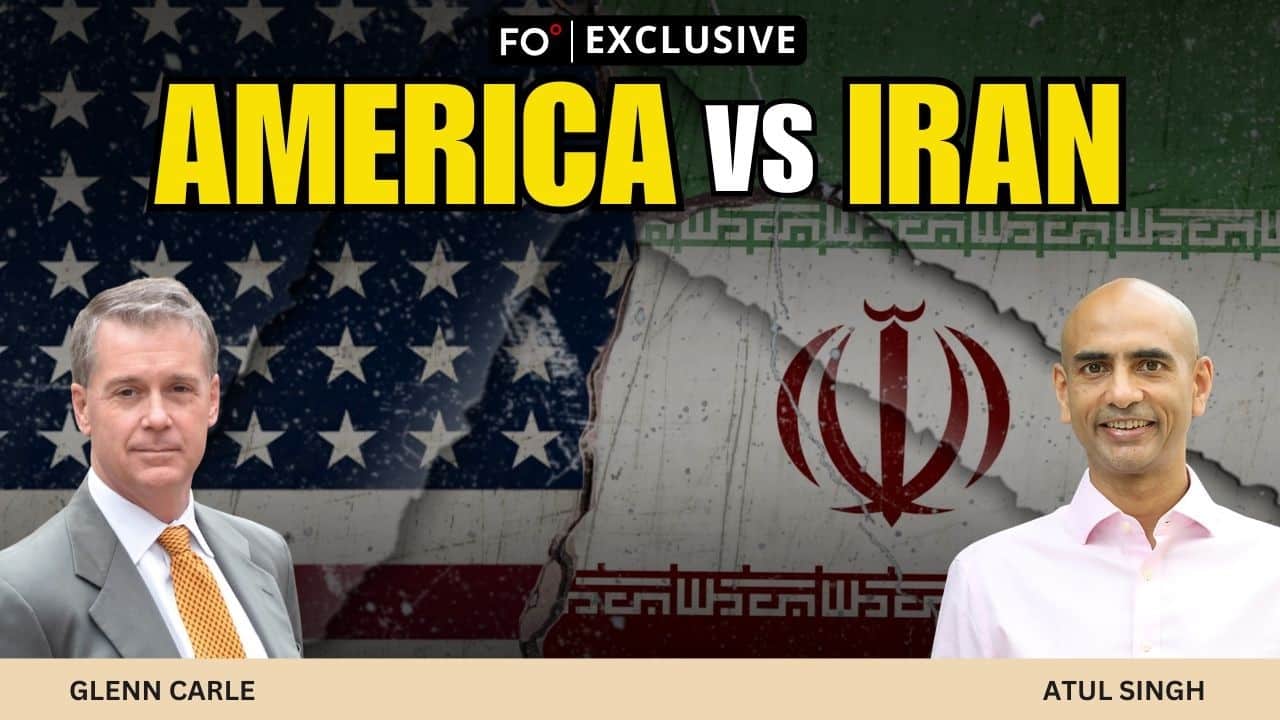
FO Exclusive: A New Iran–US Conflict Looms Large
Glenn Carle”
post_date=”March 08, 2026 06:03″
pUrl=”https://www.fairobserver.com/world-news/us-news/fo-exclusive-a-hot-mess-after-the-supreme-court-strikes-down-trump-tariffs/” pid=”161136″
post-content=”
Editor-in-Chief Atul Singh and FOI Senior Partner Glenn Carle, a retired CIA officer who now advises companies, governments and organizations on geopolitical risk, examine a 6–3 US Supreme Court ruling that struck down most of US President Donald Trump’s recent tariffs as illegal. The decision, issued on February 20, found that the administration exceeded its authority under the International Emergency Economic Powers Act (IEEPA), which Trump had used to declare a national emergency over the US trade deficit. Within hours, the president signaled defiance, promising to rebuild tariff barriers using “methods, practices, statutes and authorities that are even stronger than the IEEPA tariffs.” What follows now is deeper constitutional and economic uncertainty.
The constitutional fault line
Glenn frames the ruling as part of a “tectonic” struggle over the nature of American democracy. The US system, he argues, “was by design to be inefficient,” built on separation of powers and checks and balances precisely to prevent “unfettered executive authority.” For decades, however, a dominant strain within the Republican Party has embraced the theory of the unitary executive. They assert that the president must be empowered to act decisively in the national interest, even in the face of congressional or judicial resistance.
The Court’s ruling reinforces a basic constitutional principle: Taxation and tariff powers rest with Congress. Drawing on the major questions doctrine, which was previously used by the conservative majority to curb federal bureaucratic agencies, the justices now turn that reasoning against the executive itself. For Atul, this demonstrates that the Court is “not entirely a handmaiden of the executive yet,” and that checks and balances still function.
But a deeper crisis lurks. If the executive resists implementation, the judiciary has no enforcement arm of its own. The president controls the Department of Justice and the machinery that executes court orders. In theory, impeachment could discipline open defiance. In practice, however, with Congress divided and midterms looming, that appears unlikely. The ruling thus exposes both the resilience and fragility of constitutional governance.
Legal workarounds and fiscal fallout
The economic implications are immediate and complex. The IEEPA tariffs, imposed after Trump’s declaration of a national emergency on April 2, 2025, had already generated an estimated $200 billion in import duties. Those funds must now be refunded, but repayment could take years of litigation. Companies are lining up for reimbursement; class-action lawyers are preparing to argue that any refunds should flow to consumers rather than remain with corporations. Trump himself has noted that the Court did not explicitly address repayment, leaving the issue unresolved.
Meanwhile, the administration is far from out of options. Supreme Court Justice John Kavanaugh’s dissent emphasizes that “numerous other federal statutes authorize the President to impose tariffs.” Section 122 of the 1974 Trade Act allows temporary tariffs of up to 150 days to address balance-of-payments difficulties. Invoking this authority, Trump announced a 10% global tariff, raised to 15% on February 21. Other provisions permit duties of up to 50% against countries deemed to discriminate against US commerce, as well as restrictions justified on national security grounds.
More dramatically, Trump could simply delay dismantling the IEEPA tariffs. With control of the executive branch, the administration might slow compliance indefinitely, using prosecutorial discretion and presidential pardons to shield officials. Such a move would deepen the constitutional clash and compound uncertainty.
Trade deficits and inflation reality
Atul and Glenn stress that the tariffs’ original objective, reducing the US trade deficit, has not been met. The overall deficit declined marginally from $903.5 billion in 2024 to $901.5 billion in 2025, a mere $2 billion shift. In some cases, deficits widened. For instance, the US goods deficit with India rose from $45.8 billion in 2024 to $58.2 billion in 2025. A small US services surplus may turn into a roughly $4 billion deficit.
Simultaneously, tariffs have proven inflationary. Although price pressures have not surged as dramatically as some predicted, Glenn underscores the lag effect: It can take a year for the full impact of trade barriers to filter through supply chains and consumer prices. Markets can adjust to higher or lower tariffs, and even to different constitutional arrangements. What they cannot easily manage is instability. The White House’s determination to maintain and extend tariffs, even after judicial rebuke, amplifies policy unpredictability.
Uncertainty as policy
Capitol Hill sources, including Republicans, privately welcome the ruling. They believe the White House had wrested excessive authority from Congress and that the decision restores some institutional balance. In the long term, they argue, this may prove beneficial for both governance and the economy.
Yet in the short term, FOI expects the opposite of clarity. Businesses and investors should anticipate product-, sector- and country-specific duties proliferating under alternative statutes. Existing tariffs may persist while litigation unfolds. Rather than reducing uncertainty, the Court’s decision may intensify it.
Atul calls the moment a “mini crisis,” constitutional and economic at once. Despite judicial intervention, the administration remains committed to tariffs as both principle and instrument. So despite the Supreme Court ruling, the Trump administration is poised to maintain and extend its already extensive use of tariffs as a central trade policy tool.
[Lee Thompson-Kolar edited this piece.]
The views expressed in this article/video are the author’s own and do not necessarily reflect Fair Observer’s editorial policy.
”
post-content-short=”
Editor-in-Chief Atul Singh and FOI Senior Partner Glenn Carle, a retired CIA officer who now advises companies, governments and organizations on geopolitical risk, examine a 6–3 US Supreme Court ruling that struck down most of US President Donald Trump’s recent tariffs as illegal. The…”
post_summery=”In this section of the February 2026 episode of FO Exclusive, Atul Singh and Glenn Carle analyze the US Supreme Court’s 6–3 decision striking down US President Donald Trump’s IEEPA tariffs and Trump’s defiant pledge to rebuild them. They explore the constitutional clash over separation of powers and the unitary executive theory. Despite the ruling, tariff expansion will likely continue.”
post-date=”Mar 08, 2026″
post-title=”FO Exclusive: A Hot Mess After the Supreme Court Strikes Down Trump Tariffs” slug-data=”fo-exclusive-a-hot-mess-after-the-supreme-court-strikes-down-trump-tariffs”>

FO Exclusive: A Hot Mess After the Supreme Court Strikes Down Trump Tariffs
Glenn Carle”
post_date=”March 07, 2026 06:14″
pUrl=”https://www.fairobserver.com/world-news/fo-exclusive-global-lightning-roundup-of-february-2026/” pid=”161129″
post-content=”
Editor-in-Chief Atul Singh and FOI Senior Partner Glenn Carle, a retired CIA officer who now advises companies, governments and organizations on geopolitical risk, rifle through a month of shocks, scandals and political turns. A pattern emerges when seemingly local events are read as signals of institutional strain, state capacity and the evolving global balance between disorder and control.
Africa: Libya’s afterlife, Congo’s minerals, Ethiopia’s fault lines
In Libya, Saif al-Islam Gaddafi, son of former Libyan dictator Muammar Gaddafi, was killed by four unknown gunmen in the western town of Zintan. Atul treats the assassination as a sign that Libya’s fragmentation persists, with no political settlement in sight.
In the Democratic Republic of Congo, a mine collapse killed 200 people, including children. This illustrates the brutal conditions miners must navigate to obtain coltan, a critical component used in smartphone manufacture. Atul notes the scale and location: It was the Bibatama Mining Concession near Rubaya in Masisi Territory, North Kivu province, which produces roughly 1,000 metric tons annually — about half of DRC output.
The M23 rebellion, operating under the Congo River Alliance banner, reportedly holds the mines and is allegedly backed by Rwanda. Thus, this mineral economy is now a regional power contest. Glenn frames Congo’s governance vacuum as an “utter state of nature.” He argues that predation, warlordism and external meddling are the operating system, not a temporary breakdown.
Elsewhere on the continent, Ethiopian troops moved toward the country’s northern Tigray region. Ethiopia and Eritrea now trade accusations of arming rebels and preparing for war, calling to mind memories of the 2020–2022 Tigray war.
The Americas: cartel power, energy pressure, Peruvian instability
In Mexico, authorities killed Nemesio Oseguera Cervantes (known by the alias “El Mencho”), notorious leader of the Jalisco New Generation Cartel (CJNG), after tracking down his wife, Rosalinda González Valencia. The cartel response was immediate and violent. CJNG torched buildings and vehicles and killed 62 people, including 25 National Guard members. Mexican President Claudia Sheinbaum deployed 2,000 troops to stabilize the situation.
Atul notes that the United States supplied intelligence locating El Mencho, underscoring how cross-border security problems are also cross-border intelligence operations. Glenn emphasizes that decades of US counter-narcotics efforts have not changed the economics that make cartel power rational and durable.
Elsewhere, energy has become leverage. Cuba announced fuel rationing after Venezuela and Mexico reportedly curbed supplies under US pressure, prompting Canadian airlines to suspend flights due to aviation fuel shortages. In Colombia, Atul notes the political mood swing as US President Donald Trump and Colombian President Gustavo Petro publicly reconciled after trading sharp insults; Trump called their meeting “terrific.”
Peru provides a concentrated case of governance stress. Deadly floods struck the south. Simultaneously, rising global gold prices now accelerate illegal mining in the Amazon, expanding deforestation, mercury contamination and violence against remote communities. Politically, José María Balcázar became interim president, the ninth in a decade, after the previous leader was impeached amid lurid allegations about late-night meetings at the presidential palace. Peru’s government is a system where corruption, fragmentation and electoral overload blend into dysfunction, with 36 presidential candidates and 39 parties ahead of a first round this April.
United States: migration calm, market froth, AI spam, climate rollback
In the US, the hosts treat domestic developments as both policy choices and cultural signals. Seven hundred federal immigration agents were withdrawn from Minneapolis, Minnesota, with roughly 2,000 still present. Officials claim “relative peace” has returned. Atul flags personnel politics at the Federal Reserve (or the Fed). Former Member of the Fed Board of Governors Kevin Warsh is nominated to replace Fed Chair Jerome Powell when Powell steps down in May. Economists remain uncertain whether Warsh would prioritize rate cuts or inflation discipline.
Regarding US markets, Walmart reached a $1 trillion market capitalization, becoming the first traditional retailer to do so. In tech culture, the AI “social” layer looks less like a breakthrough and more like an old Internet problem in new clothing. Moltbook, a chatboard for AI agents, reported 1.5 million registered accounts, yet only 17,000 are truly autonomous. The rest are spam.
The sharpest US clash is environmental. Trump reversed the 2009 “endangerment finding,” the legal foundation for federal action against greenhouse gas emissions, especially vehicle rules. Glenn argues from lived memory of pre-regulation pollution and treats the reversal as historic backsliding. The White House touts it as “the largest deregulation in American history,” claiming savings of $2,400 per vehicle. Atul frames the choice more strategically, citing the contrast between a US doubling down on fossil energy and a China betting on electrification.
Epstein’s aftershocks: elites, exposure and moral credibility
The conversation then shifts from policy to legitimacy. In the United Kingdom, Prince Andrew Mountbatten-Windsor and Lord Peter Mandelson were arrested for dealings connected to late sex trafficker Jeffrey Epstein. The infamous Epstein files are corrosive not only because of individual allegations, but because they degrade trust across elite categories, from aristocratic and business circles to political and spiritual brands.
The scandal’s radius extends beyond Britain. Fallout touches Norwegian Crown Prince Haakon, as well as former US President Bill Clinton and Microsoft cofounder Bill Gates. Even celebrity spirituality is pulled into the undertow. Atul highlights allegations involving Indian-American new age guru Deepak Chopra and his disturbing comments, “bring your girls” and “zero in on your prey,” as lines that have returned to haunt him.
Europe and Asia: reassurance theatre, electoral churn, hardening states
In Europe, Atul selects three signals of shifting mood. In Munich, Germany, US Secretary of State Marco Rubio received a standing ovation. Atul reads this as a performance of reassurance tied to arguments about Europe’s civilizational mission and strategic posture. In France, the National Assembly passed a budget after months of instability, frustrating both far-left and far-right efforts to topple the government. French President Emmanuel Macron and Prime Minister Sébastien Lecornu were the immediate winners, but institutional survival is under strain.
The Milano Cortina Winter Olympics provide a rare upbeat civic note. The US won both men’s and women’s hockey gold against Canada in extra time, while Norway topped the overall medal table.
Asia delivers harsher headlines. China was angered after Panama’s Supreme Court annulled a contract allowing Hong Kong conglomerate CK Hutchison to operate in the Panama Canal. In Hong Kong, publisher Jimmy Lai was sentenced to 20 years in prison for offenses tied to foreign collusion and seditious publishing. In Thailand, the Thai Pride Party, aligned with military-royalist power, won about 40% of seats, the largest margin in 15 years.
In Bangladesh, the Bangladesh Nationalist Party under Bangladeshi Prime Minister Tarique Rahman won a two-thirds majority in the first election since the 2024 student-led uprising that ousted the previous prime minister, Sheikh Hasina. Atul stresses the strong performance of the Jamaat-e-Islami political party, which he reads as a rightward, more Islamist drift with clear implications for India and Pakistan.
Japan closes the lightning round. Sanae Takaichi, Japan’s first female prime minister, won Japan’s general election in a historic landslide. Her Liberal Democratic Party won a two-thirds majority in Japan’s lower house of parliament. She campaigned on cutting food-related consumption taxes and boosting defense spending amid fears of Chinese conflict, with markets and the yen surging in response.
[Lee Thompson-Kolar edited this piece.]
The views expressed in this article/video are the author’s own and do not necessarily reflect Fair Observer’s editorial policy.
”
post-content-short=”
Editor-in-Chief Atul Singh and FOI Senior Partner Glenn Carle, a retired CIA officer who now advises companies, governments and organizations on geopolitical risk, rifle through a month of shocks, scandals and political turns. A pattern emerges when seemingly local events are read as signals of…”
post_summery=”In this section of the February 2026 episode of FO Exclusive, Atul Singh and Glenn Carle survey a world marked by institutional fragility, mineral competition and political churn. From Congo’s coltan mines and Mexico’s cartel violence to US deregulation and Bangladesh’s rightward shift, local crises reveal systemic strain. Across continents, legitimacy, governance and state capacity remain under pressure.”
post-date=”Mar 07, 2026″
post-title=”FO Exclusive: Global Lightning Roundup of February 2026″ slug-data=”fo-exclusive-global-lightning-roundup-of-february-2026″>
FO Exclusive: Global Lightning Roundup of February 2026
David Mahon”
post_date=”March 02, 2026 03:49″
pUrl=”https://www.fairobserver.com/economics/fo-talks-india-and-china-can-no-longer-avoid-each-other-militarily-and-economically/” pid=”161049″
post-content=”
Editor-in-Chief Atul Singh and Beijing-based Kiwi investor David Mahon discuss the increasingly unavoidable relationship between India and China. Despite border tensions, distrust and competing regional ambitions, neither country can afford a clean decoupling in a fragmenting multipolar world. Singh presses on security fears and India’s policy constraints, while Mahon argues that interests, not grievances, will ultimately shape the relationship.
Border tensions, “dehyphenation” and the logic of restraint
Singh opens with the core question: Can trade and economic ties be separated from the border dispute and wider strategic rivalry? Mahon says yes, pointing to periodic high-level pragmatism and long stretches of restraint along disputed lines. He argues that escalation offers little strategic gain for either side, noting, “To have any military conflict there at this point for either side is actually pointless.”
Singh counters with India’s security anxieties: Beijing’s ties with Pakistan, the China–Pakistan Economic Corridor and the broader “string of pearls” concern over Chinese influence in South Asia. Mahon acknowledges these fears but suggests Delhi often overestimates Beijing’s political control in neighboring states. He cites Nepal as an example, arguing that domestic grievances, not Chinese orchestration, better explain recent unrest. Reduced engagement breeds suspicion, while dialogue, even without trust, limits miscalculation.
The trade imbalance and India’s supply-chain dependence
Turning to economics, Singh highlights India’s roughly $100 billion trade deficit with China and its continued reliance on Chinese-manufactured inputs, despite post-2020 restrictions. Mahon frames the imbalance as a structural feature of China’s role as the world’s manufacturing hub rather than a uniquely Indian failure. He agrees that the dependency is real, however.
Singh lists the pressure points: industrial machinery, electronics, solar cells and active pharmaceutical ingredients that underpin India’s drug exports. Even where India’s exports are rising, such as Apple smartphone assembly for the US market, key components still originate in China. Diversification is occurring at the margins, but core industrial linkages remain Chinese.
China as a catalyst: Mahon’s Zhu Rongji argument
Mahon proposes that India treat China less as a threat to exclude and more as a competitor-investor to harness. He invokes former Chinese Premier Zhu Rongji, who used China’s entry into the World Trade Organization to force domestic reform. External competition compels regulators to simplify rules, courts to enforce contracts and firms to raise productivity.
Applied to India, this means selective openness. Mahon proposes allowing Chinese investment in sectors such as electric vehicles under clear conditions that require technology transfer and skill development. The aim is not speed but discipline: gradual engagement that strengthens India’s manufacturing base rather than overwhelming it.
Singh reinforces the institutional critique, arguing that India’s administrative and judicial systems impose severe friction on investment. Together, they suggest that without regulatory reform, India’s ambitions to rebuild manufacturing — from roughly 13% of GDP today — will remain constrained.
China’s slowdown, US pressure and a multipolar reality
Singh challenges the idea that China’s economic slowdown will turn India into a dumping ground for excess production. Mahon rejects the narrative of collapse, calling the idea that trade drives China’s growth “an IMF myth.” He stresses that “5% in an economy of the size and scale and complexity of China is absolutely huge.”
On investment, Mahon broadens the lens, arguing that India’s weak foreign direct investment reflects a global slowdown and uncertainty generated by US policy under US President Donald Trump. Singh maintains that domestic policy choices have amplified the damage.
Both agree that India cannot ignore the United States, given its trade surplus and deep cultural ties. Mahon’s answer is structured hedging: deepen selective economic engagement with China while attracting other investment so no single relationship dominates. He even suggests concentrating early reforms in one or two Indian states, echoing China’s early special economic zones.
Pragmatism, nationalism and execution risk
Mahon outlines three broad outcomes. The best case is a “beneficially transactional” relationship in which business proceeds despite political friction. The worst-case scenario is a nationalism-driven shock or a poorly managed opening that triggers scandal or industrial accidents and poisons public opinion. Singh adds leadership risk: Both Chinese President Xi Jinping and Indian Prime Minister Narendra Modi are aging leaders, and succession periods can encourage opportunistic nationalism.
India and China may distrust each other, but supply chains, investment needs and a weakening Western-led order make engagement more likely than separation. For Mahon, the strategic opportunity is to turn that engagement into a catalyst for Indian reform rather than a story of permanent dependence.
[Lee Thompson-Kolar edited this piece.]
The views expressed in this article/video are the author’s own and do not necessarily reflect Fair Observer’s editorial policy.
”
post-content-short=”
Editor-in-Chief Atul Singh and Beijing-based Kiwi investor David Mahon discuss the increasingly unavoidable relationship between India and China. Despite border tensions, distrust and competing regional ambitions, neither country can afford a clean decoupling in a fragmenting multipolar world….”
post_summery=”In this episode of FO Talks, Atul Singh and David Mahon examine why India and China, despite border tensions and strategic mistrust, cannot decouple in a multipolar world. Mahon argues that India should use Chinese capital and competition as a catalyst for domestic reform. They highlight trade dependence, policy failures and risks of nationalism during leadership transitions.”
post-date=”Mar 02, 2026″
post-title=”FO Talks: India and China Can No Longer Avoid Each Other, Militarily and Economically” slug-data=”fo-talks-india-and-china-can-no-longer-avoid-each-other-militarily-and-economically”>
FO Talks: India and China Can No Longer Avoid Each Other, Militarily and Economically

Jenna Nicholas”
post_date=”March 01, 2026 05:24″
pUrl=”https://www.fairobserver.com/economics/fo-talks-can-spirituality-transform-capitalism/” pid=”161036″
post-content=”
Fair Observer’s Video Producer Rohan Khattar Singh speaks with Jenna Nicholas, President of LightPost Capital, about impact investing, inequality and the intersection of ethics and capitalism. Drawing on her experience as an investor and author of the best-selling book, Enlightened Bottom Line: Exploring the Intersection of Spirituality, Business, and Investing, Nicholas explores how climate, healthcare and education ventures can generate financial returns and measurable social good. The conversation also examines how her Bahá’í faith shapes her approach to leadership, capital allocation and long-term strategy.
Rethinking impact investing
Nicholas describes impact investing as a field that has grown significantly over the past decade. Rather than treating profit and purpose as opposing forces, it seeks to align them. As she puts it, “So often when we think about finance, we think about only maximizing financial returns, and that it is the opposite to social impact. But the thesis is that actually, each can reinforce the other.”
In practical terms, this means directing capital toward sectors such as climate, healthcare and education, where social and environmental considerations are embedded in a company’s mission. Nicholas points to investments such as Virta Health, which works to reverse type 2 diabetes, and Esusu, which uses rental payment data to help renters build credit profiles. These companies demonstrate that strong financial performance and social benefit are not mutually exclusive.
However, Nicholas recognizes the scale of the challenge. The global investment industry manages roughly $82 trillion in assets under management. Of that, less than 2% flows to companies or funds run by women and people of color. That disparity may signal a deeper structural imbalance in capital allocation.
Structural bias and capital allocation
Nicholas argues that the financial system does not simply reflect inequality; it often reinforces it. She points to the stark mismatch between who controls capital and the demographic composition of society.
To address this, she cofounded Impact Experience, an initiative that partners with investors and institutions to engage around bias directly. Through immersive programs in places such as Montgomery, Alabama, participants examine the historical roots of racial and gender inequities and how they shape present-day investment decisions. The goal is to bring about behavioral change that leads to different asset allocation choices.
Reform must operate on multiple levels: structural, organizational and individual. Greater transparency, intentional portfolio design and expanded networks for underrepresented founders all play a role. For Nicholas, recalibrating even a small fraction of that $82 trillion could have transformative effects.
Faith, work and the question of legacy
A distinctive dimension of Nicholas’s outlook comes from her identity as a member of the Bahá’í faith. She highlights core principles, such as the equality of men and women, the harmony of science and religion and the abolition of extremes of wealth and poverty. These ideas are not abstract doctrines but operational guideposts.
She references a line from the Bahá’í writings that a human being is “a spiritual being and only when they live in the life of their spirit are they truly happy.” For Nicholas, this reframes work as an expression of spiritual purpose rather than mere material accumulation. The concept that “work is worship” reinforces the idea that professional life can be a space of service.
Her book develops these themes through interviews with investors and entrepreneurs who have integrated values into their business models. She introduces the HEAL framework — Hope, Empathy, Abundance and Legacy — as a tool for aligning financial decision-making with long-term human flourishing. The animating question is not simply how much wealth one creates, but what trace one leaves behind.
Global perspective and expanded capital
Nicholas’s worldview has been shaped by time spent in India, China, the Congo and Silicon Valley. In India, she recalls meeting people with limited financial means but profound spiritual and social resources. These experiences inform her argument for expanding the definition of capital beyond money alone.
She proposes a broader framework that includes spiritual capital, social capital and human capital alongside financial capital. A purely material conception of capitalism, she suggests, misses the fullness of what it means to be human. By recognizing multiple forms of value, investors can make decisions that strengthen communities rather than merely extract returns.
This broader lens also informs her call to incorporate indigenous perspectives into finance. The idea of thinking seven generations ahead and considering the legacy of seven generations in the past, challenges the short-termism of quarterly earnings cycles and public market pressures.
From quarterly capitalism to seven-generation thinking
Khattar Singh presses Nicholas on whether long-term thinking is realistic in a volatile geopolitical environment. She responds that long horizons and daily discipline are not mutually exclusive. Multi-decade goals can be broken down into yearly, monthly and daily actions. The task is to ensure that short-term decisions do not undermine long-term societal well-being.
Nicholas says that finance and faith need not clash; they can coexist in productive tension. Investors and entrepreneurs alike must ask what motivates their work, what legacy they seek to build and how capital can serve broader human purposes.
The conversation ultimately circles back to a foundational question: Can modern capitalism evolve beyond quarterly metrics toward a system that values equity, sustainability and spiritual grounding? Nicholas believes it can, if those who steward capital are willing to align profit with purpose and think about the next generation.
[Lee Thompson-Kolar edited this piece.]
The views expressed in this article/video are the author’s own and do not necessarily reflect Fair Observer’s editorial policy.
”
post-content-short=”
Fair Observer’s Video Producer Rohan Khattar Singh speaks with Jenna Nicholas, President of LightPost Capital, about impact investing, inequality and the intersection of ethics and capitalism. Drawing on her experience as an investor and author of the best-selling book, Enlightened Bottom Line:…”
post_summery=”In this episode of FO Talks, Rohan Khattar Singh and Jenna Nicholas discuss impact investing and the structural biases embedded in the $82 trillion global financial system. Nicholas argues that finance and social good can reinforce one another, drawing on her Bahá’í faith and global experience. She calls for long-term, seven-generation thinking to reshape modern capitalism.”
post-date=”Mar 01, 2026″
post-title=”FO Talks: Can Spirituality Transform Capitalism?” slug-data=”fo-talks-can-spirituality-transform-capitalism”>
FO Talks: Can Spirituality Transform Capitalism?

Esther Wojcicki”
post_date=”February 28, 2026 05:24″
pUrl=”https://www.fairobserver.com/culture/fo-talks-esther-wojcicki-on-raising-resilient-children-in-an-age-of-fear-and-authoritarianism/” pid=”161019″
post-content=”
Fair Observer’s Communications and Outreach officer, Roberta Campani, speaks with renowned educator Esther Wojcicki about the deepening mental health crisis among young people and the social forces shaping it. Drawing on her childhood as the daughter of immigrants, her decades as a journalism teacher at Palo Alto High School and her Parenting TRICK framework, Wojcicki argues that fear-based parenting and political instability are undermining children’s confidence. Her solution is to use trust, responsibility and critical thinking as foundations for resilience.
Childhood lessons and the making of an educator
Wojcicki traces her philosophy back to her early years. Born in New York City to parents from Ukraine and Siberia, she grew up navigating multiple languages and cultures before her family relocated to Los Angeles. School quickly became a site of tension. She recalls being punished for helping classmates with their work, behavior that teachers labeled cheating. After repeated paddlings and being forced to sit under a teacher’s desk, she remembers making a quiet promise to herself: “When I grow up, I’m going to change everything.”
That childhood vow shaped her career. After graduating from UC Berkeley and earning a journalism degree in the 1960s and 1970s, she encountered a profession largely closed to women outside the “women’s section.” She refused to confine herself to writing about cooking or cosmetics, and so she pivoted to education. In 1984, she launched a journalism program at Palo Alto High School, creating a classroom built on student agency rather than rigid obedience.
Wojcicki considers early childhood experiences to be formative. Personality and confidence, she argues, are shaped from the earliest years, not in adulthood.
The TRICK framework: trust over control
At the center of the conversation is Wojcicki’s parenting TRICK model: Trust, Respect, Independence, Collaboration and Kindness. Through her app and advisory work, she encourages parents worldwide to adopt these principles.
Trust means believing children are capable of responsibility. Respect involves listening seriously to their ideas. Independence requires allowing them to attempt tasks on their own. Collaboration replaces dictation with dialogue. Kindness frames all interactions. These principles, she contends, are not ideological but developmental. Regardless of political orientation, parents want children who function well, think critically and adapt creatively.
Wojcicki insists the method works, pointing to her three daughters and generations of students as evidence. More importantly, she sees TRICK as a preventive response to what she calls a growing epidemic of anxiety and depression. Excessive control breeds fragility. When parents micromanage children’s lives, those children struggle to manage themselves.
Depression, politics and a culture of fear
The discussion turns stark when Wojcicki cites a troubling statistic: 54% of US college freshmen are clinically depressed. To her, this reflects a deficit in coping skills. “[They] aren’t deficient in some kind of pill,” she says. “[They] just don’t know how to cope with life.” Medication may have its place, but she believes it cannot substitute for resilience built through experience and responsibility.
Campani raises structural pressures: accelerated university timelines, economic precarity and a culture obsessed with efficiency. Wojcicki widens the lens further, pointing to global political instability, rising authoritarian rhetoric and social polarization. Young people, she argues, absorb the anxiety around them. When leaders challenge democratic norms and public discourse turns hostile, the future appears uncertain. Students question whether education leads to opportunity or whether climate change and political turmoil will override their efforts.
Wojcicki believes that fear has seeped into everyday parenting. Where she once walked a mile to kindergarten alone, many parents today drive children to school and escort them into their classrooms. Campani recounts a similar experience she had in Switzerland, where she was told her child could not walk a short distance to school independently. This pattern reveals a self-perpetuating “monster” of fear that feeds on itself.
Responsibility as resilience
Wojcicki returns to practical measures. If adults are anxious, they must resist transmitting that anxiety. Granting children meaningful responsibility, even small chores, builds competence and self-esteem. Trust communicates belief. Independence communicates capability.
She emphasizes that children who are allowed to navigate manageable risks develop confidence. Those constantly shielded may feel protected but often internalize doubt about their own abilities. The rise of food delivery services and digital convenience has further reduced opportunities for self-reliance. Teaching teenagers to cook, manage money and move through the world independently becomes a quiet act of empowerment.
TRICK is not naïve optimism. It is a strategy for raising emotionally strong individuals in unstable times. In a world she describes as turbulent and, at times, frightening, the answer is deeper trust. By fostering critical thinking, collaboration and kindness, parents and educators can equip the next generation not only to endure uncertainty but to reshape it.
[Lee Thompson-Kolar edited this piece.]
The views expressed in this article/video are the author’s own and do not necessarily reflect Fair Observer’s editorial policy.
”
post-content-short=”
Fair Observer’s Communications and Outreach officer, Roberta Campani, speaks with renowned educator Esther Wojcicki about the deepening mental health crisis among young people and the social forces shaping it. Drawing on her childhood as the daughter of immigrants, her decades as a journalism…”
post_summery=”In this episode of FO Talks, Roberta Campani and Esther Wojcicki examine the alarming rise in youth depression; statistics claim 54% of US college freshmen are clinically depressed. Wojcicki links this to fear-based parenting and political instability, arguing that resilience comes from responsibility and autonomy. Her Parenting TRICK framework offers a practical model for raising confident, emotionally strong children.”
post-date=”Feb 28, 2026″
post-title=”FO Talks: Esther Wojcicki on Raising Resilient Children in an Age of Fear and Authoritarianism” slug-data=”fo-talks-esther-wojcicki-on-raising-resilient-children-in-an-age-of-fear-and-authoritarianism”>

FO Talks: Esther Wojcicki on Raising Resilient Children in an Age of Fear and Authoritarianism