
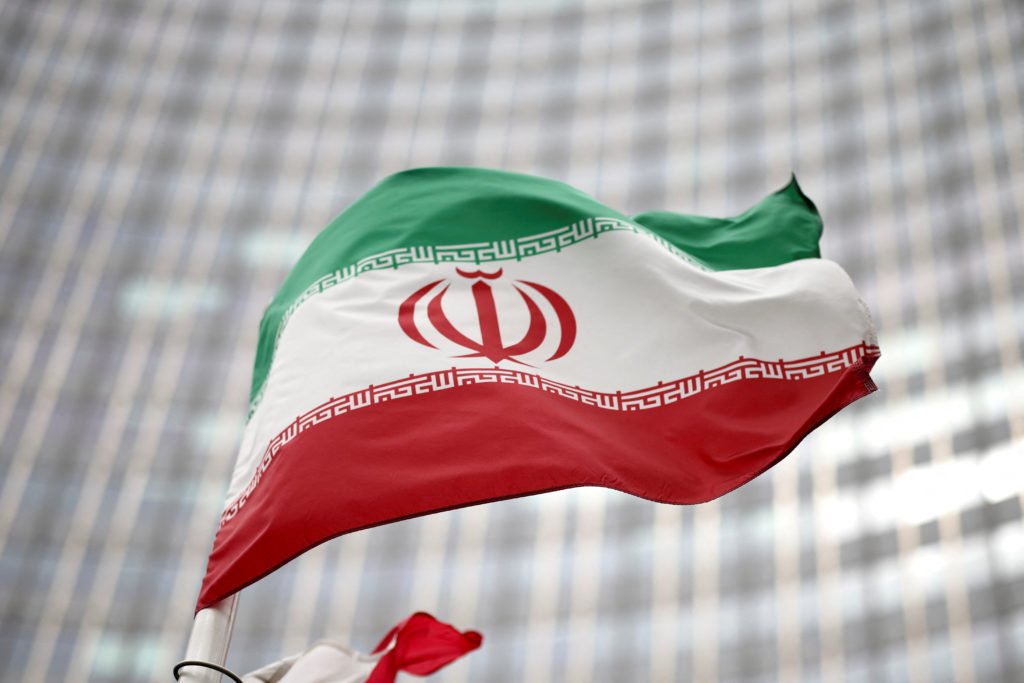
The nation we know today as Iran (formerly known as Persia) was not formally colonized by western nations for most of its history. There was considerable European interference —principally Russian and British as part of the “Great Game” between the two — in the late 19th and early 20th centuries. Also, the British sought to establish a protectorate in Persia in 1919.
However, the country, which became a constitutional monarchy in 1906, remained independent, with a Russian sphere of influence in the north and a British one to the south. Occupied at times by the British, Ottoman and Russian forces during World War I, Persia largely remained neutral in that war.
Oil was discovered in 1908 by the Anglo-Persian Oil Company (today’s British Petroleum, or BP). In 1914, the British government purchased a controlling share of the company. Iranian oil would fuel the Royal Navy and maintain the British empire through both world wars.
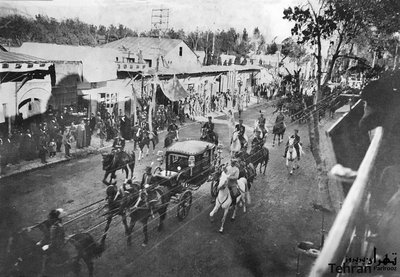
Coronation of Reza Shah, 1926. https://commons.wikimedia.org/wiki/File:Coronation_of_Reza_Shah.jpg
In 1925, Reza Khan became Shah (King) of Persia, founding the Pahlavi Dynasty and soon renaming the nation “Iran”. Reza Khan, in power for 16 years, recognized that the country could not compete in a rapidly industrializing world. He sought to modernize it, where modernization was understood as being more like the West.
Reza Shah created a centralized government bureaucracy, built a trans-Iranian railroad, created a well-equipped national army, unified the state by elevating Persian identity and language, banned education and published in non-Persian languages, required compulsory education, enforced Western dress codes for men and women — including banning the veiling of women — and raised the minimum age for marriage.
By venturing into the areas of law and education, Reza Shah brought the government into areas that had previously been dominated by religious leaders; his reforms generally diminished the power of clerics in the country.
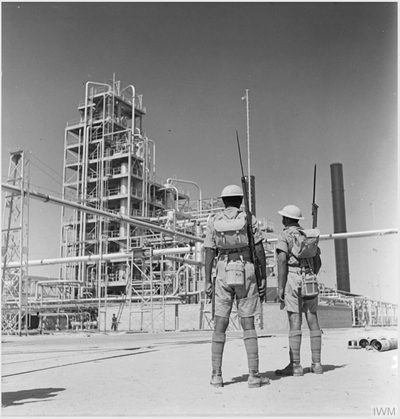
Indian soldiers of the British Empire guard an oil refinery in Iran during the Second World War. September 4, 1941. Keating, Geoffrey John. No. 1 Army Film and Photo Section, Army Film and Photographic Unit.
Reza Kahn also sought to expand trade beyond the dominant presence of Britain and the Soviet Union. He did so by establishing strong trade ties with Nazi Germany. Ultimately this led to the Anglo-Soviet invasion of Iran in 1941. The British Navy in particular needed Persian Gulf and Iranian oil reserves. Reza Khan was forced to abdicate the throne. His 22-year-old son, Mohammad Reza Pahlavi, became the new Shah.
Lesson: What we know about the U.S.-Israel attacks on Iran
Following World War II, Britain heavily invested in Iranian oil. Joined by the Americans, they were deeply suspicious of Soviet occupation of regions in northern Iran. Eventually the Soviets withdrew from the country due to British and American pressure. In early 1951, members of Parliament elected Mohammad Mosaddegh as their prime minister, representing a coalition of nationalists and clerics who tried to nationalize the renamed Anglo-Iranian Oil Company and audit the books of western oil companies.
Alarmed that Mosaddegh threatened western oil profits and was too close to the Soviet Union, the CIA and British intelligence MI-6 organized Operation Ajax, removing Mosaddegh from power by 1953. Ultimately a western consortium, led by British Petroleum, accelerated oil development in the country with profits overwhelmingly benefitting British and American companies, as well as the Shah and his family personally.
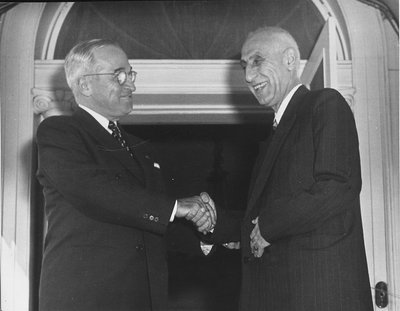
President Harry S. Truman greets Prime Minister Mohammad Mosaddegh of Iran as the latter arrives at Blair House, temporary Presidential residence in Washington D.C., Oct. 23, 1951.
Shah Mohammed Reza Pahlavi became a key U.S. ally. The United States provided massive military aid from 1953 through 1963; Iran’s army grew to more than 200,000. In the late 1950s, with the help of U.S. and Israeli intelligence, the Shah formed a special secret police unit, SAVAK, to monitor so-called domestic dissidents. SAVAK brutally attacked anyone opposing the Shah’s rule.
In 1961, the Shah dissolved the National Assembly and ruled by decree. Under pressure, he instituted liberal reforms — particularly related to women — as well as secular courts and secular education, but these measures were actively opposed by clerics.
Beginning in 1978, a combination of left-leaning and religious groups began organized protests against the Shah’s rule. They were met with a brutal crackdown and the imposition of martial law. But the Shah, who had been in power since 1941, was ill, and left Iran in January 1979. In his absence, in what became known as the Iranian Revolution, protestors took power as a revolutionary government, one soon dominated by Shi’ite religious groups led by Ayatollah Ruhollah Khomeini. Two weeks later, the Ayatollah, who led the revolution from exile, returned to the nation and became Iran’s Supreme Leader.
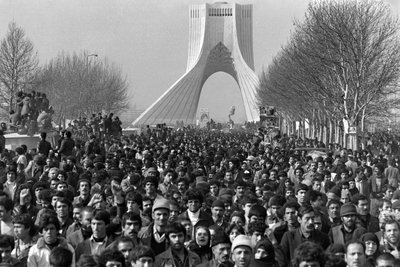
Hundred thousand of people gather at Tehran Freedom Square, formerly Monument to the Kings, to cheer the motorcade carrying Iranian opposition leader and founder of Iran’s Islamic republic ayatollah Ruhollah Khomeiny upon his return from exile on February 1, 1979 while the insurrection against the Shah’s regime spreads all over the country. AFP PHOTO GABRIEL DUVAL (Photo credit should read GABRIEL DUVAL/AFP/Getty Images)
When the U.S. admitted the Shah for medical treatment in late 1979, Iranian students seized the U.S. Embassy and took 66 Americans hostage. Students opposed the U.S. granting entry to the Shah, who they wanted returned to Iran in order to face justice for the many abuses/human rights violations committed by his regime. A rescue attempt failed. Hostages were held, often in desperate conditions, for 444 days, until Jan. 20, 1981.
Lesson: How Americans feel about U.S-Israel attacks on Iran
American–Iranian relations never recovered. Almost immediately, the Ayatollah’s government wrote a new constitution, replacing the National Assembly with a cleric-led Islamic Revolutionary Council. Street names were renamed for imams, martyred clerics and those identified as heroes of the “anti-imperial struggle.” Streets were renamed: Kennedy Square became Tohid Square, Eisenhower Avenue became Freedom Avenue and Roosevelt Avenue became Mofateh Avenue.
Strict rules were imposed on freedoms of movement, dress, marriage and work for women and men. (For one perspective on life in Iran during this period, see Persepolis, the 2003 book by Marjane Satrapi, b. 1969, documenting her experience pre- and post- the Iranian Revolution.) Even in the context of these restrictions, education expanded throughout Iran after the revolution.
Following the death of Ayatollah Khomeini in 1989, Ali Khamenei became the new Supreme Leader. While societal restrictions loosened slightly, women began protesting their social segregation and exclusion from portions of the work force. The women’s protests beginning in 2022, known as the “Woman Life Freedom” uprising, were met with a violent government crackdown.
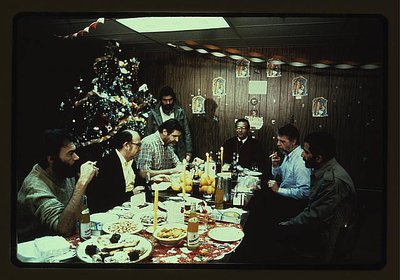
Photograph shows American hostages seated around table with a Christmas tree in the background, Tehran, Iran. Dec. 24, 1979. Hatami, photographer.
After Ayatollah Ali Khamenei declared that the protestors were “rioters” who should be “put in their place,” protests that again erupted in late 2025 were met with a violent government-led crackdown. As of late January 2026, it is believed that more than 5,000 protestors were killed by Iranian security forces.
Ali Khamenei remained Ayatollah for 37 years, through Feb. 28, 2026, when he was killed in the U.S.-Israeli military action in Iran on its first day. PBS Frontline: Remaking the Middle East: The U.S., Israel, and Iran (updated in 2026) offers an excellent review of the history of relations between the three nations.
The United States and Iran have not had direct diplomatic relations since 1980. Since 1995, the U.S. has had an embargo on trade with Iran that continued through 2016, when most sanctions were lifted. During the Obama administration, the U.S. successfully negotiated in 2015 a nuclear deal, the Joint Comprehensive Plan of Action (JCPOA), limiting Iran’s nuclear program and mandating international inspections. The Trump administration, in its first term, withdrew from the JCPOA and reestablished sanctions in 2018. To date the sanctions remain in place.
The Iranian Revolution of 1978-1980 and the subsequent hostage crisis were big news around the world. They also shaped long-lasting national narratives in both countries. These narratives, however, are very different. In the U.S., the hostage crisis is often told as an example of lawlessness and Islamic extremism, one in which the student protesters and the government of Ayatollah Khomeini are equally villains. In Iran, however, the story is framed as a fight for independence and sovereignty against a great bullying power.
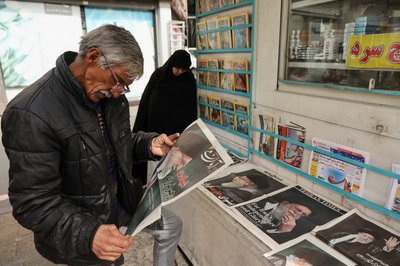
A man reads a newspaper with a cover photo of Iran’s late Supreme Leader Ayatollah Ali Khamenei, after he was killed in Israeli and U.S. strikes on Saturday, in Tehran, Iran, March 2, 2026. Majid Asgaripour/WANA (West Asia News Agency) via REUTERS ATTENTION EDITORS – THIS PICTURE WAS PROVIDED BY A THIRD PARTY
You can explore these different narratives through primary sources at the MIT U.S.-Iran Relations website. This carefully vetted website includes a timeline of American relations with Iran and a long list of documents, some from the U.S. and some from Iran, that you can analyze to see how the crisis developed and how the two countries have talked about it ever since.
Take a look at the Iran-U.S. Relations Project of the National Security Archive, which focuses on declassified documents, and consider watching the PBS American Experience episode “Taken Hostage.”
Contributed by Judi Freeman and Trevor R. Getz, executive director and former president, respectively, of the World History Association. The World History Association, through its global community of scholars, educators and students, nurtures, encourages and promotes the study of world history. For more information, visit thewha.org.
________________________________________________
Additional primary sources:
1949.12.30: Joint communique between the Shah of Iran and President Harry S. Truman
1979.10.07: Oriana Fallaci, “An Interview with Khomeini,” New York Times Magazine
1979+: Iranian revolutionary posters at the University of Chicago
1980.03.21: Ayatollah Khomeini, “We Shall Confront the World with Our Ideology,” broadcast on Radio Tehran
2006.09.19: Iranian president Mahmoud Ahmadinejad’s speech to the UN General Assembly
2009.06.04: U.S. President Barack Obama’s speech in Cairo, Egypt, addressed to the Muslim world