
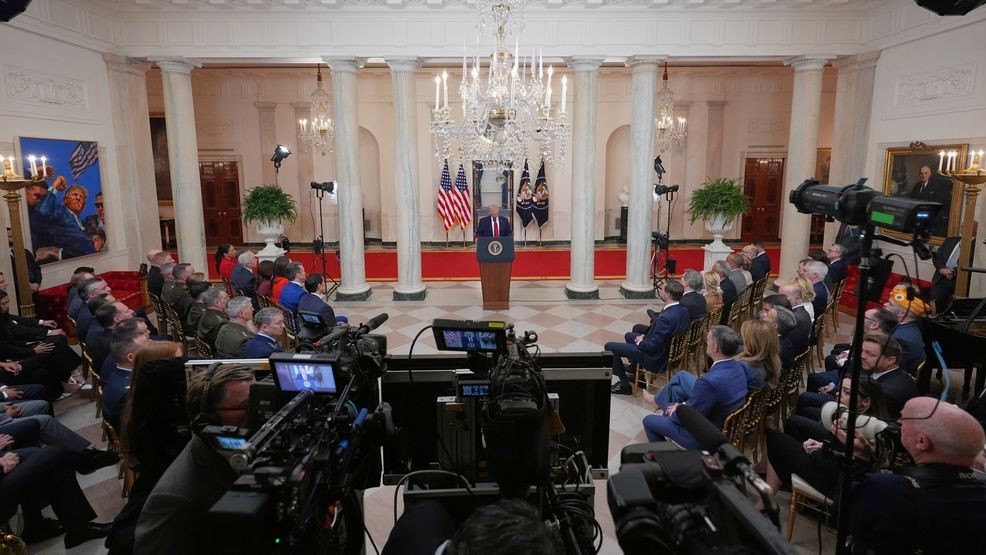
WASHINGTON (TNND) — Iran launched a new wave of missile attacks targeting Israel and Gulf Arab states on Thursday, escalating tensions just hours after President Donald Trump addressed the nation and outlined the next phase of U.S. military action.
Just before Trump began his address — in which he said U.S. “core strategic objectives are nearing completion” — explosions were heard in Dubai as air defenses worked to intercept an Iranian missile barrage.
Within minutes of the speech concluding, Israel confirmed it was responding to additional missile threats, while sirens sounded in Bahrain, home to the U.S. Navy’s 5th Fleet.
Attacks continued across Iran on Thursday, with strikes reported in multiple cities.
During his speech, Trump claimed U.S. military action had been so decisive that “one of the most powerful countries” is “really no longer a threat.”
In return, a spokesman for Iran’s military, Lt. Col. Ebrahim Zolfaghari, insisted Thursday that Tehran maintains hidden stockpiles of arms, munitions, and production facilities. He said facilities targeted so far by U.S. strikes are “insignificant.”
As tensions rise, nearly three dozen countries are convening to address the growing crisis in the Strait of Hormuz.
British officials are leading a virtual meeting involving 35 nations, including members of the G7 — excluding the United States — as well as Gulf partners such as the United Arab Emirates and Bahrain. The group previously issued a joint statement calling on Iran to reopen the Strait of Hormuz.
In his address, Trump called on countries that rely heavily on oil shipments through the Strait of Hormuz to take action themselves, saying they should “build some delayed courage” and secure their own interests.
At the same time, the president warned that U.S. military operations against Iran are set to intensify. “We are going to finish the job, and we’re going to finish it very fast,” Trump said, adding that American forces would strike Iran “extremely hard” over the next two to three weeks, even as he claimed U.S. strategic objectives are “nearing completion.”
Iran has also continued strikes on Gulf energy infrastructure, contributing to rising global energy prices and increasing economic pressure worldwide. Oil prices surged again following the latest escalation, with Brent crude climbing to approximately $108 per barrel, up nearly 50% since the conflict began.
The disruption in shipping through the Strait of Hormuz — even at reduced capacity — has rattled global markets, particularly in countries heavily dependent on Middle Eastern energy exports.
The U.S. has reportedly presented Iran with a 15-point ceasefire proposal, which Iran rejected, insisting the war will end only on its own terms.
The administration had previously set deadlines for Iran to reopen the Strait of Hormuz or face further consequences.
More than 1,900 deaths have been reported in Iran, at least 19 in Israel, and dozens across Gulf states and the West Bank. Thirteen U.S. service members have been killed, while more than 1,200 people have died in Lebanon, and over 1 million have been displaced.
Editor’s Note: The Associated Press contributed to this story.