
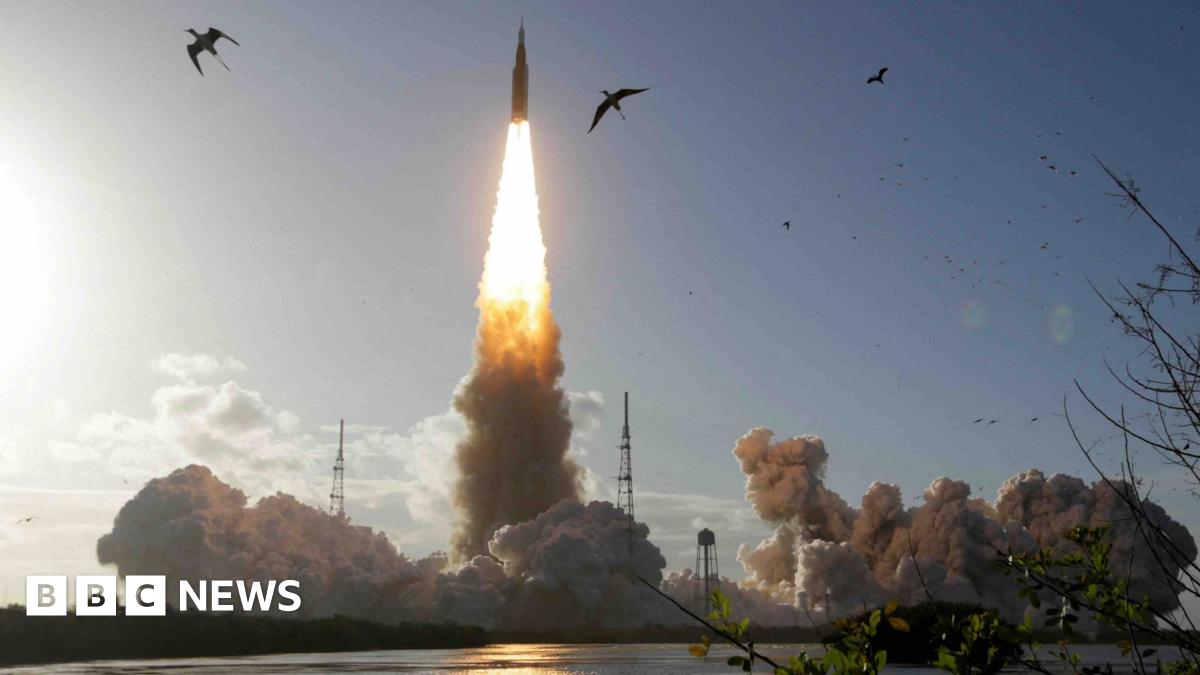
The delicate technical choreography – including rocket booster separations – went as planned as Artemis passed the Kármán line boundary between Earth’s atmosphere and space.
“After a brief 54-year intermission, Nasa is back in the business of sending astronauts to the Moon,” Nasa administrator Jared Isaacman told a news conference.
They won’t land on the Moon during their 10-day mission, but plan to circle it and could travel further from Earth than anyone has ever been before returning.
This mission will set the stage for a crewed lunar landing currently scheduled for 2028, then further out, plans for a permanently crewed base on the Moon and an eventual voyage to Mars.
On Thursday the focus was very much on the next key stage – the powerful engine burn known as the “translunar injection” that will sling the crew out of Earth orbit and on towards the Moon.
Before that could happen Artemis needed to go a little higher in its orbit. That manoeuvre – a perigee raise burn – went smoothly.
The astronauts had woken up to oversee this after what will have been a welcome although brief sleep of a few hours.
Chatter from the Orion capsule suggested they were in good spirits, although feeling a chill.
Astronaut Christina Koch asked mission control: “It is very cold in the cabin, any chance you can make it warmer, or reduce the cabin fan speed a bit more so the ventilation is not blowing as hard?”
Mission control is working to warm things up.