
Welcome back to World Brief, where we’re looking at international efforts to reopen the Strait of Hormuz, a 7.6 magnitude earthquake off Indonesia’s coast, and Armenia having to choose between Russia and the European Union.
Strait Talk
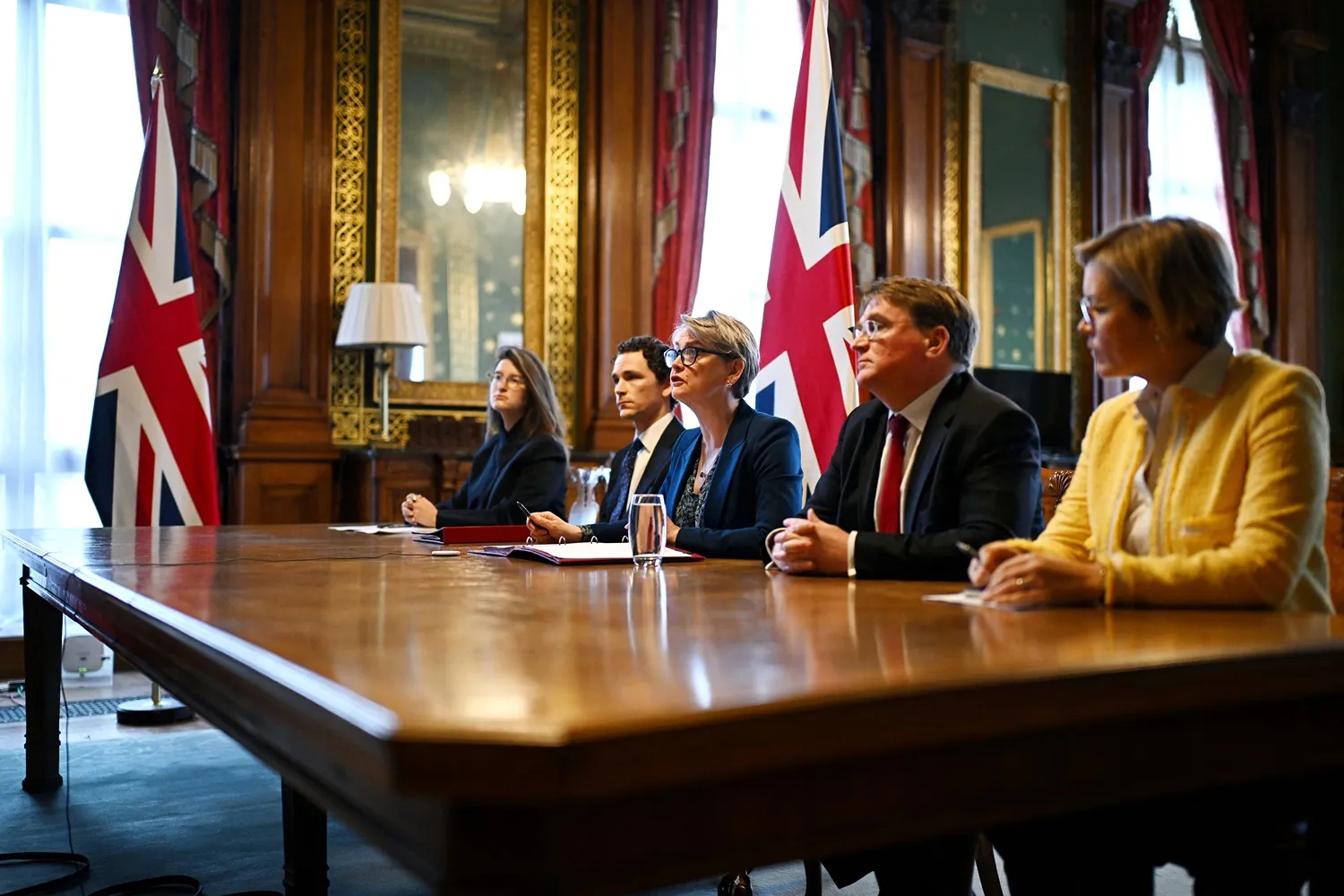
The United Kingdom hosted virtual talks on Thursday focused on forming a coalition to explore ways to reopen the Strait of Hormuz. Representatives from more than 40 countries attended, highlighting what British Foreign Secretary Yvette Cooper called “the strength of our international determination” to secure the strategic waterway.
Welcome back to World Brief, where we’re looking at international efforts to reopen the Strait of Hormuz, a 7.6 magnitude earthquake off Indonesia’s coast, and Armenia having to choose between Russia and the European Union.
Strait Talk
The United Kingdom hosted virtual talks on Thursday focused on forming a coalition to explore ways to reopen the Strait of Hormuz. Representatives from more than 40 countries attended, highlighting what British Foreign Secretary Yvette Cooper called “the strength of our international determination” to secure the strategic waterway.
Yet, one empty chair loomed large over the meeting. The United States was notably absent from Thursday’s talks, after U.S. President Donald Trump argued that it was the responsibility of other countries that rely more on the strait to resolve the issue. “Go to the strait and just take it, protect it, use it for yourselves,” Trump said during a nationwide address late Wednesday. “Iran has been essentially decimated. The hard part is done, so it should be easy.”
Since the Iran war began on Feb. 28, Iranian forces have taken effective control of the Strait of Hormuz, through which one-fifth of the world’s oil normally transits. At least 23 direct Iranian attacks on commercial vessels in the Persian Gulf have been recorded thus far, according to Lloyd’s List Intelligence, a shipping data firm. Such insecurity has sparked an unprecedented disruption to global energy flows, causing oil and gas prices to soar and depleting fuel stocks around the world.
Trump has repeatedly urged European countries to deploy their militaries to the region to help reopen the strait. But the United States’ Western allies have resisted getting directly involved. “This is not our war, and we’re not going to get dragged into it,” British Prime Minister Keir Starmer said on Wednesday.
But weeks of energy shocks that have forced nations to tap their strategic oil reserves and institute emergency conservation measures may have finally outweighed this hesitancy. Thursday’s coalition attendees did not agree to any concrete solutions; however, they vowed to hold more detailed discussions involving military planners in the coming weeks.
What such a plan might look like remains unclear. One European official told Reuters on Thursday that any first phase would likely focus on making sure that Hormuz is clear of mines, followed by a second phase aimed at protecting tankers crossing the strait. This would align with a joint statement issued last month by many of the same governments that attended Thursday’s meeting. That statement called on Tehran to “cease immediately its threats, laying of mines, drone and missile attacks and other attempts to block the Strait to commercial shipping.”
Meanwhile, the United Nations Security Council convened on Thursday to vote on a Bahrain-sponsored resolution that would authorize countries to use military force to reopen the Strait of Hormuz. The draft is supported by several Gulf Arab nations.
Yet, French President Emmanuel Macron has expressed concerns with such a plan. During his trip to South Korea on Thursday, Macron said that reopening the strait by force was “unrealistic” and could “only be done in coordination with Iran” following the establishment of a cease-fire. Paris has pushed for the creation of an international mission that would escort ships through the waterway.
Bahrain’s foreign minister said he hoped that the Security Council would vote on the draft resolution on Friday.
Today’s Most Read
What We’re Following
Major earthquake damage. A 7.6 magnitude earthquake struck off the coast of Indonesia on Thursday, severely damaging buildings, triggering small tsunami waves, and killing at least one person. According to Indonesia’s Search and Rescue Agency, at least four others were injured, three of whom were hospitalized.
The quake’s epicenter was just 93 miles from the densely populated Indonesian islands of Ternate and Sulawesi. Although local authorities are still assessing the extent of the damage, particularly in remote areas, they believe that further casualties are unlikely. The tsunami alert has been lifted.
Indonesia sits on the “Ring of Fire,” a roughly 25,000-mile belt of seismic activity along the Pacific Ocean where around 75 percent of the world’s active volcanoes are located and 90 percent of all earthquakes occur. Indonesia, specifically, has experienced several devastating earthquakes and tsunamis in recent years.
A tough choice. Russian President Vladimir Putin warned Armenian Prime Minister Nikol Pashinyan on Wednesday that Armenia cannot be part of both the European Union and the Russia-led Eurasian Economic Union. Moscow is “completely calm” about Yerevan’s efforts to forge closer ties with the EU, Putin told Pashinyan. However, the Russian leader said that being part of both economic blocs was “impossible,” and he stressed the importance of Armenia’s relationship with Russia, noting how Armenia receives Russian natural gas at a much lower cost than European prices.
Armenia has sought to bolster ties with the West after the United States brokered the Armenia-Azerbaijan peace deal last August. Pashinyan has declared his intent to join the EU, and he suspended Armenia’s participation in the Russia-led Collective Security Treaty Organization in 2024. However, the EU remains hesitant to approve Armenia’s membership bid, and the bloc has not discussed any trade deals with the country in the interim.
This puts Pashinyan in a tight spot, especially as Armenia has long held close (but recently fraught) ties with Russia. Relations became strained in 2023, when Armenia accused Russian peacekeepers stationed in the disputed Nagorno-Karabakh region of failing to stop Azerbaijani forces from seizing the territory. On Wednesday, Putin argued that Pashinyan’s decision in 2022 to recognize the region as part of Azerbaijan had made it impossible for Russia to intervene.
Normalizing ties. The U.S. Treasury Department removed sanctions on Venezuelan leader Delcy Rodríguez on Wednesday. Lifting sanctions will allow her to travel to the United States (opening up the opportunity for a White House visit) and conduct business with U.S. companies without threat of prosecution. Rodríguez is the only member of the Venezuelan government from whom the United States lifted sanctions.
“We value President Donald Trump’s decision as a step toward normalizing and strengthening relations between our countries,” Rodríguez wrote on Telegram. “We trust that this progress will allow for the lifting of current sanctions against our country, enabling us to build and guarantee an effective bilateral cooperation agenda for the benefit of our people.”
The move is part of the Trump administration’s effort to normalize ties with Caracas since U.S. forces captured then-Venezuelan President Nicolás Maduro in January. Last month, the U.S. State Department announced plans to reestablish diplomatic ties with Venezuela, and this week, it formally began operations to reopen the U.S. Embassy in Caracas.
Rodríguez has advocated for closer ties with the United States since taking over as interim leader, including by liberalizing Venezuela’s economy and opening Caracas to U.S. investment. These policies appear to have appeased Trump—who has stopped short of supporting Venezuelan opposition leader María Corina Machado—even though Rodríguez has largely kept her predecessor’s repressive regime in power. However, Machado had a closed-door meeting with U.S. Secretary of State Marco Rubio on Tuesday in Washington to discuss a path toward restoring democracy in Venezuela.
Odds and Ends
Four astronauts blasted off from Florida’s Kennedy Space Center on Wednesday as part of NASA’s Artemis II mission to the moon. The daring 10-day voyage is the first time that humans have left Earth’s orbit in 53 years. Although the Artemis II crew (which consists of three Americans and one Canadian) will not step foot on the moon’s surface, the mission is a precursor for U.S. efforts to eventually land on the lunar South Pole, which is believed to have water-ice deposits that can be used to create fuel essential for eventual travel to Mars. NASA hopes to accomplish this by 2028 in an effort to beat China to the coveted spot; Beijing plans on reaching the moon’s South Pole as early as 2030.