
If you are an analyst at a U.S. or Israeli intelligence agency summarizing the status of the conflict with Iran, a report would look, on balance, rather grim.
First, the Islamic Regime has not fallen, which means the long-term threats it poses to its population and the world remain. More specifically, hard line elements appear to remain in control according to well-sourced Iranian diaspora reporting, and they are still fighting with daily ballistic missile and drone attacks against U.S. interests in region, Israel, and the Gulf states. The Iranian leadership almost certainly feels that it is in a relatively solid position strategically as the energy crisis they have created through attacks on ships in the Strait of Hormuz is causing global economic disruptions.
While the Iranian leadership and IRGC knows that their conventional military has been seriously degraded, they reportedly still retain roughly half of their missile launchers, roughly half of their drones, and, even more importantly, can turn to Russia and China to rebuild these capabilities over time. The resumption and potential acceleration of their nuclear program is still a possibility as their enriched uranium lies underground and is likely retrievable. The U.S. special operations command has reportedly moved requisite forces in to the region for such an operation given the threat. However, U.S. casualties almost certainly would be significant, and it is unclear if President Trump would take such a risky decision given the potentially enormous costs and political blowback that could ensue.
Moreover, Iran has not yet unleashed its global terrorist apparatus on the West. While there have been attacks that are likely inspired by support for Iran and Hezbollah, intelligence agencies have warned for years about cells of Iranian agents that could potentially pursue Iran’s plans for asymmetric warfare and payback for the attacks they have endured.
Despite the highly positive military math delivered daily by Pentagon briefings that claim U.S. war objectives are all being met, there is ample evidence that Iran likely believes they are winning, especially the long game. The bottom line is that from the Iranian perspective, this conflict is not yet over in any sense. Iran knows they have cards remaining to play, and they will use them if the United States and Israel continue to climb the escalation ladder. Indeed, as President Trump continues to terrorize Iranians by threatening to destroy bridges and power plants, he risks fomenting popular resentment against the United States not undermining the regime.
These assessments would be highly unwelcome by the U.S. or Israeli administrations, who are trying to put the best face on the status of this conflict.
President Trump has seemed surprised that the Iranian regime did not fold like a deck of cards and generally does not know what to make of Iranian resiliency. Secretary Hegseth too was also reportedly “caught off guard” by Iran’s escalation.
While U.S. and Israeli intelligence agencies are no doubt working overtime on collection – and, indeed, some of our points above are based on news reporting of updated intelligence assessments – the real question is the following: if Iran is proving to be a more formidable adversary than we anticipated, how good has our collective intelligence been?
On the other side of the ledger, much has been written about the superb U.S. and Israeli intelligence community targeting efforts on the initial (and some follow-on) decapitation strikes, when the Iranian supreme leader Khamenei and many of his senior officials were killed. The “find, fix, and finish” methodology that was developed and refined in the Global War on Terrorism appeared to work at least at the outset of this conflict. In fact, the joint efforts reportedly were sparked by the U.S. recruitment of a human source on the ground, who could provide requisite “pattern of life (POL)” on the Supreme Leader. The Mossad reportedly hacked traffic cameras in Tehran to support this effort, demonstrating the creativity for which they are famous. These are no small feats and should be highly commended. We are sure there was a great deal of quiet satisfaction in the halls of CIA and at Mossad headquarters in realizing the goal of eliminating some of the world’s most evil men.
Yet the applause around this success may in fact mask a potentially serious collection gap, as we don’t see the United States or Israel gaining advance knowledge of Iranian regime plans and intentions. Why are we concerned about this? Because both Washington and Jerusalem seem to have been repeatedly caught flat-footed from the strength and character of the Iranian response. The Iranian aerial attacks against over a dozen countries in the Middle East and the closure of the Straits of Hormuz should have been actions that were picked up by U.S. and Israeli spies. These tactics – especially the closing of the Straits – were very well known as possibilities amongst those who have worked on a potential war with Iran. Our reactionary posture, however, suggests they were somehow not fully anticipated, which may also be the result of decision-makers, especially including the president, not listening to the intelligence provided. But CIA Director John Ratcliffe in recent testimony on Capitol Hil claimed to speak directly with President Trump multiple times per week plus was “in the room” for all relevant major decisions that Trump has taken on Iran.
So what are the questions that the CIA and Israeli collection are perhaps not adequately answering? There are quite a few, but essentially the following are logical collection priorities:
What is the actual health status of the Supreme Leader?
Who is making the important decisions within the Iranian government, and what are their current plans for potential leadership succession?
Will Iran continue hitting Gulf energy targets and what does their escalation ladder look like?
Will the Houthis enter the fray further?
Has Iran mobilized their overseas terrorist apparatus and under what conditions will they do so?
Are U.S. strikes against critical economic infrastructure counterproductive to any goals of regime change?
All these questions require high-level penetrations of the Iranian regime and more. Not just someone who can provide the POL on a target to be eliminated. We require the recruitment of human agents who can provide unique granular level detail on the plans and intentions of the Iranian military, political, and intelligence leadership.
Israeli intelligence deserves a bit of extra scrutiny after a recent well-sourced media report indicated that Mossad promised Prime Minister Netanyahu (who relayed this to Trump) that Israel via covert action could lead a quick and successful uprising against the regime. This of course never occurred, and, as a result, this optimistic scenario may turn out to be a grave intelligence error. Of note, the decapitation strikes and other kinetic high value target operations are far less complex than fomenting an uprising.
Finally, even if Mossad was far too optimistic in pushing this plan, what did CIA Director Ratcliffe and other operational and analytic leaders in the U.S. intelligence community say to Trump about the odds of success? After all, it is the job of U.S. intelligence community senior personnel to comment on and critique any high-risk operation that is planned by a friendly liaison service.
Taking out bad actors with U.S. and Israeli blood on their hands who continue to pose severe threats is, on our view, often a correct course of action and both the U.S. and Israeli intelligence services excel at it. But the more subtle art of developing sources and divining the intentions of adversaries does not seem to have been as successful here. The wildcard of course sits in the Oval Office – if he is simply not properly listening to his intelligence community the best spy efforts won’t matter.
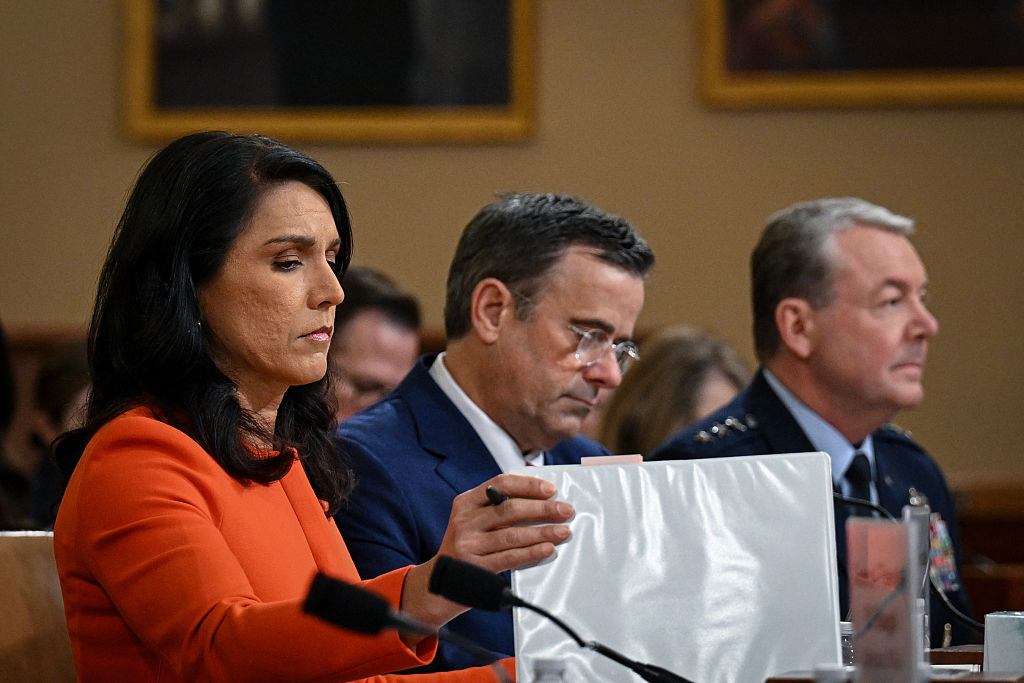
FEATURED IMAGE: (L-R) Director of National Intelligence Tulsi Gabbard, CIA Director John Ratcliffe, and Director of the Defense Intelligence Agency Lt. Gen. Jeffrey Kruse testify during a House Permanent Select Committee on Intelligence hearing on “Worldwide Threats,” on Capitol Hill in Washington, DC, on March 26, 2025. (Photo by Drew ANGERER / AFP) (Photo by DREW ANGERER/AFP via Getty Images)