
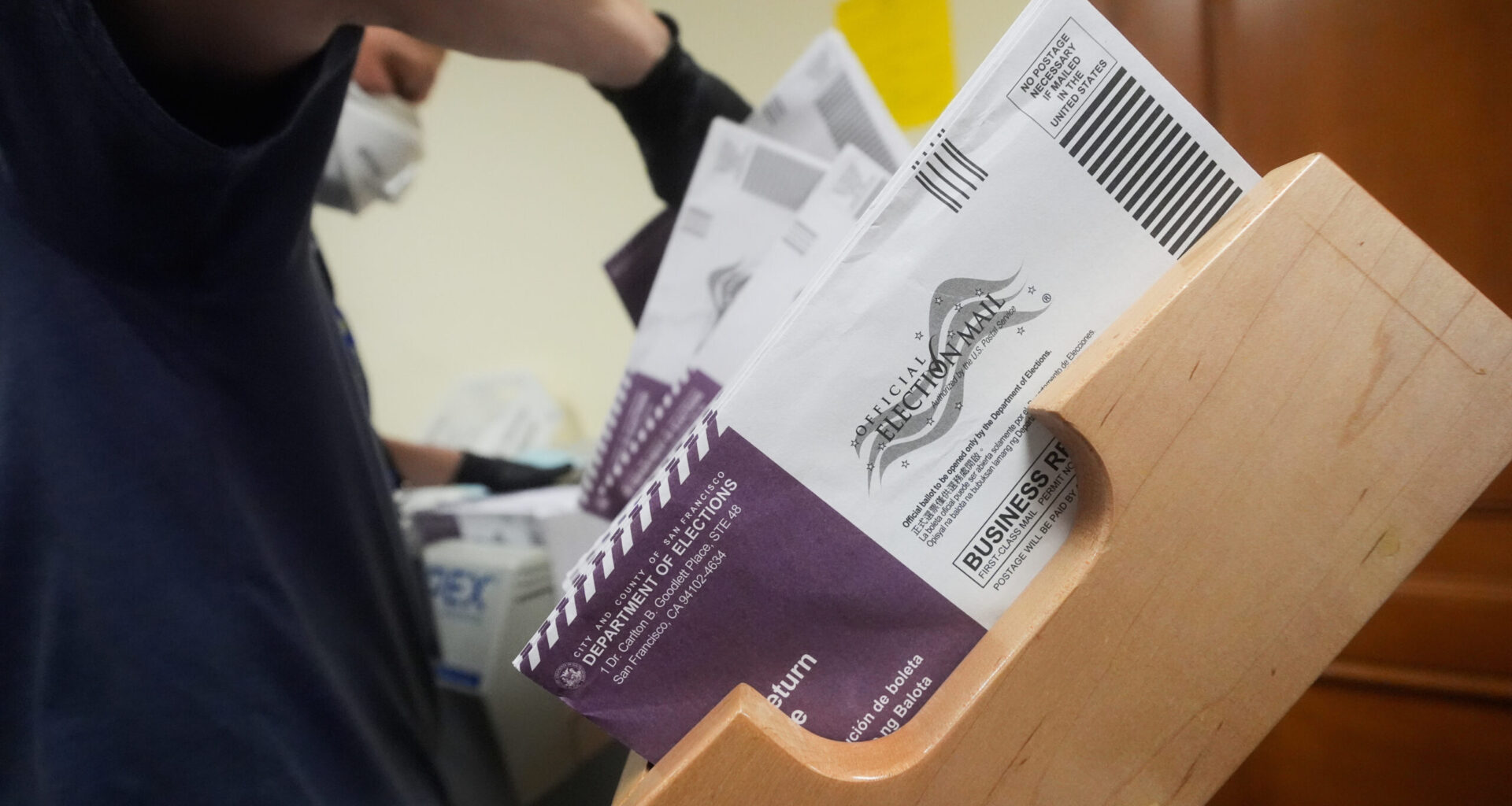
In California, there were far more mail-in ballots rejected for arriving too late in last November’s election than those rejected the year prior. Recent changes to how the U.S. Postal Service (USPS) collects and postmarks mail may explain why, and could signal future problems if President Donald Trump is granted more federal control over mail-in ballot procedures.
An average of 8 out of 1,000 mail-in ballots were rejected in last November’s election due to arriving past the legal post-Election Day deadline, according to a Los Angeles Times review of voter data. This was a quadrupling of the average number of rejected mail-in ballots for the same reason from November 2024’s election.
The difference between the two elections: A new USPS policy that changed when mail would be picked up in counties that sit far away from California’s six mail processing centers. In those mostly rural counties, ballots mailed on Election Day are now more likely to go un-postmarked that same day, and less likely to get processed and delivered in time to get legally counted.
USPS spokesperson Nikolaj Hagen told the L.A. Times that the new policies would “result in some mailpieces not arriving at our originating processing facilities on the same day that they are mailed.”
For this reason, California Secretary of State Shirley N. Weber and Attorney General Rob Bonta warned voters ahead of last November’s elections that they should aim to mail in their ballots far ahead of Election Day. Under California law, ballots are counted within a five-day grace period as long as it’s postmarked by Election Day.
“Under the U.S. Postal Service’s new process, mail dropped off at post offices and mail collection boxes more than 50 miles from a U.S. Postal Service regional hub is collected the next day, instead of the same day,” reads the state officials’ October 2025 press release. “This means that, in some areas, ballots dropped off at a post office or mail collection box on Election Day won’t be postmarked until the day after, making them late. Late ballots are not counted.”
The jump in rejected ballots comes at a time when Trump is attempting more control over how the USPS handles mail-in ballots, with an ultimate goal of possibly ending the longstanding absentee voting process altogether. Trump is attacking mail-in voting under the false pretense that it produces voter fraud.
Despite voting by mail himself, Trump signed a sweeping executive order this week that instructs the USPS to issue mail-in ballots exclusively to voters on approved federal lists and modifies current ballot envelopes with barcodes for federal tracking. The executive order was immediately avalanched by dozens of lawsuits declaring it unconstitutional.*
The Republican National Committee is also attacking mail-in voting via its legal challenge against a Mississippi law that counts appropriately postmarked absentee ballots that arrive within a five-day window of Election Day.
Oral arguments in that case were heard on March 23, wherein U.S. Supreme Court justices appeared split on whether to disqualify Mississippi’s law. The ruling will have implications for 14 other states – including California – and several U.S. territories that also have post-Election day grace periods.
*Democratic plaintiffs in this case are represented by the Elias Law Group (ELG). ELG Chair Marc Elias is the founder of Democracy Docket.