
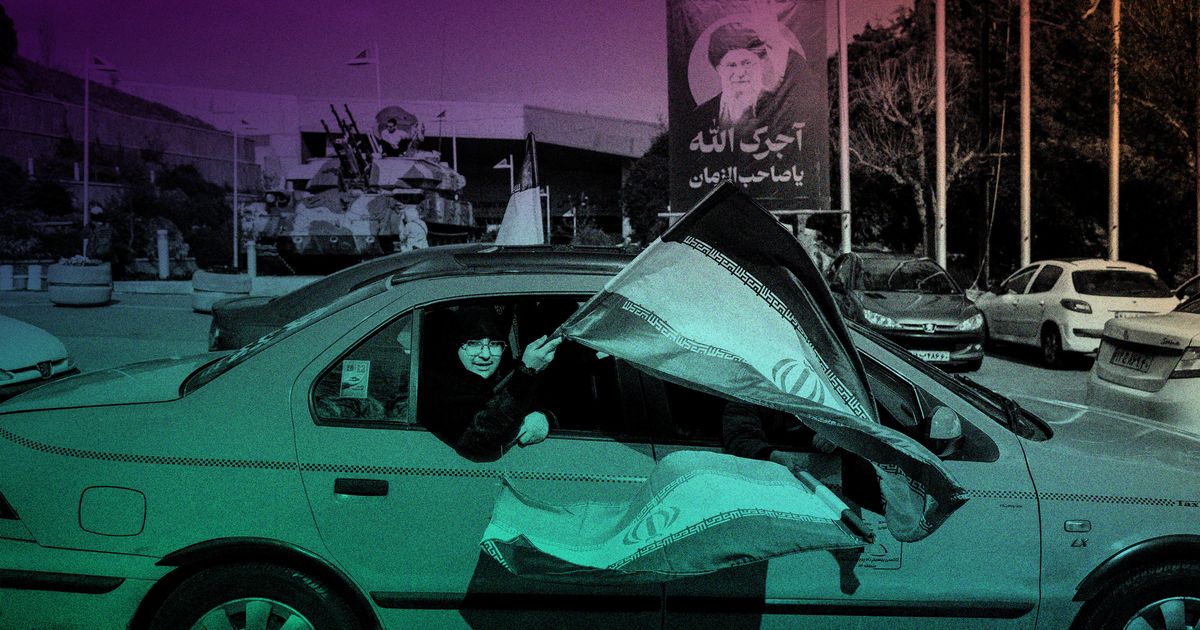
Photo-Illustration: Intelligencer; Photo: Getty Images
After the U.S. rescued an airman who had been shot down above Iran over the weekend, President Donald Trump threatened to commit war crimes against the country if it did not reopen the Strait of Hormuz, the near closure of which is creating an oil and gas crisis around the world. “Tuesday will be Power Plant Day, and Bridge Day, all wrapped up in one, in Iran,” he posted on Truth Social. “Open the Fuckin’ Strait, you crazy bastards, or you’ll be living in Hell – JUST WATCH!” But Trump’s unhinged and desperate bravado speaks to his lack of tangible accomplishments — or a coherent exit strategy — six weeks into the war he helped start. The U.S. and Israel continue to bombard Iran, but there has been no sign that the regime is crumbling; Iran, meanwhile, is still militarily capable enough to wreak havoc on its neighbors and maintain control of the waterway that may be its biggest bargaining chip. And as the war drags on, Trump is bleeding support from his nominal allies and from American voters.
To understand how the Trump administration so badly misjudged its adversary (despite loud and abundant warnings) and how Iran might use its newfound leverage at the negotiating table, I spoke with Vali Nasr, one of the world’s foremost experts on Iranian politics. Nasr has had a long career in academia and government, including serving as a senior adviser in the Obama State Department. He is a professor at Johns Hopkins University’s School of International Studies, where he was the dean for several years, and is the author of Iran’s Grand Strategy and many other books.
You told The Wall Street Journal recently that “To the Iranians, the Strait of Hormuz now matters more than the nuclear program. The nuclear program was symbolic, but didn’t provide them with any deterrence. Now, the only reason why they are surviving this war is because of the strait.” Iran fully understands the leverage it has here, so do you think Trump would accept a deal where Iran reopens the strait but can still close it at any point in the future?
Well, I don’t know what choice the U.S. has. If Trump is looking for total victory here, then he’s setting himself up for a much larger war. He thought it’d be a short war, that the regime in Iran would go in a different direction. We’re now into the second month, and it’s not unfolding the way he wanted it. It’s gone longer and has cost much more. So if he wants for Iran to have no say about if and when the Strait of Hormuz closes in the future, he needs to pursue this war into a much more expansive and longer phase.
Reports indicate that Iran maintains a significant capacity to launch missiles and drones. Let’s say there is a more prolonged war, or at least more prolonged than a couple of weeks. How do you see Iran’s capacity to fight something like that?
For now, they have the ability. I don’t see a collapse yet of social order in Iran, of daily life, of electricity, fuel, food. Yes, the population is under enormous pressure, but the Islamic Revolutionary Guard Corps is able to fight, and the kind of fight needed to keep the Strait of Hormuz closed is not the same as the ability to fight against Israel with sophisticated, large-scale ballistic missiles that can get through the Iron Dome. This is a much lower-level war. You can hit a tanker with a very cheap drone, and that will affect the willingness of companies to put their tankers through the Gulf.
Neither side of this war can go on forever. The question is what is the pain threshold for each side, and what is their level of endurance going forward? Iran’s endurance so far has been greater than what President Trump anticipated or Israel anticipated at the beginning. Maybe Iran will collapse tomorrow morning, or in two weeks. Maybe they can go on for another six months. Ultimately, President Trump cannot only be thinking about Iran’s breaking point. He has to be thinking about his own threshold of pain.
Iran has quite a bit of leverage, as we’ve established. So what kind of concessions would they be willing to make to Trump, given their favorable position?
Iran’s former foreign minister put it in an article in Foreign Affairs: They’re willing to cut a deal with him on the nuclear issue — what they offered in Geneva and perhaps even more. If Trump is willing to give them a symbolic fig leaf that they have a right to enrich, with the understanding that they won’t, he can always claim that he got them to abandon their nuclear program, and he’d get the Strait of Hormuz opened.
But because he went into this war without any clear goals and with assumptions that are not all true, he may persist as LBJ did in the Vietnam War and try to escalate to get some big victory. But if that big victory does not come and the cost to the United States begins to add up — first in economic terms, and then if soldiers get killed, plus the cost of what the United States loses elsewhere in the world — the war in Ukraine, in its competition with China — then at some point he would have to try to snatch some modicum of victory out of jaws of defeat.
We know that the Iranian regime is very unpopular, at least in some quarters, but there hasn’t been any kind of serious revolt since this started. Why is that not happening? Is it fear after the brutal crackdown in January? Is it more of a rally-around-the-flag effect given that the country is under attack?
I think this was a straw man that was created in the West, as if somehow the majority of the people of the country would go into a political protest in the middle of a war. First of all, it’s practically unrealistic. There is no political party or a movement to lead Iranians into a coherent, prolonged political revolt against the Islamic Republic. A periodic explosion of anger is not the same thing as a sustained political movement. Secondly, when people are having bombs dropped on their heads, it is not the time to be organizing around a political cause. From the minute the war started, the most important issue facing the country has been bombs dropping on the heads of its people.
I cannot think of any historical cases where angry, unhappy people have revolted in the middle of a war. It didn’t happen in Iraq, for instance. It didn’t happen when Israel attacked Iran in June. And so I think this was created as a false expectation. Partly it’s that in a time of war, people are worried about safety. People run away from Tehran to go to other provinces and places.
And the longer the war has gone, even though Israel claims it’s degrading instruments of repression in Iran, what people are seeing is that the country is being destroyed. The unity of the anti-government political stance has been broken down by those who say that the Islamic Republic should be destroyed at all costs, including the cost of damage to Iran itself. Then there are those who say the Islamic Republic should be destroyed but not at any cost. There’s a lot of diversity of reaction to this war, which does not make for a very concerted political movement.
There’s also some cynicism from the West on this, I think. Netanyahu claimed that the war would bring about regime change but could be using that as a kind of excuse to just generate as much chaos in Iran as possible.
I think very much so. I think the Islamic Republic lost its public a long time ago. But it’s also true that an enormous amount of money went into television stations and social media outside Iran to weaponize the political unhappiness of the Iranian people. Israel has been supporting the Shah’s son and these very well-funded television stations running out of exile. The massive social-media campaign directed at the Iranian people amounted essentially to Israel looking at the domestic political scene in Iran as an instrument of war on the Islamic Republic. It hoped that the people would be an add-on factor for Israel, but in reality it hasn’t worked out that way.
Maybe the first day of the war when Khamenei died, people said, “Good riddance, maybe something better will come out of this.” But then the war didn’t stop there. It continued and it got bigger and bigger, and the targets became much more civilian. Israel hit the Pasteur Institute in Tehran, and they claim on social media that this was a place doing biological-warfare research. But everyday Iranians know that institute. It’s in the busiest part of Tehran. It’s a building that is perfectly accessible to everybody, where people went to get vaccinations. To say that the same facility was a supersecret biomedical lab is not believable to everyday Iranians. People outside could believe this sort of argument, but I don’t think the people inside believe it.
The longer the bombing goes on, the more there is a nationalist feeling that is much larger than the Islamic Republic. I’ve read many people observing that in the 2,500 years of Iran’s history, many governments have come and gone. What matters is the country surviving, and the country is bigger than just 47 years of Islamic Republic. And ultimately the loyalty of all Iranians, including the pro-regime Iranians, is to the country, not to the regime, not to a particular government. That’s becoming more and more apparent. I think the portion of Iranians, both outside and inside Iran, who are willing to argue that the Islamic Republic should be destroyed at any cost, including the cost to the country itself, and who would thank Trump and Bibi for bombing it, is getting smaller and smaller.
What’s your sense of who’s actually running the country now? The new supreme leader, Mojtaba Khamenei, still hasn’t been seen in public since he got the job, and you’ve got a lot of people speaking out who aren’t actually involved in the current government. So it’s hard to tell who’s actually in charge.
Although that’s always been the case with Iran. That’s partly the way the system is set up, that it’s multimodal. There’s not a single authority. It’s not like the way it was under the Shah or under Stalin. In Iran, everybody was always speaking at the same time. Even during nuclear negotiations, the president would say something and some Revolutionary Guard commander would contradict him. There’s no message discipline; in other words, everybody is an authority unto themselves. But that’s part of the reason why the Islamic Republic has survived, because it doesn’t depend on one person.
So you have a political machine and a bureaucratic machine and a military machine, all of which are not dependent on people but are genuinely machines. They’re institutions, and the decapitation of people has not impeded the functioning of those institutions. The revolutionary guard is still fighting, the government is still functioning, the political machine is still functioning, but the personalities have changed. So yes, you have a supreme leader who was probably injured during an airstrike. Ultimately, if there is a deal on the table or some big issue, he would have to own it and render a verdict on it. The role of the supreme leader in Iran has largely been not as a micromanager decision-maker like the Shah or Mohammed bin Salman but rather an arbiter of different opinions on a key issue.
The final word, is the way I always understood it.
The final word, but actually, the way the father ruled over 40 years is that he would go out of the way to create a consensus, and only then would he weigh in and try to bring the system along as a whole. It’s still too early to know what the son’s leadership style is. And then there are people below him, from the Speaker of the Parliament to the head of the judiciary, to the president who’s in charge of the bureaucratic function in the government, to revolutionary guards, the national security adviser, etc. — some of whom are new to the job because their predecessor was assassinated by Israel. All of those people are decision-makers.
What is different is that some of these people are new, so we don’t know their record very much in the job as opposed to somebody like Ali Larijani, who was there a very long time. The other is that there was a lot more decision-making in Iran that was happening above the ground. Now things have become much more secretive and underground, so it’s less visible to us.
There’s this notion that if you kill enough people in the regime, something will really change.
There is a change, because the killings eliminated the old guard, which tended to be more prudent and a little less risk-taking, and replaced it with a far more aggressive, hawkish version of the Islamic Republic. So when President Trump says there was regime change in Tehran, he’s correct. They did bring bad regime change, except it’s not more reasonable people. Or maybe they’re more reasonable, but they’re also extreme hawks. There is a difference between Larijani, who was killed by Israel and the über-hawkish general who replaced him, in terms of caliber, political orientation, where they come down on issues. Yes, every regime ultimately has a breaking point, but the way Iran is organized is that the breaking point definitely is not where President Trump expected, which was on day two, day three. This is not about hitting one or two people and the system collapses.
And getting to that breaking point would require the patience of the American public and more money and more troops and more everything. Which is not an attractive prospect for Trump.
No, particularly because President Trump never laid out a case for this war and why it was actually urgent and needed to happen. It’s like he’s presenting the war to the American people as a solution, but he’s not clear about what the problem was. So he’s making things grandiose: They were about to have a bomb, their ballistic missiles would reach the United States, or this is payback for 47 years of the worst kind of people. He first said the regime had killed 32,000 people earlier this year. Then, the other night, he said 45,000 people. To me, it all sounds like he started a war thinking it was going to be short and sweet. But now, because the war was ill-defined and Americans never understood the urgency, it is much more difficult for him to justify the escalating cost of the war. If he’s going there, he’ll have to risk a lot more politically.
If you had to guess how this resolves, does the pathway you outlined earlier — some kind of nuclear deal and the Strait of Hormuz reopens, maybe under even stricter Iranian control — strike you as the most likely way out of this?
It doesn’t look like the Islamic Republic’s going to fall anytime soon. So if you’re not prepared to invade Iran to basically yank it out by force, this war ultimately will end around the table. I think President Trump is basically facing three choices. He could abandon the fight altogether and leave, which means the war has not ended and will start again. He could escalate with a land invasion or by capturing an island. Or he could go to the table. The U.S. is already at the table on some level, but Trump wants more leverage, wants to dictate what they’re going to give. It’s not that different from when the U.S. was negotiating in Vietnam. They negotiated; it broke down. Five years later, they negotiated again. Kissinger was bombing Cambodia and North Vietnam as he was talking in Paris. The idea was to keep getting leverage on the Vietnamese, but in the end that war did not end up with Hanoi falling to Washington or the North Vietnamese abandoning the fight. In the end, much like the war in Afghanistan with the Taliban, it ended up with the U.S. signing a deal.
This interview has been edited for length and clarity.
Sign Up for the Intelligencer Newsletter
Daily news about the politics, business, and technology shaping our world.
Vox Media, LLC Terms and Privacy Notice