
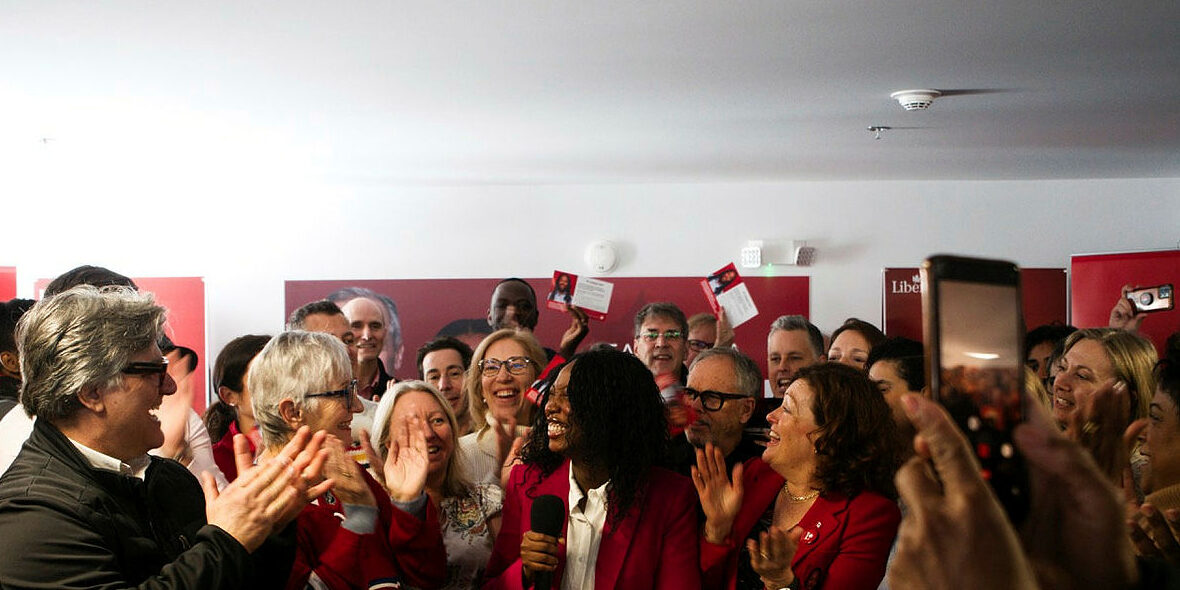
The presence of 42 independent candidates and the use of a “write-in” or “adapted ballot” could prove decisive in the tightly contested April 13 byelection in Terrebonne, Que., say some Liberal sources and pollsters, adding that a close result could trigger another legal challenge.
Prime Minister Mark Carney (Nepean, Ont.) has called three byelections for April 13. Two are taking place in the Toronto-area ridings of University–Rosedale and Scarborough Southwest, and one is in Terrebonne, Que.
While the two Toronto-area seats are considered safe for the Liberals, the real contest is expected in Terrebonne, a riding that’s being closely watched by political insiders. Long regarded as a safe Bloc Québécois seat, Terrebonne flipped in the 2025 general election when the Liberals won by a razor-thin margin of one vote. The Liberal candidate Tatiana Auguste won 23,352 votes or 38.7 per cent of the vote, while the Bloc candidate Sinclair-Desgagné won 23,351 votes, or 38.7 per cent of the vote.
It later turned out that a mail-in ballot cast for the Bloc candidate was returned due to an Elections Canada error. Although the agency acknowledged the mistake, it had no mechanism to correct it. Sinclair-Desgagné, who held the riding between 2021 and 2025, challenged the result in court, and after a months-long legal fight, the Supreme Court annulled the election, triggering the byelection. Sinclair-Desgagné is running again, as is Auguste, who was initially declared the winner and served as MP from April 28, 2025, until the court’s decision on Feb. 13, 2026.
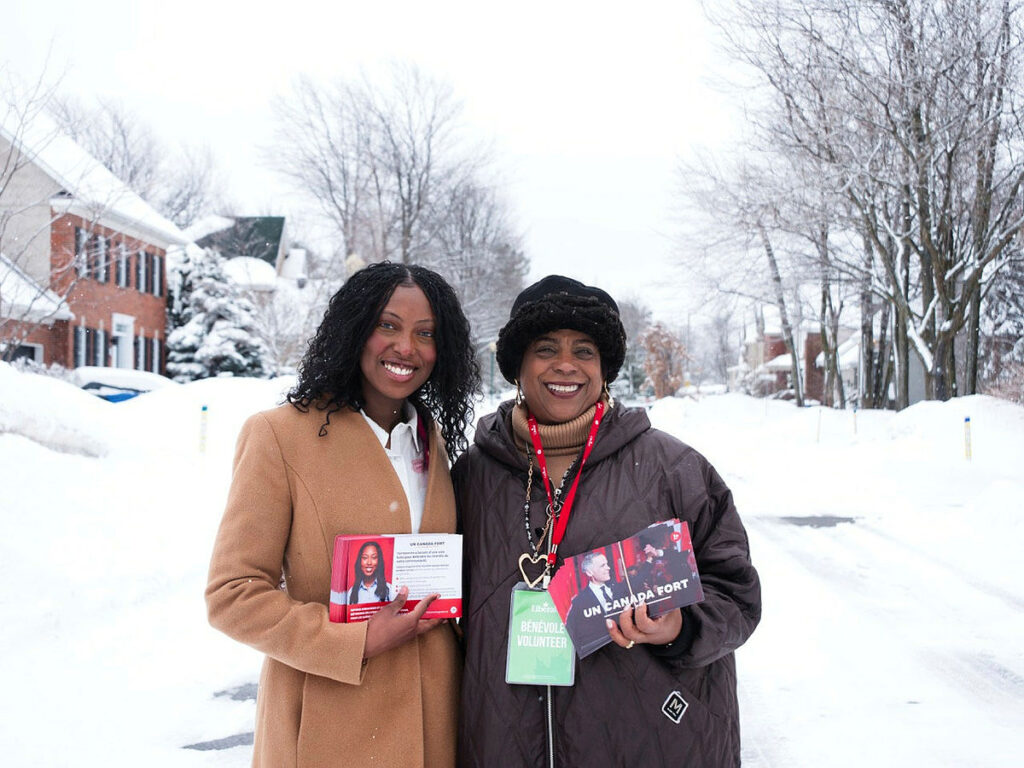 Health Minister Marjorie Michel, right, pictured March 14, 2026, campaigning with Liberal candidate Tatiana Auguste in Terrebonne, Que. Michel personally recruited Auguste as a candidate before the last general election. The Hill Times photograph by Aidan Raynor
Currently, the Liberals hold 170 seats in the House and need two more to secure a majority. A win in Terrebonne would give them a one-seat cushion. A majority would allow the government to pass legislation more easily and control most House committees, except for four. It would also mark the party’s first time holding more than 50 per cent of seats since the 2015 election when Justin Trudeau first came to power with a landslide majority.
Get Today’s Headlines Newsletter
Wake up to the day’s top political and policy headlines. Weekday Mornings.
By entering your email address you consent to receive email from The Hill Times containing news, analysis, updates and offers. You may unsubscribe at any time. See our privacy policy
Both the Liberals and the Bloc Québécois are heavily invested in the Terrebonne race: for the Liberals, it is key to achieving a majority after narrowly unseating a Bloc MP by one vote last spring, while, for the Bloc, Terrebonne is a longtime stronghold it’s held since 1984.
‘As long as the elector’s intent is clear, their vote will be counted’: Elections Canada
A total of 48 candidates are running in the byelection, including 42 independents backed by the Longest Ballot Committee, an advocacy group which pushes for electoral reform by flooding ballots to highlight concerns about representation. In past elections with large candidate pools, Elections Canada has printed unusually long ballots—sometimes up to a metre in length—making counting more time-consuming and delaying results. In a recent Alberta byelection with more than 200 candidates, the agency used an “adapted ballot,” or a “write-in ballot” requiring voters to write their preferred candidate’s name.
Elections Canada will use the same approach in Terrebonne, meaning voters must write the candidate’s name and may include the party name, though party-only entries will not be counted. Given that the last result in the Quebec riding was decided by a single vote, the combination of an adapted ballot and a crowded field could further complicate the outcome.
“As long as the elector’s intention is clear, their vote will be counted, even if they misspell the candidate’s name,” said a March 25 Elections Canada press release.
According to polling aggregator 338canada.com’s projection on April 2, the riding of Terrebonne would be a toss-up between the Liberals and the Bloc. The ridings of University-Rosedale and Scarborough Southwest were projected to remain safe Liberal seats.
Nik Nanos, chief data scientist for Nanos Research, said last week that, based on his polling, the Liberals had gained an advantage by early last week, adding his modelling does not account for individual candidates or voter turnout. He said that while the race began as a toss-up between the governing party and the Bloc, it now appears to favour the Liberals. Nanos also said he understands the rationale for using an adapted ballot, but said he hopes the result is not close, warning that a tight finish could lead to disputes over voter intent and significantly delay the final results.
“There’s just another level of complexity on that front,” said Nanos.
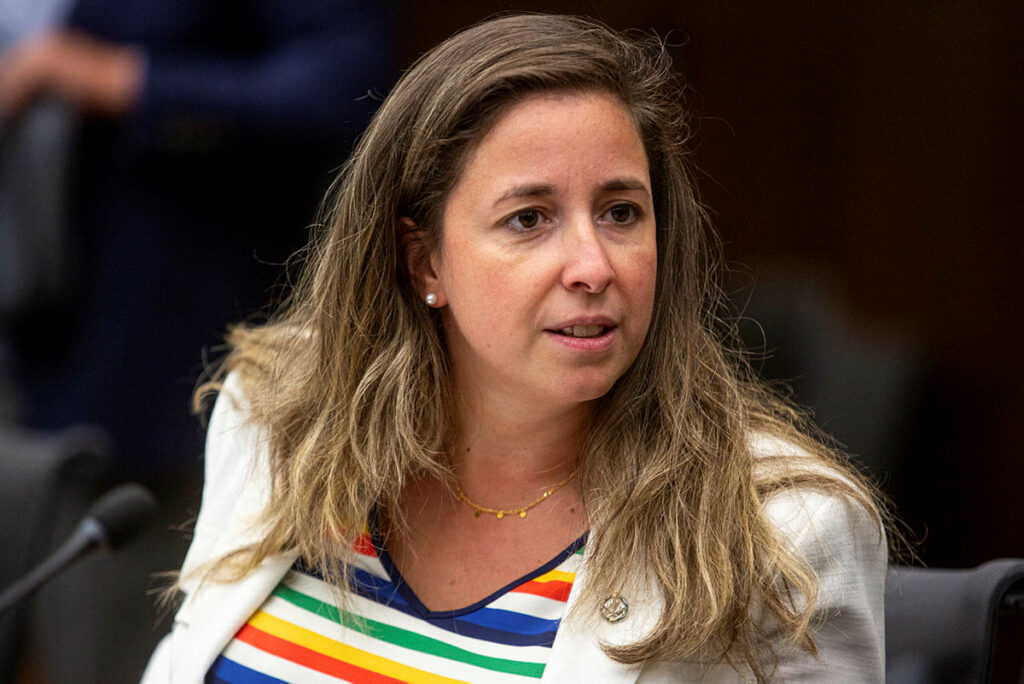 Former Bloc Québécois MP Nathalie Sinclair-Desgagné lost the Terrebonne riding by a margin of only one vote in the last election. She’s running again in the April 13 byelection. The Hill Times photograph by Andrew Meade
“On election night, there’s probably going to be a sense of how many ballots were difficult to decipher in terms of what their intent was.”
According to Nanos Research’s most recent poll released last week, the Liberals had a 32.1-per-cent lead over the Bloc in Quebec, home to 78 electoral seats. So, if a general election were to happen now, the Liberals would get 53.2 per cent of the vote, the Bloc 21.1 per cent, the Conservatives 20.1, and the NDP 2.8 per cent.
Another close result could end up in court, says Jack Siegel
Liberal sources told The Hill Times that their party is “throwing everything” they have to win the byelection.
“The party is pushing very heavy on that seat,” said one Liberal source.
“The party is pouring in a lot of resources. They are throwing everything they have at that seat. They’re sending in resources. They are making phone banks.”
Last month, more than 20 Liberal MPs—including Health Minister Marjorie Michel (Papineau, Que.)— were in the riding to support candidate Auguste, whom Michel had recruited to run in the riding last year. Party sources said the Liberals are taking nothing for granted and are providing full support to the campaign.
They also expressed concern that the write-in ballot could lead to a higher number of rejected votes compared to a standard ballot. At the same time, they pointed out that with 42 independent candidates in the race, even if each were to receive just one vote, that amounts to 42 votes, a number that could prove significant given that the last election was decided by a single vote.
Quito Maggi, CEO of Mainstreet Research, told The Hill Times that he conducted a poll in the riding about a month ago that showed the Liberals ahead by three points, and he expects the byelection to be a nail-biter.
“I would expect a fairly close outcome,” said Maggi. “I would lean towards saying the Liberals have a slight advantage there.”
He said the Liberals appear to have an edge, as byelections often are a referendum on the governing party, which is currently riding high in the polls. As the incumbent, the Liberals also have an organizational advantage over the Bloc Québécois, with several MPs regularly visiting the riding to support Auguste. At the same time, Maggi said that the provincial Parti Québécois is assisting its federal cousin, treating the byelection as a test run for its strategy ahead of the provincial election this fall.
“Organizationally, the Liberals have the advantage because they’re the incumbent government, because they have the infrastructure, the team, the volunteers, etc., that are being pumped into the these three byelections,” said Maggi.
“The entirety of the Quebec wing of the party is going into this riding every day.”
Maggi also said the Easter long weekend could play a key role in shaping voters’ decisions, as friends and families often gather and discuss politics, especially in a high-stakes race like Terrebonne, which could influence how people ultimately vote in the byelection.
Jack Siegel, who’s previously served as the Liberal Party’s legal counsel for many years, told The Hill Times that a close result could ultimately end up in court, adding that if 30,000 votes are cast and the margin is as small as 30 votes, it would automatically trigger a recount.
Given the use of an adapted ballot, he said, the number of rejected ballots could be higher than usual, and much will depend on Elections Canada’s guidance for interpreting ballots where voter intent is unclear.
“If I was organizing scrutineers in the polls for my party on election night, I would be sure to have as many scrutineers in there as possible objecting to every ballot that we don’t get to go our way … where there’s a variation between the candidate name and what was actually written on the ballot,” said Siegel.
arana@hilltimes.com
The Hill Times

Abbas Rana is the assistant deputy editor at The Hill Times. He reports on parliamentary caucuses, nomination contests, party leadership campaigns, Prime Minister’s Office, and cabinet. Rana loves to chat with sources on the record or on a not-for-attribution basis, especially when they have verifiable story tips that could be followed as news stories. Born and raised in Pakistan, Rana speaks Punjabi, Urdu, and Hindi. See all stories BY ABBAS RANA