
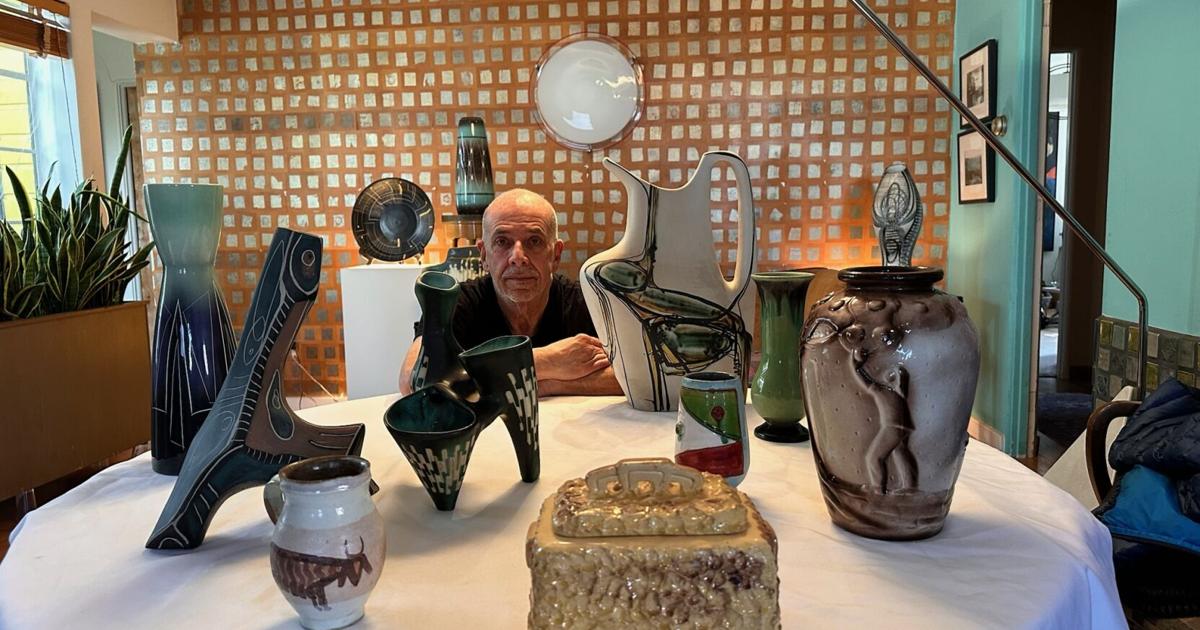
A defining experience in the life of native Detroiter Robert Lebow happened in Israel.
Since making his first trip to the Jewish state in 1973, Lebow has returned periodically for extended, four-month visits. He attends reunions and celebrates events with his family and the friends he made at Kibbutz Shefayim, between Tel Aviv and Netanya on the Mediterranean coast.
It was in the early 1990s that Lebow, 73 — self-described as “born with the ‘collecting gene’” — first discovered Israeli moderne ceramics, dating from roughly 1935-1975. It was the period of the Modern Movement called Bauhaus.
When his husband Peter’s sister visited them in Israel from Tokyo, the trio decided to tour the ancient city of Jaffa. Lebow spied an enormous piece of ceramic that intrigued him in an antiques shop. “The shop owner explained what it was, who it was by and I purchased that piece.”

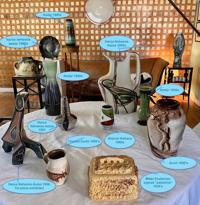
Lebow made this graphic to show the artists and age of some of his pieces.
That same night while walking the couple’s dog, Lebow found a ceramic piece on the street and brought it home. The discarded piece looked familiar to his eye and hand.
“I realized it was of the same production, the same artist and the same factory as the piece I had purchased earlier that day,” Lebow said. “I saw that as a ‘sign’ as to what I would begin collecting.” Both pieces were by Nehemia Azzaz at Harsa Ceramics.
Lebow has developed an expertise in his specialty after collecting Israeli moderne ceramics for more than 35 years. Today, he owns “somewhere around 500 pieces of pottery, representing the amazing and incredible evolution of the Israeli modern art movement,” he said.
“I bought everything worth buying,” Lebow said about building his collection, although his eye grew more discerning as time went on. “I’d buy an exceptional form or glaze, even if a bit damaged. I wanted the full range of what was being produced through the years.”
He figured that the more than 6,000 Bauhaus-style buildings in Tel Aviv must have been filled with Bauhaus furnishings, indicating “a wealthy field of unexplored art out there. The pre-state Israel pieces marked ‘Palestine’ were especially interesting to me.”
Progression of the Israeli Art Movement
The ceramics he purchased and owns “represent the progression of the Israeli art movement from the mid-1930s purely European style to the pure Israeli style of the 1960s and ’70s.”
The dainty teapot and plate he showed a visitor recently was by artist Hedwig Grossman, known as the “Mother of Modern Israeli Ceramics.”
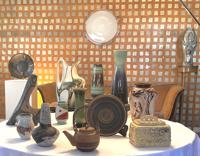
More of the pieces in Lebow’s collection
“She was most active in the late 1930s and early ’40s,” Lebow said.
A new Israeli style was developing even before the Jewish state’s founding in 1948. These works often emphasized the abstractions of nature as an expression of Zionist identity. Lebow presented a favorite Avnit Company piece from his collection, created in the 1950s, that he called “an allegorical” vase. Lebow turned the hefty piece around to show three different sections: orange trees, orange pickers and a basket of oranges.
Discussing other prominent names in the Israeli moderne ceramics movement, Lebow mentioned Hanna Charag-Zuntz (1915-2007), a Zionist born in Germany. Nehemia Azzas, previously mentioned, was founder/manager of the Harsa Company, in the Negev Desert town of Be’er Sheva.
Instrumental in developing an Israeli style of ceramics in the mid-1950s, Azzas started an art studio as a new division for his company. Organized as a collective, the purpose was to produce artistic housewares. Casting molds were used to create objects that included jars, pots and vases.
Under director Azzas, and later Pnina Amir Zamir, new immigrant workers were given ceramic forms and instructed to decorate the pieces. They were encouraged to draw inspiration from their new land, including their impressions of the landscape, sea and food. Everyone in the collective had an equal say in deciding which decorative items would be produced.
“These folks were real adventurers working in the desert and making incredible art,” Lebow said. He counts 200 Harsa-produced pieces among his collection.
Lapid Ceramics was one of Israel’s primary producers of mid-century modern decorative arts ceramics before its factory in Tel Aviv-Jaffo closed in 1990. Lebow takes pride that “many of my own pieces are reproduced in the book, The History of Lapid Ceramics, by Israeli author Kobi Klaitman.” He connected with Klaitman on Facebook.
Lebow chose to stop collecting Israeli ceramics produced after the mid-1970s. “This was the end of the modern movement, and the world was moving into post-Modernism. My area of interest, Modernism, was ending.”
It took many years, as Lebow had predicted, for Israeli moderne ceramics to gain respect from art critics and in the marketplace.
He can never forget what happened in 1998 when he sought to have some of his ceramics displayed at the Israel Museum in Jerusalem. Lebow said he brought binders filled with photographs and every detail about his collection (then, about 200 pieces).
“The curator of modern art called my collection ‘nothing but wedding gifts,’ even though some of Israel’s most important artists were among the makers,” Lebow said. “I was ‘dismissed.’”
He continued, “My collection is more than ‘pretty pieces.’ It is a historic/cultural composition of Israeli art, the evolution from purely Western art forms and glazes to the exclusively Israeli field of forms, glazes, sizes and styles… seen also in graphic arts, fashion, architecture and more.”
Israeli moderne ceramics today are one of the hottest collectibles in the Israeli art world. According to Lebow: “The pricing varies wildly from flea market finds for a handful of shekels, to four figures for rare pieces sold through collector and auction houses.”
Robert Lebow
Title: Ceramics and art collector
Family: His Hebrew-speaking husband, Peter Gahan, and their friendly dog, Aviva. She is a new Canaan dog, the national dog of Israel, and descended from one of the world’s oldest breeds.
Residence: Huntington Woods. A Detroit-based Dutch architect created the family’s 1938 Bauhaus-style home, now a cozy, art- and antiques-filled space, including Lebow’s Israeli moderne ceramics collection.
Education & Career: A graduate of Vernor School in Detroit and Ferndale High School, Robert earned his bachelor’s of arts degree in art at Wayne State University in Detroit. He is the owner of his home-based Robert Lebow Fine Interiors, involved with residential environmental design.
Jewish connections: Robert became a bar mitzvah at the former Ahavas Achim Synagogue in Detroit, eventually merged into Adat Shalom Synagogue in Farmington Hills. He currently studies Hebrew at JLearn, an adult-learning program of the Jewish Federation of Detroit.
The Detroit Jewish News has been supported by readers like you since 1942. Support independent, local, Jewish journalism with a donation today.