
Geoff Bennett:
Tonight, the war with Iran is on the verge of escalation, with President Donald Trump threatening to target Iran’s power grid and Tehran vowing even more forceful strikes on Israel and U.S. Gulf allies if there is no cease-fire by tomorrow night.
Amna Nawaz:
The president simultaneously expressed confidence in a diplomatic outcome, but there’s no public sign of progress. Also today, the U.S. celebrated the successful mission that rescued the American aviators shot down on Friday.
Nick Schifrin begins our report on a busy day in Iran and at the White House.
Nick Schifrin:
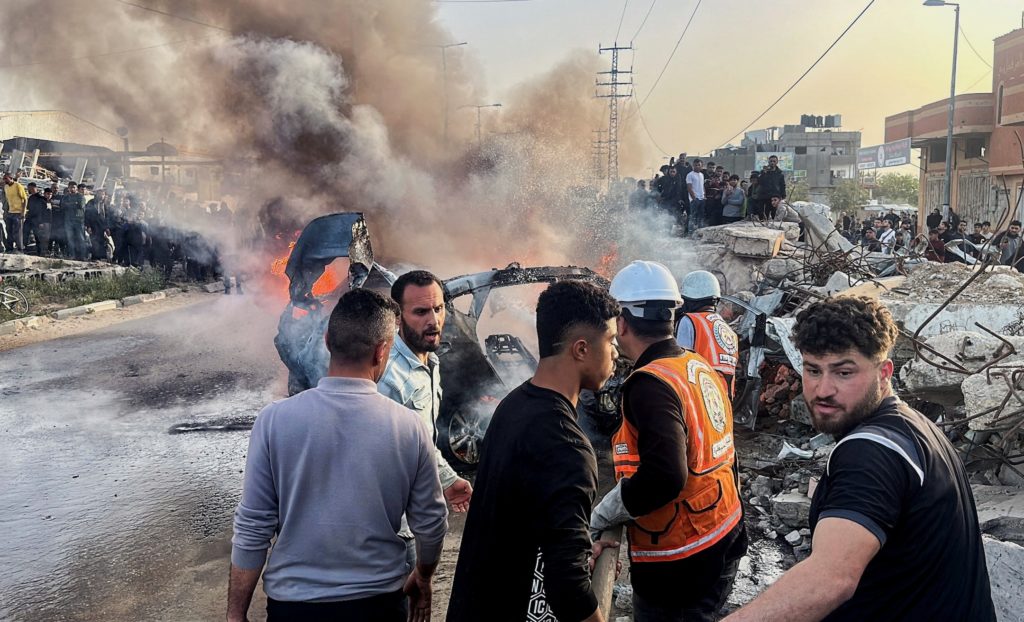
Today in Tehran, another dawn lit up by airstrikes on an airport and an apartment building cut in half in an attack that state media reported killed six, as President Trump threatened escalation.
President Donald Trump:
We have a plan because of the power of our military where every bridge in Iran will be decimated by 12:00 tomorrow night, where every power plant in Iran will be out of business, burning, exploding and never to be used again, I mean, complete demolition by 12:00.
Nick Schifrin:
Yesterday, he used coarser language, threatening — quote — “Tuesday will be power plant day and bridge day all wrapped up in one in Iran. There will be nothing like it. Open the (expletive deleted) strait, you crazy bastards, or you will be living in hell. Just watch. Praise be to Allah.”
Donald Trump:
They have until tomorrow. Now, we will see what happens. I can tell you they’re negotiating, we think, in good faith. We’re going to find out.
Nick Schifrin:
This weekend, mediators from Pakistan, Turkey and Egypt reportedly offered a 45 day cease-fire, during which Iran would open the Strait of Hormuz and the U.S. and Iran would negotiate the end of the war. Iranian state media reported that Iran rejected that, demanding the end of the war, sanctions relief, reparations and financial control over the Strait of Hormuz, through which 20 percent of the world’s oil and natural gas usually flows.
Donald Trump:
We have to have a deal that’s acceptable to me. And part of that deal is going to be, we want free traffic of oil and everything else.
Question:
Mr. President are you allowed to — or are you willing to end this conflict with Iran charging tolls for passage through the strait?
Donald Trump:
Us charging tolls?
Question:
Iran.
Donald Trump:
What about us charging tolls?
Question:
Is that something you’re considering?
Donald Trump:
I’d rather do that than let them have them. Right. Why shouldn’t we? We’re the winner. We won, OK? They are militarily defeated.
Nick Schifrin:
But Iran maintains its ability to threaten U.S. allies. Today, Israeli families cowered in fear during an Iranian attack.
Last night, Iran launched a barrage of cluster munitions that break up into that break up into small bombs that fly miles apart. And, today, rescue workers in Haifa dug out the bodies of four victims; 23 Israeli civilians have now been killed since the start of the war. Today, Iran vowed its own escalation.
Lt. Col. Ebrahim Zolfaghari, Iranian Military Spokesperson (through interpreter):
If attacks on civilian targets are repeated, the next phases of our offensive and retaliatory operations will be carried out much more forcefully.
Nick Schifrin:
Israel has already been striking civilian targets that it says are also used by the Iranian military. Today, it was a petrochemical plant and Tehran’s Sharif University of Technology that professors said had no connection to the military.
This was not only once a place of learning, but also protest. Four years ago, the university’s students demonstrated against the regime for killing activist Mahsa Amini. Back then, they fled from the very same security forces that Israel has said hopes will be overthrown.
Donald Trump:
We’re here today to celebrate the success of one of the largest, most complex, most harrowing combat searches.
Nick Schifrin:
The White House today also celebrated this weekend’s historic rescue, what the military said included more than 150 aircraft and hundreds of special operations forces inside Iran to save the pilot and weapons service officer of an F-15 after it was shot down on Friday by a shoulder-fired surface-to-air missile.
Iranian police posted the Americans’ documents. The pilot was rescued within hours, but the weapons service officer was missing, dozens of miles away.
Donald Trump:
He scaled cliff faces, bleeding rather profusely, treated his own wounds, and contacted American forces to transmit his location.
Nick Schifrin:
He survived more than 50 hours, during which time the Iranian regime offered a bounty to find him. U.S. helicopters flew so low, locals targeted them with rifles. The mission was risky and needed multiple contingencies. A specialized search-and-rescue helicopter took fire, their crew injured. Helicopters needed to be refueled mid-mission.
And an A-10 providing close air support was struck and had to be ditched over Kuwait.
Donald Trump:
Hundreds of people could have been killed, so we had people that were within the military that said this is not a wise — and I understood that, but I decided to do it.
Nick Schifrin:
That’s when the U.S. deployed decoys to confuse Iran about the weapons service officer’s location. And the CIA helped find him, said Director John Ratcliffe.
John Ratcliffe, CIA Director:
In addition to the human and technical assets deployed by the president to find our airman, CIA executed a deception campaign to confuse the Iranians, who were desperately hunting for our airmen.
Nick Schifrin:
Secretary Pete Hegseth today explicitly compared the aviator to Jesus Christ’s resurrection.
Pete Hegseth, U.S. Defense Secretary:
Shot down on a Friday, Good Friday, hidden in a cave, a crevice, all of Saturday, and rescued on Sunday, flown out of Iran as the sun was rising on Easter Sunday, a pilot reborn all home and accounted for, a nation rejoicing.
Nick Schifrin:
But, tonight, the nation of Iran is bracing for escalation, as President Trump said, the entire country can be taken out in one night, and that night might be tomorrow.
For the “PBS News Hour,” I’m Nick Schifrin.