
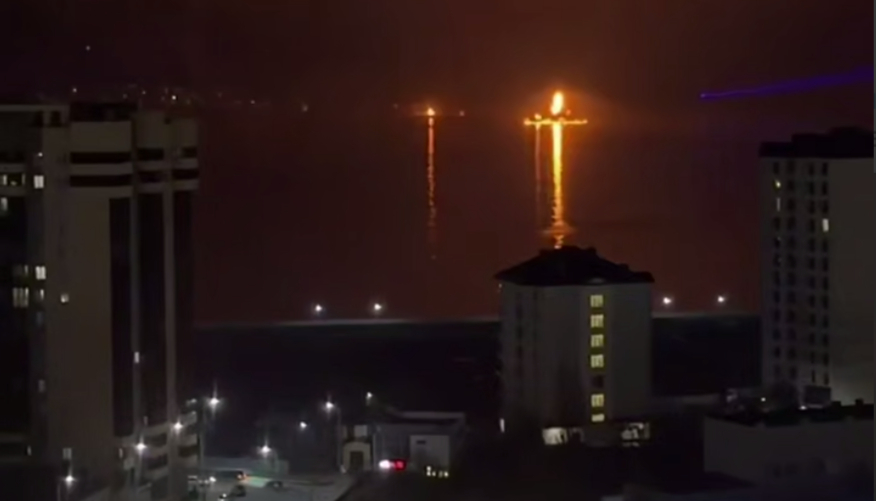
Ukraine’s long-range drone forces overnight Sunday-Monday attacked Russia’s biggest crude-loading terminal on the Black Sea in the port of Novorossiysk, leaving behind fires lighting up the horizon and visible from space, and shutting down oil export operations completely.
Other Ukrainian drone strike packages simultaneously hit probable air defense sites in Russia’s western Krasnodar region and in the Russia-occupied Crimea peninsula, along with targets elsewhere in Russia.
JOIN US ON TELEGRAM
Follow our coverage of the war on the @Kyivpost_official.
The punishing Novorossiysk raid came in the wake of more than a week of nearly nightly drone assaults against Russian crude oil export terminals on the Baltic Sea that had, by early April, taken an estimated 40% of total Russia Federation oil export capacity off line.
The central target of Ukraine’s latest attacks against Black Sea loading facilities, the Sheskharis oil terminal, is Russia’s main export outlet for Russian Ural and Siberian Light crude, along with Kazakh crude.
In peacetime Novorossiysk port facilities handled around 25-35% of all Russian Federation crude oil exports, or about 3-3.2 million tons of combined crude per month. In wartime, according to industry reports, the site accounts for about 20% of Russia’s crude oil exports.
Ukraine’s overnight attack with a reported 50+ pilotless aircraft was the most ambitious and destructive carried out by Ukraine against Novorossiysk oil transportation facilities of the war so far. Past raids hitting the port and causing confirmed damage took place on Nov. 14 and 29, Feb. 7 and on March 1, according to Kyiv Post records.
Other Topics of Interest
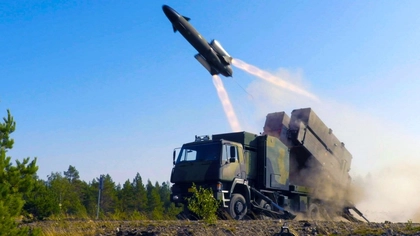
Ukrainian Navy Confirms High-Tech Swedish Missile Used in Oil Rig Strike
The official name of the Saab-Bofors RBS-15 missile is “Gungir” – the Old Norse word for the mythological magic spear wielded by the god Odin.
Initial reports of a possible major Ukrainian drone raid against Novorossiysk first surfaced at around 7 p.m. local time (16:00 UTC) on Sunday, with Novorossiysk Mayor Andrei Kravchenko announcing a probable incoming Ukrainian strike and warning citizens to remain calm and not to video-record incoming Ukrainian drones or Russian air defenses engaging them.
Russian social media users, ignoring Mayor Kravchenko’s instructions, reported seeing and hearing propeller-driven drones over Novorossiysk and intense fire by responding air defenses, beginning around 11 p.m. local time (20:00 UTC).
Over the next 90 minutes text messages, photographs and video flooded social media channels and documented a massive battle in the airspace above and around the port.
Some images showed unidentified aircraft with silhouettes similar to the Ukraine Unmanned Systems Forces (USF, Ukrainian: Сили безпілотних систем or SBS) workhorse An-196 Liutyi drone, a pusher-prop with a distinctive dual fuselage.
Video and photographs reaching open sources showed sometimes fireworks-like engagements above Novorossiysk in a night sky lit up by AAA (anti-aircraft artillery) tracers, anti-aircraft cannon shells detonating at the end of their trajectory, anti-aircraft missiles flying past or intercepting UAVs, with blue- and purple-colored searchlights sweeping the skies.
Some audio recorded the tearing burst sound of rapid-fire Gatling-type cannon usually used by Russian forces to protect high value targets from aerial attack.
According to unconfirmed reports published on the Russia state-controlled social media app MAX, Russian defense forces fired around 35 interceptor missiles from Pantsir (NATO: SA-22 “Greyhound”), BUK-M3 (NATO: SA-27 “Gollum”) and S-300 (NATO: SA-20 “Gargoyle”) platforms at the incoming Ukrainian UAVs.
During the attack and immediately afterward, users reported hearing between four and ten heavy explosions from the direction of the port, and posted images of a horizon lit up by fires toward the seacoast.
Russia’s Defense Ministry in a morning statement claimed 50 Ukrainian drones had been shot down in the airspace around the Krasnodar region and Novorossiysk. City authorities reported that drones struck six apartment buildings and two private homes, in total injuring eight civilians among them two children.
Some Ukrainian information platforms suggested the impacts may have resulted from successful Russian jamming of a Ukrainian drone; and while Kremlin spokespersons have accused Ukraine of targeting civilians for years, they have not provided evidence supporting the allegations.
Meanwhile, Ukrainian officials and drone operators have denied such accusations since Russia’s February 2022 invasion began, and Kyiv Post reporters since then have found no credible evidence supporting these claims.
Sunrise showed four major fires burning within the port territory and black smoke reaching hundreds of meters into the sky. By mid-morning the independent Russian news agency Astra reported the Ukrainian attack had demolished multiple critical nodes within the Shekharis facility and stopped its operations entirely.
The CyberBroshono OSINT (open source intelligence) research group, among other independent military information platforms, confirmed the port was fully offline and that damage was severe.
Estimates varied somewhat but according to most reports, two of the port’s main tanker berths and loading pipelines adjacent to them had taken multiple hits and were on fire, and that the port’s main pipeline shut off and control nodes had been hit directly and demolished.
NASA’s worldwide fire watch network FIRMS, midday on Monday, showed two substantial fires burning in Novorossiysk, with one hot spot covering practically all of the Shekhsaris loading facility territory.
Although the main weight of their attacks fell on Novorossisyk, Ukrainian SBS operators on the night according to air defense announcements flew harassment or strike missions against Russian air defense sites across the Russia-occupied region of Crimea including the cities of Kerch, Evpatioria, Feodosia, Dzhankoe, and the Saki military airfield near the regional capital of Simferopol.
Fighter scrambles and ground explosions were reported in the vicinity of the port city of Sevastopol and its major military airfield Kacha, and according to some Russia milbloggers Crimea air defenses expended dozens of interceptor missiles engaging the incoming Ukrainian drones, only to run out of some munitions entirely.
The popular Russian milblogger Vladimir Romanov in a possibly prescient post to his 150,000+ followers on April 4, some 36 hours before the Ukrainian strikes were conducted against Novorossiysk, accused Russian military authorities of failing to deliver sufficient ammunition to air defense units and warned that Ukraine’s drone forces would take advantage of the situation.
Romanov demanded in an open letter addressed to the Crimea air defense command and the Russian Defense Ministry:
“GIVE US MISSILES FOR TOR/PANTSIR! We can see the targets and technically have the capability to hit them, but we’ve got nothing to do it with!!!”
As world oil prices have nearly doubled following the launch by US President Trump and Israeli Prime Minister Netanyahu of a war against Iran and the closure of the crude oil-trade critical Strait of Hormuz, potential Russian earnings for all oil exports could have spiked to between $1.4-$1.8 billion/day.
However, taken together, damage caused by Ukrainian strikes against export terminals in the Baltic and Black Sea could cut those earnings by as much as 70 percent, as long as the damage remains unrepaired.
Ukraine’s Kyrylo Budanov, now Head of Ukraine’s Presidential Office and formerly chief of Ukraine’s military intelligency agency HUR, in an April 4 interview with the Bloomberg news agency said that his country’s “Western allies” had asked Kyiv to pause or limit its campaign attacking Russian oil refineries and export capacity with drones, so that Russian oil might reach market and help prevent prices for oil on world markets from rising even higher.
In March 2024, according to Politico and Reuters reports at the time, the White House led by Democratic President Joe Biden, concerned at the time that Ukrainian attacks had forced Moscow to take 10-15 percent of Russian production capacity off-line and would potentially spike prices at the pump during an election year, pressured the Ukrainian government to stop the strikes or face a cut-off of financial assistance and critical weaponry including US-manufactured long-range strike systems.
Ukraine mostly complied with the request until late Summer mid-2025, when it kicked off an escalating bombardment of Russia’s energy infrastructure using domestically manufactured drones.
Since then that strategic aerial attack campaign, according to Kyiv Post counts, has hit more than 500 strategic targets in Russia, most recently Novorossiysk.