
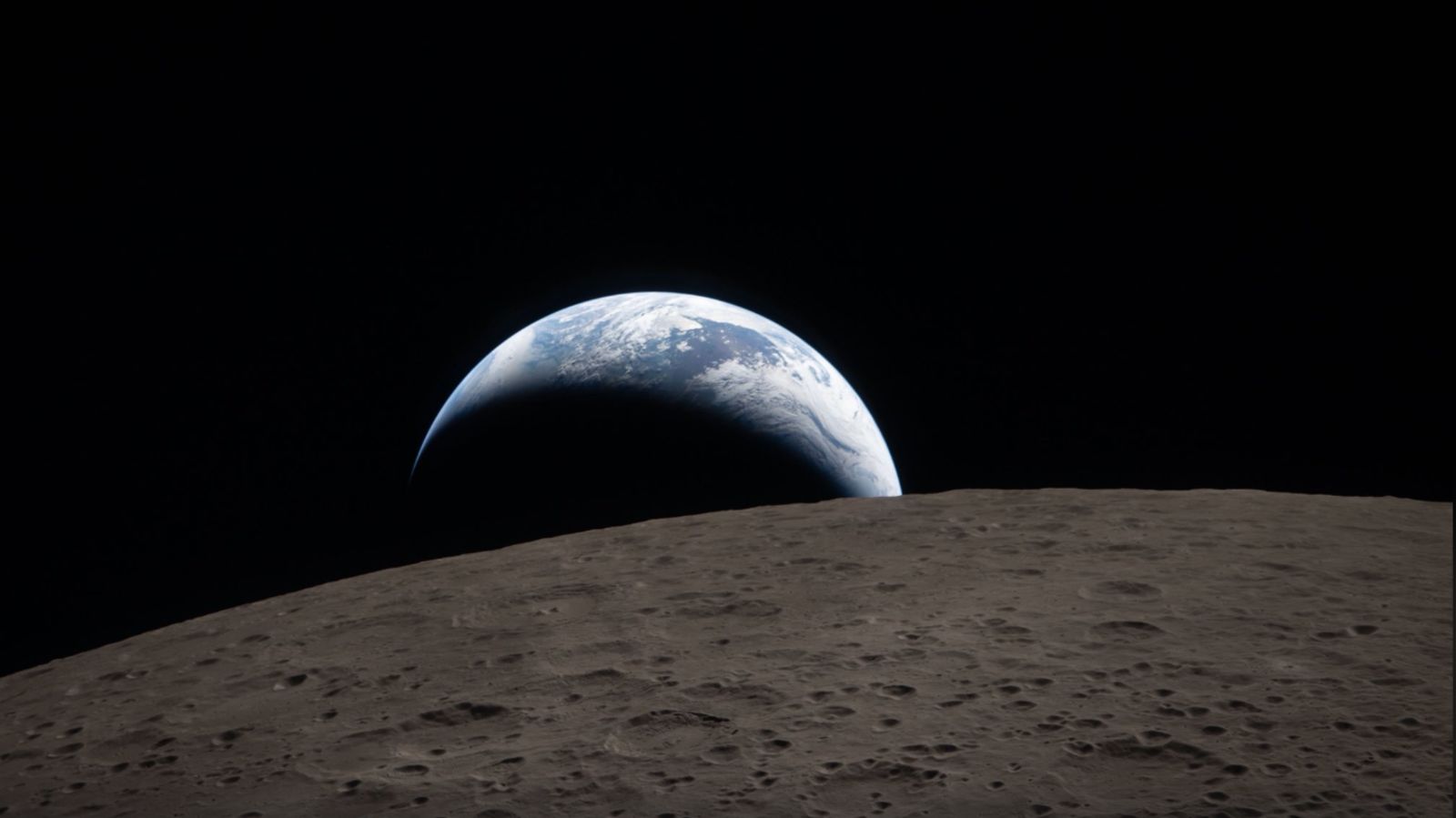
Humans have seen the far-side of the moon with the unaided eye for the first time, as the Artemis II crew passed behind it during their lunar flyby.
The White House released the first photo taken by the crew of the far-side on Tuesday.
“Humanity, from the other side. First photo from the far side of the Moon. Captured from Orion as Earth dips beyond the lunar horizon,” the picture, dated April 6, was captioned on a post on X.
The Artemis II astronauts are on their way back to Earth from the moon after going deeper into space than any humans have ever gone before.
The Orion spacecraft travelled a record-breaking 252,756 miles (406,771km) away from Earth on Monday evening, becoming so close to the moon it appeared to them the size of a basketball held at arm’s length, Nasa said.
This is not the first image of the far-side of the moon ever, but it is the first photograph of it to have been taken by a human.
In 1959, the Lunar 3 spacecraft launched from Kazakhstan and reached the moon, capturing and sending back grainy images of that part of its surface.
However, the astronauts were the first humans to see some parts of the moon’s far side.
The Moon is seen in the window of the Orion spacecraft, photo taken by The Artemis II crew, at the end of day 5 of journey to the Moon. Credit: AP
As planned, the Artemis II crew lost contact with Earth for around 40 minutes during their journey behind the moon.
After seeing the far-side, the crew then entered a period where the moon eclipsed the sun before making their journey back to Earth, with Mercury, Venus, Mars and Saturn visible during the darkness.
The White House shared the photograph in a second post to X, writing: “Totality, beyond Earth. From lunar orbit, the Moon eclipses the Sun, revealing a view few in human history have ever witnessed”.
The crew saw the moon eclipse the sun, before making their journey back to Earth. Credit: Nasa
The Artemis II crew is made up of four American astronauts (Reid Wiseman, Victor Glover, pilot and Christina Koch) and one Canadian, Jeremy Hansen.
Hansen described how the crew had been “giddy” as they came within 4,067 miles (6,545km) of the moon.
“When we were on the far-side of the moon and out of contact with planet Earth, we all knew it. It was a milestone, we saw Earth disappear, but we were so busy with the science,” Hansen said.
The spaceship launched from Kennedy Space Center in Florida on April 1.
It will take the crew four days to get back to Earth, with a splashdown in the Pacific expected on Friday.
Artemis II astronaut Jeremy Hansen of Canada, connects live from the Orion spacecraft to speak with media. Credit: AP
Artemis II is the second mission as part of Nasa’s lunar exploration programme Artemis, during which the space agency are sending astronauts on “increasingly difficult missions”.
“We’re going back to the Moon for scientific discovery, economic benefits, and inspiration for a new generation of explorers”, they say, as well as to build on their foundation for the “first crewed missions to Mars.”
Artemis is part of Nasa’s longer-term plans to eventually build a lunar base on the surface of the moon, which would allow astronauts to live and work there.
With the support of such a base, the space agency would then be able to work on the technology required to protect a future Mars crew from lack of air, space radiation and extreme temperatures.
Subscribe free to our weekly newsletter for exclusive and original coverage from ITV News. Direct to your inbox every Friday morning.
Reporting History sees journalists join News At Ten anchor Tom Bradby to revisit their remarkable on-the-day reports of the defining events of the modern age. Listen to the episodes below…