
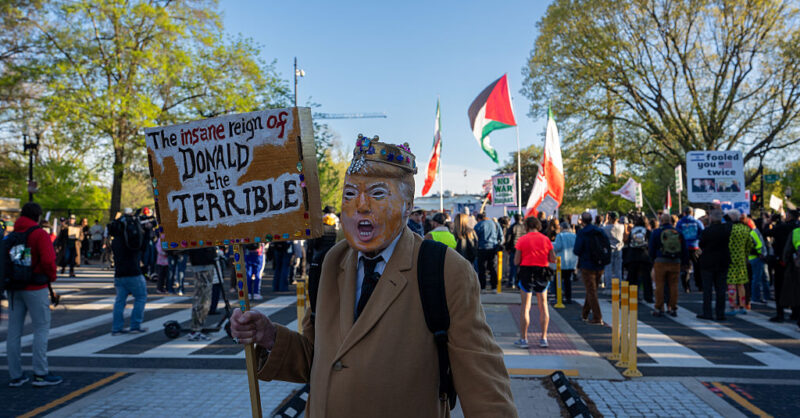
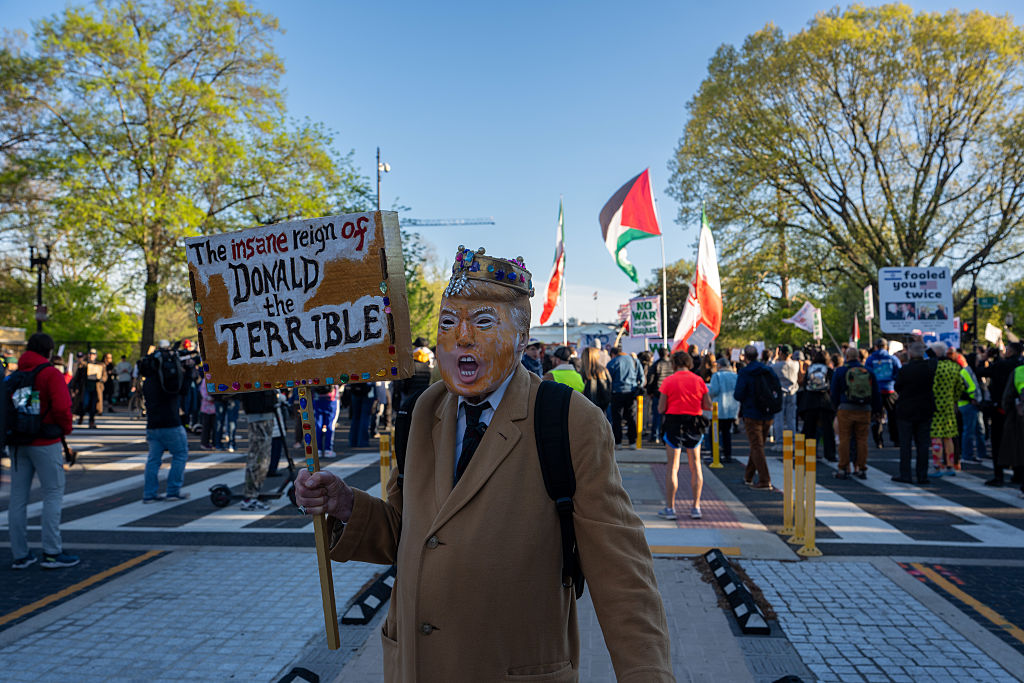
Photo by Andrew Leyden/Getty Images
As the final hours ticked down to Donald Trump’s deadline of 8pm, US eastern time, on Tuesday (7 April) for Iran to submit to his terms, the US president issued a series of increasingly apocalyptic threats. “A whole civilization will die tonight, never to be brought back again,” he wrote on Truth Social that morning, proclaiming it “one of the most important moments in the long and complex history of the World”.
Just over two hours later, Trump called the Fox News anchor Bret Baier to reiterate that “8pm is happening”, vowing to deliver “an attack like they have not seen”. When asked by one reporter whether the president was considering a nuclear attack on Iran, the White House press office referred him to Trump’s earlier social media post and remarked: “Only the President knows where things stand and what he will do.”
With just under four hours left on the clock, and much of the commentariat on X apparently researching the chain of command for an American nuclear strike – it turns out the president has sole authority to order an attack – Pakistan’s prime minister publicly appealed to Trump to extend his deadline for Iran’s annihilation by two weeks. Shehbaz Sharif claimed that diplomatic efforts were “progressing steadily, strongly and powerfully”, calling for Tehran to allow shipping to resume through the Strait of Hormuz during the same period as a gesture of goodwill.
This gave both sides a potential off-ramp if they decided to take it. 90 minutes before the deadline expired, Trump duly posted that he would “hold off the destructive force being sent tonight to Iran” for a period of two weeks, subject to Tehran agreeing to the “COMPLETE, IMMEDIATE, and SAFE OPENING of the Strait of Hormuz”. Iran’s foreign minister, Abbas Araghchi, subsequently announced that Iran had agreed to Pakistan’s proposal and would grant “safe passage” through the strait “via coordinating with Iran’s Armed Forces”. (It was not clear how many vessels Iranian officials intended to allow through, and whether they would press ahead with an earlier demand that ships should pay a fee to transit, reportedly $2 million.)

Subscribe to the New Statesman today and save 75%
The price of oil immediately began to fall, markets can be expected to rally, and both sides are sure to claim an emphatic victory even as difficult negotiations, and the prospect of a return to fighting at any moment, still lie ahead. At the time of writing, shortly after the ceasefire was announced, air raid sirens were reportedly sounding in Israel, accompanied by warnings of an incoming Iranian ballistic missile, although there were no subsequent reports of any damage. Kuwait also said its military was responding to missile and drone attacks, although it was possible that the ceasefire order had not yet filtered down to all Iranian units. In a statement, Iran’s national security council warned, “our fingers are on the trigger and if the enemy falters even a tiny bit, we will respond forcefully.”
At best, what has been achieved is a tentative return to the status quo ante at the cost of massive destruction in Iran, thousands of lives across the Middle East, along with 13 US military personnel, the serious depletion of US missile stocks, and severe damage to American alliances, many of which were already in dire straits before this war. Largely overlooked in his press conference on 6 April, which was dominated by the extraordinary rescue of an American airman who was shot down over Iran and Trump’s continued threats against Iran, he derided Nato as a “paper tiger” and reiterated that “we want Greenland.”
The main issues that Trump has previously invoked to justify this war, such as Iran’s refusal to give up its right to enrich uranium, its ballistic missile arsenal, support for proxies across the region and ability to threaten its Gulf neighbours, remain unresolved. If the fighting stops along the current lines, the Iranian regime will retain the knowledge and likely the capability to resume its nuclear programme, perhaps now with an even more powerful incentive to pursue the bomb. Iran’s stockpile of highly enriched uranium remains unaccounted for, though Trump has claimed it is buried deep beneath the complex in Isfahan that the US bombed last June and is under continuous surveillance, presumably by satellite, to deter any attempts to recover the material. Likewise, much of Iran’s arsenal of missiles and drones, and its ability to target its neighbours, remains intact.
Despite Trump’s claims that he has achieved “Complete and Total Regime Change” in Iran and is now negotiating with “different, smarter, and less radicalised minds”, the same regime remains in power. If anything, even more hardline officials are now in charge. They have continued to execute political prisoners and crush domestic dissent throughout this war, and will now boast of their success in facing down the world’s most powerful military. The fatwa, or religious edict, the late Supreme leader Ali Khamenei issued in 2003 forbidding the pursuit of nuclear weapons, presumably died with him at the start of this war.
The surviving regime also has a new, arguably much more effective form of leverage than its nuclear program in the form of its proven ability to effectively close the Strait of Hormuz, holding 20 per cent of the world’s oil supply hostage, and with it, the global economy. Trump might point to the reopening of the strait – if indeed remains open – as more supposed evidence of America “winning” under his leadership, but the strait was fully open before he embarked on this war. Fighting his way back to the conditions that existed before this conflict, or worse, hardly constitutes a great victory.
Even some of the president’s most steadfast supporters are questioning his conduct during this conflict, most notably his explicit threats to target civilian infrastructure such as power plants, which would almost certainly constitute a war crime, and to destroy a “whole civilization”, which would appear to meet the United Nations’ definition of genocide.
While some will insist that Trump is “executing a sophisticated ‘madman’ strategy in a complex game of 5-D chess”, wrote Oren Cass, a conservative commentator and chief economist at the American Compass thinktank, “now rather than later seems the time to say that the actions that he is proposing would be a disaster for our country, both strategically and morally, which makes the remarks themselves a terrible mistake.” In a post on X in the hours before the ceasefire was announced on 7 April, Cass remarked that, “if these are empty threats that we all know he will not carry out, then they are ineffective threats (the Iranians are on X too!), merely making the president and our nation look foolish.” Whether those threats were serious or not, he continued, “we should be willing to say: This is wrong.”
“This is evil and madness,” wrote former Republican congresswoman Marjorie Taylor-Greene, who broke with Trump last year over his handling of the Epstein files. She called for the 25th amendment to be invoked, which allows the vice president along with a majority of the cabinet to declare the president unable to discharge their duties and initiate a process to remove him from office.
On the other side, Lindsay Graham, a Republican senator from South Carolina who has long been a fervent supporter of military action against, seemed unable to contain his disappointment that Trump appeared to be backing down. “We must remember that the Strait of Hormuz was attacked by Iran after the start of the war, destroying freedom of navigation,” he wrote in response to Trump’s post announcing the ceasefire, urging the president to ensure that the Iranian regime was “not rewarded for this hostile act against the world”. He also demanded that “every ounce of the approximately 900 lbs. of highly enriched uranium” believed still to be in the country must be “controlled by the U.S. and removed from Iran to prevent them in the future from having a dirty bomb or returning to the enrichment business.” As he concluded, sounding distinctly sceptical: “Time will tell.”
[Further reading: The end of the American empire]
Content from our partners