
Iranian state television declared today that the Iranian-mined Strait of Hormuz was closed once again. Minutes later, maritime tracking data from MarineTraffic showed the Panama-flagged, United States Treasury-sanctioned oil tanker AUROURA executed a sharp 180-degree turn while approaching the strait’s exit and headed back into the Persian Gulf. The vessel, long documented moving Iranian crude in violation of sanctions, never crossed. This is not a random disruption. It is the exact sequence I detailed in my recent column on the Pakistan-brokered ceasefire.
That indirect arrangement, engineered through Islamabad under Chinese pressure and announced by President Trump as a two-week suspension of strikes, left Iran’s nuclear infrastructure largely intact and its Mediterranean proxy untouched. Now Tehran signals its contempt by throttling the waterway that carries 20 percent of global petroleum consumption and roughly 25 percent of all seaborne oil trade.
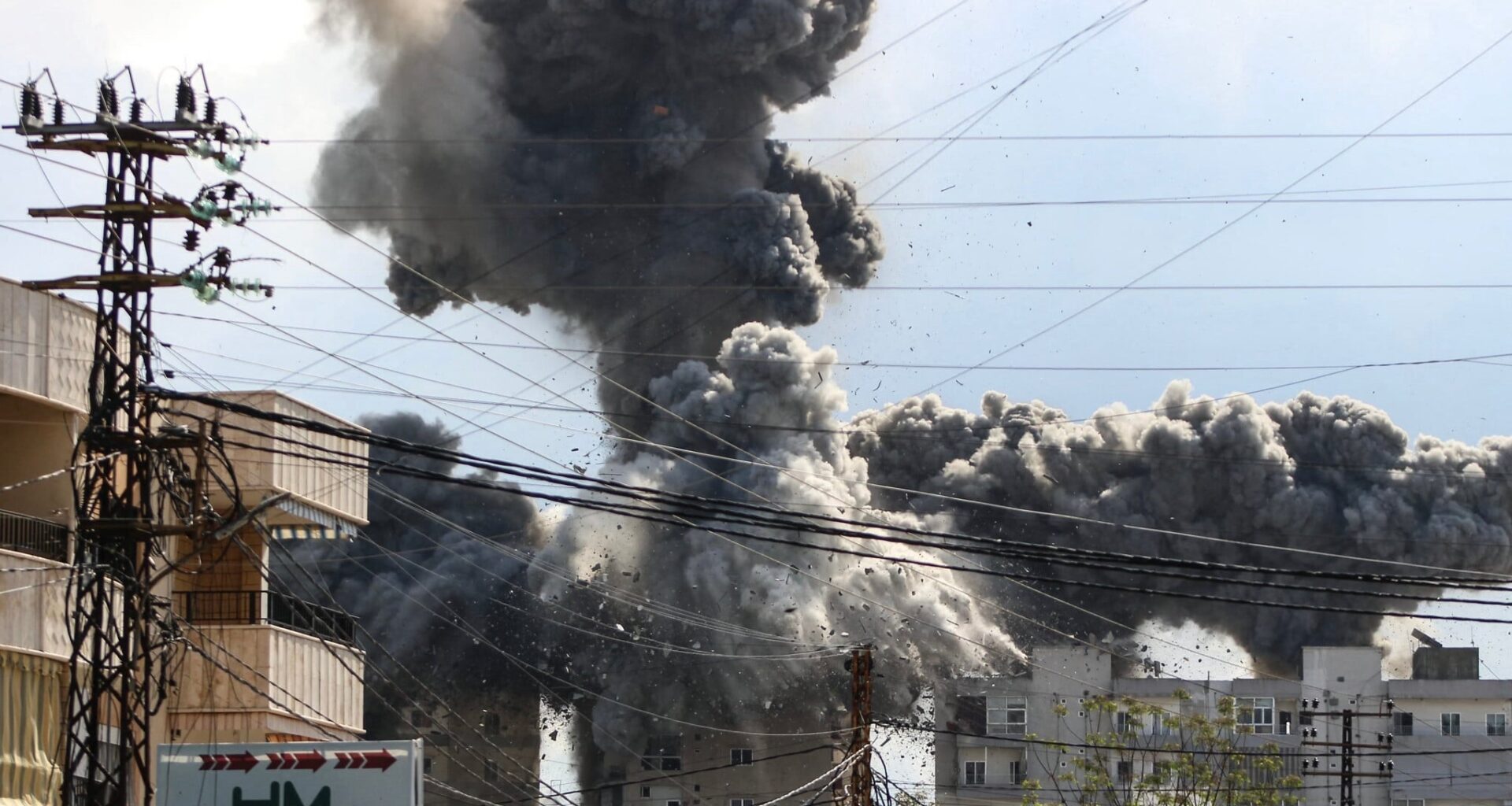
Due to this reality, the Israel Defense Forces responded with their largest coordinated airstrikes yet on Hezbollah targets across southern Lebanon and the Bekaa Valley. Israeli Prime Minister Netanyahu stated plainly that Lebanon was never part of the Iran arrangement. President Trump and Vice President Vance confirmed the same. Yet the international narrative has already begun its familiar pivot.
Just as they did during the Gaza operation and the Iran exchanges, the leftist international media, globalist editorial boards, and foreign diplomats will soon demand that Israel halt its Lebanon campaign to “preserve regional calm.” Like the weak French government and the corrupt-communist Spanish regime today, they will frame the strikes as the provocation, ignore the threat Hezbollah poses, and insist that any Iranian retaliation traces back to Jerusalem rather than Tehran’s own breach.
The numbers expose why Israel cannot afford restraint. Before October 7, 2023, Hezbollah fielded an estimated 130,000 rockets and missiles, according to assessments by the Center for Strategic and International Studies. Even after sustained Israeli operations reduced the arsenal to between 11,000 and 13,000 projectiles by March 2026, per Wall Street Journal reporting, the group retains the capacity for massed barrages. Rockets and missiles still account for 71.5 percent of Hezbollah attacks, according to Alma Research Center data through March 2026. These weapons, many precision-guided and supplied by Iran, sit embedded inside civilian homes, schools, and apartment blocks south of the Litani River.
The result: more than 60,000 Israelis remain displaced from northern communities nearly two and a half years after Hezbollah opened its front on October 8, 2023, in coordination with Hamas.
Hezbollah operates as a parallel state inside Lebanon. The Lebanese government has never fulfilled its obligations under United Nations Security Council (UNSC) Resolution 1701, passed in 2006 to end the previous war. That resolution required Hezbollah’s full disarmament south of the Litani, the deployment of the Lebanese Armed Forces as the sole legitimate authority, and the withdrawal of all foreign forces.
Eighteen years later, Hezbollah maintains an independent command structure, veto power over governments, and a rocket force larger than most national armies. United Nations Interim Force in Lebanon peacekeepers have repeatedly documented violations, including denial of access and continued weapons storage. Beirut lacks both the political will and the military capacity to enforce the resolution. Hezbollah’s dominance renders the Lebanese state a fiction in its own southern territory.
That said, it is imperative to understand that this is not a localized border dispute. Hezbollah functions as Iran’s primary forward base on the Mediterranean, funded, armed, and directed by the Islamic Revolutionary Guard Corps to project power against Israel and the Sunni Arab States. Its arsenal and tunnel network create a layered conventional threat that could enable a ground incursion dwarfing the scale of the October 7, 2023, Hamas assault. Israeli operations now target that infrastructure while Iran remains momentarily constrained by the fragile truce.
The right to conduct these strikes rests squarely on Article 51 of the United Nations (UN) Charter, which recognizes the inherent right of self-defense against armed attack until the UNSC takes effective action. The council has never neutralized Hezbollah. The Lebanese government has not. Therefore, Israel acts to restore deterrence where others have failed.
The upcoming international response will sidestep these facts. European governments and UN bodies will emphasize “proportionality” and “civilian casualties” reported by Lebanese health authorities, many aligned with Hezbollah. They will link any Iranian move on Hormuz or elsewhere to Israeli actions in Lebanon, inverting cause and effect.
Meanwhile, Sunni Arab States, already hedging toward Beijing and Moscow after witnessing Washington’s rapid shift from maximum pressure to negotiated pause, will issue measured statements to manage domestic opinion and keep Iran at bay. The strategic objective remains unchanged: isolate Israel diplomatically, renew calls for arms restrictions, and erode the legal foundation of its self-defense claims.
The geostrategic stakes extend far beyond the Levant. Control of the Strait of Hormuz gives Iran leverage over Asian economies heavily dependent on Gulf energy. Japan imports 93% of its oil via the route, South Korea 68%, and India roughly 53% of its crude. A sustained or repeated closure spikes global prices, weakens Western alliances, and rewards the Iran-Russia-China-North Korea axis, which benefits from a distracted and energy-vulnerable Europe and the United States.
The Pakistan-brokered deal, by leaving 440.9 kilograms of 60-percent-enriched uranium largely unaccounted for, according to the latest International Atomic Energy Agency assessments, preserves Tehran’s breakout potential. That stockpile, if further processed, could yield material for at least ten nuclear weapons. The arrangement also shields Hezbollah from simultaneous pressure, granting the proxy time to reconstitute.
This pattern repeats because the international system rewards it. Previous campaigns against Hamas in Gaza produced identical demands for unilateral Israeli restraint while ignoring the group’s charter, their tunnel economy, and the Iranian resupply lines. The same voices now preparing to condemn the ongoing Israeli operation in Lebanon have never enforced Resolution 1701 or pressured Beirut to dismantle Hezbollah’s parallel army. The result is perpetual escalation and selective outrage directed solely at the defender.
Israel’s current operations in Lebanon demonstrate the costs of allowing an Iranian proxy to entrench on its border. The ongoing Iranian missile attacks in the region and the Hormuz incident prove the Pakistan-brokered ceasefire’s fragility and the price of leaving core threats unaddressed.
Global energy flows, nuclear thresholds, and regional power balances all converge here. Any diplomatic effort that pressures Israel to stop while excusing Hezbollah’s arsenal and Iran’s violations will not produce stability. It will guarantee the next, larger crisis.
History records who upheld the right to self-defense and who sacrificed it for temporary calm. The data, the displacements, the unresolved resolutions, and the reopened strait leave no room for illusion.
Jose Lev is an American-Israeli scholar focused on Middle Eastern security doctrine.
A multilingual veteran of both the Israel Defense Forces’ special forces and the U.S. Army, he holds a B.S. in Neuroscience with a minor in Israel Studies from American University in Washington, D.C., three master’s degrees in international geopolitics, applied economics, and security and intelligence studies, as well as a medical degree. He is currently completing a Ph.D. in Intelligence and Global Security in the Washington, D.C. area.
Alongside blogging for The Times of Israel, he is a writing fellow at the U.S.-based think tank, the Middle East Forum; regularly appears on Latin American television networks to provide geopolitical and security analysis; and is a member of the Association for Israel Studies.