
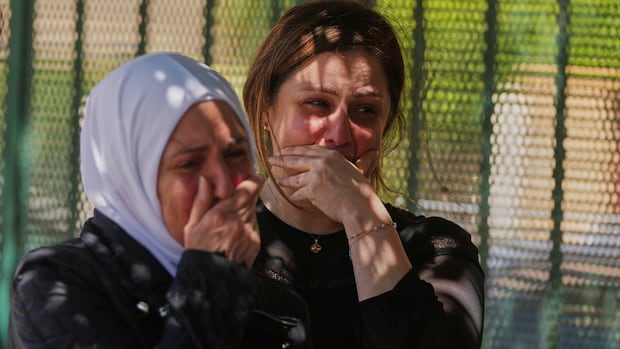
Israel bombed more targets in Lebanon on Thursday, putting the Middle East ceasefire in further jeopardy after its most intensive strikes of the war on its neighbour killed more than 200 people, according to Lebanon’s Health Ministry.
The escalating violence has threatened to torpedo U.S. President Donald Trump’s truce with Iran from the outset.
Israeli Prime Minister Benjamin Netanyahu said on Thursday that he has given an instruction for Israel to begin peace talks with Lebanon that would also include the disarming of Hezbollah.
“In light of Lebanon’s repeated requests to open direct negotiations with Israel, I instructed the cabinet yesterday to start direct negotiations with Lebanon as soon as possible,” Netanyahu said in a statement.
“The negotiations will focus on disarming Hezbollah and establishing peaceful relations between Israel and Lebanon.”
Iranian negotiators were expected to set off later on Thursday for Pakistan for the first peace talks of the war, where they are due to meet a U.S. delegation on Saturday.
WATCH | Canadian in Lebanon describes Israeli airstrikes: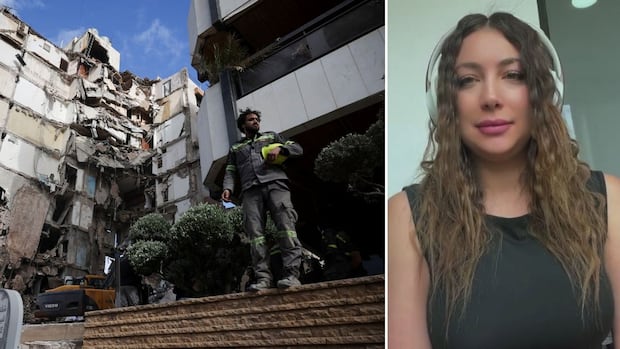
‘Absolute terror’: Canadian in Lebanon describes Israeli air assaults
Shay Ayoub, a Lebanese Canadian living in Beirut, says Israeli assaults on Lebanon come without notice. ‘You spend the entire day just listening to airstrikes,” she said. “It’s a very terrorizing experience.’
But there was no sign Iran had lifted its blockade of the Strait of Hormuz, which has caused the worst disruption to global energy supplies in history. Tehran said there would be no deal as long as Israel was striking Lebanon.
The shortage drove the price that European and Asian refineries pay for oil to record levels near $150 US a barrel, with even higher prices for some products such as jet fuel.
Israel, which invaded Lebanon last month in parallel with the war on Iran to root out the armed group Hezbollah, Tehran’s ally, says its actions there are not covered by the ceasefire announced late on Tuesday by Trump.
Washington has also said Lebanon is not covered by the truce, but Iran and Pakistan, which acted as mediator, say it was explicitly part of the deal. A host of countries, including Britain and France, said the truce should extend to Lebanon.
A Pakistani source with knowledge of the discussions said Pakistan was working on ceasefires for Lebanon and Yemen: “It will be discussed during the [upcoming] talks and we will settle it.”
Hezbollah resumes attacks
The Israeli military said on Thursday it had killed the nephew of Hezbollah’s Secretary-General Naim Qassem, who had served as his personal secretary, and had struck river crossings in Lebanon overnight.
Israel struck Beirut’s southern suburbs just before midnight and at dawn, and hit towns across the south on Thursday morning, Lebanese state media said.
For its part, Hezbollah, which had initially said it would pause attacks on Israel in line with the ceasefire, said it was resuming them on Thursday morning and had fired once across the border and twice at Israeli forces in southern Lebanon.
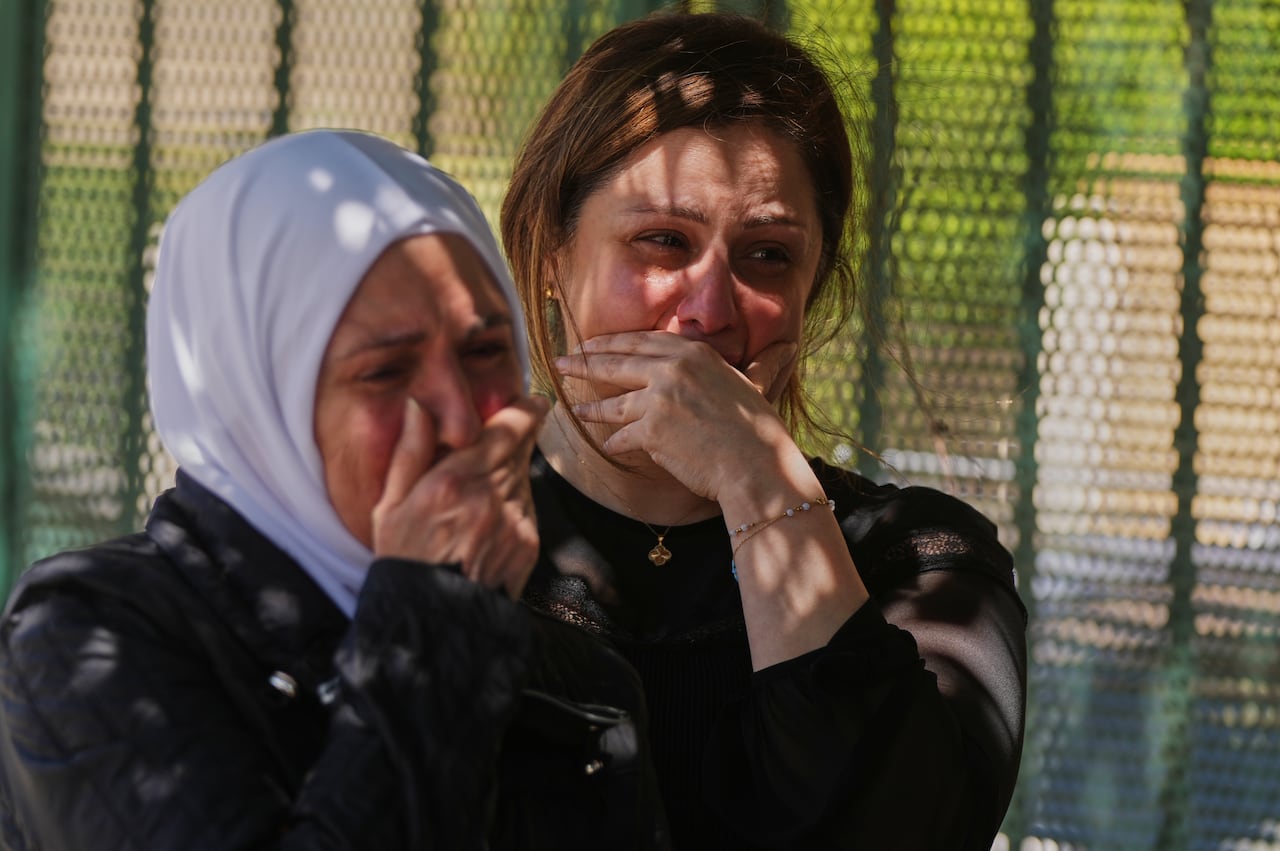 Two women watch a funeral procession for a man killed in an Israeli airstrike, in Beirut, Lebanon, on Thursday. (Hassan Ammar/The Associated Press)
Families gathered on Thursday at Beirut hospitals to identify slain loved ones, and rescuers worked through the night to try to save those trapped under rubble from attacks that hit populated areas without customary warnings to civilians.
“This is my place, this is my house, I’ve been living here like more than 51 years. So, everything destroyed. See?” said Naim Chebbo, sweeping shattered glass and debris from his home in Beirut after strikes destroyed the building next door.
WATCH | What is complicating the ceasefire?:
Inside the U.S.-Iran ceasefire that everybody interprets differently | About That
The U.S. and Iran reached a fragile ceasefire agreement hours after President Donald Trump’s threat to destroy Iran’s ‘whole civilization.’ Andrew Chang explains what’s complicating the deal, breaking down the confusion around its terms and the hurdles remaining as U.S.-Israel negotiations with Iran continue.
Images provided by The Canadian Press, Reuters, Adobe Stock and Getty Images
Lebanon declared a day of national mourning and shut state offices. At one funeral in central Beirut, mourners gathered quietly to bury a man who had been killed. His wife had survived the bombing, which sheared off half the building and left survivors trapped on upper floors for hours.
Iran’s Deputy Foreign minister Saeed Khatibzadeh told BBC Radio that Israel’s strikes on Lebanon were a “grave violation” of the ceasefire.
“It was a catastrophe, could actually end in more catastrophe, and this is the nature of this rogue behaviour that we are seeing from Israel in the whole Middle East.”
Medical supplies nearly depleted
Some of Lebanon’s hospitals could run out of life-saving trauma medical kits within days as supplies near depletion following mass casualties over the past day, the World Health Organization (WHO) said on Thursday.
The life-saving trauma kits include bandages, antibiotics and anesthetics to treat patients who sustained war-related injuries, the WHO said.
“Some of the trauma management supplies were in short [supply] and we may run out in a few days,” Dr. Abdinasir Abubakar, the WHO’s representative in Lebanon, told Reuters.
“If we have another mass casualty, like what happened yesterday, it will be a disaster,” Abubakar said.
“Probably we will lose more lives just because we don’t have enough supplies.”
Shortages of supplies of trauma kits have been driven by a surge in recent casualties — the majority of whom are civilians — with roughly three weeks’ worth of supplies being depleted in one day, Abubakar said.
Medicines to treat patients with chronic disease, such as insulin for diabetes patients, could also be out of stock within weeks — after supply chains were disrupted following the war in the Gulf and the closure of the Strait of Hormuz, Abubakar said.
Spain condemns Israeli attacks
Spain strongly condemned Israeli strikes on Lebanon as well as the broader war on Iran on Thursday, cementing Madrid’s role as an outspoken critic of the U.S. and Israeli military campaigns despite U.S. threats to punish unco-operative NATO allies.
In remarks to lawmakers, Spanish Foreign Minister Jose Manuel Albares described the conflict as an attack on civilization, echoing scathing criticism heaped by Spain’s Prime Minister Pedro Sanchez on Trump’s decision to attack Iran.
“We’re facing the greatest assault on the civilization built upon the humanist ideals of reason, peace, understanding and universal law over the abuse of power, brute force and arbitrariness,” Albares said.
“The prophets of war and violence seek to return to the values and practices of history’s darkest moments,” he added, accusing Israel of violating international law and the two-week ceasefire.
Sanchez has closed Spanish airspace to any aircraft involved in a confrontation he has described as reckless and illegal.
On Wednesday night, Sanchez reiterated his call for the European Union to scuttle its association agreement with Israel, urging an end to “impunity for [Israel’s] criminal actions.”