
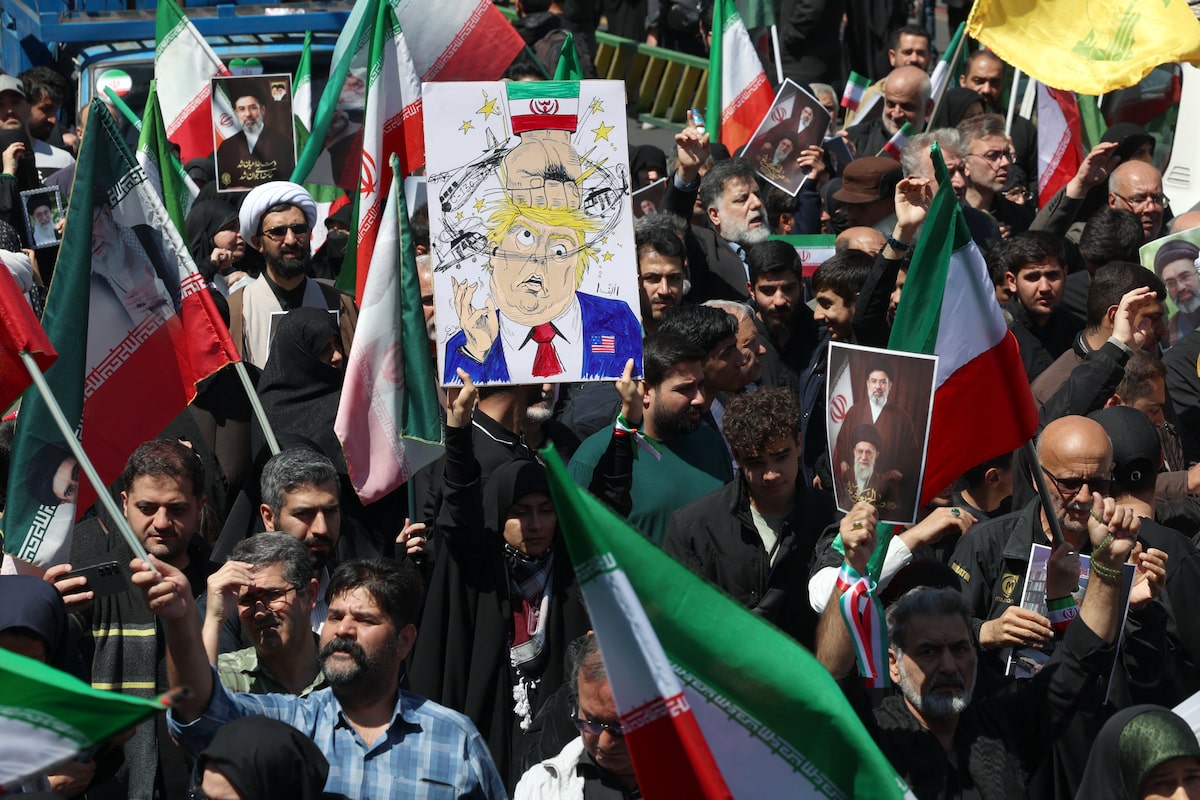
Iranians march in the streets of Tehran during a rally to commemorate the death of supreme leader Ayatollah Ali Khamenei on Thursday.-/AFP/Getty Images
Shlomo Ben-Ami, a former Israeli foreign minister, is the author of Prophets Without Honor: The 2000 Camp David Summit and the End of the Two-State Solution.
When the news of the U.S.-Iran ceasefire broke, I was reminded of an exchange described by U.S. colonel Harry Summers in 1982. “You never defeated us on the battlefield,” he said to a former North Vietnamese colonel. “Yes, but we won the war,” was the categorical response.
Make no mistake: the deal seals the strategic defeat of the U.S.-Israel alliance in Iran. This war will be remembered as yet another episode of powerful countries falling into the trap of asymmetric warfare, in which the mightiest militaries invariably fail to translate tactical gains into strategic victories.
Trump’s critics question how the U.S. is better off after war with Iran
The principles of war, laid out by Carl von Clausewitz in 1812, make clear that the destruction of enemy forces should have a terminal impact on their will to resist. Asymmetric wars defy this norm of “decisive battle,” and there was no reason to think that Iran would be an exception. A civilization animated by ideological fervour, which has endured centuries of wars of survival, was never going to surrender easily. A country that sacrificed some 750,000 of its people’s lives, including thousands of children, in its eight-year war against Iraq in the 1980s always had a tremendous advantage over enemies that crumble under the emotional impact of a few dozen body bags. A regime that in January murdered tens of thousands of its own citizens in a mere 48 hours was not going to be fazed by threats against civilians.
Even as the U.S. and Israel have killed much of the Islamic Republic’s political and military leadership, and demolished much of its military capacity, the regime has waged a war of attrition against the global economy by blocking transit through the Strait of Hormuz. In the process, Iran has managed to replenish its budget: it is now earning nearly twice as much from oil sales as before the war, while raking in profits from taxing ships for passage through the Strait.
Cargo ships wait in the Gulf, near the Strait of Hormuz, in early March. Even the reopening of the Strait of Hormuz after the ceasefire cannot be considered a victory for the U.S. and Israel.Stringer/Reuters
To top it all off, the U.S. and Israel have failed to achieve any of their war aims. Even the reopening of the Strait cannot be considered a victory, since it was open before the war. Iran’s ballistic-missile capabilities and its enriched uranium supplies remain a problem that will be addressed through diplomacy.
Different individuals now lead Iran, but they are no more moderate than their predecessors. The Islamic Republic has been transformed into an outright military dictatorship, with the Ayatollahs providing religious legitimacy to the hardline Islamic Revolutionary Guard Corps.
The broader regional implications are no more favourable to the U.S. and Israel. The war is bound to lead to a redrawing of the geopolitical map of the Middle East. Ties among the countries most overtly challenging the Western-led global order – China, Iran, Russia and North Korea – might be strengthened, and their resolve hardened.
At the same time, the Gulf states, which have borne the brunt of Iran’s retaliatory strikes, might start viewing U.S. military bases as more of a liability than an effective deterrent and move to diversify their alliances. They may consider aligning with a regional power like Turkey, which already has ties to the Gulf Cooperation Council, or Pakistan, which has a defence treaty with Saudi Arabia and has shown a willingness to share its nuclear know-how with Islamic states. In fact, the likelihood of nuclear proliferation in the Middle East has now grown, as leaders in Iran and elsewhere come to view nuclear weapons as the ultimate insurance policy.
Analysis: Iran ceasefire reveals a world transformed
Anti-war protestors gather in Habima Square in Tel Aviv last week. Benjamin Netanyahu’s wars in Gaza, Lebanon and Iran have divided the country and tarnished Israel’s standing in the world.Erik Marmor/Getty Images
As for Israel, unless it holds Benjamin Netanyahu accountable for leading the country into the abyss, its democracy is doomed. With his violent and poorly conceived policies, the Prime Minister has torn apart a once-cohesive society and undermined Israel’s standing in the U.S. to the point that Americans’ alienation poses a strategic threat. His attempt to use Iran to distract from Israel’s escalating brutality toward the Palestinians – which has been essential to Mr. Netanyahu’s political survival – only compounds the catastrophe.
During the Cold War, the late U.S. diplomat and strategist George Kennan recognized that internal dysfunction and external overreach would cause the Soviet Union to collapse on its own. So, he focused on preventing Soviet expansion while avoiding an unnecessary military showdown.
The same containment strategy could have worked against the Islamic Republic, which sooner or later would have collapsed under the weight of its internal contradictions. Instead, the U.S. and Israel initiated a confrontation that was never going to go their way. And whereas the U.S. might be able to absorb the shock of yet another defeat in an asymmetrical war, Israel is no superpower, no matter what Mr. Netanyahu claims.
Copyright: Project Syndicate, 2026. www.project-syndicate.org