
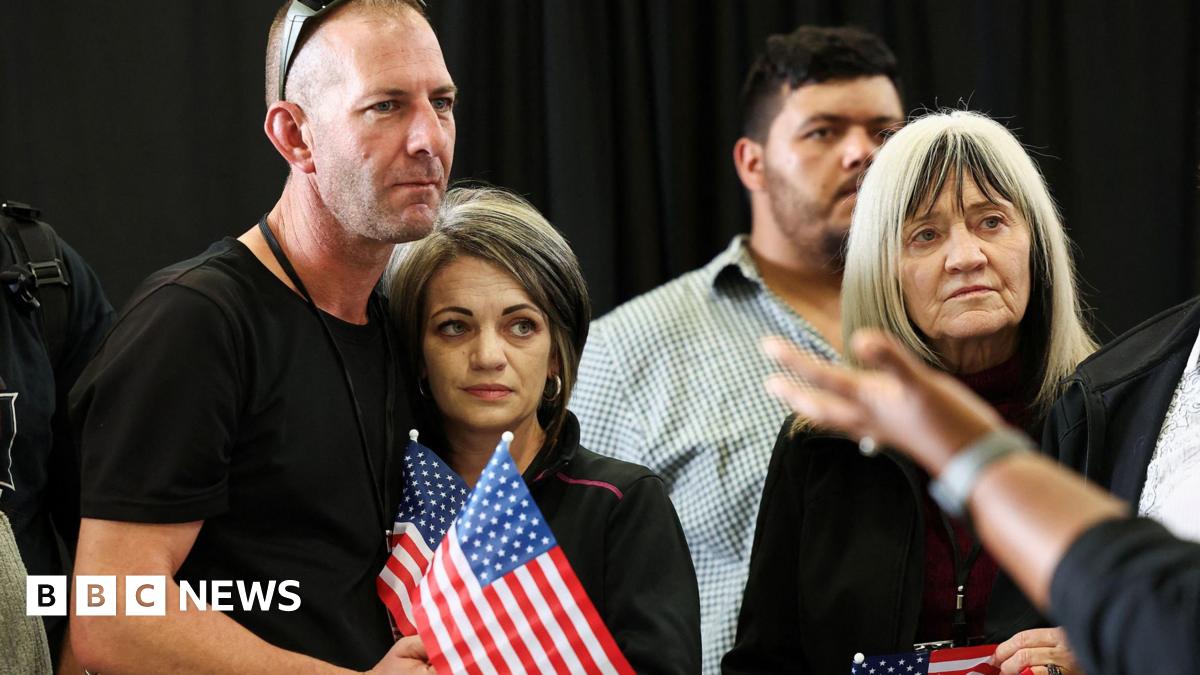
In announcing the change, Trump said it would help strengthen national security and public safety.
Priority was to be given to Afrikaner South Africans and “other victims of illegal or unjust discrimination in their respective homelands”, according to an announcement.
Diplomatic tensions between Washington and Pretoria have been rising since Trump returned to the White House.
Just over a year ago, South Africa’s ambassador in the US, Ebrahim Rasool, was expelled after accusing Trump of “mobilising a supremacism” and trying to “project white victimhood as a dog whistle”.
Then, in the Oval Office in May, Trump confronted his South African counterpart, Cyril Ramaphosa, where he claimed that white farmers in South Africa were targets of persecution and “genocide”.
Ramaphosa tried to refute Trump’s assertions and was backed up by John Steenhuisen, the white leader of the Democratic Alliance, which is part of the coalition government.
“Certainly, the majority of South Africa’s commercial and smallholder farmers really do want to stay in South Africa and make it work,” Steenhuisen told Trump.
In October, the South African government criticised the US decision to prioritise refugee applications from white Afrikaners, saying claims of a white genocide have been widely discredited and lacked reliable evidence.
It highlighted an open letter published by prominent members of the Afrikaner community – including academics, businesspeople and descendants of apartheid-era figures – who rejected the narrative, with some signatories calling the relocation scheme racist.
The first group of 68 South African refugees reached the US in May last year. The numbers began ticking up this year, with 2,848 people arriving across February and March.
They have resettled across the US, with the highest concentration – 543 – living in Texas.