
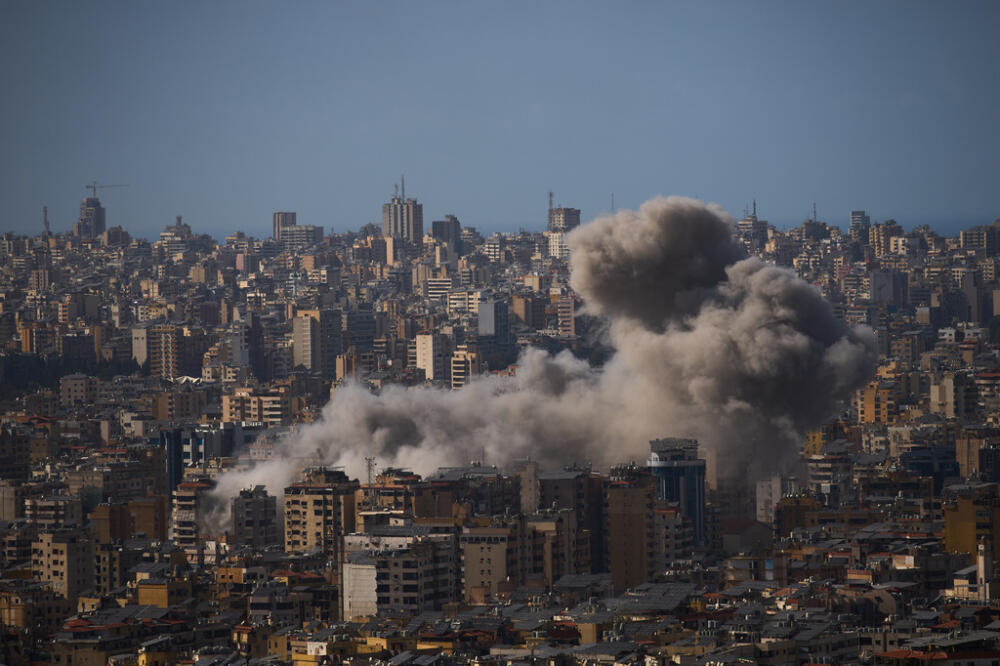
So far, more than a million people have been forcibly displaced by Israel’s invasion of southern Lebanon. Prime Minister Benjamin Netanyahu says eradicating Hezbollah is critical for Israeli security. But critics argue Israeli occupation will only reenergize the Iran-backed militia.
Guests
Imad Salamey, professor of Political Science and International Affairs at the Lebanese American University in Beirut.
Sarit Zehavi, the founder and president of Alma, an Israeli institute specializing in security challenges along the Lebanese border.
Emily Rose, Reuters correspondent in Jerusalem, Israel.
The version of our broadcast available at the top of this page and via podcast apps is a condensed version of the full show. You can listen to the full, unedited broadcast here:
Transcript
Part I
MEGHNA CHAKRABARTI: The events of the past 48 hours go like this. On Monday, through Pakistani intermediaries, Iran delivered a 10-point proposal to end the war, delivered that to the U.S. and Israel. That same day, President Trump called the proposal, quote, a very significant step, but he added: It’s not good enough.
Then yesterday, Tuesday, Trump threatened to annihilate Iran, posting on social media that “a whole civilization will die tonight.” If Iran didn’t meet Trump’s 8:00 p.m. Eastern deadline to reopen the Strait of Hormuz. Then at 3:17 p.m. Eastern time, Pakistan’s Prime Minister Shehbaz Sharif posted on X: I earnestly request President Trump to extend the deadline for two weeks.
We urge all warring parties to observe a ceasefire everywhere for two weeks to allow diplomacy to achieve conclusive termination of the war. End quote.
Then a little more than three hours later, 6:32 p.m. Eastern yesterday evening, Trump announced that he has agreed to a two-week suspension of U.S. bombing campaigns in Iran.
He called it “a double-sided ceasefire,” end quote. But rather than Iran accepting Trump’s terms, it’s the president of the United States who seems to have accepted Iran’s proposal from Monday, which includes continued Iranian control over the Strait of Hormuz, lifting all sanctions on Iran, releasing frozen assets.
And a version released in Farsi. In that version, Iran also included the phrase, quote, acceptance of enrichment for its nuclear program, end quote. But that phrase was missing from English versions Iranian diplomats shared with journalists. As negotiations do continue, if Iran wins U.S. commitment to any of those proposals, it would put Tehran in a better place than it was before the start of the U.S. and Israel’s war.
Yesterday, Israeli Prime Minister, Benjamin Netanyahu also stated that Israel supports the ceasefire as long as Iran reopens the Strait of Hormuz. But that, quote, the two week ceasefire does not include Lebanon.
There has been no cessation of bombing in Lebanon. Today, the Israeli military announced it has carried out the largest coordinated strike in the current war against Hezbollah, striking more than 100 targets across Lebanon, including the capital of Beirut. Civilian targets were also hit to Israel claims that Hezbollah uses those sites as civilian shields.
So we will start today in Beirut, where Imad Salamey joins us. He’s a professor of political science and international affairs at the Lebanese American University in Beirut. And Professor Salamey, thank you so much for joining us.
What has your morning been like so far?
IMAD SALAMEY: Hi Meghna. And yes, like you mentioned, dramatic situations are fast unraveling in the region, and we were hoping in Lebanon that we will be part of this ceasefire agreement at least. And some of the people who’ve been displaced due to the conflict would return home.
But unfortunately, about three hours ago, we were confronted by a bloody day. A day where Israel has targeted almost a hundred different locations in the country. Primarily in Beirut and Beirut, as you know, is full of displaced population that came primarily from the southern part of the country, and some of them also came from the eastern part of the country.
So the population here is very dense. The streets are full of people, they’re full of tents, and all the sudden you see, we see this campaign of bombardment hitting randomly in different locations of the city, causing pretty much a bloodbath in the street. Hospitals now are full of wounded and dead, also ambulances.
You can hear them, they can hear that siren in the streets. People are asking for blood donations. It’s really like a massacre unfolding in the front of our eyes.
It’s really like a massacre unfolding in the front of our eyes.
Imad Salamey
CHAKRABARTI: Were you able to see or feel any of the bombings from where you are in Beirut?
SALAMEY: Yes. One bomb hit my street, is about 50 meters away from where I reside.
And there were many casualties in there. Mostly civilian because these are not really targeted or assassinated attempts, but it really hitting buildings. Bringing down a whole entire building with all the residents there in a pretext that Israel is trying to kill a Hezbollah operator.
But these tend to become indiscriminate and definitely violations of international laws and Geneva conventions that make civilian population protected under during warfare. But definitely Israel seems not so caring about international laws, not to say Geneva conventions. And it’s really after blood it seems.
It’s either because perhaps Israel is unhappy with what happened in term of ceasefire. Maybe that ceasefire left Israel not so much on the table or deciding the negotiation, or perhaps because Israel want to continue its attack in Lebanon. For what it’s called security concerns.
And elimination of Hezbollah from the country.
CHAKRABARTI: We will hear from someone in Northern Israel in just a few minutes to hear the argument about the necessity for Israeli security to expand control into Southern Lebanon. But professor, if I may, right now in the United States where I’m located, it’s about 10, it’s about 12 minutes past 10 in the morning Eastern time.
Just for listeners who know who are hearing this perhaps a little later in the day. When you said that one of the bombs fell or exploded on your street, first of all, I hope you are okay. And people that you know are okay, but can you describe what that felt like?
SALAMEY: We were expecting deescalation of the war, and we were happy that as ceasefire was reached and no annihilation of any civilizations that will take place and we will be paying for that confrontation. And we were trying to rethink about normalizing our lives. And as I’m a professor at the university. And we’ve been operating online, we start thinking that it’s time for the students to come to campus and resume normal lives and that kind of thing, my wife going to work, my son going to work, and we’re going back to normal lives. And all of a sudden, this bomb that shook us, without any warnings. Previous events, Israel will send a warning to particular areas or residents to flee, but this time it had no warning and a bomb just hit a residential building.
And I assure you, it’s a residential building. And probably has doubled its population because of many displays are living there now. And we’ve seen blood on the streets and people screaming and running, knowing where to go given this situation, it was quite chaotic honestly.
CHAKRABARTI: It shook your building.
Are you able to see the building that the bomb hit from where you are right now?
SALAMEY: Not directly, but I’ve seen the smoke coming out and we were able to extinguish the fires and now there are many working on clearing out the streets so cars can pass through.
CHAKRABARTI: Now, as you well know Professor Salamey, Israel has said repeatedly that the targets it selects are very carefully chosen because they have evidence that Hezbollah uses those locations for either staging its fighters, storing munitions, using civilian shields. But you’re saying that’s not, that is not true on your street.
People may be wondering now, how can you confirm that? How can you affirm that there’s no presence of Hezbollah where you are?
SALAMEY: This is a very difficult thing, quite honestly. I’m not here to defend Hezbollah, Hezbollah do utilize sometimes or hold weapons in civilian areas, but this is due to the fact that especially if we’re talking about South Lebanon.
Most of the young people who supportive of Hezbollah are part of the social and communal fabric. It’s not these guys are an army, or they have like particular military positions that they reside in and they keep their weapons. These are part of the community and actually this is what Hezbollah has been able to successfully kind of achieve over many decades, is to mobilize the community, particularly the Shia community behind its appeal. And those appeal have been its ability and many occasions to confront Israel trying to invade South Lebanon and occupy it. So Hezbollah always prides itself on having achieved a defeat to Israel over the years by forcing it out of South Lebanon.
So in a way it has presented itself as a protector of the community and also runs variety of social services like a welfare network. While the Lebanese state is very weak and it’s not present, pretty much, especially in these remote areas. So Hezbollah became part of the community rather than a separate military force.
And this, it’s really difficult to distinguish, given this fact, where Hezbollah, young people, fighters, civilians, it’s become really difficult. And therefore, Israel attempt to attack and to say that it’s trying to make distinctions between civilians and military is really nonsense.
Most of these attacks in certain areas have targeted Hezbollah, but in most have been really attacking civilian population and terrorizing the population rather than really doing a military or achieving military objectives.
Part II
CHAKRABARTI: I’d like to bring Sarit Zehavi into the conversation now. Sarit joins us from Kfar Vradim in Northern Israel.
She’s the founder and president of Alma, an Israeli institute specializing in security challenges along the Israel-Lebanon border. She’s also retired Lieutenant Colonel who served for 15 years in the Israeli Defense Forces Intelligence Corps. Sarit, welcome to On Point.
Thank you for joining us, and I’m wondering if you too can describe what your life has been over the past four to six weeks since the U.S. and Israel launched its war against Iran, because Hezbollah has been sending barrages of rockets into Northern Israel.
SARIT ZEHAVI: Thank you for having me. It’s important for me to be with you today. I live nine kilometers, which is around six miles from the Lebanese border. And actually it’s not a few weeks, it’s almost three years —
CHAKRABARTI: Since October 7th. Yes.
ZEHAVI: Since October 8th, 2023. When Hezbollah opened war against us and actually opened another front for Israel, which was clearly not interested in opening another front after we had Hamas in Gaza.
And then there was an agreement. Again, the same agreement as we used to have 20 years ago that promised us that the Lebanese government will disarm Hezbollah, at least in South Lebanon, if not in all of Lebanon. It depends to which security council resolution you’re looking at. And so since there were constant violations, like daily violations of Hezbollah during the period between the two campaigns.
There was an Israeli dilemma of what to do in order to stop the rehabilitation of the military force of Hezbollah, which exceeded the IDF efforts to prevent it, since we did attack in Lebanon between the two campaigns, but only about two attacks, twice a day average. And then Hezbollah again attacked us over here in the north.
And by the way, some of the attacks went all the way to Tel Aviv area to the center of Israel. So we are constantly bombed. I had to run to the bomb shelter a few times a day, while I have seconds to get there, and I usually don’t make it on time. Like the professor talked about Israeli bombings in Beirut, 50 meters from his house.
I had the same over here in my house. Few times, not just once. Very close meters away. Houses were damaged and families cannot live in those houses anymore. Which is what we call statistic shooting. Like Hezbollah is shooting inaccurate weapons all over the place and saying very clearly that it is targeting military and civilian targets in Israel, while the overall goal of Hezbollah is just as the overall goal of Iran, death to Israel, death to America, there is no difference in this regard.
CHAKRABARTI: I want to just observe an obvious fact that here we have the two of you, a Lebanese professor in Beirut an Israeli lieutenant, retired Lieutenant Colonel in Northern Israel. In the same intellectual space on this radio program.
Now, I’m not saying that Professor Salamey is at all representing Hezbollah. That is not what I’m saying. Because it’s not the case. But the fact that we can have this conversation makes me wonder. At the risk of asking what may seem to be an idiotic question, but Sarit Zehavi, people external to the region may be wondering why hasn’t there been able to be made any meaningful progress towards some sort of even reduction of the violence or the enmity that seems to require perpetual war on the border that you’re living near.
ZEHAVI: Israelis are asking the same question. We are the one who are sending our soldiers, which to remind everybody in Israel, it’s compulsory service. So basically all of us, our mothers to soldiers, sisters of soldiers, brothers of soldiers we don’t want to pay this price with their lives and the lives of civilians.
I don’t want to have my 12 years old daughter hearing a whistle and then see a rocket hit 50 meters from her and have zero time to get to the bomb shelter. Nobody enjoys this situation. Okay. The answer lies in the elephant in the room, and the elephant is Hezbollah. You cannot ignore the fact that the Lebanese government is just failed to deliver. It refused to clash with Hezbollah, and Hezbollah refused to disarm.
That way, we ended up with a huge monster on the other side of the border that planned to slaughter us just like Hamas had done. And I have proofs to what I’m saying. In the north, in our beds, in our communities, and bombed us for many months while Israel didn’t go to an offensive in Lebanon for many months last time.
And it took us 11 months to actually do that. So we cannot have peace with Lebanon ignoring the fact that there is an army, another army in Lebanon that the Lebanese government refused to do something about it.
CHAKRABARTI: Professor Salamey, I appreciate your patience just now, no one I can imagine that nobody in Lebanon wants the current attacks also going on in Lebanon.
Nobody wants this more than 1.2 million people displaced from Southern Lebanon by the Israeli incursion there. Now just your thoughts.
SALAMEY: Yes of course, nobody like to live in a state of war. And unfortunately, the Lebanese population, generation after generation have been living under situation of war and being used sometimes as tools in regional warfare, but definitely the presence of Israel and its visions toward the region has helped the least, especially that since its establishment, it led to the displacement of Palestinians from their homelands. And Lebanon had come to bear the coast of hosting Palestinian displaced populations living in today 12 refugee camps throughout the country, and Lebanon has been taking care of them.
And Lebanon has demanded nothing other than having these Palestinians the right to go back to their own countries, which Israel, of course, has refused to do and therefore, Lebanon is in a state of war with Israel. Partially because of that fact. But also, Israel has been in constant violations of Lebanese sovereignty. Since I remember, and I opened my eyes to the world, seen Israeli planes constantly violating our airspace, always attacking villages.
Many of the villages on the south Lebanon have been destroyed so many times before Hezbollah and before the PLO came about. And Israel has always incited violence in those countries and led to multiple levels of displacement due to the fact that its nature, its military nature. This military nature has always thought to ask for security.
And therefore considered all countries around it, including the Palestinians, to be part of, they need to be revised in order to fit its own security rather than to provide security and peace to other neighbors.
CHAKRABARTI: Professor, may I just ask you a quick question on that front and please forgive the interruption, but may I ask you.
Rationally speaking, when a nation is being attacked, and in this case, I’m thinking about Israel from armed groups on its border, what nation would not want to take action to assure its own security? I don’t think anyone in any country would think its our responsibility to assure the security of the nations around us.
SALAMEY: True, but if you see how many times the Arabs and Lebanon and the Palestinians have sought to have peace with Israel, and Israel continuously have rejected these peace efforts and responded with fire. Look at the West Bank right now in Palestinian authority. Look at how Israel now send its settlers there and terrorizes the population there, there are no Hamas there.
Let’s say. There are nobody violating Israel. Nobody’s threatening Israel. And look what happened in there. Look at Syria, Northern Syria now with Druze, in Druze area in the Golan Heights. Israel continuously invades and tries to say that there are, that it’s surrounded by terrorists, everybody is trying to come and terminate Israel and drive the Jews to the sea.
It’s all nonsense. This is the kind of propaganda Israel continuously uses in order to continuously armed and establish what it calls security zones. It looks at all these neighboring states as a source of threat. And therefore, it creates these A, B, and Z zones and then violate. Look at now the Lebanese government, for instance, signed with Israel and the hostility agreement last year.
CHAKRABARTI: Actually, professor again, forgive me for the interruption. I do want to talk about that agreement. But let me just first give Sarit Zehavi a chance to respond and then we’ll get to that. The other sort of previous attempts at peace. But Sarit, go ahead.
ZEHAVI: I think that I have a very short time to answer a long list of lies by the distinguished professor, but I will try to do that.
Speaking about the Palestinian refugees, my grandmother was born in Beirut. My other grandmother was born in Hebron. Both of them had to flee those places because of attacks by the Arabs before the state of Israel. Am I a refugee? Was I ever compensated? You are talking about Palestinian refugees of 70 years ago.
There is no precedent to this anywhere in the world. Second, we are not taking an inch of Lebanon. In the past 20 years, between May 2000 that we had unilaterally with no agreement, had withdrawn from Lebanon and withdrawal, it was recognized by the UN, and then we were attacked in 2006, and then we were attacked again in 2023, and then we were attacked again in 2026.
There was no security zone in those times, and yet Hezbollah was not disarmed. According to the promise of the Lebanese government. War crimes.
CHAKRABARTI: Are you saying there was no, are you saying wait.
ZEHAVI: I need to answer all those lies. I’m sorry. Collateral damage. He blamed us in war crimes due to international law that the professor spoke about, collateral damage is legal under three conditions.
Warning the population, which this is the reason why there are so many displaced people in Lebanon, because there are rockets and missiles inside their houses. We found them when we maneuvered in Lebanon. We proved that they are hiding those weapons in every house in the Muslim Shia towns.
That’s why they are being destroyed. And those weapons were launched against us. The second condition is —
CHAKRABARTI: You have proof that they were hiding weapons in every house. Every single house in southern, in towns in southern Lebanon?
ZEHAVI: Yes. You can find the proof in my website, we published a map with all the filmed examples that we have, of course, and IDF soldiers that came back, said that they found weapons in every house.
This is something that is well known across Lebanon and was proven in the previous campaign. The third condition is proportionality, and you can understand, and since we are living next to the border. You cannot evaluate the proportionality of one missile of Iran will hit here or Hezbollah and Israeli bomb will hit there.
So we are doing the best we can to warn the Lebanese population. While Hezbollah is doing the best it can to use them as human shields. As for Syria, we are the only nation in the world that came to help the Druze of Syria while they were massacred by the new government of Syria experiencing the same as October 7th, including atrocities, rape, and kidnapping of civilians.
So I truly don’t understand why when you are asking him a question about the past 20 years of relationship between Israel and Lebanon, he decides to answer you with the Palestinians, and again, saying that there is no Hamas in West Bank. Come on.
CHAKRABARTI: Because I think the issue, the Palestinian issue, quote-unquote, is intractable.
It’s completely woven into the sources of war and violence in the region. But let me ask you, Sarit, proportionality. This is a thing that I think a lot of people, there’s so much passionate debate over. Do you think that it is a proportional response from Israel to now, as I mentioned earlier, have displaced, yes, they’ve warned civilians, but have displaced almost one and a half or even more than one and a half million people from Southern Lebanon. Is that proportional?
ZEHAVI: What’s the? No. You are mixing two different conditions. Okay. Warning the population is all about making sure they will not be bombed and taking them out of the war zone.
We are committed to do that by international law.
CHAKRABARTI: Yes. I’m acknowledging that.
ZEHAVI: Nothing to do with proportionality. Proportionality talks about the casualties. If we didn’t warn them, they would be much more casualties because the weapons of Hezbollah are in every house. How can you carry out attacks against Hezbollah that is hiding and launching missiles from within those houses if you don’t warn the population and ask them to evacuate.
CHAKRABARTI: No, let rephrase, your point is well taken. Let me rephrase, because both of you have talked about refugees. We seem to have an endless cycle of the creation of more refugees, every generation in the region. You talked about how your family are refugees originally from Lebanon, but now we have, Israel has created one and a half million new refugees being pushed out of Southern Lebanon.
ZEHAVI: No, they’re not refugees. I’m sorry. They are not refugees. My grandparents and father had to leave the countries where they were born. These people of south Lebanon and Dahieh are not refugees. They are displaced and they will be able to come back once Hezbollah will stop threatening us. I have no interest —
CHAKRABARTI: Even if they’re Shia Muslim.
If they are Shia Muslim, the Israeli government will allow them back?
ZEHAVI: Of course, it doesn’t matter what’s their religion, it matters who is using them as human shields. They will not be —
CHAKRABARTI: Except at this point in time, forgive me, I don’t mean to sound argumentative, but except at this point in time, there have been many reports that the Israeli government has reached out to leaders in towns in southern Lebanon to their Christian and Druze leaders and said, you can stay, but if you have Shia Muslims in your village or even in your homes, you have to tell them to leave.
ZEHAVI: Because Christians and Druze didn’t use their houses to launch rockets towards us, it’s very clear. We only warn those where the war zone is. And the war zone is inside the Muslim Shia towns because this is where the rockets are. This is where Hezbollah was preparing to slaughter us. And was preparing for the invasion and it was proven with tons of videos and pictures of the tunnels and the munition and everything we have found there.
So I don’t understand. Do you want us to evacuate Christians that had nothing to do with Hezbollah as well? We are not doing that. We are only warning those who are part of the war zone. Those who used as human shields of Hezbollah, by the way, yes. Hezbollah was trying to use the Christians as well as human shields, and that’s why we warned them around it.
CHAKRABARTI: I think the question was if those Shia families are in places where the Christians are there as well, and maybe there’s no munitions, why were they asked to leave? But I want to talk about previous peace attempts with Hezbollah when we come back.
Part III
CHAKRABARTI: I want to speak briefly with Emily Rose. She’s the Reuters correspondent with us in Jerusalem, Israel. Emily, welcome to the program.
EMILY ROSE: Thanks for having me.
So I just want to spend a few minutes with you getting a sense as to if there’s any possibility for negotiations or talks even between the Israeli government and the Lebanese government that might even bring a temporary cessation of the Israel’s campaign in southern Lebanon.
ROSE: I’ll say firstly that this is a fluid situation. It’s basically changing right before my eyes. I can say that we’re delivering that rolling coverage at Reuters and you can continue to watch as it comes in. I think one thing we’re watching is that we haven’t actually seen a formal response yet from Hezbollah.
And we’re looking for that and obviously we’ll update it as it comes through. And then just recently, just in the past hour, we saw an Israeli military official say that Hezbollah has been embedding itself more north inside, deeply inside Lebanon. Of course, Reuters couldn’t independently verify that, but the Israeli military official did say that in the past hour and discussed the types of targets that were struck today, throughout the day. So it’s a very fluid situation.
Also, just in the last hour there was an alert sounded in northern communities in Israel. It turned out to be a false alarm. But one thing to look out for is to see if Hezbollah does issue any kind of military response and a verbal response to the strikes that have taken place in the past couple of hours.
CHAKRABARTI: And as of again, just to give listeners a sense of the time, we’re broadcasting this first at 10:43 a.m. Eastern time, and so no response yet from Hezbollah. But Emily, let me ask you, how would you describe what Israeli officials, both in the military and Prime Minister Benjamin Netanyahu, have said about their intentions in southern Lebanon?
Is it to occupy that territory? Is it to seize it, to create that security zone that we’ve been hearing about? What is their declared intention?
ROSE: So Reuters, we reported very early on in this war with Iran that Israeli officials, Israeli political officials, expected that the war with Hezbollah would surpass the war with Iran.
That even if there was a deal struck with Iran, the war with Hezbollah would continue. And as I’ve been speaking to Israeli military officials and political officials throughout the war, some of them have made a distinction to me. Particularly in the military echelon about what their intentions are in Southern Lebanon.
One distinction that was made to me was that the point or the military strategy and the point in southern Lebanon was actually to try to push Hezbollah away from the border. It was explained to me that despite Israel having a very multi-layered and sophisticated aerial defense system, smaller form weaponry like RPGs, handheld weapons that are fired, can fire about 10 kilometers across the border, and those cannot be intercepted by Israel’s sophisticated and most sophisticated aerial defense systems, simply because they’re too short term. They’re too short distance and there’s not enough time.
So the idea is to push, as was explained to me, the idea was to push Hezbollah further. A lot of details are still seemed to be unclear but it was explained to me that the threat, the imminent threat to those civilians in those northern towns really on the border was so short distance that there needed to be some kind of mechanism that would push Hezbollah north of … this line that has been considered even by Israeli officials or said by Israeli officials in the past couple of weeks as that line that they wanted to push Hezbollah past in order to, as they say, maintain that security for those northern towns on the border.
CHAKRABARTI: And then hypothetically if the Israeli military is successful in doing that, has there been any official communication about what Israel would do then?
Would it require a permanent military presence in southern Lebanon or what?
ROSE: I’ve been told that the idea, and this has been reinforced to me both by military officials and political officials. The idea is that whole area needs to be free of a threat to Israeli northern towns, that it needs to be a demilitarized zone.
And whether that happens via a political solution or whether that happens via a military solution, military officials have told me that remains the decision of the political echelon. But that it could truly happen in both ways. That’s the way some military officials have explained it to me.
So I think in that sense, it truly remains unclear at this very moment.
CHAKRABARTI: Yeah. Emily Rose, Reuters correspondent with us from Jerusalem. Thank you, Emily.
Let’s go back to Professor Imad Salamey, and I appreciate, again, both you and Sarit listening along with us to Emily in Jerusalem. Professor Salamey, I know you probably have a lot of things that you’d like to respond to regarding what Sarit said. Go ahead if you’d like, but I’m also actually perhaps even more curious about your thoughts regarding what led to the failure of previous attempts to disarm Hezbollah.
You had mentioned earlier some weakness within the Lebanese government itself. What can be done to shore up the Lebanese government such that Hezbollah can be further neutralized by the Lebanese themselves?
SALAMEY: Yes, Meghna. I’d like to respond to you of course, and I don’t mean to be in a debate with your guest, unfortunately, especially after hearing insulting remarks that I do not accept in any kind of professional discussion, especially on your respected radio station.
But anyway, responding to you, of course, many agreements have been established in the past between Arab, between Palestinian in particular or different Arab states, Jordan and Egypt and Israel, and definitely none of these agreements address the issue of weapons in houses or people holding weapons. Because if this was the pretext of bombarding villages and depopulating areas, then, you know, I don’t know what to do with the Israelis knowing full well that not only their settlers are fully armed and terrorizing population all over the place in west Bank.
But the entire Israeli populations is trained and equipped and full of weapons inside their houses and under their houses. This is, cannot be utilized as a pretext of war and to committing unproportional attacks and causing cleansing of the populations or destroying villages and depopulating whole areas from the South Lebanon in particular. But in generally speaking, Arabs have in 2002 offered Israel peace, assembling in Lebanon.
They offered Israel peace by accepting two state solutions, which Israel rejected.
CHAKRABARTI: Professor, if I may, can I move forward in time a little bit? Because also even more recently I believe it was in 2024 there was discussion or perhaps even some action regarding U.S. involvement to help build up the Lebanese government and Lebanese forces to help eradicate Hezbollah.
I’m wondering what happened with that effort, if you have any thoughts on that?
SALAMEY: Yes. In 2024, there was an agreement, end the hostility agreement between Lebanon and Israel and brokered by the United States. A mechanism was established in order to monitor the implementations of this agreement, which implied the disarmament of Hezbollah from southern Lebanon.
A first step toward disarmament in different areas, and in fact, the Lebanese government was very positive in moving about this. And it dispatched Lebanese army in the south of the Litani River, closer to the Israeli borders, and began to dismantle many of the infrastructures of Hezbollah. And confiscating weapons and dismantling many of its bases.
At the same time, Israel did not stop attacking and United Nation interim forces that monitor ceasefires under U.S. Security Resolution 1701 in southern Lebanon. I recorded more than 10,000 violations by Israel over Lebanese airspace or by bombing different targets in Lebanon and causing more than 300 death throughout different areas in Lebanon.
And still no single shot was shot at Israel for more than one year. While Lebanese government was trying to do its job and dismantle Hezbollah infrastructure till what happened now with this regional war. At the same time —
CHAKRABARTI: If I may, professor, and again, please, both of you have request repeatedly that you forgive the interruption.
It’s just that I’m really bound to the strictness of our clock. But I would just like to quickly give Sarit a chance to respond to that same question about efforts in 2024.
SALAMEY: But if you don’t mind, just to say one other very quickly. One other thing is the fact that the Lebanese government has declared its intention for direct negotiation with Israel, and this came out of our Prime Minister, as well as the Lebanese president, both intentions is to conduct negotiation, both declared Hezbollah armed groups to be illegal in the country and wanted every support possible to implement these policies. But unfortunately, it was Israel that has refused to negotiate.
CHAKRABARTI: Sarit, please go ahead.
ZEHAVI: So again, one after the other. You are defining, the professor is defining Israel as military societies since I mentioned that we all serve in the Army, but I don’t hide rockets beneath my children’s bed. Neither tunnels, no antitank missiles, which this was the case. In the Muslim Shia towns of south Lebanon, half of the rockets that were launched in the current campaign were launched from south of the Litani River, the area that the Lebanese government claimed that was disarmed.
So clearly there was, or there is weapons of Hezbollah in those places. As for what you ask about between the two campaigns, look we shouldn’t start from between the two campaigns. We should start from 2006 and from, for almost 20 years, the Lebanese government did nothing to this arm Hezbollah.
So this time what we had done is to measure by deeds rather than by words, and there were no deeds. As I’ve said, the Lebanese government already provided seven proofs or eight proofs for the actions of seizing weapons of Hezbollah. It didn’t, and the Lebanese army said it very clearly, that they are not entering into houses to search for the weapons of Hezbollah.
They did it very few times and they collaborated and coordinated with Hezbollah the entrance into those buildings. And that’s why whenever Israel identified Hezbollah activity south of the Litani River during this the past year, between the two campaigns, yes, we attacked it and as I’ve said, it was twice a day average while Hezbollah was disarming, smuggling weapons through Syria, training its elite unit again to invade into Israel.
Rebuilding its storages of weapons in Beirut … and south of the Litani nearly as was demonstrated. Again, the Lebanese government is welcome. I am the first person, and Israelis want peace with Lebanon. Israelis want peace with Lebanon, but we want to see deeds by the Lebanese government against Hezbollah and not just towards our promises of 20 years that were not fulfilled.
CHAKRABARTI: We only have a couple of minutes left and with both of your approval, I’d like to actually set aside the political analysis for this last few minutes of the conversation. Because as I listen to both of you and my gratitude is profound, that both of you could join us today. I cannot help but to think my parents came from South Asia, so I’m very familiar with the visceral truth of a multi-generational blood battle between two groups who see each other as permanent and unending enemies.
And in the case of Pakistan and India, they happen to both be nuclear armed. I just wanna ask you both, and this might seem foolish, but from a purely human point of view. Are you Sarit and are you Imad capable of feeling or are you feeling right now even just a little bit of empathy for each other?
ZEHAVI: More than a little bit. Of course, I feel empathy for the Lebanese.
CHAKRABARTI: For Imad specifically?
ZEHAVI: There are more than two sides here. There are the Lebanese who are against Hezbollah and there are the Lebanese who support Hezbollah. It’s three sides and Emad, same question for you.
SALAMEY: Yes, I was educated by Jewish intellectuals in the United States.
My Jewish-Lebanese neighbors I lived close to them. I have all respect for all human beings to live in peace and want peace and we definitely, Lebanon, seek to have a peaceful life. So it’s population. The point here is that there are conditions for peace.
Peace cannot be attained easily sometimes. Unless the root cause of the issues are addressed. And I’m hoping those will be addressed so we can arrive to genuine peace.
The first draft of this transcript was created by Descript, an AI transcription tool. An On Point producer then thoroughly reviewed, corrected, and reformatted the transcript before publication. The use of this AI tool creates the capacity to provide these transcripts.