
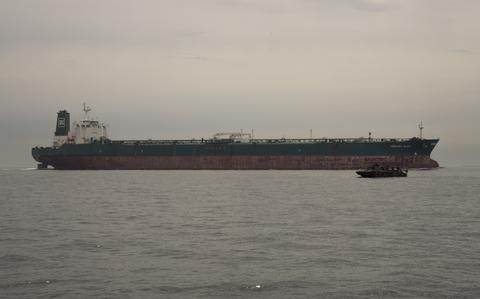
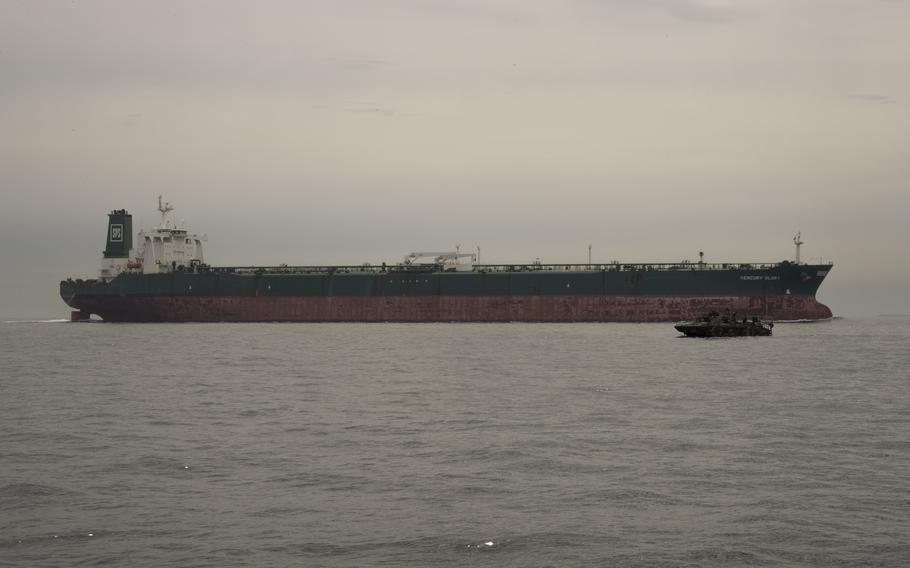
An oil tanker transits the Arabian Gulf in this undated photo. President Donald Trump warned Iran not to charge fees for ships passing through the Strait of Hormuz, the narrow passage connecting the gulf to global markets, ahead of negotiations to end the war. (Martine Cuaron/U.S. Navy)
Disagreements over control of a major sea lane and questions about the U.S.-Iran ceasefire were still looming Friday as the two countries prepared for high-stakes talks on ending a war that has claimed 13 American service members’ lives.
Vice President JD Vance will lead a delegation to Islamabad, Pakistan, where meetings with Iranian officials are scheduled to begin on Saturday, according to White House officials.
The key issue hanging over the talks is the reopening of the Strait of Hormuz, an oil transit corridor that Iran closed off in retaliation for combined strikes by the U.S. and Israel.
The strait has remained at a virtual standstill despite Tuesday’s ceasefire agreement. Maritime trackers showed few vessels in the waterway Friday morning, and analysts said only ships carrying Iranian cargoes were allowed to pass through it.
As part of the two-week ceasefire, the strait is supposed to be free and open, U.S. officials said. But Iran so far appears unwilling to give up control of the waterway, which usually carries about a fifth of the world’s oil.
Tehran has demanded sovereignty over the strait as part of any permanent deal, and some reports say vessels that attempt to pass through without coordinating with Iranian authorities are being threatened with further attacks.
President Donald Trump said on his Truth Social platform Thursday that Iran cannot levy tolls on tankers passing through the strait.
“There are reports that Iran is charging fees to tankers going through the Hormuz Strait — They better not be and, if they are, they better stop now!” he wrote.
A few hours later he wrote: “Iran is doing a very poor job, dishonorable some would say, of allowing Oil to go through the Strait of Hormuz. That is not the agreement we have!”
The blockade has roiled global markets and sent fuel prices soaring, though markets calmed slightly after announcement of the ceasefire.
Brent crude, a global benchmark for oil prices, has dropped to about $94 per barrel after hitting a high of $112 last month.
But the decline has done little to assuage fears about long-term impacts to oil supply chains, especially as disagreements between the U.S. and Iran persist. U.S. officials have insisted they may resume strikes if a permanent deal does not materialize.
The U.S. will help with ship congestion in the strait, loading supplies and making sure everything goes well, Trump said this week without providing further details.
In the past, he has suggested that U.S. Navy vessels could escort tankers, though officials have not outlined a plan for such operations and the proposal could carry risks of escalation.
Any potential security effort in the strait will likely depend on whether the ceasefire between the U.S. and Iran holds and whether the talks in Pakistan produce a broader agreement.
The first days of the ceasefire have been some of the bloodiest in the war, with Israel launching fresh attacks against Hezbollah, an Iran-backed militant group in Lebanon.
Israel’s strikes have put the fragile negotiations on even shakier ground, with Iran threatening to pull out of Saturday’s talks if the ceasefire is not extended to Lebanon. The campaign against Hezbollah resumed Friday morning.
As of Friday afternoon, there was no confirmation of Iranian negotiators’ arrival in Pakistan.