
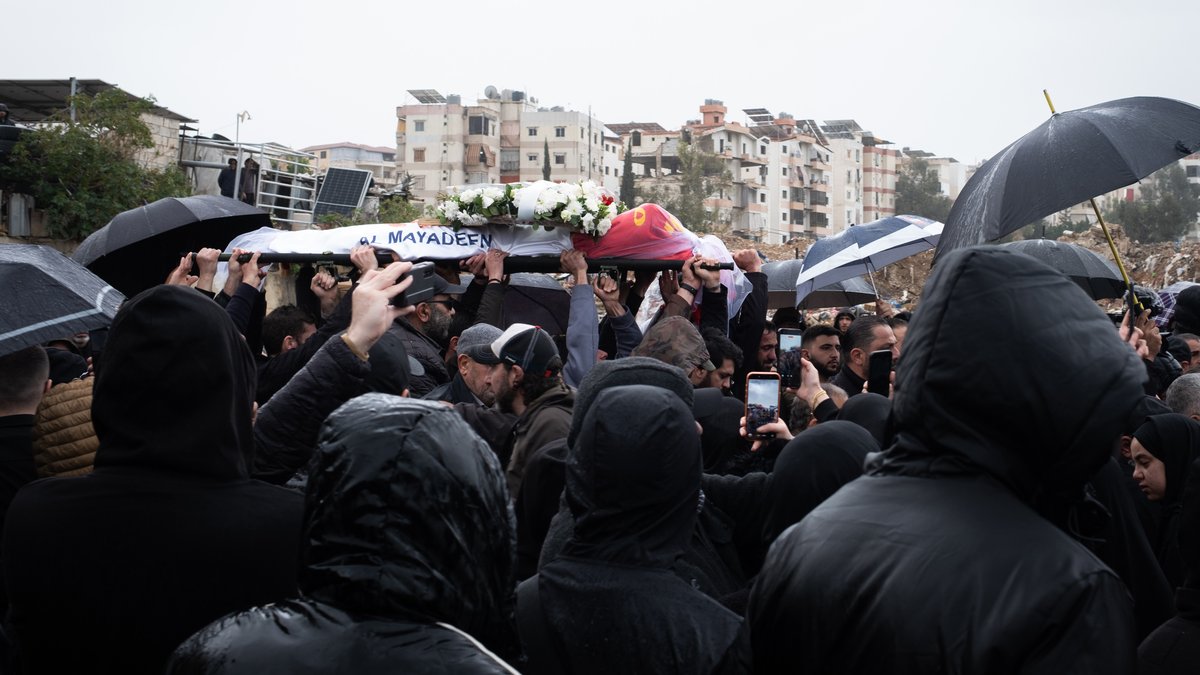
On the morning of March 29, a crowd of mourners gathered at Rawdat al-Imam al-Sadiq cemetery south of Beirut, Lebanon, to pray over the remains of Ali Shoaib, Fatima Ftouni, and her brother Mohamad Ftouni—three Lebanese journalists killed by Israel. The group held their bodies, which were wrapped in the flags of their media organizations, on their shoulders. Rain soaked the flags and turned the dirt around their cinderblock graves to mud as dozens of their media colleagues looked on.
An Israeli drone strike had killed the journalists the day prior near Jezzine, Lebanon, as they traveled to report on the ongoing Israeli invasion. The first strike killed Shoaib and Mohamad Ftouni instantly; the second killed Fatima Ftouni as she clambered from the wrecked car. A third strike claimed the lives of two civilians, an off-duty paramedic and his friend, who rushed to help.
“Once again, the Israeli aggression violates the most basic rules of international law,” Lebanese President Joseph Aoun posted on X, “by targeting journalists, who are ultimately civilians performing a professional duty.”
A spokesperson for the Israel Defense Forces (IDF) justified the strike on Shoaib by alleging, without evidence, that the journalist belonged to Hezbollah’s military wing and collected intelligence on Israeli troop movements. An IDF official later told Fox News that a photograph it had shared of Shoaib in military garb was fabricated.
Since the escalation of hostilities on March 2, Israel has killed more than 1,800 people and injured more than 6,000, according to the Lebanese health ministry. And despite the IDF’s claims to have only targeted members of Hezbollah, the casualties are in fact far wider ranging. IDF airstrikes and shelling have killed at least seven media workers, more than fifty medics, and hundreds of other civilians. Three U.N. peacekeepers from Indonesia have been killed as well; a U.N. investigation attributed one of the deaths to an Israeli tank and two to an IED that “most likely” belonged to Hezbollah. Israeli evacuation warnings have forcibly displaced more than one million people in Lebanon, which is more than a fifth of the population.
On April 8, after the announcement of a tenuous ceasefire between the United States and Iran, Israel conducted its heaviest bombing campaign over Lebanon since the beginning of the war. Beirut burned as hospitals in the city were overwhelmed with casualties. In a single day, Israel killed 303 people—among them journalists Suzanne Khalil of Al-Manar and Ghada Dayekh of Sawt Al-Farah—and injured more than 1,000 as it struck densely populated civilian areas throughout Lebanon without warning. Israel alleged, without evidence, that Hezbollah operatives had moved out of the Dahiyeh suburbs of Beirut and into northern areas of the city. The numbers of dead and injured are sure to rise as doctors and aid workers rescue people trapped beneath rubble and work to identify bodies at hospitals.
The attack on Shoaib and the Ftouni siblings followed an Israeli strike that killed freelance photojournalist Hussain Hamoud and another that killed Mohammed Sherri, head of political programming for Lebanese television channel Al-Manar, and his wife. Al-Manar is operated by Hezbollah and Al-Mayadeen aligns itself with pro-resistance viewpoints. First formed in response to the 1982 Israeli invasion of Lebanon, Hezbollah has grown to include a political wing represented in the Lebanese parliament, civil health services, financial institutions and media organizations. In some parts of the country, especially those with large Shi’a populations, Hezbollah-linked entities are the primary public service providers.
Journalists are protected under international humanitarian law and the laws of war, no matter their political affiliation or the tenor of their reporting; targeting media workers, and civilians in general, constitutes a war crime.
In February, the Committee to Protect Journalists (CPJ) reported an alarming rise in the deaths of journalists last year, recording the highest ever number of journalist killings since 1992. The CPJ found Israel responsible for two-thirds of all press killings in 2024 and 2025, the majority of which occurred in Palestine. “Within the context of rising conflict worldwide, Israel’s disregard for the lives of journalists—and the international laws intended to protect them—is, however, unparalleled,” the report states. “Israel has now killed more journalists than any other government since CPJ began collecting records.”
Israel’s rampant bombings of civilian areas, targeting of civilian infrastructure, and psychological warfare—which has included last-minute evacuation orders, sonic booms, and encouraging sectarian anti-Shi’a Muslim hatred—suggest it is pursuing a strategy of collective punishment in its mission to dismantle Hezbollah’s military capabilities. While the Lebanese government took the unprecedented step of outlawing the group’s military activities early in the conflict, the Lebanese Armed Forces have not enforced Hezbollah’s disarmament.
The IDF has used its campaign against Hezbollah to justify its escalating land invasion in southern Lebanon. On March 31, the Israeli defense minister announced Israel’s intentions to occupy territory in southern Lebanon up to the Litani River, establishing a “security zone” under indefinite military occupation. The IDF has also begun to target roads in the Bekaa Valley in eastern Lebanon, aiming to cut off all access to the south and isolate areas seen as traditional Hezbollah strongholds. Both American and Israeli officials have openly voiced ambitions for a “Greater Israel” that extends Israeli control over Egypt, Lebanon, and Syria.
As the war takes a rising toll on civilians, many Lebanese people nevertheless remain defiant. At a march from Martyrs’ Square in Beirut after the killings of Shoaib and the Ftouni siblings, a crowd of hundreds of people condemned the attack on journalists and a booming voice over loudspeakers vowed never to fall silent. Men, women, and children carried pictures of Shoaib and Fatima Ftouni as one mourner held aloft a blue press helmet at the front of the procession.
On April 9, Israeli Prime Minister Benjamin Netanyahu instructed his government to open direct negotiations with Lebanese President Joseph Aoun. The announcements signaled operations against Hezbollah would continue, and details of the scope of talks have yet to be confirmed. Meanwhile in Beirut, the injured are still being treated, the dead counted.