
While the announced halt to the devastating, regionwide Iran war was hailed globally this week, the Middle East is approaching crucial talks Saturday between the United States and Iran with concerns and confusion more than hope.
Since being announced Tuesday, the two-week ceasefire enabling talks between the U.S. and Iran in Islamabad, Pakistan, has been undermined steadily: by deadly Israeli strikes in Lebanon, Iranian strikes on Gulf Arab energy infrastructure, alleged strikes on Iran, and by U.S.-Iran disagreement over what, exactly, both sides agreed to.
Iran is letting only a handful of ships per day pass through the Strait of Hormuz – the narrow passageway through which 20% of the world’s oil and gas is shipped – Iran’s main leverage and a key U.S. and global interest.
Why We Wrote This
Pakistan is due to host U.S.-Iran talks Saturday. But they face fierce headwinds, including alleged ceasefire violations, disagreement over what was agreed to so far, and above all, a deep well of mutual distrust. In the Middle East, concerns are mounting over an unresolved conflict and the instability resulting from a “wrong agreement.”
Beyond the shaky status of the ceasefire, anxiety and distrust persist.
Gulf states, who feel cut out of the mediation, fear the U.S. will strike a deal with Iran that leaves Tehran with control over the strait – their economic lifeline – strengthening Iran’s hold on the region.
Tehran does not trust the U.S., particularly the Trump administration, which pulled out of previous talks with Iran twice in the last year to launch military strikes against the Islamic Republic.
Israel wants to ensure Iran ends its nuclear and ballistic missiles programs, both so far unrealized war aims.
Raising the talks’ stakes further is the postwar landscape: The ceasefire has frozen a conflict in which there is no clear victor, all feel vulnerable, and every regional actor’s threat perception is at an existential level.
Observers and officials agree: Rather than usher in a new era of peace in the region, the Islamabad talks, even if they do succeed, are likely to herald a new era of competition, military buildup, and distrust in the Middle East.
“We are committed to peace, but the wrong agreement will leave the region in a cycle of instability and wars,” warns a Gulf Arab official who was unauthorized to speak to the press.
Troubled talks
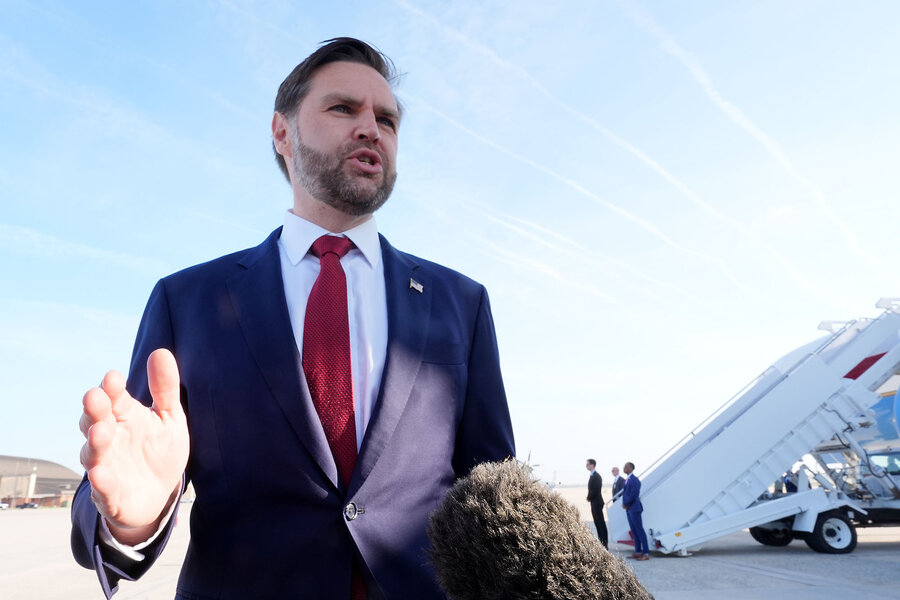
The U.S. delegation in Islamabad will be led by Vice President JD Vance and include envoys Steve Witkoff and Jared Kushner. The latter two led contentious nuclear talks with Iran that broke down in February, in part due to what international experts and diplomats describe as the pair’s lack of understanding of technical issues and of Iran’s reported concessions.

Iranian Foreign Minister Abbas Araghchi adjusts his glasses during a news conference following talks with Russian Foreign Minister Sergei Lavrov, in Moscow, Dec. 17, 2025.
The Iranian delegation will be led by Foreign Minister Abbas Araghchi and parliament speaker Mohammad Baqer Qalibaf, a former commander in the powerful Islamic Revolutionary Guard Corps.
The sides have made contradictory claims over what was agreed upon for the temporary ceasefire and which issues are up for discussion.
Iran says the U.S. had agreed to its terms for the talks, which include Iran’s right to enrich uranium, the lifting of sanctions, and a permanent agreement to end all U.S. attacks on Iran.
Yet Wednesday, White House spokesperson Karoline Leavitt said the U.S. had not agreed to Iran’s “wish list” and that President Donald Trump’s “red line” of no uranium enrichment by Iran remains.
Further threatening the talks are Israel’s deadly attacks in Lebanon, which continued Thursday, and Hezbollah’s rocket-fire response at northern Israel.
Pakistan has insisted that Lebanon is part of the ceasefire it brokered, and Iran has threatened to end the ceasefire if Israel continues the bombing. Israel and President Trump have said Lebanon and Hezbollah, Iran’s proxy, are not included in the agreement.
Yet Thursday, under international pressure and at Mr. Trump’s behest, Prime Minister Benjamin Netanyahu said Israel would enter into direct negotiations with Lebanon to discuss peaceful relations and Hezbollah’s disarmament. He said Israel would not, however, cease its fire, which Beirut calls a necessary condition for the talks.
President Trump has vowed to keep the U.S. military buildup in the Middle East in place to ensure Iran sticks to the ceasefire and any potential deal.
“Historical distrust”
Iranian negotiators have warned, meanwhile, that past experience suggests that talks with the U.S. could be derailed quickly.
“The deep historical distrust we hold toward the United States stems from its repeated violations of all forms of commitments – a pattern that has regrettably been repeated once again … even before the negotiations began,” Mr. Qalibaf, posted on X late Wednesday.
Iran accused the Trump administration of breaking the truce agreement by excluding Lebanon from the ceasefire, allowing the alleged entry of drones into Iran, and for its “denial of Iran’s right to enrichment.”

Rescuers assisted by heavy machinery work at the site of an Israeli strike in the southern suburbs of Beirut, April 10, 2026.
“Trust in the U.S. as a negotiating partner was already at zero because the Trump administration has burned Iran three times: first by pulling out of the JCPOA [the nuclear agreement negotiated by President Barack Obama], and then when Trump bombed Iran in the middle of negotiations last year and this year,” says Ali Vaez, director of the Iran Project for the International Crisis Group.
Iran and the U.S. “are beginning from a negative starting point,” Mr. Vaez tells the Monitor, “and the fact they can’t agree on the terms of a relatively straightforward ceasefire is yet another bad sign.”
Meanwhile, Gulf Arab states fear that the Trump administration, seeking to spin the talks as a “win” and end a costly conflict, will settle for a deal that leaves Iran in control of Hormuz. That would allow Iran to control Gulf imports of food and raw materials and their exports of oil and gas, effectively holding them hostage.
The United Arab Emirates Foreign Ministry said Wednesday it seeks clarification of the ceasefire agreement, urging “unconditional reopening” of the strait, and an agreement addressing Iran’s nuclear and military capabilities and proxies.
“If Iran is going to be the enforcement mechanism for the traffic light at Hormuz, that means the role of Iran as the policeman of the Gulf is coming back. That is a worry for the people in the Gulf, and it should be a worry for people around the world,” says Mohammed Baharoon, director general of the Dubai Public Policy Research Center.
“The UAE position has been very clear and it is a position all [Gulf] countries share: We will not pay fees for passage in the Strait of Hormuz.”
Israeli officials and pundits have also expressed concern that Mr. Trump will agree to a deal that does not address Iran’s nuclear program or its ballistic missiles.
Mr. Netanyahu says the U.S.-Iran talks are taking place in consultation with Israel. But in an address Wednesday branding the talks a “diplomatic disaster” for Israel, opposition leader Yair Lapid said, “Israel had no influence whatsoever” over the mediation, leaving it with little say over “matters touching the very core of our national security.”
Given the immense damage Israeli attacks have caused on Iranian industries, observers say a key Iranian demand is sanctions relief – a complex issue – and the right to monetize the Strait of Hormuz.
“If the Iranians survive a hot war they certainly do not want to freeze in a cold peace,” says Mr. Vaez. “Which means they need resources in order to reconstruct.”
Arms race?
With a trust gap among all parties and low hopes for the talks, the Middle East seems headed into a new arms race.
As Iran looks to replenish its missiles and drones, Gulf states are rapidly entering agreements to enhance and ramp up their own production of weapons and anti-drone defense systems.
“Like Iran, Gulf states are looking to have their own local defense production,” including missile production, says Bader al-Saif, a political analyst and assistant professor of history at Kuwait University.
“One lesson this war has reiterated is that we have to increase our agency and localize the value chain of our defense capabilities and not depend on others for our protection,” he says, noting that “the Gulf states were in the driver seat when defending themselves during this war.”
Some concerns for regional stability and security are more immediate.
Observers say even as it sits at the negotiating table, Iran may be gearing up for the conflict to resume and escalate, calculating that America and President Trump have not yet paid a heavy-enough price – politically and economically – to prevent future attacks.
“For Iranians, as painful as the next stage in this conflict could be, it is better than becoming another Lebanon, Gaza, or Syria in which the U.S. and Israel can strike at will and Iran suffers a slow death,” says Mr. Vaez.
“This is why it is willing to absorb a much higher cost now, in a conflict in which it has already been able to take the global economy hostage, rather than see this turn into a cycle of aggression against it that it can ill afford.”