
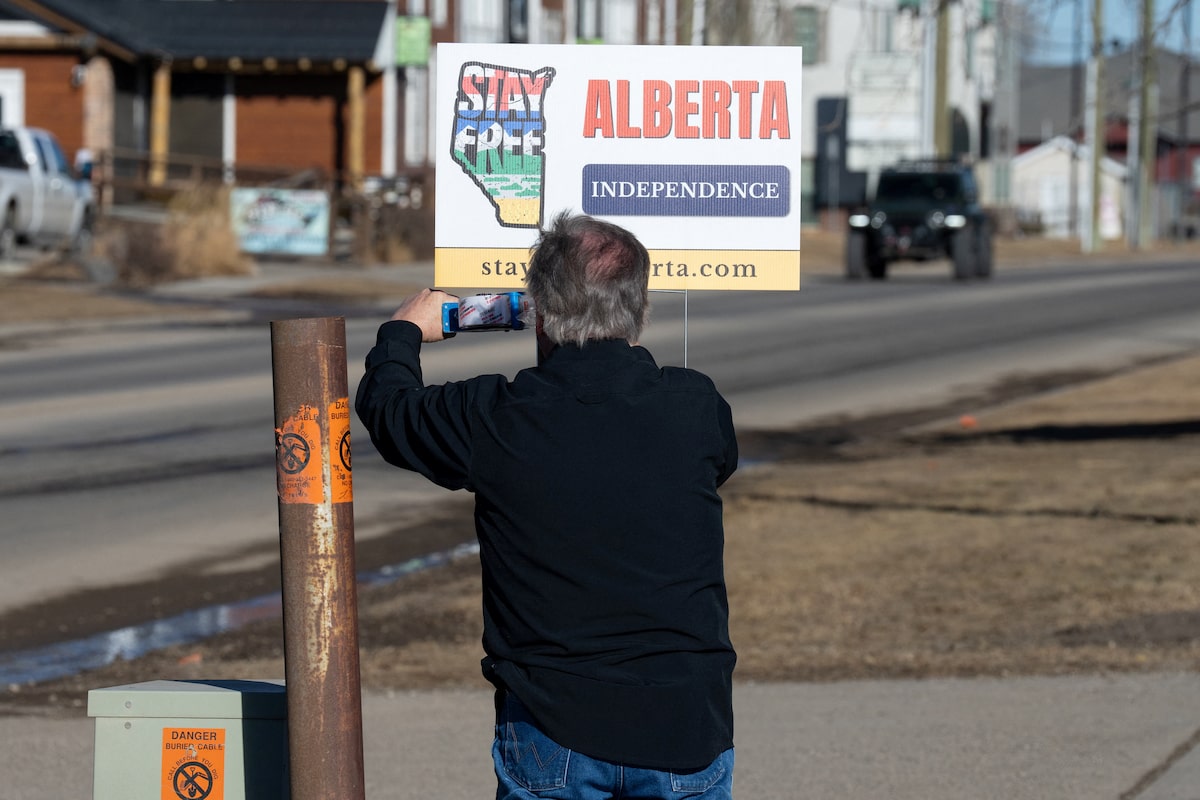
A volunteer with the Alberta Independence movement puts up a campaign sign at a petition signing location in High River, Alta., last month.Todd Korol/Reuters
A judge has temporarily blocked Alberta’s chief electoral officer from certifying a petition on provincial independence.
Court of King’s Bench Justice Shaina Leonard, in a decision published Friday afternoon, wrote she was issuing a stay order, or a legal pause, on the petition’s certification until she makes a ruling on the case brought forward by Alberta First Nations.
Justice Leonard wrote that Alberta separatists are allowed to continue their signature-gathering effort ahead of the May 2 deadline to reach the nearly 178,000 signatories needed under Alberta’s rules to force an independence referendum.
Her Friday decision was a response to concerns laid out this week by counsel for Athabasca Chipewyan First Nation and the Blackfoot Confederacy. They have asked for a judicial review of the chief electoral officer’s Jan. 2 decision to approve the pro-independence petition.
Alberta separatist lawyer argues independence vote wouldn’t violate First Nations’ treaty rights
Alberta separatists making alternative plans to force referendum if they lose court challenge
Justice Leonard issued the decision less than 24 hours after adjourning a three-day hearing on the matter.
The legal challenge is the latest attempt to stymie the citizen-led effort aiming to sever Alberta’s ties with Canada. Alberta’s independence movement, support for which polls around 20 to 30 per cent, has gained steam in the past year because of new direct-democracy rules legislated by Premier Danielle Smith, dissatisfaction with Ottawa and U.S. President Donald Trump’s 51st State provocations.
Justice Leonard’s final decision will determine whether separatist leader Mitch Sylvestre’s petition meets certain requirements in Alberta’s Citizen Initiative Act, which allows residents to put policy and constitutional matters on a referendum ballot if they gather enough signatures.
Sturgeon Lake Cree Nation triggered the hearings earlier this year by suing the Alberta and federal governments, and the province’s chief electoral officer. It has asked Justice Leonard to reinstate constitutional protections in the citizen-initiative laws that Ms. Smith’s government removed last year.
Together, the First Nations have argued that independence is impossible without their consent, that it would violate their treaty rights and that a referendum would fling open the door to foreign interference.
Justice Leonard, in her six-page decision, wrote that she found alleged harm toward the Nations that is “irreparable and ongoing,” and added that the pause would be in effect for about a month while she weighs her decision.
Orlagh O’Kelly, counsel for Sturgeon Lake, said Friday that Justice Leonard’s decision was “really great news.”
“It means that the judge is going to take at least a month to consider these very important issues and make the decisions she needs to make without the pressure and concern that the signatures would be submitted early and that the goalposts would be moved on our clients again,” Ms. O’Kelly said.
“We’re really looking forward to seeing her final decision.”
Jeffrey Rath, legal counsel for Mr. Sylvestre and also one of the leaders behind the separatist movement, told The Globe and Mail he felt it was “very odd” for a judge to suggest they have “jurisdiction to interfere with a legislative officer.”
“I think it’s completely unprecedented in the Commonwealth that a judge would have the temerity to issue what’s effectively an injunction order against an officer of the legislature,” he said.
“I think it’s well outside the court’s jurisdiction.”
Even so, he said the decision doesn’t affect the signature-collection effort.
At this week’s hearing, lawyers for the First Nations took a hard line on the risks that separation would pose: rampant foreign interference led by the U.S., strict Alberta-Canada international borders passing through treaty land and backsliding on commitments to reconciliation.
Opinion: Alberta’s push for independence is the culmination of decades of poor treatment by Ottawa
Kevin Hille, a lawyer representing Athabasca Chipewyan First Nation, described a “vanishing runway” to have courts address its treaty concerns.
“We’re on the precipice of rolling into a realm of non-justiciable, purely political considerations and losing court oversight,” Mr. Hille said in court this week.
The government of Alberta, meanwhile, described the First Nations’ concerns about treaty violations and foreign interference as hypotheticals. Neil Dobson, counsel for the province, argued there are “constitutional limitations about what the province can and can’t do.”
“The province can’t unilaterally remove treaty rights or change the constitution. That would require something further,” Mr. Dobson said.
Justice Leonard’s decision is the second legal roadblock separatists have faced in their effort to trigger an independence referendum.
Last summer, the separatists’ petition hit a snag when Alberta’s chief electoral officer – concerned about Charter implications – asked the Court of King’s Bench Justice Colin Feasby for his opinion on the constitutionality of the proposed independence question.
Mr. Feasby eventually ruled that Alberta’s citizen-initiative laws don’t permit a separatist bid and independence would violate First Nation treaties, but he didn’t rule out Alberta’s ability to call a referendum on separation.
However, his ruling was blunted in December last year when the Premier rewrote the Citizen Initiative Act, nixing a provision that required referendum questions comply with the Constitution.
Last week, Mr. Sylvestre and Mr. Rath said they had surpassed the nearly 178,000-signature mark needed to force a referendum.
Mr. Sylvestre has told The Globe he plans to sidestep the courts if they lose again. He said he would ask the government to ratify his petition if the judge blocks the chief electoral officer from counting his signatures.