
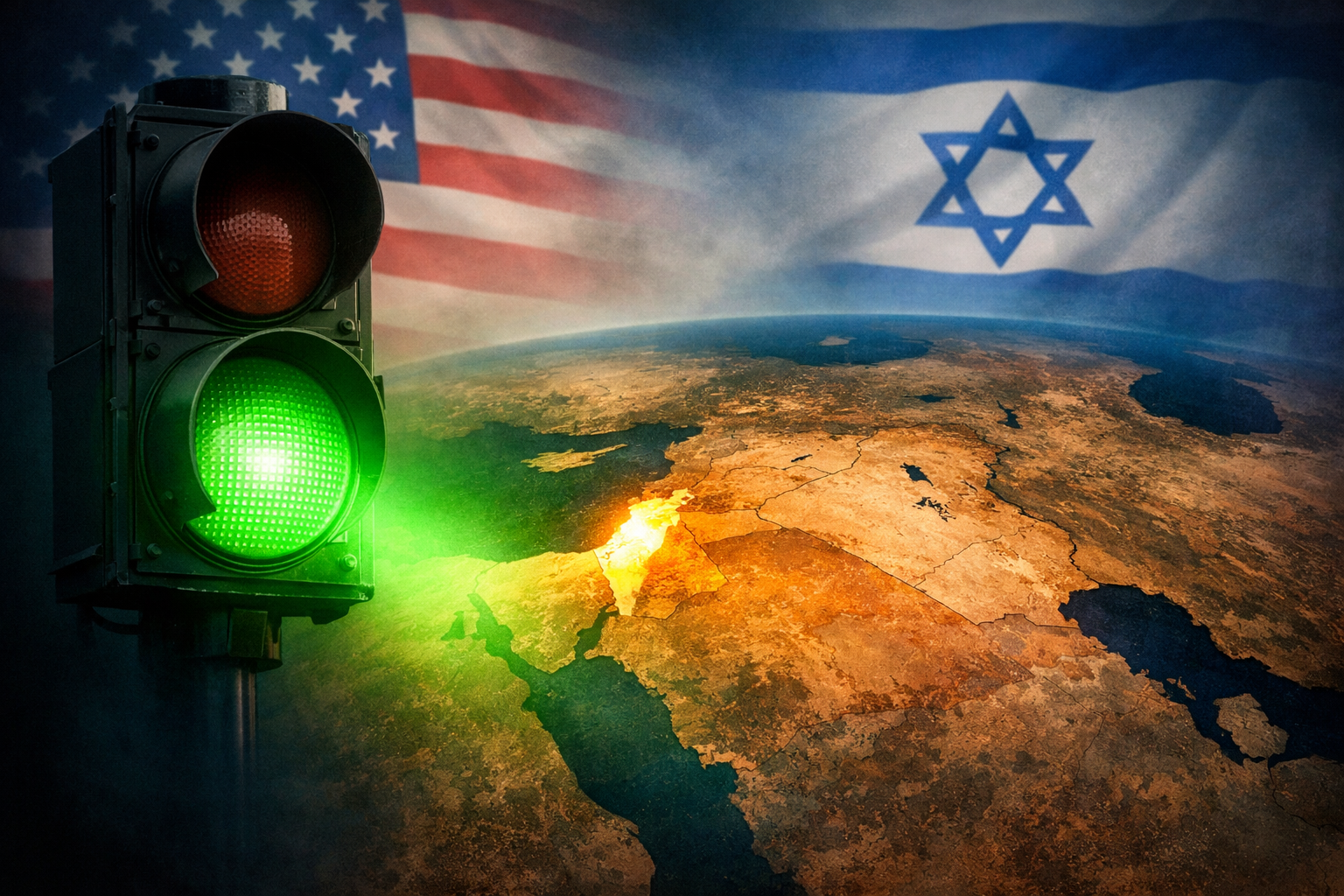
Few nations fight wars; fewer still are told, in real time, whether another capital has nodded in approval of them doing so.
The Permission Slip Superpower
There are many remarkable nations in the world. Some build empires, others collapse into them. Some launch wars; others issue strongly worded statements about those who do. But only one country, it seems, must first check in with a distant superpower before deciding whether it may defend itself. Israel, if we are to believe the modern press, is less a sovereign state and more a particularly well-armed teenager—forever lingering at the geopolitical doorway, car keys in hand, asking Washington, “Back by midnight?”
The headlines now write themselves. Israel doesn’t act—it is allowed to act. It doesn’t decide—it receives a nod. Military campaigns are not launched; they are apparently authorized, like software updates requiring parental consent.
This would all be amusing were it not so widely believed.
Because the “green light” narrative has not survived purely on media laziness. It has been nourished by something more durable: the visible architecture of the US–Israel relationship itself. Billions in military aid debated openly. Joint systems developed. Diplomatic choreography so tight that a gesture in Washington becomes a signal in Jerusalem. When Israel moves, the question is not only what it is doing—but what America has said about it.
And crucially, sometimes that answer matters.
When Reality Feeds the Phrase
If the phrase “green light” were entirely false, it would have collapsed under repetition. Instead, it persists because it is a distortion built on top of a recognizable pattern. The US–Israel alliance is not conducted in whispers. It is publicly choreographed: consultations, briefings, leaks, clarifications, and the occasional staged disagreement.
Before major operations, there are discussions. During them, updates. After them, explanations. It resembles less unilateral action and more joint production—except only one actor is on the battlefield. This is not abnormal in alliances. What is unusual is how visible and continuously narrated this coordination is.
When Washington signals restraint and Israeli action slows, observers connect the dots. When support is signaled and action intensifies, the dots connect themselves. Add an anonymous official and suddenly coordination begins to resemble authorization.
The line between coordination and permission is theoretically clear—but geopolitically fragile.
Sovereignty on a Leash: The Perception of American Gravity
Israel is sovereign. It has acted against American preferences before—sometimes quietly, sometimes loudly enough to cause diplomatic friction. But sovereignty does not exist in a vacuum. It operates inside a strategic ecosystem dominated by Washington’s military, diplomatic, and financial reach.
This does not produce control. It produces gravity.
When your primary supplier, diplomatic shield, and strategic partner is the world’s superpower, its preferences become structurally important. Not through orders, but through consequences. Choices are made within incentives. Timelines are adjusted around diplomatic windows. Messaging is calibrated for Washington audiences as much as regional ones.
Over time, this creates a pattern of alignment that outsiders interpret as dependency.
And once perception stabilizes, it begins to harden into assumption: Israel acts—but not entirely alone.
The Only Country That Looks Like It Needs Permission
All allies coordinate with the United States. NATO members consult. Gulf states align. European powers adjust. Yet none of these relationships are routinely framed in terms of “permission.”
The difference is not substance—it is visibility.
No one seriously suggests that Britain requires a “green light” from the United States before deploying forces. France is not described as awaiting a nod from Washington before intervening in Africa. Even states far more dependent on American military protection manage to retain the outward dignity of autonomous decision-making. Their coordination is framed as partnership. Their alignment is described as strategy. Israel, by contrast, is cast in an entirely different role.
Israel’s conflicts are frequent, urgent, and globally scrutinized. Every decision is immediate news. Every delay is interpreted. Every alignment becomes narrative material. Under such conditions, coordination becomes indistinguishable from instruction. There is also asymmetry of scale. A superpower and a regional power do not appear as equals even when they are partners. To outside observers, hierarchy is the default interpretation.
Thus Israel becomes the only state whose alliance is routinely misread as supervision.
Propaganda’s Best Friend: When Optics Become Ammunition
This perception does not stay in Western media. It travels—efficiently—into adversarial narratives.
Groups like Hamas and Hezbollah argue that Israel is not a sovereign actor but a Western extension. In their framing, Israel is not a state but an instrument. Once Western headlines repeatedly suggest American “approval,” the leap from coordination to control becomes trivial. If Israel acts with US approval, it must answer elsewhere. If it answers elsewhere, it does not truly belong. And if it does not belong, resistance becomes “liberation.”
It is a distortion—but a useful one.
And like all effective propaganda, it does not need to be true. It only needs to be plausible.
The Strategic Cost: When Perception Becomes Deterrence
In geopolitics, perception shapes behavior.
If Israel is believed to act within American constraints, then pressure shifts accordingly. Appeals go to Washington. Ceasefires are negotiated in US corridors. Escalation is calculated with American intervention assumed.
Why confront Israel directly if Washington is perceived as the real decision point?
Deterrence erodes not through loss of capability, but through doubt about independence of action. Even partial belief in dependency is enough to reshape adversarial strategy.
The battlefield expands—not geographically, but diplomatically.
The Alliance Paradox: Strength That Looks Like Subordination
The US–Israel relationship is among the strongest alliances in modern geopolitics. It is built on shared interests, military cooperation, and deep strategic alignment.
Yet it is precisely this strength that creates the perception problem.
The closer the coordination, the more it appears hierarchical. The more visible the alliance, the more it invites misinterpretation. Coordination becomes expectation. Alignment becomes assumption. Assumption becomes narrative. One partner speaks; the other appears to respond. Whether this reflects reality becomes secondary to how it looks.
Because in geopolitics, perception is the operational currency.
Sovereignty, with Terms and Conditions
Israel does not require permission to act. But it operates within a relationship so visible and consequential that its actions are rarely interpreted as entirely independent.
This is what the “green light” narrative imperfectly captures: not control, but constraint; not subordination, but influence; not absence of sovereignty, but sovereignty that is constantly explained to skeptical audiences. And a country that must repeatedly insist on its independence has already lost part of the argument—not in fact, but in perception.
The challenge is not to deny the alliance, but to manage its optics without allowing it to resemble supervision. Because respect in international politics is not granted solely on capability. It is granted on perceived autonomy.
And a state that appears to act only when permitted—whether or not it is true—will eventually find that others stop bothering to ask.