
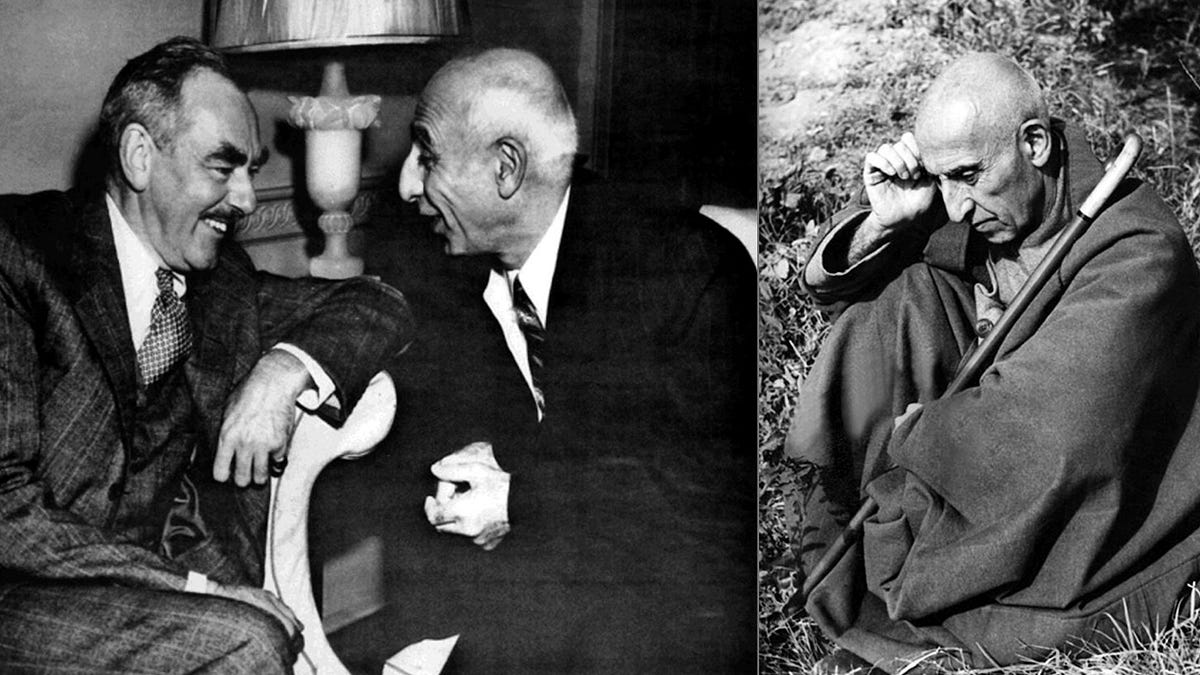
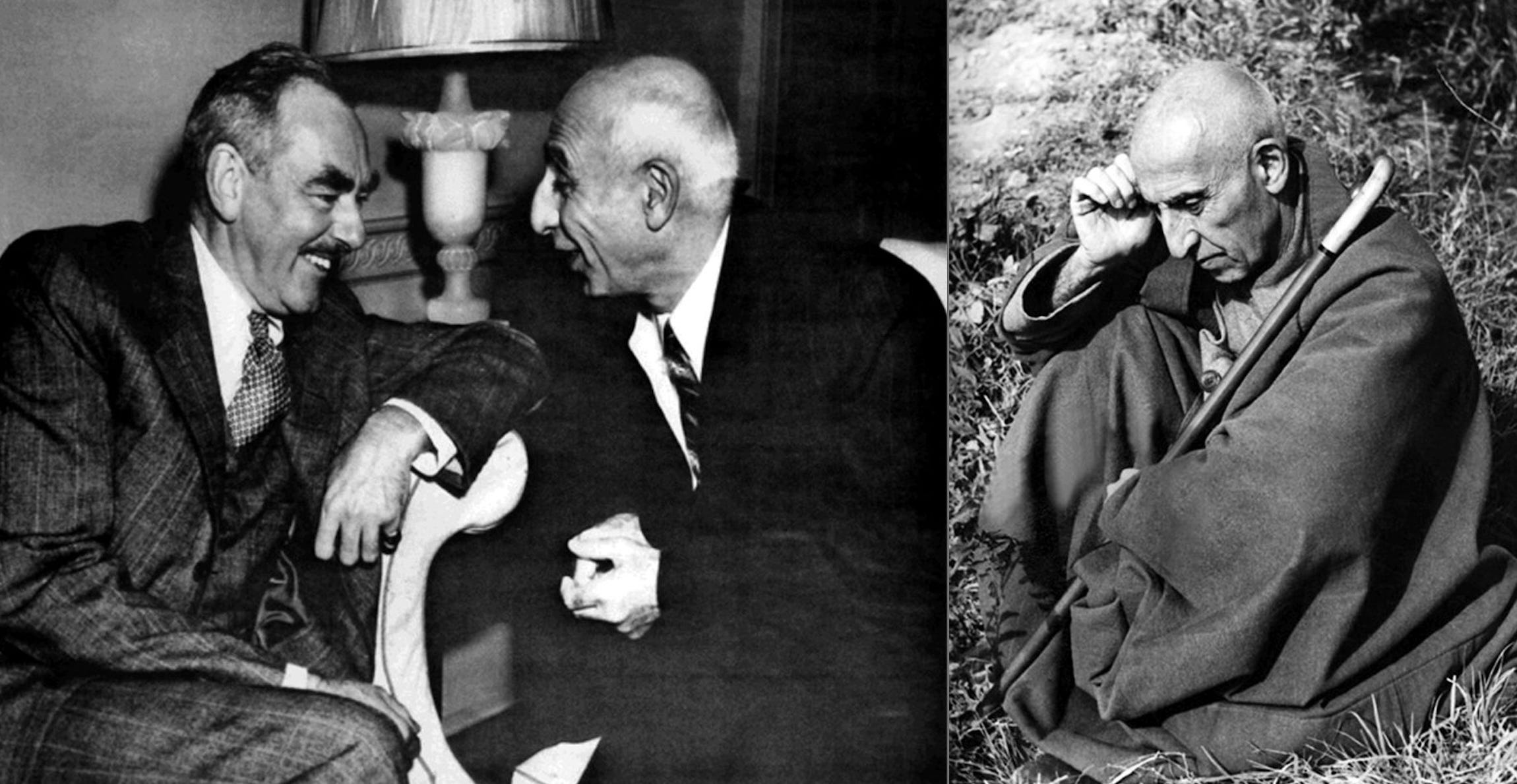
 What a difference two years can make: In first photo, from Washington in 1951, Dean Acheson (on left), as US Secretary of State, warmly greets Mohammad Mosaddegh, the recently elected prime minister of Iran. Then in 1953, the CIA engineered a coup to overthrow Mosaddegh and replace him with the Shah. Mohammad Mosaddegh spent the rest of his life in prison or house arrest, as shown in second photo. Most people in today’s Iran know this story. Few people in today’s America do. (Pictures From History/Universal Images Group/Getty Images.)
This post is the first of a two-part series, with the second coming in a day or two. They’re both about the path in modern US/Iranian relations that led to the current debacle. [Update: See correction below, about my mis-reference to Mark Bowden’s excellent Black Hawk Down. And another correction in the footnotes, about Jimmy Carter’s toast to the Shah. Never write in a hurry!]
The theme connecting these accounts is memory. By that I mean the part of “history” that endures not just in books or classrooms but in people’s consciousness and attitudes.
Of all the “asymmetries” between the US and Iran in this wholly unnecessary, ever-more-destructive confrontation, the gap in public memory is one of the most dramatic. And probably the least emphasized, on the US side.
I make no claim as an Iran expert. But I’ve lived through much of this US/Iranian history, read about and interviewed experts on much more of it, and—as I’ll describe below—was personally part of one dramatic and significant episode.
Together these influences and insights have given me a sense of the widening gap between “public memory” in Iran—what many Iranians think is the story of their relationship with the United States—and the counterpart “public amnesia” on the same topic in the United States. Obviously such a gap is most dangerous when it involves near-total historical ignorance on the US-leadership side, which our situation now.
I’ll present this as a timeline, organized by US presidential administration. This first installment starts with Harry Truman and Dwight Eisenhower, and ends with the presidency that was itself ended largely because of conflict with Iran. That was, of course, Jimmy Carter’s. (For whom I worked as White House speechwriter, including on his trip to Iran.) Part two will begin with the presidency that began largely due to Carter’s Iran troubles—Ronald Reagan’s, which was soon ensnarled in its own, different Iran scandals and disasters—and will continue through Donald Trump and his ruinous decision to attack.
This account is a summarized overview, but along the way I’ll link to academic, journalistic, think-tank, and other accounts that give a fuller story.
Almost as soon as World War II ended, the US began sizing up regimes around the world on whether they were “with us or against us,” in the struggle against the Soviet Union and global communism. This eventually led to open or covert US alliances with the likes of the Diem family in Vietnam, the Marcoses in the Philippines, Batista in Cuba, Somoza in Nicaragua, Syngman Rhee in Korea, Chiang Kai-Shek in mainland China and then Taiwan, and many more.
In Iran, this global struggle led the US to a fateful turn in 1953. In the early 1950s, Iran had a nascent democratic moment. A Western-educated lawyer, professor, politician, and government official from a prominent family, named Mohammed Mosaddegh, was elected prime minister in 1951. Soon some of his “reform” efforts upset the US and the UK. The most dramatic was his nationalization of the Iranian oil industry, then largely controlled by British companies.
Thus in 1953, the CIA, with help of British intelligence, orchestrated a coup to overthrow him, and transfer governing power to the Shah. The CIA’s role in this coup is not speculation or conspiracy theory. It’s spelled out in all journalistic and academic histories of Iran in this era, for instance The Eagle and the Lion by the scholar James A. Bill.
As Jimmy Carter later said of this era, when announcing his own new human-rights-based foreign policy, the all-consuming early Cold War fear of communism had “led us to embrace any dictator who joined us in that fear … sometimes abandoning our own principles for theirs.” He wasn’t calling the Shah a dictator, but he was alluding to the logic of those days.
Some 56 years after the Mosaddegh coup, in his speech in Cairo during his first year in office, Barack Obama formally acknowledged that the US “played a role in the overthrow of a democratically elected Iranian government.” Declassified CIA documents later clarified what that role had been. “For many years,” Obama said in that Cairo speech, “Iran has defined itself in part by its opposition to my country, and there is in fact a tumultuous history between us.”
Why does this matter now? Boosters of Trump’s Iran war think they are sounding history-minded when they say they’re finishing a battle that has been going on “for 47 years.” Meaning that, in their minds, the first strike was when Iranian students and protestors took US diplomats hostage, under Jimmy Carter, in 1979.
Very few of today’s Iranians would have any living memory of the CIA-Mosaddegh coup. But in my experience, and based on everything I have heard and read, the date “1953” remains as resonant in Iran now as “9/11” still is for most Americans, or “December 7, 1941,” for my parents’ generation.
When did the US-Iran war “start,” from most Iranians’ perspective? Not 47 years ago, but 73.
And this is despite the rich person-to-person, cultural, academic, immigrant, and other close ties connecting people in both countries, as attested by most Americans with experience in Iran, and vice versa. I gave a glimpse of that, via profiles of an Iranian writer who has devoted his career to translating Thoreau’s work, here and here. I’ll say more about this theme next time.
Also from this era: A few years after the Shah took power, Dwight Eisenhower approved an “atoms for peace” agreement, designed to help Iran develop a non-military nuclear-energy program. Ordinary Iranians probably aren’t aware of this. I bet no one in the Trump cabinet is. But the memory of many Iranian officials would stretch back to their country’s first introduction to nuclear power.
Public memory point: “1953” has vanished from mainstream US memory of Iran. It looms large on the other side.
US policy in these years was not mainly Iran-centric. From Berlin to Cuba, from then-Czechoslovakia to other frontiers along the Iron Curtain, from Mao’s China to Indochina, these presidents had so many other emergencies to deal with.
The JFK administration placed some pressure on the Shah for land-reform and other “liberalizing” measures, as long-term protections against communist activism. These became part of the Shah’s “White Revolution” in 1963. By the end of the LBJ administration, the US was equipping the Shah’s Iran with US-made military equipment, with the idea that it would be a pro-Western bulwark and stalwart in the region.
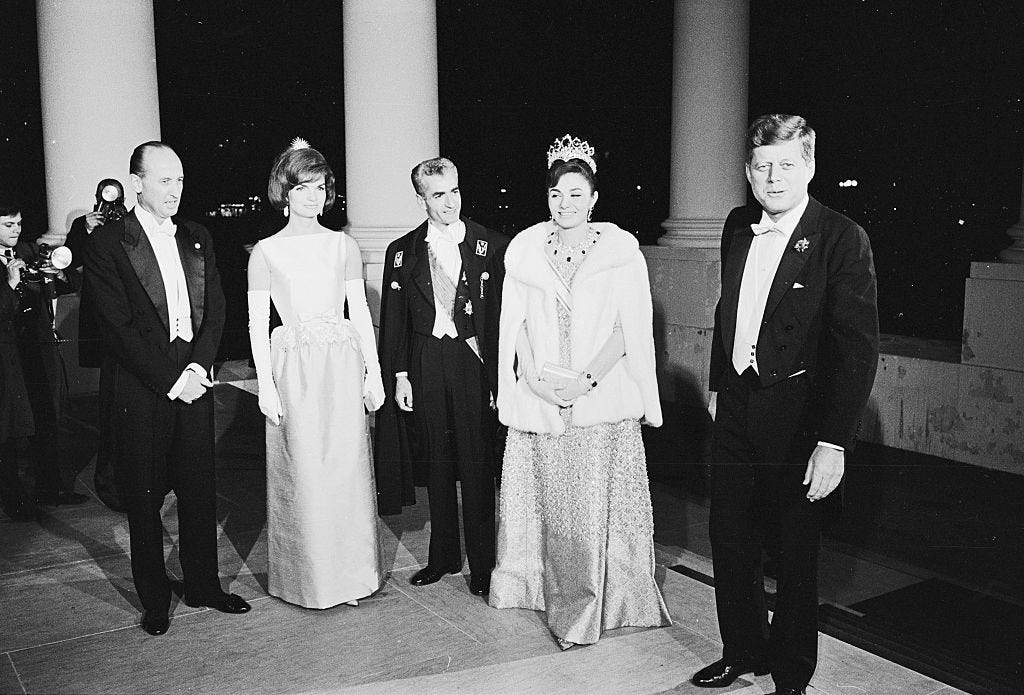 The Kennedys welcome the Shah and his wife to the White House for a state dinner in 1962. (Leffler/Library of Congress/Getty)
Also in these years, the cleric who would be known as Ayatollah Khomeini, then in his mid-60s, began protesting the Shah’s subservience to the US. He was arrested and exiled, mainly to Iraq, where he built his following and movement. By the late 1970s, he would of course emerge as leader of the Islamic revolution.
Public memory: The US was all-in with the Shah, even as domestic tensions were beginning against him. This pattern matched what was happening in many other quasi-client states, notably in the Philippines, South Korea, and of course Vietnam.
These presidents, like their immediate predecessors, had other, urgent claims on their attention and time. More and more these came from Vietnam (and Cambodia and Laos). But it was also a time of arms negotiations with the Soviet Union, and the first openings to China, and the coup in Chile, and many other emergencies. Plus Watergate and a presidential resignation!
As for Iran, US policy boiled down to what you could put in Trump-style terms: Weaponize, baby, weaponize! Nixon visited Tehran in 1972 and assured the Shah that Iran could buy any non-nuclear weapon it wanted from the US arsenal. Nixon also followed up on Eisenhower’s “atoms for peace” program by dispatching US nuclear technicians to help develop Iran’s reactors. Today’s officials in Iran would be aware of both these steps.
The Arab oil boycott and strengthening of OPEC, which overlapped the Nixon-Ford eras, greatly enriched Iran and other oil-producing countries. By the end of Gerald Ford’s time Iran had bought a huge fleet of US F-14 fighter planes, making it the major power in the region. (To jump ahead in the narrative, in the late 1980s, the US warship Vincennes thought it was being attacked by one of those Iranian F-14s—and mistakenly shot down instead a fully loaded Iran Air jetliner, killing 290 people. This remains part of public memory in Iran, as we’ll get to next time.)
Public memory: Iran was mainly absent from US media and political consciousness in that era. Within Iran, both those loyal to the Shah, and members of the growing resistance, know that the US tripled-down on his side.
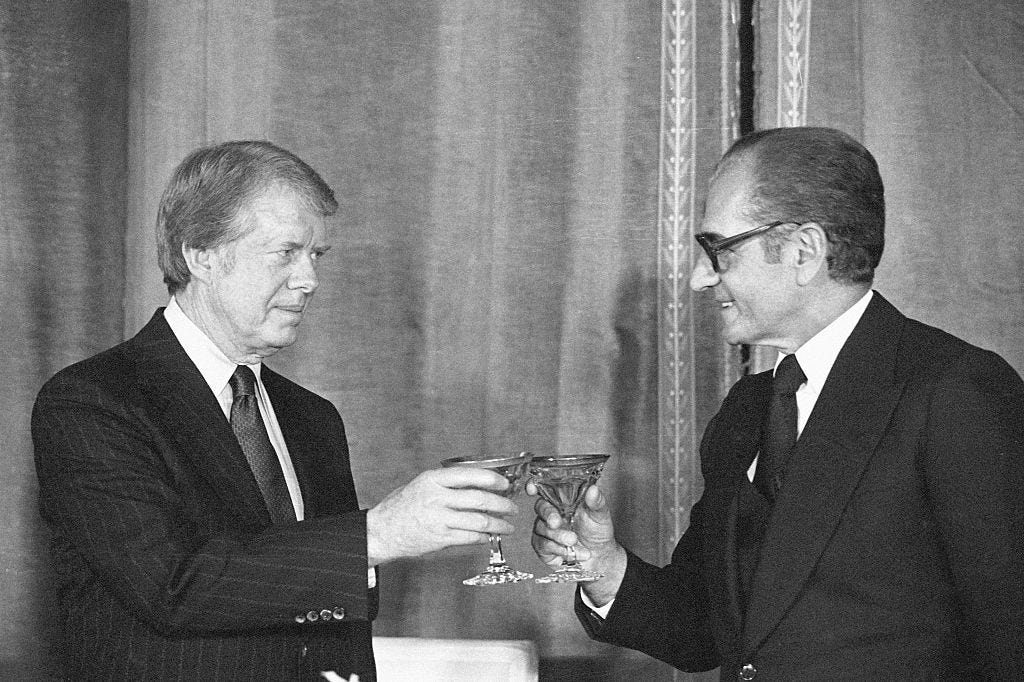 Jimmy Carter toasting the Shah on New Year’s Eve in Tehran, as 1977 became 1978. Carter said at the gala dinner that the US still regarded the Shah’s Iran as an “island of stability” in troubled part of the world. A year later, the Ayatollah’s Islamic revolutionaries took power. I was on Carter’s staff for that trip and was standing a few feet behind the photographer when he captured this moment. (Photo Bettmann/Getty.)
This is the most familiar part of the modern saga. But’s the one part of US/Iranian “history” that looms much larger in US memory than for Iran. Which is the root of many of today’s problems.