

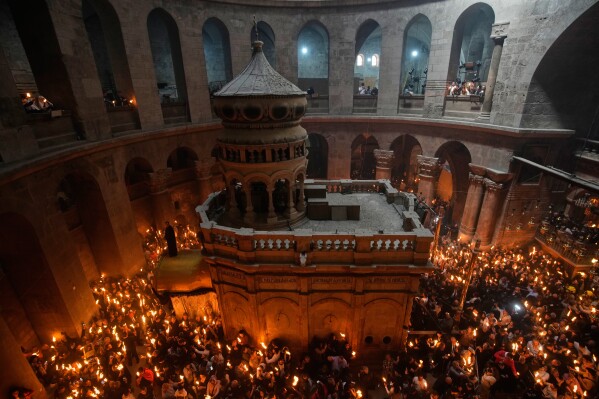
Christian Orthodox pilgrims hold up candles during the Holy Fire ceremony, at the Church of the Holy Sepulcher, the site where, according to tradition, Jesus was crucified and buried, in the Old City of Jerusalem, Saturday, April 11, 2026. (AP Photo/Ohad Zwigenberg)
Christian Orthodox pilgrims hold up candles during the Holy Fire ceremony, at the Church of the Holy Sepulcher, the site where, according to tradition, Jesus was crucified and buried, in the Old City of Jerusalem, Saturday, April 11, 2026. (AP Photo/Ohad Zwigenberg)
Add AP News on Google
Add AP News as your preferred source to see more of our stories on Google.
Share
Read More
Thousands of worshippers took part in the annual “Holy Fire” ceremony on Saturday in Jerusalem’s Church of the Holy Sepulchre, an Orthodox Christian ritual that dates back more than 1,200 years.
The ceremony, held the day before Orthodox Easter, symbolizes the resurrection of Jesus, where the Greek Orthodox Patriarch brings out candles reportedly lit by a miraculous, non-burning flame from the tomb, which is then passed to thousands of worshipers.
Holy sites across Jerusalem’s Old City, including Al-Aqsa Mosque, the Church of the Holy Sepulchre, and the Western Wall, remained closed for 40 days under Israeli security restrictions following the war on Iran, but reopened on Thursday as a fragile, two-week ceasefire between Iran, Israel, and the U.S. appeared to hold.
“Just two days ago there was absolutely no one in the Old City, it felt like an orphaned town,” said Fr. Antonious Al-Orshalemy. “But now we see wedding-like celebrations on every level. Everyone is happy, and everyone is joyful.”