
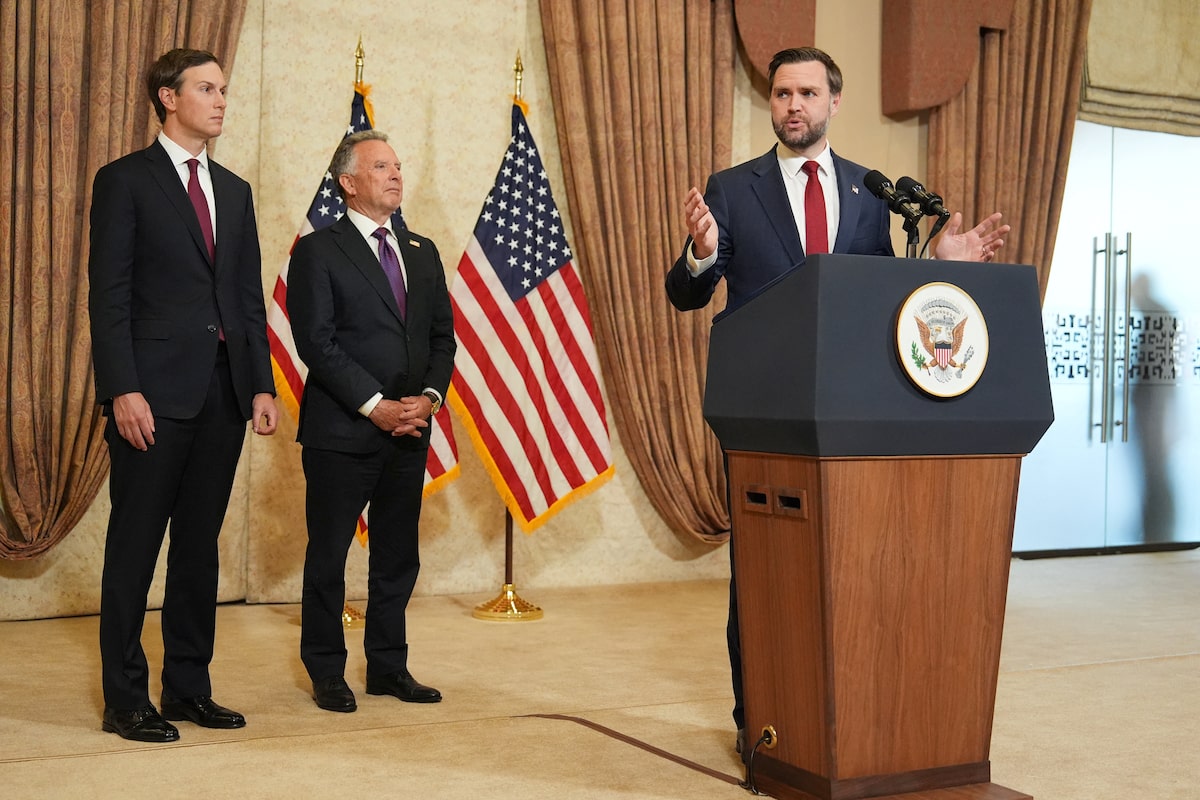
U.S. Vice President JD Vance speaks during a news conference after meeting with representatives from Pakistan and Iran as Jared Kushner and Steve Witkoff look on in Islamabad, Pakistan on Sunday.Pool/Reuters
They came. They talked. They left.
The Pakistan-brokered Iran peace talks brought the United States and Iran face-to-face for the first time in nearly 50 years. Even without an agreement – always an unrealistic expectation – the meeting itself was historic.
Expecting a two-day bargaining session to produce a final deal to end the Iran war, build even a modicum of trust between Tehran and Washington, halt Israel’s assault on Lebanon, settle the fate of the Strait of Hormuz, and deliver a nuclear agreement was never plausible.
Still, it was not all bad news. While both Iran and the United States left Pakistan saying no deal had been reached, neither declared the ceasefire over. That alone suggests the window – and quite possibly even a door – to further talks remains open.
U.S., Iran end talks after 21 hours in Pakistan with no deal as fragile ceasefire holds
Vice President J.D. Vance has said the U.S. offer is final. But is it? “Final” appears to have some elasticity in today’s U.S. administration. It is also unclear whether President Donald Trump remains invested in the war, having been quoted in The Wall Street Journal as saying, “whether we make a deal or not makes no difference to me … because we’ve won.”
On Sunday Mr. Trump writing on Truth Social threatened a naval blockade of the Strait of Hormuz.
In a post on X, Mohammad Bagher Ghalibaf, Iran’s parliamentary speaker and head of the Iranian delegation to Pakistan, offered a measured assessment of the Islamabad meeting, leaving open the possibility of further negotiations.
“The opposing side ultimately failed to gain the trust of the Iranian delegation in this round of negotiation,” he said.
Yet he also hinted at movement: “America has understood our logic and principles, and now it is time for us to decide whether it can earn our trust or not.”
The space for further talks is clearly there.
Opinion: We need to embrace the art of diplomacy, not the art of the deal
But there is no quick or easy path to a final peace deal–one that Israel will ultimately have to support, even if it is not a formal signatory. So far, there is little indication that Israel’s Prime Minister Benjamin Netanyahu wants such an agreement. Indeed, he nearly scuttled the talks before they began, launching blistering attacks on Lebanon just hours after Pakistan’s Prime Minister Shehbaz Sharif announced the ceasefire deal, which he said included Lebanon.
The Lebanese government reported more than 300 civilians killed and parts of Beirut devastated. It declared a day of mourning and threatened to file a complaint with the United Nations. Israel said it was targeting Hezbollah, claiming it killed a deputy commander, while not denying the scale of civilian casualties.
Pakistan, meanwhile, is walking an increasingly wobbly tightrope–leveraging its military strength and its relationships with both regional neighbours and the United States to first secure a two-week ceasefire and, more significantly, to bring Washington and Tehran face-to-face. That feat alone is substantial, and it may yet pay dividends.
But the stakes for Pakistan are high. Its international standing has risen, but a resumption of the war could pull it in. Having used its military weight to help bring the parties to the table, Pakistan risks being drawn into the conflict it is trying to contain. Even as Islamabad basked in the diplomatic success of convening the talks, it was also deploying forces to Saudi Arabia.
The Iran war is taking the U.S.-Israel relationship to new heights – and revealing its limits
The move reinforces its Strategic Mutual Defense Agreement with Riyadh–and raises the risk that Pakistan could be drawn into the war if renewed fighting prompts further Iranian attacks on Saudi Arabia.
According to the Saudi Foreign Ministry, “The Pakistani force consists of fighter and support aircraft belonging to the Pakistani Air Force, with the aim of enhancing joint military co-ordination, raising the level of operational readiness between the armed forces of the two countries, and supporting security and stability at both regional and international levels.”
Notably, the deployment was announced at the start of the talks – and by Saudi Arabia, not Pakistan. Both details are significant. Together, they signal a message to Iran and its Houthi allies in Yemen: a renewed war could mean facing not only Saudi Arabia, but Pakistan as well.
In effect, Saudi Arabia appears to have activated its defence arrangement with Pakistan.
Riyadh remains deeply angered by Iran’s damaging assault on its Jubail industrial complex, including the massive Sadra facility. On April 7 and 8, a barrage of Iranian missiles and drones also struck the kingdom’s critical east-west crude oil pipeline – its key export route – hitting at the heart of Saudi Arabia’s petrochemical industry.
If the war resumes and Iran again targets Saudi Arabia, Pakistan could be obliged to enter the conflict.
Pakistan’s air force demonstrated its capabilities last May during a brief four-day conflict with India, reportedly downing as many as five Indian aircraft, including three French-made Rafale fighter jets, before declaring victory. Trump, who took credit for brokering the ceasefire between the two nuclear-armed neighbours, also described Pakistan as the winner.
A renewed Iran war risks testing Pakistan’s air force again – and dangerously widening the conflict.