
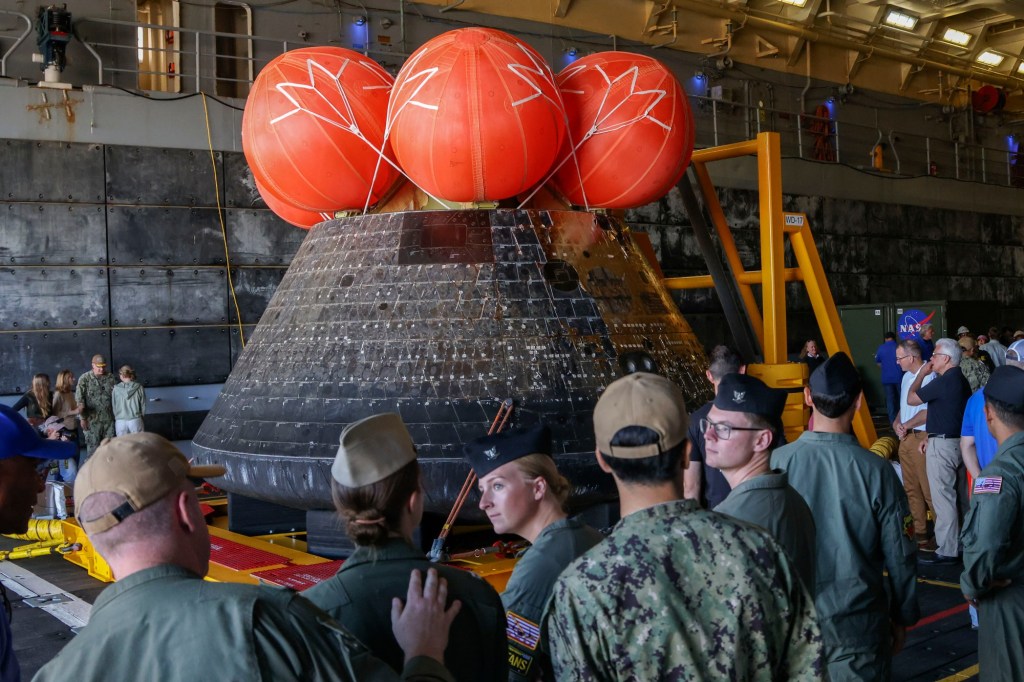
An imposing ship built to wage war docked in San Diego on Saturday morning in the name of peace and human exploration, delivering the capsule that Artemis II astronauts rode to a flawless landing a day earlier.
The USS John P. Murtha — a transport ship longer than two football fields — arrived at Naval Base San Diego playing Elton John’s beloved song “Rocket Man” over its speakers, tapping into the public’s deep interest in the historic 10-day mission.
American astronauts had not splashed down in the ocean since December 1972 when the crew of Apollo 17 came home amid waning interest in exploring the moon, and polarization over the Vietnam War. The Artemis II mission captivated the American public from the moment its four middle-aged astronauts vaulted into space for a trip around the moon. The mission launched as the U.S. and Iran conflict grew.
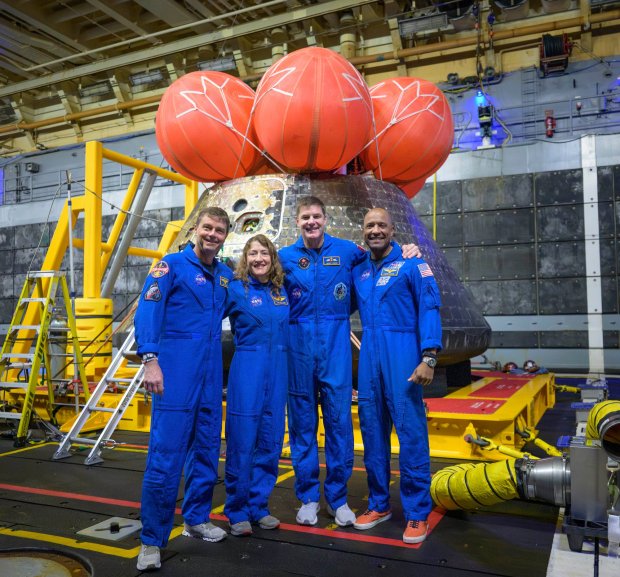 In this photo provided by NASA, from left, NASA astronauts Reid Wiseman, commander; Christina Koch, mission specialist; CSA (Canadian Space Agency) astronaut Jeremy Hansen, mission specialist; and NASA astronaut Victor Glover, Artemis II pilot, right, pose for a group photo after viewing the Orion spacecraft in the well deck of USS John P. Murtha, Saturday, April 11, 2026, in the Pacific Ocean off the coast of California. (Bill Ingalls/NASA via AP)
The Navy and NASA embraced the moment Saturday, telling reporters how they managed to deal with unexpectedly strong ocean currents and other challenges 50 miles west of San Diego while viewers around the world watched online.
Less than a day earlier, astronauts Reid Wiseman, Victor Glover, Christina Koch and Jeremy Hansen had been plucked from 3-foot swells by helicopters and transported them roughly one mile to the USS Murtha.
The Orion capsule did not produce a sonic boom upon re-entry — disappointing spectators gathered at Sunset Cliffs and other spots along the San Diego coast. But the spacecraft landed in the ocean at 5:07 p.m., the precise moment forecast by NASA.
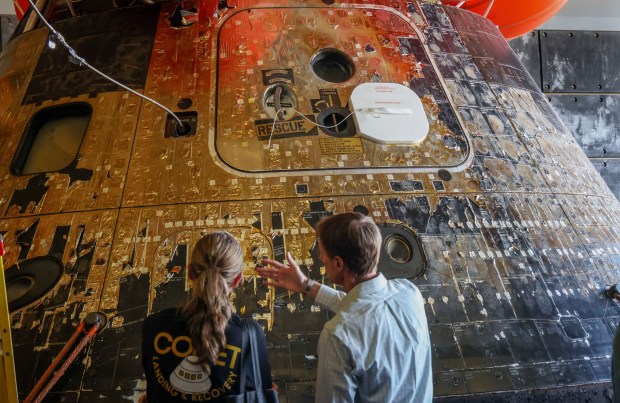 NASA analysts look over the The Artemis II Orion Capsule aboard the USS John P. Murtha at Naval Base San Diego on Saturday, April 11, 2026. The 10-day mission culminated in a successful splashdown off the coast of San Diego. (Sandy Huffaker / For The San Diego Union-Tribune)
Capt. Erik Kenny, Murtha’s commanding officer, told reporters Saturday that he could see the capsule from his 10-story-tall ship. But like many key figures, he was following much of the action on an iPad carrying live NASA video of Orion, which was kept upright by five big, orange airbags.
A glitch immediately developed.
The recovery crews circling Orion in small boats had trouble establishing audio communications with the astronauts. That got fixed.
But the Navy wasn’t pleased about surging currents, which turned out to be much stronger than expected. That made it harder for trained divers with medical skills to grab the capsule and surround it with a floatation device.
They also struggled to unfold and inflate a raft known as the “front porch,” which was to serve as a platform where the astronauts would stand while they were connected to a device that would hoist them the 40 feet between the ocean and hovering helicopters.
The capsule’s main hatch was open — a relief to planners who had worried that a storm would pass through and drench everything. But it still took time for the recovery crew to crawl inside the capsule. A moment of relief followed. The Navy said the astronauts were sitting, waving hello and smiling.
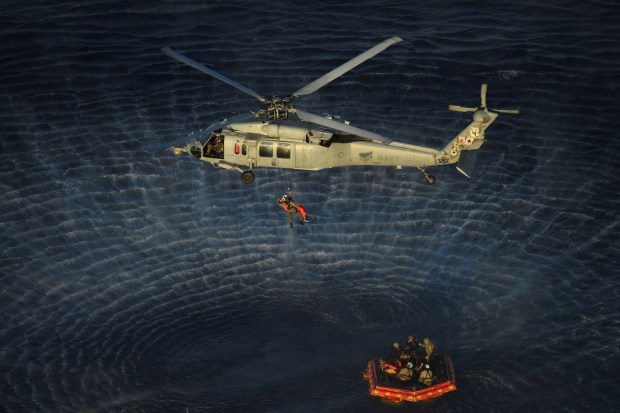 A photo provided by NASA shows Artemis II crew members hoisted into a U.S. Navy MH-60 helicopter from a rescue dinghy after successfully splashing down following their 10-day mission around the Moon, in the Pacific Ocean, April 10, 2026. (James Blair/NASA via The New York Times)
The crew gamely crawled onto the porch, which was pitching a bit, leading a reporter to ask Saturday why the Navy didn’t simply put the astronauts into a boat and quickly transport them to the Murtha. Navy officials explained that it wasn’t possible to definitively forecast that the ocean would be unusually calm. Using the helicopters was a sounder option.
Kenny had to keep the ship sailing in specific directions to make it easier for helicopters to take off and land. That was especially true when four helicopters — two of them carrying astronauts — landed on the ship’s comparatively small flight deck as the sun was nearing the horizon.
The landings were perfect, enabling the Navy to get the astronauts on their feet and, before long, into the ship’s large hospital for medical exams.
The rails of the ship were crowded with crew members who cheered and used iPhones to capture and distribute the moment. Back in 1972, during the last Apollo flight, the crew did the same, but with Kodak Instamatic cameras.
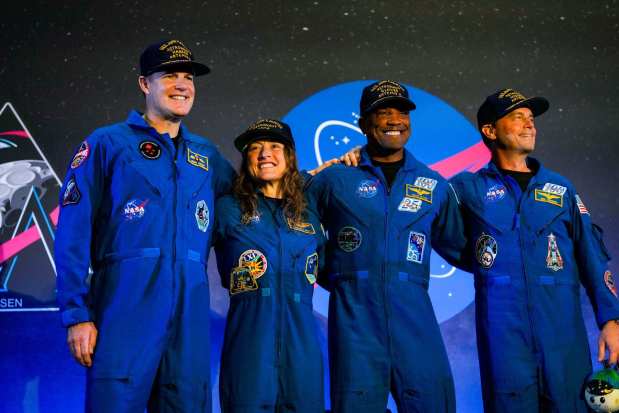 From left, Jeremy Hansen, Christina Koch, Victor Glover and Reid Wiseman, the Artemis II crew, are welcomed on stage during a news conference following their mission orbiting the moon, in Houston, on Saturday, April 11, 2026. (Raquel Natalicchio/Houston Chronicle via AP)
When the astronauts returned to Houston on Saturday, their homecoming was poignant: They returned to NASA’s Houston base on the 56th anniversary of the launch of Apollo 13, whose “Houston, we’ve had a problem” refrain turned a near-disaster into triumph.
“This was not easy,” an emotional Wiseman said. “Before you launch, it feels like it’s the greatest dream on Earth. And when you’re out there, you just want to get back to your families and your friends. It’s a special thing to be a human, and it’s a special thing to be on planet Earth.”
Added Glover: “I have not processed what we just did and I’m afraid to start even trying.”
Hansen said the crew embodied love “and extracting joy out of that” as the four joined together to stand in a row, embracing one another. “When you look up here, you’re not looking at us. We are a mirror reflecting you. And if you like what you see, then just look a little deeper. This is you.”
The Associated Press contributed to this story.