
The 2021 add‑on water purchase agreement between Israel and Jordan has expired without renewal, cutting annual Israeli supplies back from about 100 million cubic metres (MCM) to the 50 MCM guaranteed under the 1994 peace treaty. Jordan requested an extension, but Israel attached political conditions and publicly weighed rejecting the request; in the end, the two sides did not agree new terms, and the arrangement simply lapsed.
Jordan’s Water Reality Has Not Changed
Jordan remains one of the most water‑scarce countries in the world, with total available water just above one billion cubic metres per year and heavy reliance on overdrawn aquifers. Per capita availability is far below the absolute scarcity threshold, and climate change is making rainfall more erratic and droughts more frequent.
Under the 1994 peace treaty, Israel is obliged to supply Jordan with around 50 MCM of water annually from Lake Tiberias, partly compensating for upstream diversions that dramatically reduced flows in the lower Jordan River. In 2021, the two governments agreed an additional 50 MCM per year on top of the treaty quota, temporarily doubling deliveries to help Jordan cope with rising demand and recurring shortages.
When the add‑on agreement approached expiry in 2024, Jordan asked Israel to extend it for another year, citing its continued water stress. Israeli media and regional outlets reported that Jerusalem was considering rejecting or limiting the extension because of Amman’s sharp criticism of the Gaza war and broader bilateral tensions.
Israeli officials also linked renewal to political conditions, including moderating public rhetoric and restoring full diplomatic engagement, while Jordan was reluctant to be seen as trading its stance on Gaza and the West Bank for water. As talks dragged on without agreement, the extra 50 MCM arrangement expired; since late 2025, supplies have reverted to the 50 MCM per year provided under the peace treaty alone.
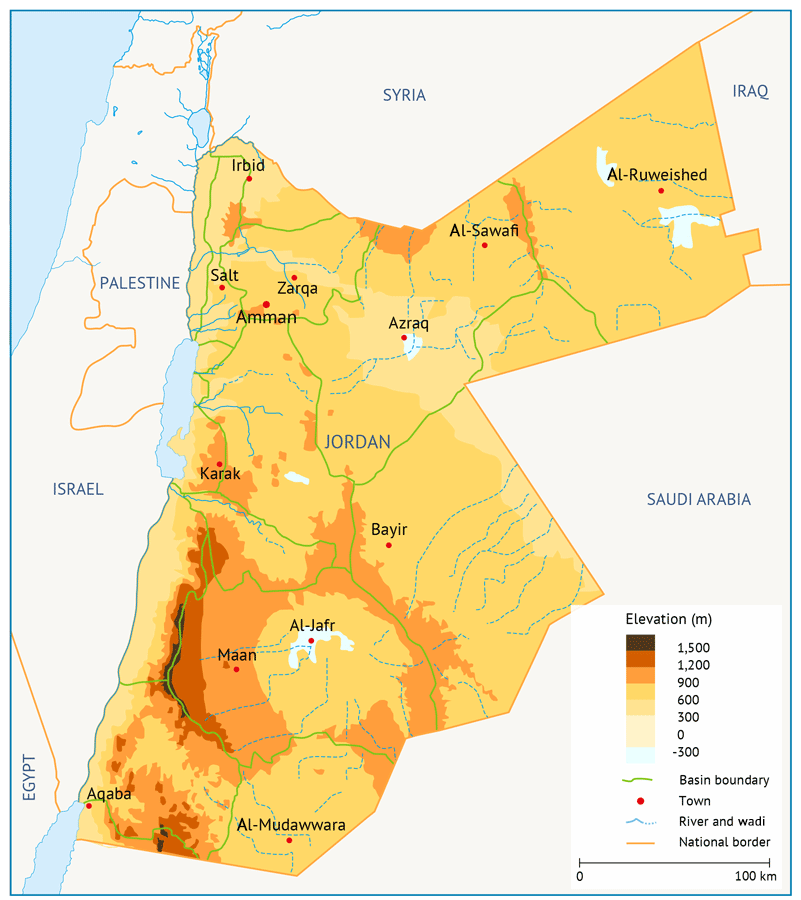 Surface water basins in Jordan. @Fanack water
War, Security And Public Opinion
The Gaza war and Israeli actions in the West Bank have pushed political relations to their lowest point in years. In October 2023, Jordan recalled its ambassador from Israel in protest at what it described as an unprecedented humanitarian catastrophe in Gaza and told Israel not to return its envoy to Amman. Public opinion, in a country where a majority of citizens are of Palestinian origin, has become even more hostile to visible “normalisation” with Israel, including joint projects.
At the same time, the widening confrontation between Israel and Iran has increased Jordan’s security risks. Since 2024, Jordan has repeatedly intercepted drones and missiles crossing its airspace during Iranian attacks on Israel, and more recently has reported intercepting dozens of projectiles directly targeting Jordanian territory. In this environment, tying an extra 50 MCM of drinking water each year to cooperation with Israel looks less like prudent pragmatism and more like a potential vulnerability if the conflict escalates.
Jordan’s Alternative: More Control, Not Isolation
Jordan’s response has been to seek more control over its water future, rather than to shut the door on all regional cooperation. The centrepiece is the National Water Carrier—the Aqaba–Amman Water Desalination and Conveyance Project—which will build a large reverse‑osmosis desalination plant on the Red Sea and pump around 300 MCM of drinking water per year to Amman and other highland cities.
The project, supported by the Green Climate Fund and development banks, will be Jordan’s largest infrastructure scheme and could eventually cover roughly a third of current national water use. Once operational, it will not remove the need for transboundary water, but it will reduce the political leverage that any single neighbour can exercise over Jordan’s taps. At the same time, Amman is trying to revitalise water cooperation with Syria on the Yarmouk River and shared aquifers, and to maintain its agreement with Saudi Arabia over the Disi/Saq fossil aquifer, spreading risk across several partners rather than concentrating it on Israel.
A Narrow Space For Cooperation
The expiry of the add‑on deal does not mean that all prospects for Israeli–Jordanian water cooperation have vanished. Civil society organisations like EcoPeace Middle East have spent years demonstrating that shared water can be a platform for dialogue as well as a source of tension. Through its “Good Water Neighbors” programme, EcoPeace has connected Jordanian, Israeli, and Palestinian communities along shared rivers and aquifers, using joint monitoring and local projects to build trust even when official relations were strained.
EcoPeace’s “Green Blue Deal” and Water–Energy Nexus proposals, which inspired elements of the now‑shelved regional water‑for‑energy scheme, argue that climate change and resource scarcity make some degree of cross‑border interdependence both inevitable and desirable—if it is designed fairly and transparently. In the current climate, large, high‑profile deals are unlikely, but more modest forms of technical cooperation—on issues such as optimising treaty flows, sharing hydrological data, or managing pollution in shared basins—remain possible when they can be kept out of the political spotlight.
A Realistic Outlook
In the short term, Jordan is likely to rely more on its own measures—desalination, leakage reduction, and expanded wastewater reuse—while managing with the 50 MCM treaty supply from Israel and whatever additional water it can secure through talks with Syria and Saudi Arabia. Public anger over Gaza and security fears linked to the Iran conflict mean that any new, highly symbolic water agreement with Israel would be difficult to sell domestically, even if it made technical sense.
Over the longer term, however, water is too essential for either side to completely abandon cooperation. The more realistic scenario is one of narrower, quieter, and more fragile coordination: treaty‑based transfers continue, occasional adjustments are negotiated in times of acute need, and civil society initiatives like those of EcoPeace keep communication channels open while policymakers wait for the regional temperature to drop. It is not an optimistic vision, but it does leave a small, hard‑earned space in which pragmatic cooperation can survive—and possibly grow again if the political and security context improves.