
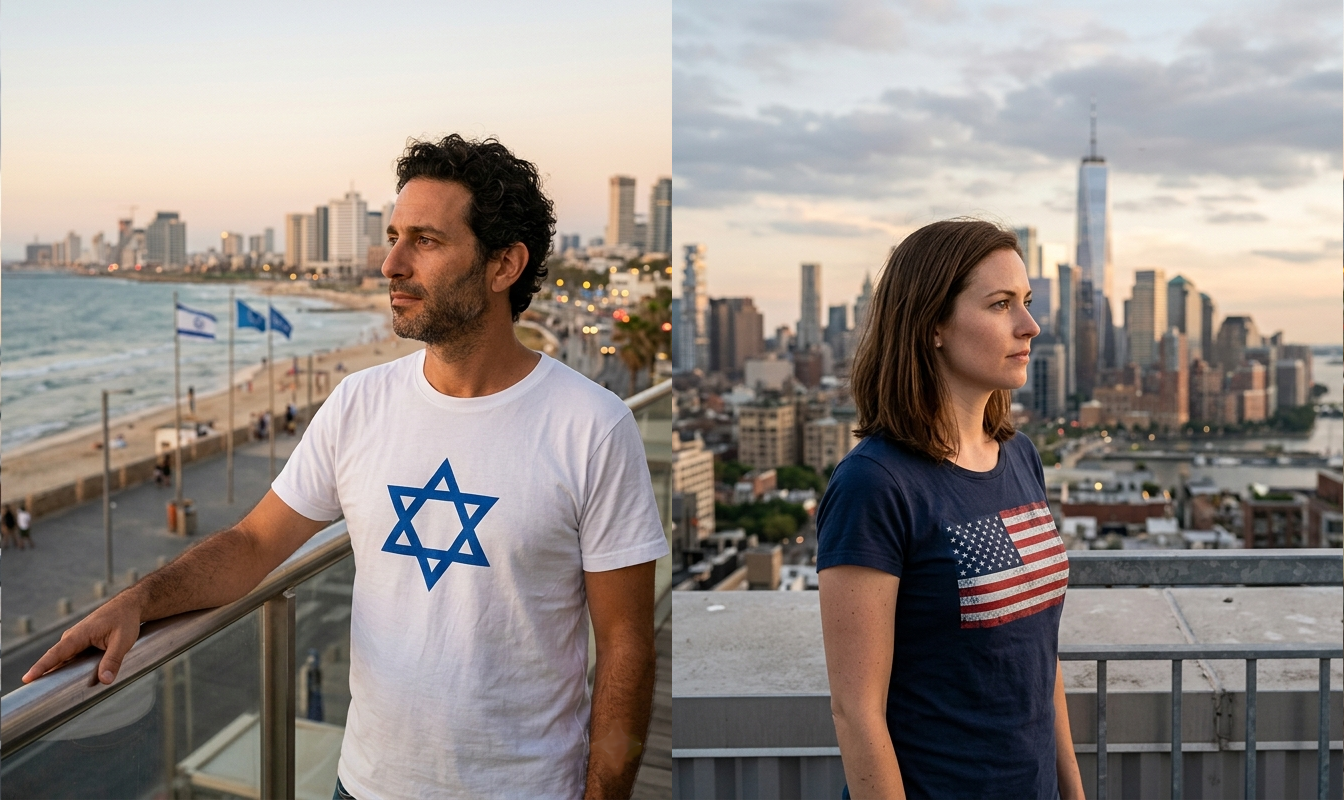
April 2026 Pew Research Center polling documents a marked realignment in American public opinion toward Israel along age, partisan, and religious lines. That realignment matters because it exposes a growing divergence between US public preferences and Israeli public preferences at a moment when both governments are dominated by right wing, religiously aligned coalitions. The divergence is producing strategic friction: Americans — especially Democrats, independents, and younger voters — increasingly view a credible path to Palestinian statehood as essential to long term regional peace, while many Israelis view Palestinian political agency as an unacceptable security risk.
The April 2026 Pew snapshot: the numbers that matter
Pew surveyed 3,507 U.S. adults from March 23–29, 2026. The findings are stark:
60% of U.S. adults now hold an unfavorable view of Israel; 37% view it favorably.
59% of Americans say they have little or no confidence in Prime Minister Benjamin Netanyahu to “do the right thing regarding world affairs.”
Partisan and generational splits are large. About 80% of Democrats and Democratic-leaning independents express unfavorable views of Israel, while 58% of Republicans and Republican-leaning adults view Israel favorably overall; however, majorities under age 50 in both parties now rate Israel and Netanyahu negatively.
Religious differences are pronounced. Jewish Americans and white evangelical Protestants are the most favorable groups toward Israel (about 64% and 65% favorable, respectively), but even among U.S. Jews a majority report little or no confidence in Netanyahu (about 56%).
A late February poll by Gallup showed 41% percent of Americans now say they sympathize more with the Palestinians in the Middle East situation, while 36% sympathize more with the Israelis.
These figures matter because they change the domestic political constraints on U.S. policymakers. Where bipartisan public tolerance once allowed Washington to underwrite long term security commitments without explicit domestic tradeoffs, the new distribution of opinion means that support for policies that foreclose a Palestinian political horizon now carries higher electoral and budgetary costs.
Israeli public opinion and political configuration: a contrasting posture
Contemporaneous Israeli polling tells a sharply different story — and the data are unambiguous across multiple independent sources. Opposition to Palestinian statehood is the commanding majority view, hardened significantly by the events of October 7 and the wars that followed.
A November 2025 survey by the Jerusalem Center for Foreign Affairs found 70% of Israelis opposed to a Palestinian state along the 1967 lines — the highest level of opposition recorded in their ongoing series since the war began. Critically, 62% said they would still oppose Palestinian statehood even if it were offered as part of a normalization deal with Saudi Arabia, and among Jewish Israelis that figure rose to 73%. The INSS October 2025 survey corroborated these findings: 57% of Israelis oppose a Palestinian state under any circumstances, with that figure rising to 68% among Jewish Israelis specifically. Gallup polling conducted in Israel during July and August 2025 found only 27% of Israelis support a two-state solution, with 63% opposed — a stark reversal from 2012, when a majority of Israelis (61%) backed the concept. Pew’s own early 2025 survey of Israeli adults found that only 21% believe Israel and a Palestinian state can coexist peacefully, the lowest figure since Pew began asking the question in 2013 and down 14 percentage points from spring 2023.
Israeli public opinion — shaped by security narratives, coalition politics, and a sustained wartime footing — is not merely skeptical of a Palestinian political horizon. It treats that horizon as a direct security liability. The political salience of maximalist security objectives reflects genuine and broadly held public conviction.
Put plainly: U.S. public opinion is trending toward conditionality tied to a political horizon; Israeli public opinion is trending toward security maximalism that rejects that horizon. The two electorates operate from irreconcilable core assumptions about what will produce durable peace and what constitutes acceptable risk.
The political horizon as the hinge of regional normalization
A credible political horizon for Palestinians — a phased, verifiable pathway toward political rights and statehood — is the explicit condition embedded in U.S. diplomatic frameworks, UNSC 2803 formulations, and the normalization offers advanced by key Arab states. For Washington and many Arab partners, that horizon is the mechanism that converts short term de-escalation into durable regional integration. For much of Israel’s political class and a large segment of its public, however, the same pathway is framed as an unacceptable concession. This divergence is the strategic hinge of the U.S.–Israel disconnect.
Operationally, the gap produces three linked effects:
It blocks regional normalization. Arab states that have conditioned engagement on a political horizon will not deliver the diplomatic payoff the United States needs to justify costly commitments if Israel refuses to accept a phased political pathway.
It deepens Israel’s dependency on the United States. Israeli maximalist objectives — whether coercive pressure on Iran or indefinite control over contested territories — cannot be achieved unilaterally and presuppose sustained U.S. political, economic, and military backing.
It creates self-reinforcing frontline fragility. Maximalist policies harden adversary resolve, increase exposure, and narrow options for de-escalation, which in turn raises the probability that crises will escalate beyond Israel’s unilateral capacity to manage.
Why the divergence matters for U.S. strategic posture
The April 2026 Pew data change the center of gravity in three practical ways.
Electoral incentives. Politicians sensitive to younger and more diverse electorates face pressure to condition support on measurable progress toward a political horizon. That pressure reduces the political space for open-ended commitments without benchmarks.
The supplemental funding problem. The strategic friction point is not whether Congress will cut existing security commitments to Israel — few, if any, analysts expect that. The question is whether a narrowly divided House will approve the scale of supplemental funding that Israeli maximalist objectives actually require. A supplemental in the range of $200 billion for objectives that command broad Israeli public support but majority opposition among U.S. voters represents a qualitatively different request than baseline security assistance. That distinction is where the U.S.-Israel opinion divergence stops being attitudinal and becomes a hard constraint on Israeli strategic capacity.
The electoral calendar sharpens that constraint further. Swing-district Republicans facing competitive November races will be acutely reluctant to cast a visible vote for large-scale supplemental funding at a moment when constituents are already absorbing the economic consequences of the Iran war — renewed inflationary pressure, supply disruptions, and heightened recession risk. For those members the political calculus is straightforward: the upside of the vote is limited, and the downside is a ready-made attack line in a difficult cycle. If Democrats reclaim the House majority in November, the supplemental question becomes substantially harder still.
Diplomatic leverage and credibility. Washington’s ability to broker regional deals depends on domestic audiences perceiving a coherent strategy that links U.S. commitments to achievable political outcomes. If U.S. publics believe Washington is subsidizing a status quo that forecloses Palestinian agency, domestic support for regional leadership will erode.
In short, the U.S. center of gravity is shifting away from unconditional support of Israel toward conditionality tied to Israel’s alignment with U.S. regional peace initiatives — and that shift is driven by measurable demographic and partisan realignments that the April 2026 Pew data make concrete.
Strategic implications and policy prescriptions
The disconnect is structural, not cyclical. The divergence over the political horizon reflects durable shifts in public opinion and political incentives on both sides. Short term crisis management will not erase these trends.
Three pragmatic elements are necessary to bridge the gap or manage its consequences:
A credible, phased political horizon for Palestinians. Any durable regional architecture must include verifiable sequencing that addresses Israeli security concerns while restoring Palestinian political agency.
Calibrated U.S. strategy and messaging. Washington must align domestic messaging with realistic commitments, set clear benchmarks for assistance, and avoid open-ended exposure that domestic audiences will not sustain.
Israeli political adjustments. Israeli leaders must confront the tradeoffs of maximalism: continued pursuit of maximalist objectives without political accommodation externalizes costs onto the United States, strains the bilateral relationship, and leaves the underlying drivers of instability intact.
If these elements are not adopted, the bilateral relationship will remain operationally important but increasingly transactional: cooperation will persist where interests align, but shared assumptions about long term regional stability will continue to fray — and the funding architecture that underwrites Israeli strategic ambition will grow more precarious with each electoral cycle. Israeli leaders who believe they have no choice but to pursue maximalist objectives, with or without American cooperation, have some difficult choices to make. Overestimating Israel’s ability to pursue a fully independent security posture may carry even greater risk than being structurally dependent on a politically constrained superpower.
William Keenan is a retired Middle East Intelligence Analyst who served at NATO and the Pentagon. He lived and worked in the Middle East/North Africa for over 15 years. He is the author of ARABIA – Nine Years in the Kingdom.